Category: Chinese Character and Japanese Kanji Calligraphy Wall Scrolls

Chinese Character Japanese Kanji Tattoo Service

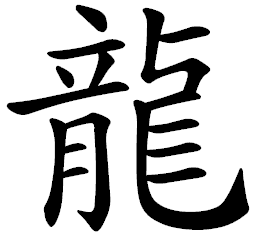
dragon symbol

Asian Symbols Tattoo Service

Don't end up with meaningless or fake Chinese characters on your body!

Free Japanese/Chinese Dragon Symbol Tattoo.


Your Price:
US$20.00U.S. Dollars

GBP £11.36British Pounds
Euro €14.04Euro
Canadian $21.33Canadian Dollars
Australian $24.72Australian Dollars


Please chose from available options near the bottom of this page before adding this item to your shopping cart


It seems that having Chinese/Japanese character tattoos is getting more popular every day. From pop divas to top sports stars, everyone is getting inked with Asian tattoos.

But there is a huge problem!

Many people (including Britney Spears) are ending up with incorrect characters or meaningless characters that some tattoo artist simply made up.

From the Asian perspective, westerners are often seen as being silly for getting tattoos of Chinese and Japanese characters. Contrary to popular belief, there is almost no "tattoo culture" in China (exceptions being Shanghai and Hong Kong). There is a bit of tattoo art happening in Japan, but far from as "main stream" as tattoos have become in the USA.

There are even websites in China and Japan whose sole purpose seems to be making fun of American movie stars, ball players, and singers who've been inked with strange Asian tattoos.

I know you are going to get a tattoo anyway, and I feel it is my duty (as one who follows the benevolent teachings of Confucius) to take care of you. I don't want you to get stuck with something embarrassing on your body (at least not in addition to anything embarrassing on your body that God seems to have given you).

Don't end up with "Big Gay Pink Dragon" on your arm (unless that's what you want). Plenty of people have emailed me with pictures of their Asian character tattoos, and many times, I've had to tell them some really bad news about the meaning of their tattoo. There was actually a guy that had "powerful dragon female" on his neck. That might be fine for a feminist or some "other type of woman" (insert your own label, I'm not touching this one), but for this guy, it was devastating, and if I read his last email correctly, he was on his way to the tattoo parlor to put some "special artwork" on tattoo artist's face.

To avoid all of this, I've created our "Asian tattoo service".

Whether you need just one simple character, or you want a whole phrase translated, we'll do it for you, and output it as large image files in a variety of character styles.

All of our work is checked by one white guy (me), and our professional Chinese translator (who happens to be my wife). She and I have worked professionally to translate books, important documents, and of course, stories and titles of artwork that you see on our website. In short, we have a lot of experience translating, and we are not going to steer you wrong - my reputation depends on it.

I've spent almost a decade of my life, living in various Japanese, Chinese, and other Asian households. I know enough to steer you in the right direction if you are looking for a specifically-Japanese tattoo. However, if you have a phrase you want translated into Japanese, I do have a professional Japanese translator on call, though he costs a bit extra.

Much of the time, single words are written the same in Japanese and Chinese (in fact, they are often the same in old Korean Hanja too). Therefore your tattoo will often be universal in the CJK (Chinese Japanese Korean) world.
However, if this is not the case, I suggest going with the Chinese version, since 1/3 of the world's population will be able to natively read your tattoo, while only 1% of the world population is Japanese.

FYI: They were Chinese characters first!
Japan did not have a written language, and simply absorbed Chinese characters into the Japanese language by meaning around the 5th century. The word Kanji in Japanese actually means "Chinese Characters".
A similar thing happened in Korea (though Hanja characters were almost replaced by Hangul characters in the last century). The word Hanja in Korean means "Chinese Characters" and these are still used in literature and proper names in South Korea.
There was even a time when Vietnam used Chinese characters as it's form of written language.
Now, 1500 years after Japan and Korea "borrowed" Chinese characters, they often hold exactly the same meaning in the CJK world (but not always!).

We'll get you away from the pitfalls, and give you the info you need...
If you order "Samurai" in Japanese we'll let you know that this character means "waiter" or "servant" in Chinese, so that you can make an informed decision.

Another example: The title "Magnificent Geisha" in Japanese means "Talented Whore" in Chinese. But there is a word in Chinese that means "Mysterious Woman" but means "whore" in Japanese.
As you can see, in some cases, you need to be careful.


To Order:

Just enter the word, character, or phrase that you are looking for in the order form at the bottom of this page.

After that, we may email back and forth with you a little, if your phrase is complex. We really want to make sure it is accurate. Then, after a day or two, we'll give you a web page to download and print image files of your characters.

To make it simple, this service is priced based on the number of English words that you want translated.
It's $20 for the first word, and $5 for each additional word.
FYI: English words will be represented with one or two Chinese characters. In some cases, as many as three characters.
Note: You can count compound words like "will-power" or "non-violence" as one. Also, no need to count little articles like "and", "is", "of" etc.


Here are some samples of character types/styles/fonts that you will have access to:

All of the Chinese characters below are of the same word meaning simply "Dragon" (which is pronounced "long" but the "o" should sound like the "o" in the word "own"). If you were looking for this popular Dragon character, here is your chance to get it for free...

It's also a chance to get an education about the evolution of Chinese and Japanese Kanji Characters...

Click here for a Free Sample of what to expect when you pay for this service.

Seal Script (Zhuanshu) Chinese Characters

Over 2200 years old

Original Ancient Seal Script

Typical Seal Script

Square Seal Script
Examples of the earliest pictographs or hieroglyphics in China date back almost 5000 years. The most famous are the "oracle inscriptions" on tortoise shells from Shang Dynasty (17th to 11th century B.C.).

Here's the quick history lesson: The area now known as China was for many centuries, a fragmented region with various kingdoms rising and falling. Each kingdom or nationality in this rugged land had it's own writing system, and could not effectively communicate with people of other kingdoms.

Finally, in about 221 B.C. the first Qin Dynasty Emperor unified all of China. One of the Qin Emperor's goals was to standardize the writing system across all of his empire which he did during the first 20 years of his reign.

Seal Script Characters were the first standardized writing system to be adopted across much of Asia.
Check out all the possibilities for a Chinese character and Japanese Kanji Dragon tattoo.

Official Script (Lishu) Chinese Characters

Almost as old as Seal Script

Transitional Official Script

Stylized Official Script

Fine-Line Official Script
The Official Script was the second-generation of writing approved during the Qin Dynasty. Official Script is easier to write and a little more flexible compared to Seal Script, but is still very complex. The printing press would not be invented for thousands of years, so official scribes literally had their hands full as they penned various documents.
Free Chinese Dragon Symbol Tattoo Images.

Traditional (Kaishu) Chinese Characters

Up to 1700 years old

Hand-Print Traditional

Calligraphy Traditional

Handwriting Traditional (Xingshu)

Stone Carved
These characters are understood in China, Japan, Singapore, Hong Kong, Taiwan, Macao, much of South Korea, as well as many people in Malaysia, and communities of Chinese and Japanese people around the world.

Historians will argue this point, but the Traditional Chinese Characters that you see today entered a somewhat final lexicon during the Wei kingdom (220-265 A.D.) and the Jin Dynasties (265-420 A.D.).

Simplified Chinese Characters

Only in existence for 50 years
Simplified Computer Font Bold Simplified Hand-Print Simplified
Chairman Mao - According to the Beatles, carrying a picture of this man with you, will keep anyone from sleeping with youThese characters were implemented in 1956 after Chairman Mao took over China in 1949. They are based loosely on traditional characters, but lack many of the strokes of the originals. Chairman Mao's idea was to make Chinese characters easier to write for the under-educated masses in China at that time. These characters are only used in mainland China (and somewhat in Singapore and Chinese communities around Malaysia).

I do not recommend these characters for tattoos because they are not universally understood throughout many Oriental cultures in the same way that Traditional Characters are.

Note that most people in the mainland with a anything slightly beyond a high school education can read Traditional Characters (and many Traditional Characters were left untouched during the changeover to the Simplified Character system).

Also note that Japan went through a simplification program after WWII with similar results.

Special Traditional Chinese Character Fonts

Slightly older than yesterday

Japanese Tea Cup

Ming or Song Style

Saw Tooth

Hello Kitty
On everything from billboards, logos, TV commercials, and items on store shelves in China, you will see characters like these.

"Special Traditional" and "Saw Tooth" are moderately popular for tattoos.

However, "Hello Kitty"... ...not so much.
Free Dragon Character Tattoo.


Options for this artwork...

:

« Previous Artwork | Next Artwork »

Your Price:
US$20.00U.S. Dollars

GBP £11.36British Pounds
Euro €14.04Euro
Canadian $21.33Canadian Dollars
Australian $24.72Australian Dollars


All orders billed in U.S. Dollars.
Other currencies shown for reference at approximate exchange rates.


More info...

More Character Samples

Below are all the characters for the word "Mei Guo" which means "America" (as in the USA) written vertically.

If you are curious, mei = beautiful and guo = country or kingdom
Therefore, the name for America in Chinese literally means "Beautiful Country"

Please note: All Chinese Characters can be written vertically from top to bottom. Simplified Characters are written from left to right, and Traditional Characters are usually written from right to left when not written vertically.

America - Ancient Chinese Seal Script America - Chinese Official Script America - Japanese Kanji / Chinese Traditional Characters America - Chinese Simplified Characters America - Special Japanese Kanji / Chinese Characters

We'll be glad to explain any issues or questions that you might have. There are a lot of differences between English and Chinese, not only in the use of Chinese characters versus Roman letters, but also in grammar, phrase construction and in meanings that are often historically attached to certain words or characters.

Artwork
Search:

Exact
Phrase

Oriental Outpost LogoFlagTowerwatercolor
Chinese Calligraphy Search
ArtPaintingsAsian Art Gallery

Adventures in Asian Art