Death in Chinese or Japanese Calligraphy
Death is kind of a taboo thing in Asian cultures, so we can only offer a limited number of death-related titles.
Please see Death in our dictionary for more death-related Chinese and Japanese words.
Switched to secondary search mode due to lack of results using primary.
These secondary results may not be very accurate. Try a different but similar meaning word or phrase for better results. Or...
Look up in my Japanese Kanji & Chinese Character Dictionary(My dictionary is a different system then the calligraphy search you just tried)
If you want a special phrase, word, title, name, or proverb, feel free to contact me, and I will translate your custom calligraphy idea for you.
2. Assassin
3. Avatar
6. The Buddha is in Each Sentient Being
7. Choose Life
8. Confucius
9. The Law of Creation and Destruction
15. Honorable Death - No Surrender
18. Dim Mak
19. Emperor
20. Empress
21. Enjoy Life
22. Eternal Life / Everlasting Life / Immortality
23. Eternal Life / Future Life
24. The one who retreats 50 paces mocks the one to retreats 100
26. Five Precepts
27. Grim Reaper / God of Death
28. Gung Ho
29. Ikken Hissatsu
30. Impermanence
31. Jesus is My Life
32. Kill / Slaughter / Murder / Butcher
33. Kill / Massacre / Mass Killing
34. Life is Short
35. Live Free or Die
36. Madly in Love
38. Musashi
39. New Life
40. Nirvana
42. No Pain No Gain
43. Phoenix Rise from the Ashes
44. Phuong
45. Pure Land / Jodo
49. Reincarnation
50. Reincarnation / Transmigration of Souls
51. Reincarnation / Life in Flux
53. Samsara / Endless Cycle of Rebirth
54. Sword of Death
55. Shigurui
56. Shinken Shobu
57. Birth Old-Age Sickness Death
58. Sun Tzu: Regard Your Soldiers as Children
59. Tea
Five Codes of Tang Soo Do
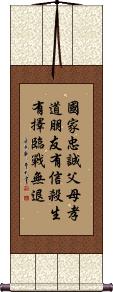
国家忠诚父母孝道朋友有信杀生有择临战无退 are the five codes of Tang Soo Do.
I suggest you have this arranged in five columns when you get to the options page for your custom calligraphy wall scroll.
Here are my translations of each of the five codes:
國家忠誠 Be loyal to your country.
父母孝道 In regards to parents, behave in a filial way.
朋友有信 Be faithful in friendship.
殺生有擇 When fighting for life and death, make noble choices.
臨戰無退 No retreat in battle.
Note: “Tang Soo Do” is a romanization of 唐手道. It's 당수도 in Korean Hangul. It can also be romanized as “Tangsudo” or “Dangsudo.”
Assassin
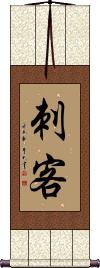
刺客 is the most sophisticated way to write “assassin” in Chinese, Korean and Japanese.
The unsophisticated way just means murderer.
Avatar
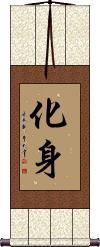
化身 is a way to say avatar in Chinese characters, Korean Hanja, and Japanese Kanji.
This is the original Buddhist idea of an avatar (not the movie). This can also mean: incarnation; reincarnation; embodiment; personification; impersonation.
化身 is the Chinese word used for the original Sanskrit, nirmāṇakāya. Alternates for nirmāṇakāya include 應身, 應化身, or 變化身. In the context of Buddhism, this is a Buddha's metamorphosic body, which has the power to assume any shape to propagate the Truth. This title, 化身, is used for the appearance of a Buddha's many forms.
Blessings on this Home
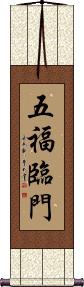
五福臨門 means “five good fortunes arrive [at the] door.”
It is understood to mean “may the five blessings descend upon this home.”
These blessings are known in ancient China to be: longevity, wealth, health, virtue, and natural death (living to old age). This is one of several auspicious sayings you might hear during the Chinese New Year.
Death Before Dishonor
Better to be broken jade than unbroken pottery
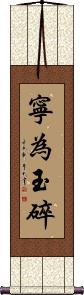
寧為玉碎 is the short version of a longer Chinese proverb which means “rather be shattered piece of jade than an unbroken piece of pottery.”
寧為玉碎 says the “rather be a broken piece of jade” part (the second half is implied - everyone in China knows this idiom).
A little more explanation:
Death is implied with the “broken” meaning. Jade is one of the most precious materials in Chinese history, and in this case, is compared with one's honor and self-worth. Pottery is just something you eat off of; it has no deep value, just as a person who has lost their honor or had none to begin with.
Thus, this means “better to die with honor than to live in shame” or words to that effect.
This is often translated in English as “Death Before Dishonor,” the famous military slogan.
I would also compare this to the English proverb, “Better to die on your feet than to live on your knees.”
Death Before Dishonor
Better to be broken jade than unbroken pottery
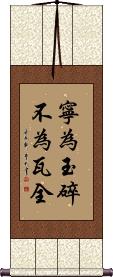
寧為玉碎不為瓦全 is the long version of a Chinese proverb that means “rather be shattered piece of jade than an unbroken piece of pottery.”
A little more explanation:
Death is implied with the “broken” meaning. Jade is one of the most precious materials in Chinese history, and in this case, is compared with one's honor and self-worth. Pottery is just something you eat off of, it has no deep value, just as a person who has lost their honor, or had none to begin with.
Thus, this means “better to die with honor than to live in shame” or words to that effect.
寧為玉碎不為瓦全 is often translated in English as “Death Before Dishonor,” the famous military slogan.
I would also compare this to the English proverb, “Better to die on your feet than to live on your knees.”
This is an idiom. It therefore doesn’t directly say exactly what it means. If you think about the English idiom, "The grass is always greener," it does not directly say "jealousy" or "envy" but everyone knows that it is implied.
The Buddha is in Each Sentient Being
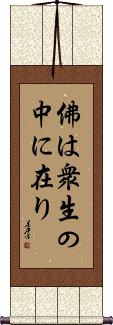
佛は衆生の中に在り is “Butsu wa shujo no naka ni ari” and means that the Buddha (potential for Buddhahood) exists in all beings in the universe.
So yes, your dog has the potential to be a Buddha (but only in a future reincarnation as a human). But all things, from the tiny cricket to the humpback whale have Buddha nature within them. If one takes the time to look and contemplate, one will see the Buddha in all things.
In Japan, sometimes the Buddha character is written 仏 instead of 佛, so you might see the whole phrase written as 仏は衆生の中に在り.
Note: Because this selection contains some special Japanese Hiragana characters, it should be written by a Japanese calligrapher.
Choose Life
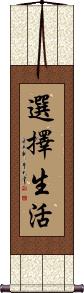
選擇生活 can mean to choose life instead of death (or suicide) or to choose to live life to the fullest.
I think of it as the key phrase used by Renton (Ewan McGregor) in the movie Trainspotting. While Chinese people will not think of Trainspotting when they see this phrase, for me, it will always be what comes near the end of this colorful rant:
Choose life. Choose a job. Choose a career. Choose a family. Choose a fucking big television. Choose washing machines, cars, compact disc players, and electrical tin can openers. Choose good health, low cholesterol, and dental insurance. Choose fixed-interest mortgage repayments. Choose a starter home. Choose your friends. Choose leisure wear and matching luggage. Choose a three-piece suite on-hire purchase in a range of fucking fabrics. Choose DIY and wondering who the fuck you are on a Sunday morning. Choose sitting on that couch watching mind-numbing, spirit-crushing game shows, stuffing fucking junk food into your mouth. Choose rotting away at the end of it all, pissing your last in a miserable home, nothing more than an embarrassment to the selfish, fucked-up brats you have spawned to replace yourself. Choose your future. Choose life.
Confucius
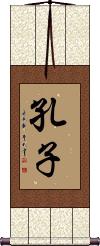
孔子 is how to write the name of the great sage, known in the West as Confucius.
His real name is Kongzi (The name Confucius is a westernized version of his name - his family name is Kong, and “zi” was added as a title of distinction).
He lived some 2500 years ago in Qufu, a town in modern-day Shandong Province of Northern China (about 6 hours south of Beijing by bus). He was a consort to Emperors, and after his death, the impact of his philosophies still served to advise emperors, officials, and common people for generations.
Also during these thousands of years, the Kong family remained powerful in China, and the Kong estate was much like the Vatican in Rome. The Kong estate existed as if on sovereign ground with its own small garrison of guards and the privileges of a kingdom within an empire.
This was true up until the time the Kong family had to flee to Taiwan in 1949 when the Red Army took victory over the Nationalists during the Revolution. The home of Confucius was later razed and all statues were defaced or stolen during the Cultural Revolution. Finally, after years of smearing his name and image, it is once again okay to celebrate the teachings of Confucius in mainland China.
Known as Khổng Tử in Vietnamese.
The Law of Creation and Destruction
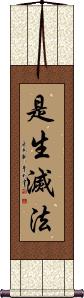
是生滅法 is a Buddhist term for “the law of arising and ceasing,” or, “the law of creation and destruction.”
Everything has a beginning and an end, birth and death, etc. All things follow this law.
Not Long for this World
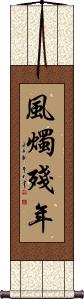
This phrase means “Old and ailing with little time left” or “Not long for this world.”
There is a real suggestion here that someone will die soon.
This was added by a special request of a customer and is perhaps, not the most positive phrase that you could put on a wall scroll.
This would be the most offensive possible gift to give to an older person - please do not do that!
Death Before Surrender
Rather die than compromise
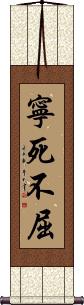
寧死不屈 is often translated as “Death Before Dishonor.”
The literal translation is more like, “Better die than compromise.” The last two characters mean “not to bend” or “not to bow down.” Some might even say that it means “not to surrender.” Thus, you could say this proverb means “Better to die than live on my knees” or simply “no surrender” (with the real idea being that you would rather die than surrender).
Death Before Dishonor
You can die or kill, but never dishonor or disgrace yourself
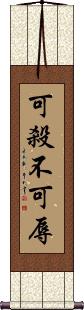
可殺不可辱 almost directly matches the idea of “Death Before Dishonor” while also being an ancient Chinese proverb.
The direct meaning is, “[you] can die/kill [but you] cannot [allow] dishonor/disgrace [upon yourself].” Chinese grammar, and especially ancient grammar, is a little different than English. Not nearly as many articles are needed, and a lot is implied.
There are many ways to express ideas similar to “Death Before Dishonor” in Chinese, and I would rate this one in the top two.
Death Before Dishonor
A soldier can die or kill, but never dishonor or disgrace himself
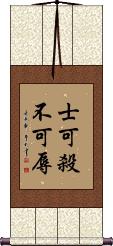
士可殺不可辱 almost directly matches the military idea of “Death Before Dishonor,” while also being an ancient Chinese proverb.
The direct meaning is, “[A] soldier/warrior can die/kill [but he/she] cannot [allow] dishonor/disgrace [upon himself/herself].” Chinese grammar, and especially ancient grammar, is a little different than English. Not nearly as many articles are needed, and a lot is implied.
There are a lot of ways to express ideas similar to “Death Before Dishonor” in Chinese, and I would rate this one in the top two.
This is the original form of this proverb with the character for “soldier/warrior” at the beginning. Most of the time, this character is dropped, becoming a five-character proverb (the soldier/warrior part is implied, even without the character being present in the proverb). We also offer a shorter version.
Death Before Dishonor
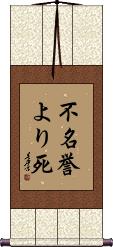
不名誉より死 is the Japanese version of “Death Before Dishonor.”
Japanese grammar is a bit different than English, so this really means something like “Rather die than to be dishonored.” However, “dishonor” is the first three Kanji, and death is the last Kanji. There are two Hiragana (より) which indicate the preference is death when comparing dishonor to death.
Note: Because this selection contains some special Japanese Hiragana characters, it should be written by a Japanese calligrapher.
Death with Dignity
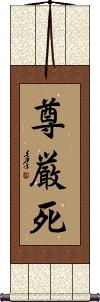
尊厳死 is not a good choice for a wall scroll unless you have a very specific and personal reason.
This was added at the request of a customer.
尊厳死 means “death with dignity” or “natural death” (as opposed to extending one's life unnaturally with life support).
Death Before Surrender
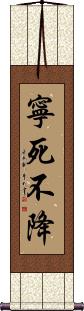
寧死不降 is an ancient Chinese proverb that can be translated as “Rather die than surrender,” “Prefer death over surrender,” “To prefer death to surrender,” or simply “No surrender.”
This is probably the closest proverb to the English proverb “Better to die on your feet than to live on your knees.”
Honorable Death - No Surrender
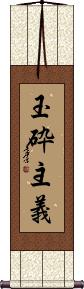
This ancient Japanese proverb can be translated as “The principle of honorable death and no surrender,” or simply “No surrender.”
If you directly translate this, you get something that means “Doctrine of suicide,” or “Ideology of honorable death.”
玉砕主義 is a specifically-Japanese proverb that embraces the long history of honorable suicide or self-sacrifice for honor in Japanese culture.
Frightful Demon / Asura
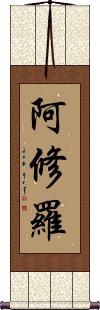
This demon title comes from the ancient Sanskrit word Asura.
阿修羅 is often used in Buddhism when describing various demons. Sometimes defined as “Fighting and battling a giant demon.”
In the context of Buddhism: This title originally meant a spirit, spirits, or even the gods (perhaps before 1700 years ago). It now generally indicates titanic demons, enemies of the gods, with whom, especially Indra, they wage constant war. They are defined as “not devas,” “ugly,” and “without wine.” There are four classes of asuras, separated according to their manner of rebirth. They can be egg-born, womb-born, transformation-born, and spawn- or water-born. Their abode is in the ocean, north of Sumeru but certain of the weaker dwell in a western mountain cave. They have realms, rulers, and palaces, as have the devas.
In terms of power, Asuras rank above humans but below most other deities. They live near the coastal foot of Mount Sumeru (on the northern side). Their domain is partially or wholly in the ocean.
Die Without Regret
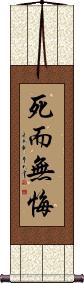
死而無悔 is how to say “die with no regrets” in Mandarin Chinese.
This proverb comes from the Analects of Confucius.
See Also: No Regrets
Dim Mak
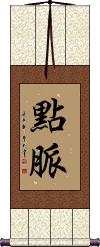
Dim Mak or 點脈 is a martial arts term that refers to hitting a pressure point.
It is often theorized that hitting just the right (or wrong) pressure point can cause instant death. Hence, I have seen Dim Mak mistranslated as “death punch” or “touch of death.” But really, this is just the point (點) of pulse or meridian (脈) - aka pressure point.
See Also: 點穴
Emperor
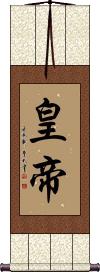
皇帝 means emperor in Chinese, Japanese, and old Korean.
From times of old, the emperors of Asia ruled under the authority of God himself. One definition of an emperor is a ruler put in power by God. This definition separates emperors from the various kings in Chinese history (although defining who is a king versus an emperor gets vague sometimes).
Occasionally, the emperor's wife was widowed, and she took the role of an empress until her death (see our entry for empress if that is what you are looking for).
Empress
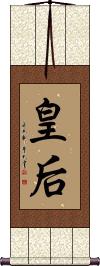
皇后 is the title of empress/emperess, the female form of the emperor.
皇后 is used in Chinese, Japanese Kanji, and old Korean Hanja.
While the emperor's reign was for life, if he died, his wife would hold his power. In this case, a woman was the ultimate ruler of the greater part of East Asia (now China) until her death and the succession of the emperor's firstborn son to lead the empire. Numerous times in various Chinese dynasties, an empress took power in this way.
The first character means emperor by itself.
The second character alone can mean “wife of an emperor or king” (the first character clarifies that we are talking about an empress and not a queen). It can also mean sovereign or last offspring, depending on context.
Note: In some books, this word is translated as queen. While only incorrect if you get technical (because an empress is theoretically a higher level than a queen), the meaning is very similar.
皇后 is sometimes used for the title of queen, but more technically, this is the wife of the emperor (a higher level than a queen).
Enjoy Life
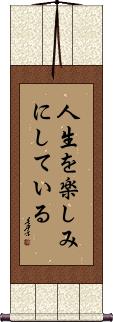
人生を楽しみにしている is one way to write “enjoy life” in Japanese.
The character breakdown:
人生 (jinsei) life (i.e. conception to death) human lifetime, living.
を (o) connecting particle.
楽しみ (tanoshimi) enjoyment; pleasure; anticipation; looking forward to.
に (ni) connecting particle.
し (shi) to do; to cause; to become; to make (into).
て (te) connecting particle.
いる (iru) indicates continuing action or resulting state.
Note: Because this selection contains some special Japanese Hiragana characters, it should be written by a Japanese calligrapher.
Eternal Life / Everlasting Life / Immortality
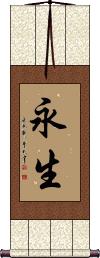
永生 are the last two words from John 3:16 in the Chinese Union Bible.
Although not specifically Christian, this is the way to express ever-lasting life or eternal life in Chinese.
In Japanese, this can either mean eternal life or immortality.
See Also: Eternity | Rebirth | Reincarnation | Immortality
Eternal Life / Future Life
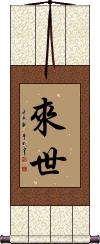
來世 is a word that can be used in many different ways.
It is often used to express the next life (life in heaven or wherever your soul is bound for). So it does have a religious overtone. However, it can also be used to express your life in the future - perhaps during your present lifetime.
It can also be translated as “the next world,” “the next generation,” “the time that is to come,” “otherworld,” or simply “posterity.”
See Also: Eternity | Rebirth | Reincarnation | Immortality
The one who retreats 50 paces mocks the one to retreats 100
The pot calls the kettle black
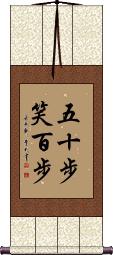
五十步笑百步 is a Chinese proverb that means the one who retreats 50 paces mocks the one who retreats 100 paces.
During the Warring States Period of what is now China (475 - 221 B.C.), the King of Wei was in love with war. He often fought with other kingdoms just for spite or fun.
One day, the King of Wei asked the philosopher Mencius, “I love my people, and all say I do the best for them. I move the people from famine-stricken areas to places of plenty and transport grains from rich areas to the poor. Nobody goes hungry in my kingdom, and I treat my people far better than other kings. But why does the population of my kingdom not increase, and why does the population of other kingdoms not decrease?”
Mencius answered, “Since you love war, I will make this example: When going to war, and the drums beat to start the attack, some soldiers flee for their lives in fear. Some run 100 paces in retreat, and others run 50 steps. Then the ones who retreated 50 paces laugh and taunt those who retreated 100 paces, calling them cowards mortally afraid of death. Do you think this is reasonable?
The King of Wei answered, “Of course not! Those who run 50 paces are just as timid as those who run 100 paces.”
Mencius then said, “You are a king who treats his subjects better than other kings treat their people, but you are so fond of war that your people suffer from great losses in battle. Therefore, your population does not grow. While other kings allow their people to starve to death, you send your people to die in war. Is there any difference?”
This famous conversation led to the six-character proverb shown here. It serves as a warning to avoid hypocrisy. It goes hand-in-hand with the western phrase, “The pot calls the kettle black,” or the Biblical phrase, “Before trying to remove a splinter from your neighbor's eye, first remove the plank from your own eye.”
The Five Fortunes

This is the title of “The Five Fortunes” in Chinese.
The implied five fortunes are as follows:
Longevity (壽)
Wealth (富)
Health & Composure (康寧)
Love of Virtue (攸好德)
A Peaceful Death (考終命)
Five Precepts
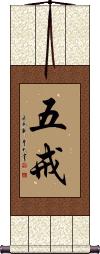
五戒 is the title or name for the five precepts of Buddhism.
These are prohibitions against killing, theft, sexual misconduct, lying, and intoxication.
Also phrased as commandments against murder, stealing, adultery, false speech, and consuming intoxicating liquors.
These five precepts or “pañca-veramaṇī” apply to the Buddhist laity as well as monks and nuns. The observance of these five ensures rebirth in the human realm.
Grim Reaper / God of Death
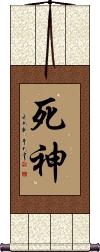
死神 is the title of the mythological figure (often called the Grim Reaper in western culture) in charge of taking the souls of those who die.
This title can be translated directly as “god of death” or “spirit of death.” The first character literally means “death,” and the second means “spirit” or “god.”
死神 is a very strange title for a calligraphy wall scroll. I'm not even sure if my calligraphers will write it, as it has some bad superstitious feelings attached to it.
Gung Ho
Working Together
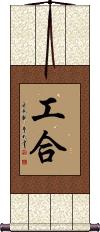
工合 is one of those Asian words that is used more in English than in the original Chinese.
Gung Ho was originally used to speak of Carlson's Raiders, a group of “Gung Ho” U.S. Marines who went on an island-hopping campaign of death during WWII.
A movie called Gung Ho came out in the mid-1940s and was later re-released in the 1950s depicting the 2nd Marine Raider Battalion, and brought this word to the mainstream.
It is still sometimes used today within the U.S. Marine Corps brotherhood to refer to a unit or group that works well together or is otherwise efficient and motivated (has good morals).
In 1986, there was a movie called Gung Ho about a Japanese company taking over an American automotive factory. They completely ignored the fact that this was a Chinese title.
It should be noted that this title actually means a condition, state, manner, or the health of something in Japanese.
Language and pronunciation notes:
Like many Asian words absorbed into common use in English, this one is drastically mispronounced. The official Romanization is “gong he” but that doesn't tell you enough. The vowel sound on the first character is like the English word “own,” now just add the g-sounds to the beginning and end. The second character is misleading, as you might think it is like the English word “he.” In reality, the vowel sound is more like the “u” in “up.”
It should also be noted that the current generation in China no longer uses or recognizes this as a common word or slogan.
Note: This can be pronounced and is a word in Japanese, though seldom used. Japanese will use a variation of "具合" instead. But still, not common.
Ikken Hissatsu
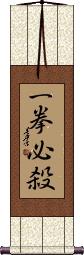
一拳必殺 is Ikken Hissatsu, a Japanese martial arts term that means to annihilate with one blow.
This translates directly as “one fist, certain death.”
Impermanence
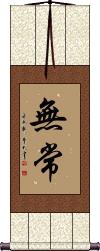
無常 is the state of being “not permanent,” “not enduring,” transitory, or evolving.
It can also mean variable or changeable. In some contexts, it can refer to a ghost that is supposed to take a soul upon death. Following that, this term can also mean to pass away or die.
In the Buddhist context, this is a reminder that everything in this world is ever-changing, and all circumstances of your life are temporary.
If you take the Buddhist philosophy further, none of these circumstances are real, and your existence is an illusion. Thus, the idea of the eternal soul is perhaps just your attachment to your ego. Once you release your attachment to all impermanent things, you will be on your way to enlightenment and Buddhahood.
Language notes for this word when used outside the context of Buddhism:
In Korean Hanja, this means uncertainty, transiency, mutability, or evanescent.
In Japanese, the definition orbits closer to the state of being uncertain.
Jesus is My Life
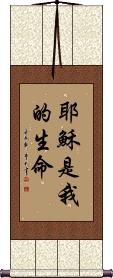
耶穌是我的生命 means Jesus is my life in Chinese.
The first two characters are a transliteration of the name Jesus into Mandarin Chinese.
The third character means, is.
The fourth and fifth mean my or mine.
The last two characters mean life, as in lifespan, or from birth to death.
This is not a common phrase for Chinese Christians, but this is the best way to translate this idea from English to Mandarin Chinese.
Kill / Slaughter / Murder / Butcher
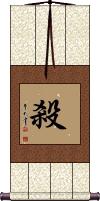
殺 is how to write “to kill” or “killing.”
殺 is an absolutely shocking word to have on a wall scroll. It will bewilder, scare, and perhaps offend any Chinese, Korean, or Japanese person who sees it. I do not in any way recommend this for a piece of calligraphy artwork. This entry is only here because our calligraphy search engine received so many requests for “kill.”
Note: In Korean Hanja, this character is not often used alone - see the other two-character entry for “kill.”
Kill / Massacre / Mass Killing
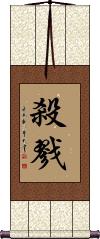
殺戮 is how to write “kill” or “massacre.”
殺戮 is an absolutely shocking word to have on a wall scroll. It will bewilder, scare, and perhaps offend any Chinese, Korean or Japanese person who sees it. I do not in any way recommend this for a piece of calligraphy artwork. This entry is only here because our calligraphy search engine received many requests for “kill” and “massacre.”
You are all a bunch of sick puppies!
Life is Short
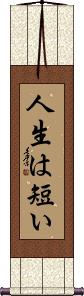
人生は短い is “life is short” in Japanese.
The character breakdown:
人生 (jinsei) life (i.e., conception to death); human life, living, lifetime.
は (ha/wa) particle (means “is” in this case).
短い (mijikai) short.
Note: Because this selection contains some special Japanese Hiragana characters, it should be written by a Japanese calligrapher.
Live Free or Die
Give me liberty or give me death
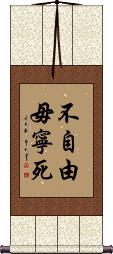
不自由毋寧死 means “Give me liberty or give me death” in Chinese.
This is also the best way to say, “Live free or die.”
The characters break down this way:
不 = Not; none; without.
自由 = Freedom; liberty; freewill; self-determination.
毋寧 = Rather; would rather; rather be.
死 = Dead; death.
This will go nicely next to your “Don't tread on me” flag. This phrase is known well enough in China that it's listed in a few dictionaries. Though I doubt you will find too many Chinese citizens willing to yell this on the steps of the capital in Beijing.
See Also: Death Before Dishonor
Madly in Love
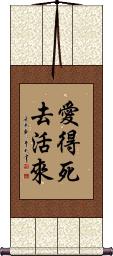
爱得死去活来 is a Chinese phrase that means “to be madly in love.”
It almost literally means “Love as if your life depended on it,” or “Love you to death, just to live.”
Marijuana / Weed / Pot
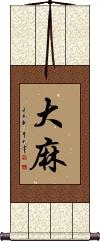
大麻 is how to write marijuana, weed, pot, grass, cannabis, or hemp in Chinese and Japanese Kanji. I never thought to add this, but these terms were searched for more than 5000 times on our website.
I have not checked to see if our calligraphers might have any problem with writing this. In case you didn't know, using, selling, and distributing pot in China is punishable by death. However, you can buy nice Lebanese hash at the hotel just down the way from the Lebanese Embassy in Beijing (I'm pretty sure it's brought into the country via a diplomatic pouch).
This means "Cannabis Sativa" in Korean but they add a third Hanja character to specifically mean the marijuana species that you know and love.
Musashi
The most famous Samurai
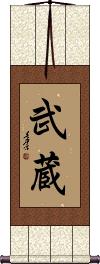
Miyamoto Musashi is probably the most famous Samurai in all of Japanese history.
武蔵 is the short title for a man long in legend. While coming from a lower class, his new sword and fighting techniques put him on par with the best that feudal Japan had to offer. His long career started with his first duel at age 13!
He is credited with using two swords at once and never losing a single battle in his career. After becoming a Buddhist, and getting older, like many old warriors, he took up a peaceful and solitary life until his death around 1645 A.D.
Note: Technically, Musashi is his given name, and Miyamoto is his surname. However, it's suggested that he assumed both of these names and had a few other names in childhood, as well as being given a Buddhist name. It's hard to know what to call him, as with most Kanji, there are multiple pronunciations. The characters for Musashi can also be pronounced Takezō. But everyone in modern times seems to know him by the name Musashi.
New Life
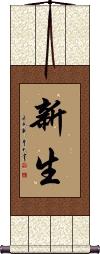
新生 literally means “new life” or “new birth” in Chinese, Japanese Kanji, and old Korean Hanja.
Depending on the context, this word can also mean newborn, new student, rebirth, new birth, or nascent.
In Japanese, this can be the given name Wakaki.
Note: This is not the most common word selection for a calligraphy wall scroll. But if you’re a westerner, you can bend the rules a bit.
Nirvana
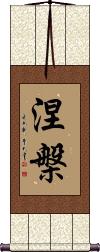
涅槃/涅盤 are the Chinese characters that mean Nirvāṇa. I will let you decide what Nirvana means to you.
This can also be translated as “Buddha's death and salvation” or “death of a Buddhist monk,” depending on the context. However, this is not seen with any bad meaning. You could replace “death” with “moving on,” as that is how it's seen in a Buddhist context.
More info from our dictionary: Nirvana
The Noble Eightfold Path
Ashtangika Marga / Astangika-Marga / Atthangika Magga
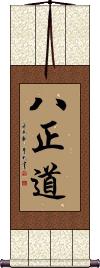
八正道 is a complex set of steps that Buddhists much take to cleanse karma, achieve enlightenment, eventually cease the cycle of rebirth and live in a state of Nirvana.
Note: This term is exclusively used by devout Buddhists. It is not a common term and remains an unknown concept to most Japanese and Chinese people. Sometimes written as 八聖道.
See Also: Buddhism | Enlightenment
No Pain No Gain
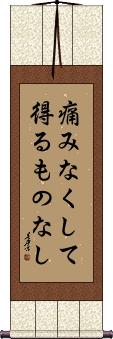
痛みなくして得るものなし is a Japanese phrase that means “no pain, no gain.”
This suggests that with pain, a gain must follow.
The pain Kanji here can also be translated as sorrow or suffering. The gain can also mean profit, advantage, or benefit. In the Japanese Buddhist context, that gain Kanji can mean rebirth in paradise, entering nirvana.
The character breakdown:
痛みなく (itami naku) pain; ache; sore; grief; distress. The naku part adds the meaning of “a lot of” or “extended”
して (shite) and then. (indicates a causative expression; acts as a connective particle)
得る (eru) to get; to acquire; to obtain; to procure; to earn; to win; to gain; to secure; to attain.
もの (mono) conjunctive particle indicating a cause or reason.
なし (nashi) none of; -less; without; no.
Note: Because this selection contains some special Japanese Hiragana characters, it should be written by a Japanese calligrapher.
Phoenix Rise from the Ashes
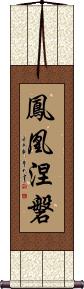
鳳凰涅磐 is a proverb that suggests “Legendary Phoenix rises from the ashes.” It means “Legendary Phoenix [reaches] Nirvana.”
There is a legend in China of a great bird reborn once every 500 years. This bird gathers all the ill will, suffering, desire, and other negative things of the world. The bird then plunges into the fire to burn away all negative things, sacrificing itself in the process (achieving Nirvana, or perhaps allowing others the opportunity to reach Nirvana).
500 years later, the phoenix is reborn from the ashes again, and the cycle repeats.
Phuong
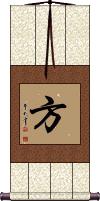
方 is the original Chinese character for the Vietnamese surname Phuong or Phương.
方 means square, upright, or side. In Vietnamese specifically, it can mean "direction" or "phoenix" (rebirth).
In Cambodian there is an unrelated surname, ភួង, meaning "garland necklace (of flowers)" which also romanizes as Phuong. This is probably not the character you want if your name is Cambodian (unless your ancestry is Chinese or you know what you are doing).
Pure Land / Jodo
Also a sect of Buddhism
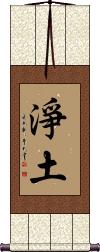
淨土 literally means “pure land” or “clean earth.”
淨土 is also the abbreviated title of a Buddhist sect that involves faith in the rebirth of Buddha Amitabha (Amitābha) in the Western Heaven. Sometimes this sect is translated as “Paradise of the West.” Other titles of this school of Buddhism include Amidism or Elysium.
See Also: Nirvana | Shin Buddhism
Re-Birth / Renaissance
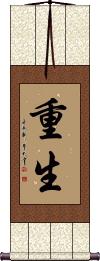
重生 is the Chinese word for rebirth. This can be used literally or metaphorically. As a metaphor, you could use this to say something like, “We are watching the rebirth of New Orleans after the disaster of Katrina.”
重生 is sometimes translated as “renaissance.”
Note: 重生 is not the Buddhist concept of reincarnation or re-birth.
See Also: Reincarnation
Resurrection / Re-Birth
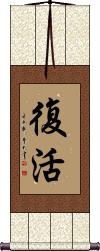
復活 is the Chinese, Japanese and Korean word for resurrection or rebirth.
復活 literally means “return to life.”
It is the term used in most Asian Bibles to refer to the resurrection of Christ. In Japanese, it is sometimes used to mean a Christian Revival. In some contexts, it can mean resuscitation.
See Also: Christianity | Jesus Christ | God of Abraham
Rehabilitation / Rebirth
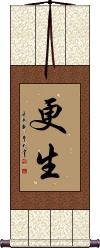
This is a Chinese, Korean and Japanese word that means rebirth or resurrection.
Other definitions include reinvigorated, rejuvenated, a new lease of life, rehabilitation, remaking one's life, starting life anew, regeneration, reorganization, rebuilding, recovery, restoration, remaking, coming back to life, revival, or resuscitation.
Reincarnation (Buddhism)
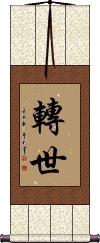
轉世 is the Buddhist idea of reincarnation or transmigration.
Other definitions of this term: “Attainer of Nirvana from within the desire realm,” “A practitioner who enters directly into Nirvana from the desire realm, without traversing the form and formless realms. One of the 27 kinds of Hinayana sages,” or simply, “to return again to this life.”
轉世 is also a Japanese title, but the first Kanji was slightly simplified after WWII. Just let us know if you want the modern Japanese version when you order.
Reincarnation / Transmigration of Souls
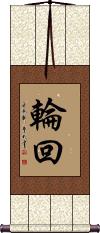
輪回 is a universal word in Japanese and Chinese that expresses the Buddhist idea of “reincarnation,” “transmigration of souls,” or “the eternal cycle of birth and death.”
In some contexts, this can also mean “karma,” and others will say it represents “samsara.”
The first character means wheel, ring, turn, circle, loop, or rotate.
The second character can be thought of as a suffix meaning “-times.” This second character can also refer to something that revolves, returns, goes back, or is a counter of the number of occurrences of some event.
Together the sum supersedes the parts, and it means reincarnation. But knowing the essence of each character may help you understand some of the meaning behind the word.
 Shown to the right is the more common way to write the second character in Japanese.
it’s
an alternate form of this character in Chinese (so neither way is technically wrong in either language). If you select a Japanese calligrapher, expect that is will look like the Kanji to the right.
Shown to the right is the more common way to write the second character in Japanese.
it’s
an alternate form of this character in Chinese (so neither way is technically wrong in either language). If you select a Japanese calligrapher, expect that is will look like the Kanji to the right.
Reincarnation / Life in Flux
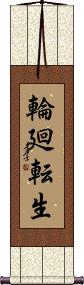
輪廻転生 is a Japanese Zen quote or proverb that expresses the idea of all things being in flux through the endless circle of birth, death, and rebirth or the circle of transmigration.
Return From Death’s Door
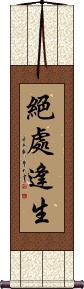
絕處逢生 is a Chinese proverb/idiom that talks of coming back from death's door or an unexpected rescue from danger.
Figuratively, this can be to recover from a seemingly impossible situation or to find a way out of a predicament.
If you have survived a near-death experience or severe illness, this might be an appropriate wall scroll for you.
Samsara / Endless Cycle of Rebirth
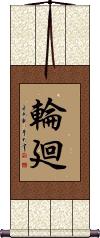
輪廻 is one of a few ways to express संसार or Saṃsāra in Chinese, Japanese, and old Korean.
The Buddhist term can be translated in several ways, including:
An endless cycle of death and rebirth.
The turning of the wheel.
To revolve.
Transmigration in six ways.
The wheel of transmigration.
The round of existence.
Sword of Death
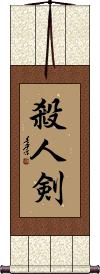
殺人剣 is a Japanese title for “Death Sword,” “Life Taking Sword,” or “satsujinken.”
This is the opposite of katsujinken or the “life-saving sword.” This title is not as commonly used in Japanese but pairs well when hung with katsujinken.
The first two Kanji are a word that translates as homicide, murder or kill (a person). 殺人剣 is specifically to kill a person (as the second character means person or human) as opposed to an animal, etc.
The last Kanji is the Japanese variant of the originally-Chinese character for a sword.
See Also: Katsujinken
Shigurui
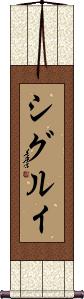
シグルイ is the name Shigurui as in the manga series “Death Frenzy” in Japanese Katakana.
Note: Because this title is entirely Japanese Katakana, it should be written by a Japanese calligrapher.
Shinken Shobu
Death Match
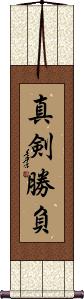
In modern Japanese, 真剣勝負 means to take something very seriously.
The literal and historical meaning is “real sword battle.” In old times, a Samurai apprentice would practice with a wooden practice sword. Once trained and qualified, they would wield a real steel sword made for battle and killing. They were ready for a “death match” or Shinken Shobu.
真剣 is an adjective that has come to mean serious/earnest. The literal translation is “real sword.”
勝負 in the simplest terms, means match, contest, game, or bout. Depending on the context, it could also mean victory or defeat, winning and losing, or the outcome of a battle.
There is a suggestion in Shinken Shobu that you train with serious and real intent, as we should train with the same fervor and dedication as if the battle was real. “Train as we fight.”
See Also: The More We Sweat in Training the Less We Bleed in Battle | Cry in the Dojo - Laugh on the Battlefield
Birth Old-Age Sickness Death
Born to Suffer
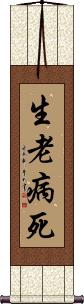
生老病死 means “to be born, to grow old, to get sick and to die” or “birth, aging, sickness, and death.”
This is an old somewhat-morbid Chinese proverb that is also used in Korean and Japanese. It figuratively means the fate of humankind (i.e. mortality) or suggests that we are all born to suffer.
In the Buddhist context, there are the “four inevitables in human life” or “four afflictions that are the lot of every human” known as “四苦” (literally “four afflictions”). Sometimes this proverb is written with that affliction character, 苦, at the end like 生老病死苦.
Sun Tzu: Regard Your Soldiers as Children
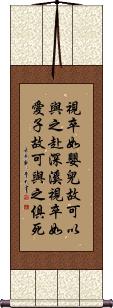
視卒如嬰兒故可以與之赴深溪視卒如愛子故可與之俱死 is an entry from the 10th section within the Earth/Terrain chapter of Sun Tzu's Art of War.
This is often translated as “Regard your soldiers as your children, and they will follow you into the deepest valleys. Look upon them as your own beloved sons, and they will stand by you even unto death.”
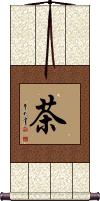
茶 means tea. It can refer to prepared tea (ready-to-drink) or dry tea leaves.
The origin of tea is China but the same character is used in Japanese Kanji, and old Korean Hanja with the exact same meaning. Japanese and Korean even borrowed the pronunciation from Chinese (pronounced “cha” in all three languages).
It's said that an early doctor (or herbologist) in ancient China kept poisoning himself as he tried different new herb concoctions. He invented tea as a means to detoxify himself as he recovered from 1 of the 76 times he nearly poisoned himself to death. Tea is seen not just as a drink but as a form of medicine used to remove impurities from the body.
The word “chai” (used in many languages to refer to various teas) is derived from this Chinese word.
茶 also means camellia, as Asian teas are often based on the leaves of camellia plant varieties.
The White Hairs of Old Age
Until death do us part
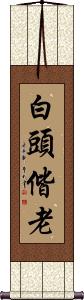
白頭偕老 is a Chinese proverb that means (to live together until the) white hairs of old age.
This is the Chinese way of saying “to live to a ripe old age in conjugal bliss” or “until death do us part.”
Mujo no Kaze / Wind of Impermanence
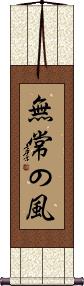
無常の風 is an old Japanese proverb that means the wind of impermanence or the wind of change in Japanese.
This can refer to the force that ends life, like the wind scattering a flower's petals. Life is yet another impermanent existence that is fragile, blown out like a candle.
The first two characters mean uncertainty, transiency, impermanence, mutability, variable, and/or changeable.
In some Buddhist contexts, 無常 can be analogous to a spirit departing at death (with a suggestion of the impermanence of life).
The last two characters mean “of wind” or a possessive like “wind of...” but Japanese grammar will have the wind come last in the phrase.
The following table may be helpful for those studying Chinese or Japanese...
| Title | Characters | Romaji (Romanized Japanese) | Various forms of Romanized Chinese | |
| Five Codes of Tang Soo Do | 國家忠誠父母孝道朋友有信殺生有擇臨戰無退 国家忠诚父母孝道朋友有信杀生有择临战无退 | guó jiā zhōng chéng fù mǔ xiào dào péng yǒu yǒu xìn shā shēng yǒu zé lín zhàn wú tuì guo2 jia1 zhong1 cheng2 fu4 mu3 xiao4 dao4 peng2 you3 you3 xin4 sha1 sheng1 you3 ze2 lin2 zhan4 wu2 tui4 guo jia zhong cheng fu mu xiao dao peng you you xin sha sheng you ze lin zhan wu tui | kuo chia chung ch`eng fu mu hsiao tao p`eng yu yu hsin sha sheng yu tse lin chan wu t`ui kuo chia chung cheng fu mu hsiao tao peng yu yu hsin sha sheng yu tse lin chan wu tui |
|
| Assassin | 刺客 | shikaku / shikyaku | cì kè / ci4 ke4 / ci ke / cike | tz`u k`o / tzuko / tzu ko |
| Avatar | 化身 | keshin | huà shēn / hua4 shen1 / hua shen / huashen | |
| Blessings on this Home | 五福臨門 五福临门 | wǔ fú lín mén wu3 fu2 lin2 men2 wu fu lin men wufulinmen | ||
| Death Before Dishonor | 寧為玉碎 宁为玉碎 | níng wéi yù suì ning2 wei2 yu4 sui4 ning wei yu sui ningweiyusui | ning wei yü sui ningweiyüsui |
|
| Death Before Dishonor | 寧為玉碎不為瓦全 宁为玉碎不为瓦全 | níng wéi yù suì bù wéi wǎ quán ning2 wei2 yu4 sui4 bu4 wei2 wa3 quan2 ning wei yu sui bu wei wa quan ningweiyusuibuweiwaquan | ning wei yü sui pu wei wa ch`üan ning wei yü sui pu wei wa chüan |
|
| The Buddha is in Each Sentient Being | 佛は衆生の中に在り | butsu wa shujou no naka ni ari butsuwashujounonakaniari butsu wa shujo no naka ni ari | ||
| Choose Life | 選擇生活 选择生活 | xuǎn zé shēng huó xuan3 ze2 sheng1 huo2 xuan ze sheng huo xuanzeshenghuo | hsüan tse sheng huo hsüantseshenghuo |
|
| Confucius | 孔子 | koushi / koshi | kǒng zǐ / kong3 zi3 / kong zi / kongzi | k`ung tzu / kungtzu / kung tzu |
| The Law of Creation and Destruction | 是生滅法 是生灭法 | zeshoumeppou zeshomepo | shì shēng miè fǎ shi4 sheng1 mie4 fa3 shi sheng mie fa shishengmiefa | shih sheng mieh fa shihshengmiehfa |
| Not Long for this World | 風燭殘年 风烛残年 | fēng zhú cán nián feng1 zhu2 can2 nian2 feng zhu can nian fengzhucannian | feng chu ts`an nien fengchutsannien feng chu tsan nien |
|
| Death Before Surrender | 寧死不屈 宁死不屈 | níng sǐ bù qū ning2 si3 bu4 qu1 ning si bu qu ningsibuqu | ning ssu pu ch`ü ningssupuchü ning ssu pu chü |
|
| Death Before Dishonor | 可殺不可辱 可杀不可辱 | kě shā bù kě rǔ ke3 sha1 bu4 ke3 ru3 ke sha bu ke ru keshabukeru | k`o sha pu k`o ju koshapukoju ko sha pu ko ju |
|
| Death Before Dishonor | 士可殺不可辱 士可杀不可辱 | shì kě shā bù kě rǔ shi4 ke3 sha1 bu4 ke3 ru3 shi ke sha bu ke ru shikeshabukeru | shih k`o sha pu k`o ju shihkoshapukoju shih ko sha pu ko ju |
|
| Death Before Dishonor | 不名譽より死 不名誉より死 | fu mei yo yo ri shi fumeiyoyorishi | ||
| Death with Dignity | 尊厳死 | son gen shi songenshi | ||
| Death Before Surrender | 寧死不降 宁死不降 | nìng sǐ bù xiáng ning4 si3 bu4 xiang2 ning si bu xiang ningsibuxiang | ning ssu pu hsiang ningssupuhsiang |
|
| Honorable Death - No Surrender | 玉砕主義 | gyokusai shugi gyokusaishugi | ||
| Frightful Demon Asura | 阿修羅 阿修罗 | ashura | ē xiū luó e1 xiu1 luo2 e xiu luo exiuluo | o hsiu lo ohsiulo |
| Die Without Regret | 死而無悔 死而无悔 | sǐ ér wú huǐ si3 er2 wu2 hui3 si er wu hui sierwuhui | ssu erh wu hui ssuerhwuhui |
|
| Dim Mak | 點脈 点脉 | diǎn mài / dian3 mai4 / dian mai / dianmai | tien mai / tienmai | |
| Emperor | 皇帝 | koutei / kotei | huáng dì / huang2 di4 / huang di / huangdi | huang ti / huangti |
| Empress | 皇后 | kou gou / kougou / ko go | huáng hòu huang2 hou4 huang hou huanghou | |
| Enjoy Life | 人生を楽しみにしている | jin sei o tano shi mi ni shi te i ru | ||
| Eternal Life Everlasting Life Immortality | 永生 | eisei | yǒng shēng yong3 sheng1 yong sheng yongsheng | yung sheng yungsheng |
| Eternal Life Future Life | 來世 来世 | rai-se | lái shì / lai2 shi4 / lai shi / laishi | lai shih / laishih |
| The one who retreats 50 paces mocks the one to retreats 100 | 五十步笑百步 | wù shí bù xiào bǎi bù wu4 shi2 bu4 xiao4 bai3 bu4 wu shi bu xiao bai bu wushibuxiaobaibu | wu shih pu hsiao pai pu wushihpuhsiaopaipu |
|
| The Five Fortunes | 五福 | wǔ fú / wu3 fu2 / wu fu / wufu | ||
| Five Precepts | 五戒 | go kai / gokai | wǔ jiè / wu3 jie4 / wu jie / wujie | wu chieh / wuchieh |
| Grim Reaper God of Death | 死神 | shinigami | sǐ shén / si3 shen2 / si shen / sishen | ssu shen / ssushen |
| Gung Ho | 工合 | guai | gōng hé / gong1 he2 / gong he / gonghe | kung ho / kungho |
| Ikken Hissatsu | 一拳必殺 | ikken hissatsu ikkenhissatsu iken hisatsu | ||
| Impermanence | 無常 无常 | mujou / mujo | wú cháng / wu2 chang2 / wu chang / wuchang | wu ch`ang / wuchang / wu chang |
| Jesus is My Life | 耶穌是我的生命 耶稣是我的生命 | yē sū shì wǒ de shēng mìng ye1 su1 shi4 wo3 de sheng1 ming4 ye su shi wo de sheng ming yesushiwodeshengming | yeh su shih wo te sheng ming yehsushihwoteshengming |
|
| Kill Slaughter Murder Butcher | 殺 杀 | satsu | shā / sha1 / sha | |
| Kill Massacre Mass Killing | 殺戮 杀戮 | satsuriku | shā lù / sha1 lu4 / sha lu / shalu | |
| Life is Short | 人生は短い | jinsei ha mijikai jinseihamijikai | ||
| Live Free or Die | 不自由毋寧死 不自由毋宁死 | bú zì yóu wú nìng sǐ bu2 zi4 you2 wu2 ning4 si3 bu zi you wu ning si buziyouwuningsi | pu tzu yu wu ning ssu putzuyuwuningssu |
|
| Madly in Love | 愛得死去活來 爱得死去活来 | ài de sǐ qù huó lái ai4 de5 si3 qu4 huo2 lai2 ai de si qu huo lai aidesiquhuolai | ai te ssu ch`ü huo lai aitessuchühuolai ai te ssu chü huo lai |
|
| Marijuana Weed Pot | 大麻 | tai ma / taima | dà má / da4 ma2 / da ma / dama | ta ma / tama |
| Musashi | 武蔵 | mu sashi / musashi | ||
| New Life | 新生 | waka ki / wakaki | xīn shēng xin1 sheng1 xin sheng xinsheng | hsin sheng hsinsheng |
| Nirvana | 涅槃 / 涅盤 涅盘 | ne han / nehan | niè pán / nie4 pan2 / nie pan / niepan | nieh p`an / niehpan / nieh pan |
| The Noble Eightfold Path | 八正道 | hasshoudou / hashodo | bā zhèng dào ba1 zheng4 dao4 ba zheng dao bazhengdao | pa cheng tao pachengtao |
| No Pain No Gain | 痛みなくして得るものなし | itami naku shite erumono wa nashi | ||
| Phoenix Rise from the Ashes | 鳳凰涅磐 凤凰涅磐 | fèng huáng niè pán feng4 huang2 nie4 pan2 feng huang nie pan fenghuangniepan | feng huang nieh p`an fenghuangniehpan feng huang nieh pan |
|
| Phuong | 方 | fāng / fang1 / fang | ||
| Pure Land Jodo | 淨土 净土 | jou do / joudo / jo do | jìng tǔ / jing4 tu3 / jing tu / jingtu | ching t`u / chingtu / ching tu |
| Re-Birth Renaissance | 重生 | chóng shēng chong2 sheng1 chong sheng chongsheng | ch`ung sheng chungsheng chung sheng |
|
| Resurrection Re-Birth | 復活 复活 | hukkatsu / hukatsu | fù huó / fu4 huo2 / fu huo / fuhuo | |
| Rehabilitation Rebirth | 更生 | kousei / kose kosei / kose | gēng shēng geng1 sheng1 geng sheng gengsheng | keng sheng kengsheng |
| Reincarnation (Buddhism) | 轉世 转世 | ten sei / tensei | zhuǎn shì zhuan3 shi4 zhuan shi zhuanshi | chuan shih chuanshih |
| Reincarnation Transmigration of Souls | 輪回 / 輪廻 轮回 | rin ne / rinne | lún huí / lun2 hui2 / lun hui / lunhui | |
| Reincarnation Life in Flux | 輪廻転生 | rinne tenshou rinnetenshou rinne tensho | ||
| Return From Death’s Door | 絕處逢生 绝处逢生 | jué chǔ féng shēng jue2 chu3 feng2 sheng1 jue chu feng sheng juechufengsheng | chüeh ch`u feng sheng chüehchufengsheng chüeh chu feng sheng |
|
| Samsara Endless Cycle of Rebirth | 輪廻 轮廻 | rinne | lún huí / lun2 hui2 / lun hui / lunhui | |
| Sword of Death | 殺人剣 杀人剣 | satsu jin ken satsujinken | ||
| Shigurui | シグルイ | shigurui | ||
| Shinken Shobu | 真剣勝負 | shinken shoubu shinkenshoubu shinken shobu | ||
| Birth Old-Age Sickness Death | 生老病死 | shou rou byou shi shouroubyoushi sho ro byo shi | shēng lǎo bìng sǐ sheng1 lao3 bing4 si3 sheng lao bing si shenglaobingsi | sheng lao ping ssu shenglaopingssu |
| Sun Tzu: Regard Your Soldiers as Children | 視卒如嬰兒故可以與之赴深溪視卒如愛子故可與之俱死 视卒如婴儿故可以与之赴深溪视卒如爱子故可与之俱死 | shì cù rú yīng ér gù kě yǐ yú zhī fù shēn xī shì cù rú ài zǐ gù kě yú zhī jū sǐ shi4 cu4 ru2 ying1 er2 gu4 ke3 yi3 yu2 zhi1 fu4 shen1 xi1 shi4 cu4 ru2 ai4 zi3 gu4 ke3 yu2 zhi1 ju1 si3 shi cu ru ying er gu ke yi yu zhi fu shen xi shi cu ru ai zi gu ke yu zhi ju si | shih ts`u ju ying erh ku k`o i yü chih fu shen hsi shih ts`u ju ai tzu ku k`o yü chih chü ssu shih tsu ju ying erh ku ko i yü chih fu shen hsi shih tsu ju ai tzu ku ko yü chih chü ssu |
|
| Tea | 茶 | cha | chá / cha2 / cha | ch`a / cha |
| The White Hairs of Old Age | 白頭偕老 白头偕老 | bái tóu xié lǎo bai2 tou2 xie2 lao3 bai tou xie lao baitouxielao | pai t`ou hsieh lao paitouhsiehlao pai tou hsieh lao |
|
| Mujo no Kaze Wind of Impermanence | 無常の風 | mu jou no kaze mujounokaze mu jo no kaze | ||
| In some entries above you will see that characters have different versions above and below a line. In these cases, the characters above the line are Traditional Chinese, while the ones below are Simplified Chinese. | ||||



