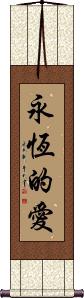
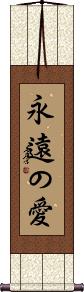
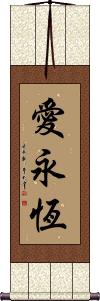
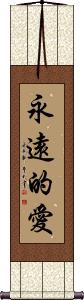
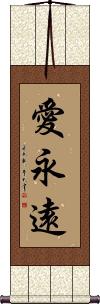
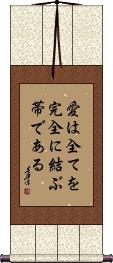
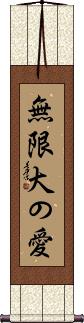
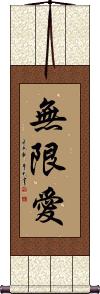
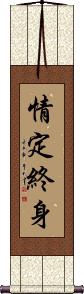
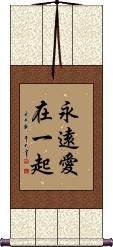
We have many options to create artwork with the Chinese characters / Asian symbols / Japanese Kanji for Eternal Love on a wall scroll or portrait.
If you want to create a cool Eternal Love Asian character tattoo, you can purchase that on our Chinese and Japanese Tattoo Image Service page and we'll help you select from many forms of ancient Asian symbols that express the idea of Eternal Love.
Quick links to words on this page...


The first two characters mean "eternal" and the last character is "love". The third character is a possessive article which sort of makes this selection mean "Love of the eternal kind".
This version is best if your audience is Chinese. We also have a Japanese version of this entry.
See Also... Forever Love | Eternal Love (japanese)


The first two characters mean eternal, eternity, perpetuity, immortality, and permanence.
The third character is a possessive article which sort of makes this selection mean "Love, of the eternal kind".
The last character is "love".
Cultural note: Most of the time, it is taboo to use the word "love" in Japanese. For instance, a Japanese man will say, "I like you", rather than, "I love you", to his spouse/girlfriend. However, this entry for eternal love is acceptable because of the way it is composed.
This entry is only appropriate if your audience is Japanese. We also have a Chinese version of this phrase.


The first two characters mean "forever" and the last character is "love". The third character is a possesive article which sort of makes this selection mean "The forever kind of love".


This is literally "True Love" in Chinese.
The first character means "real", "true" and "genuine". The second character means "love" and "affection".
During the customization of your calligraphy wall scroll, there is a place to add an inscription. You might want that inscription to be your names in Chinese down the side of your wall scroll, or perhaps just below these two main characters (just $9 extra). A nice gift to celebrate an anniversary or marriage!


This is a slightly poetic way to express this sentiment to someone.
The meaning is "My True Love" but the characters directly translate as "I/Me/My Heart/Mind True/Real Love".
Note that Chinese grammar and construction are different, so this sounds very eloquent and artsy in Chinese.
In Korean Hanja, the third character should be written differently, just let me know when you place your order if you want that version - it will still make sense in Chinese. This phrase makes sense in Korean, but not commonly used.


Kindness is showing you care, doing some good to make life better for others. Be thoughtful about people's needs. Show love and compassion to someone who is sad or needs your help. When you are tempted to be cruel, to criticize or tease, decide to be kind instead.
Can also mean "affectionate" or "cordial".
See Also... Caring | Benevolence

This is a very universal character. It means love in Chinese, Japanese Kanji, old Korean Hanja, and old Vietnamese.
This is one of the most recognized Asian symbols in the west, and is often seen on tee-shirts, coffee mugs, tattoos, and more.
This character can also be defined as affection, to be fond of, to like, or to be keen on. It often refers to romantic love, but in Chinese, one can say "I love that movie" using this character as well.
It's very common for couples to say "I love you" in Chinese. However, in Japanese, "love" is not a term used very often. In fact, a person is more likely to say "I like you" rather than "I love you" in Japanese. So this word is well-known, but seldom spoken.
See Also... Caring | Benevolence | Friendliness | Double Happiness Happy Marriage Wall Scroll

Beyond "benevolence" word can be also be defined as "charity" or "mercy" depending on usage.
The meaning suggests that one should pay alms to the poor, care for those in trouble, and take care of his fellow man (or woman).
This is one of the five tenets of Confucius. In fact, it is a subject in which Confucius spent a great deal of time explaining to his disciples.
I have also seen this benevolent-related word translated as perfect virtue, selflessness, love for humanity, humaneness, goodness, good will, or simply "love" in the non-romantic form.
This is also a virtue of the Samurai Warrior
See our page with just Code of the Samurai / Bushido here
See Also... Altruism | Kindness | Charity | Brotherhood | Confucius


Caring is giving love and attention to people and things that matter to you and anyone who is in need of help. When you care about people, you help them. You do a careful job, giving your very best effort. You treat people and things gently and respectfully. Caring makes the world a safer place.
This means caring in Chinese, and is also a word in Korean Hanja, but with more of a flavor or "taking an interest" and "concern".
Note, this is also a word in Korean Hanja, but in Korean, it means taking interest or concern. In Korean it's still a good word, but it doesn't quite have the "caring for a person" meaning that it does in Chinese.
See Also... Benevolence | Altruism


Compassion is caring and understanding someone is hurt or troubled (even if you don't know them). It is wanting to help, even if all you can do is listen and say kind words. You forgive mistakes. You are a friend when someone needs a friend.
These same two characters contain this meaning of compassion and sympathy in Chinese, Japanese, and Korean, which makes this word universal.


This Chinese philosophy tells of how we continue to learn throughout our lives. It can be translated in a few ways such as "Study Has No End" or "Knowledge is Infinite".
The deeper meaning: Even when we finish school we are still students of the world gaining more knowledge from our surroundings with each passing day.
See Also... An Open Book Benefits Your Mind | Wisdom | Learn From Wisdom


This is how the name for Aphrodite, Goddess of Love is written in Chinese characters.


This is the Chinese word for eternity.
The first character means always, forever and perpetual. The second character holds the meaning of permanent. Together, they create a word that means eternal, eternally or infinite time.


In Chinese and Korean, this means universal fraternity, brotherhood, or universal love.
In Japanese, this means charity, benevolence, philanthropy, or love for humanity.
Please note these subtle differences and take that into account depending on your intended audience (Chinese, Korean or Japanese).
See Also... Benevolence | Altruism


These are the last two words from John 3:16 in the Chinese Union Bible.
Although not specifically Christian, this is the way to express ever-lasting life or eternal life in Chinese.
In Japanese this can either mean eternal life or immortality.
See Also... Eternity


This word can be used in many different ways. It is often used to express the next life (life in heaven or wherever your soul is bound for). So it does have a religious overtone. However, it can also be used to express your life in the future - perhaps during your present lifetime. It can also be translated as "the next world", "the next generation", "the time that is to come", or simply "posterity".
See Also... Eternity | Rebirth | Reincarnation


This is the Chinese and Japanese way to express "Peace and Love". These are two separate words, so the calligrapher will put a slight space between the first two characters which mean peace, and the last two which represent universal love. This space is not shown on the sample character images for this phrase.
A special note: Word lists may seem okay in English, but feel strange in Chinese and Japanese. We don't offer too many of them, but this one is often-requested, and feels okay in Chinese and Japanese, though a bit uncommon in Korean.
See Also... Peace


This is the true essence of sincerity. It takes strength of personality to be truly sincere without over-doing it. Speaking of strength, this is probably the strongest way to convey the idea of sincerity in the Chinese language without over-doing it.
The first character literally means true, real, and genuine. While the second character means sincere and honest.
See Also... Honor


This is the last line of a famous poem. It is perceived as a tribute or ode to your parent's or mother from a child or children that have left home.
The poem was written by Meng Jiao during the Tang Dynasty (about 1200 years ago). The Chinese title is "You Zi Yin" which means "The Traveler's Recite".
The last line as shown here speaks of the generous and warm spring sun light which gives the grass far beyond what the little grass can could ever give back (except perhaps by showing its lovely green leaves and flourishing). The metaphor is that the sun is your mother or parents, and you are the grass. Your parents raise you and give you all the love and care you need to prepare you for the world. A debt which you can never repay, nor is repayment expected.
The first part of the poem (not written in the characters to the left) suggests that the thread in a loving mother's hands is the shirt of her traveling offspring. Vigorously sewing while wishing them to come back sooner than they left.
...This part is really hard to translate into English that makes any sense, but maybe you get the idea. We are talking about a poem that is so old that many Chinese people would have trouble reading it (as if it was the King James Version of Chinese).


This is exactly what the title suggests. The words directly translate from English to Chinese characters. This is a common phrase used between lovers in China.
Note: While the Japanese language uses the same characters, this phrase would not be spoken - it's kind of taboo in Japan. A man might tell a woman that he likes her with the phrase “Watashi wa anata ga suki-desu” (I regarding you have liking). If your audience is Japanese, avoid this “I love you” phrase. If you need something special, we have a Japanese translator on call.


This is the love between siblings. When you love, protect, care for, and have a deep bond that only brothers or sisters can.
The actual translation is "Hand and Foot" but it is said the relationship between brothers or sisters is like that of hands and feet. They belong together, and complete the body. Even though this says "hand and foot", it will always be read with the brotherly and sisterly love meaning in Chinese.
Note: During the past 20 years, the "One child policy" in China is slowly making this term obsolete.


This means benevolent heart or merciful heart in Japanese. This is a Japanese only phrase, and must be ordered using one of our master calligraphers (We suggest our Japanese master calligrapher). This is because the third character is special Hiragana.
Chances are you are into Inuyasha and are seeking the title of chapter 471 which is often translated as "Merciful Heart".
See Also... Altruism


This is how the name for Venus, Goddess of Love is written in Chinese characters.


The best kind of love to have I suppose. This word has the well-know character for love. But the second character modifies and/or reinforces the meaning to become adore, adoring love, or to love and adore.
I say that I suppose this is the best kind of love because adoring someone is fine, until you are in the shoes of the Prince of the Kingdom of Wu. This Prince adored a certain beautiful woman (Xi Shi) so much that he neglected his duties, and soon let the kingdom fall into ruins.


This came from a customer's request, but it's not too bad. These three simple characters suggest that you are born, you learn to love, and then exit the world.


Whether you want to make a joke about what marriage really is, or just feel that the world in full of love and hate, this selection is for you.
These characters happen to literally translate. So the first character is love. The middle character is a connecting particle like "and" in English. The last character is hate.
Upon request, we can omit the "and" character and just put a dot to separate love and hate if you prefer.


This is a universal word in Japanese, Korean and Chinese which means love and affection. Some may translate this as "love between a man and a woman". Depending on context, it can mean utter devotion or favorite.

This is the simplest way to express the idea of compassion. It can also mean love for your fellow humans, humanity, or living creatures. Sometimes this is extended to mean charity.
This term is often used with Buddhist or Christian context. The concept was also spoken of by Laozi (Lao Tze) in the Dao De Jing (Tao Te Ching).
This Chinese character is understood in Japanese, but is usually used in compound words (not seen alone). Also used in Korean Hanja, so it's very universal.
See Also... Mercy | Benevolence | Forgiveness


The first character here means "love" the last two mean "eteral" or "eternally". This is the shortest way to express the idea of "love eternally" in Chinese.
See Also... Love Forever


The first character here means "love" the last two mean "forever". This is the shortest way to express this idea in Chinese.


This entry was added at the request of a customer. This is how to write "love without reason" in Mandarin Chinese (using proper grammar, etc).
This is not a commonly-used, nor ancient phrase in Chinese.


This means love passionately, ardent love, devotion. The literal meaning is "hot love", as the first character means heat, fervent, hot and warm. Sometimes it can mean fever, restless, or zeal. The second character is, of course, love.


This means to love and honor. This is more or less the kind of thing you'd find in marriage vows.
The first character suggests emotions, passion, and feelings.
In this context, the second character means to honor your lover's wishes, and treat them justly and righteously (fairly).
This is the short and sweet form, there is also a longer poetic form (you can find it here: Love and Honor if it's not on the page you are currently viewing).
See Also... Love And Honor


This means to love and honor. This is more or less the kind of thing you'd find in marriage vows.
The first two characters suggest deep love or deep emotions, passion, and feelings.
The last two character s mean generous justice or thick honor (the third character is an adjective that means generous or thick). It just means that you will honor your lover's wishes, and treat them justly and righteously (fairly).
This is the longer four-character version, there is also a short and sweet two character version (you can find it here: Love and Honor if it's not on the page you are currently viewing).
See Also... Love And Honor


The first two characters mean "live" as in "to be alive" or "pursue life".
The third character means love.
The last character means laugh (sometimes means smile).
This is not a normal phrase, in that it does not have a subject, verb, and object. It is a word list. It should be noted that word lists are not normal or natural in Asian languages/grammar (at least not as normal as they are in English). The calligrapher may separate each word slightly with some space to show that they are separate ideas (such spacing not shown in the scroll mock up to the left).
We only added this entry because so many people requested it.


This literally means "loving heart". It can also be translated as "compassion".
Specifically in Japanese, this can be defined as a loving heart, a mind full of desire, or a mind dominated by desire.
In Chinese, it carries more of a compassion meaning.
See Also... Compassion


Characters shown
above are read
vertically, starting
from the right
This literally translates as, "Love [your] children in [your] heart, [but] be stern [with them] in [your] manner".
This is a little like saying "Love your child, but don't spare the switch".
Wall scroll artwork shown on this page is priced as follows:
1 character $28.88 each
2-3 characters $39.88 each
4 characters $49.88 each
5-10 characters $59.88 each
After you select your calligraphy, our website will take you through the process of customizing your artwork.
Options for other mounting such as portraits are available for $12 less.
We also offer the services of a famous master calligrapher for a $40 fee on any scroll if you are looking for investment-quality calligraphy.
If you chose our famous master-calligrapher, you also get more choices for silk and paper colors and the option for larger artwork.
All of our calligraphy is completely done by hand in the ancient way.
When the calligrapher finishes creating your artwork, it is taken to our art mounting workshop in Beijing where a wall scroll is made by hand from a combination of silk, rice paper, and wood.
After we create your wall scroll, it takes at least two weeks for air mail delivery from Beijing to you.
Therefore, allow at least 3 weeks for delivery from the time you place your order.
When you select your calligraphy, you'll be taken to another page where you can choose various custom options.
The scroll that I am holding in this picture is a "regular size"
4-character wall scroll.
As you can see, it is a great size to hang on your wall.
(We also offer custom wall scrolls in larger sizes)
Professional calligraphers are getting to be hard to find these days.
Instead of drawing characters by hand, the new generation in China merely type roman letters into their computer keyboards and pick the character that they want from a list that pops up.
There is some fear that true Chinese calligraphy may become a lost art in the coming years. Many art institutes in China are now promoting calligraphy programs in hopes of keeping this unique form
of art alive.
Even with the teachings of a top-ranked calligrapher in China, my calligraphy will never be good enough to sell. I will leave that to the experts.
The same calligrapher who gave me those lessons also attracted a crowd of thousands and a TV crew as he created characters over 6-feet high. He happens to be ranked as one of the top 100 calligraphers in all of China. He is also one of very few that would actually attempt such a feat.
The following table is only helpful for those studying Chinese (or Japanese), and perhaps helps search engines to find this page when someone enters Romanized Chinese or Japanese
| Title | Characters Simplified Traditional |
Japanese Romaji (Romanized Japanese) | Various forms of Hanyu-Pinyin (Romanized Chinese) | |||
| Eternal Love | 永恒的爱 永恆的愛 | n/a | yǒng héng de ài | yong3 heng2 de ai4 | ||
| Eternal Love (Japanese) | 永遠の愛 永遠の愛 | eiennoai | n/a | |||
| Forever Love | 永远的爱 永遠的愛 | n/a | yǒng yuǎn de ài | yong3 yuan3 de ai4 | ||
| True Love | 真爱 真愛 | shinai | zhēn ài | zhen1 ai4 | ||
| My True Love | 我心真爱 我心真愛 | n/a | wǒ xīn zhēn ài | wo3 xin1 zhen1 ai4 | ||
| Kindness | 亲切 親切 | shinsetsu | qīn qiè | qin1 qie4 | ||
| Love | 爱 愛 | ai | ài | ai4 | ||
| Benevolence | 仁 仁 | jin | rén | ren2 | ||
| Caring | 关心 關心 | n/a | guān xīn | guan1 xin1 | ||
| Compassion | 同情 同情 | doujou | tóng qíng | tong2 qing2 | ||
| Learning is Eternal | 学无止境 學無止境 | n/a | xué wú zhǐ jìng | xue2 wu2 zhi3 jing4 | ||
| Goddess of Love: Venus | 维纳斯 維納斯 | n/a | wēi nà sī | wei1 na4 si1 | ||
| Eternal / Eternity | 永恒 永恆 | n/a | yǒng héng | yong3 heng2 | ||
| Love for Humanity | 博爱 博愛 | hakuai | bó ài | bo2 ai4 | ||
| Eternal Life / Everlasting Life | 永生 永生 | eisei | yǒng shēng | yong3 sheng1 | ||
| Eternal Life / Future Life | 来世 來世 | rai-se | lái shì | lai2 shi4 | ||
| Peace and Love | 和平博爱 和平博愛 | waheihakuai | hé píng bó ài | he2 ping2 bo2 ai4 | ||
| Sincere / True Sincerity | 真诚 真誠 | n/a | zhēn chéng | zhen1 cheng2 | ||
| Appreciation & Love for Your Parents | 谁言寸草心报得三春晖 誰言寸草心報得三春暉 | n/a | shuí yán cùn cǎo xīn, bào dé sān chūn huī | shui2 yan2 cun4 cao3 xin1 bao4 de2 san1 chun1 hui1 | ||
| I Love You | 我爱你 我愛你 | n/a | wǒ ài nǐ | wo3 ai4 ni3 | ||
| Brotherly and Sisterly Love | 手足情 手足情 | n/a | shǒu zú qíng | shou3 zu2 qing2 | ||
| Benevolent Heart | 慈悲の心 慈悲の心 | jihinokokoro | n/a | |||
| Goddess of Love: Aphrodite | 阿芙洛狄特 阿芙洛狄特 | n/a | ā fū luò dí tè | a1 fu1 luo4 di2 te4 | ||
| Adoring Love | 爱慕 愛慕 | aibo | ài mù | ai4 mu4 | ||
| Live Love Die | 生爱死 生愛死 | seiaishi | shēng ài sǐ | sheng1 ai4 si3 | ||
| Love and Hate | 爱与恨 愛與恨 | n/a | ài yǔ hèn | ai4 yu3 hen4 | ||
| Love and Affection | 爱情 愛情 | aijou | ài qíng | ai4 qing2 | ||
| Mercy / Compassion / Love | 慈 慈 | ji | cí | ci2 | ||
| Love Eternal / Love Eternally | 爱永恒 愛永恆 | n/a | ài yǒng héng | ai4 yong3 heng2 | ||
| Love Forever | 爱永远 愛永遠 | n/a | ài yǒng yuǎn | ai4 yong3 yuan3 | ||
| Love Without Reason | 爱而无由 愛而無由 | n/a | ài ér wú yóu | ai4 er2 wu2 you2 | ||
| Passionate Love Ardent Love and Devotion | 热爱 熱愛 | netsuai | rè ài | re4 ai4 | ||
| Love and Honor | 情义 情義 | n/a | qíng yì | qing2 yi4 | ||
| Love and Honor | 深情厚义 深情厚義 | n/a | shēn qíng hòu yì | shen1 qing2 hou4 yi4 | ||
| Live, Love, Laugh | 生活笑爱 生活笑愛 | n/a | shēng huó ài xiào | sheng1 huo2 ai4 xiao4 | ||
| Loving Heart / Compassion | 爱心 愛心 | aishin | ài xīn | ai4 xin1 | ||
| Love Your Children, But Discipline Them Too | 爱在心里狠在面皮 愛在心裡狠在麵皮 | n/a | ài zài xīn lǐ hěn zài miàn pì | ai4 zai4 xin1 li3 hen3 zai4 mian4 pi4 | ||
| If you have not set up your computer to display Chinese, the characters in this table probably look like empty boxes or random text garbage.
This is why we spent hundreds of hours making images so that you could view the characters in the "Eternal Love" listings above. If you want your Windows computer to be able to display Chinese characters you can either head to your Regional and Language options in your Win XP control panel, select the [Languages] tab and click on [Install files for East Asian Languages]. This task will ask for your Win XP CD to complete in most cases. If you don't have your Windows XP CD, or are running Windows 98, you can also download/run the simplified Chinese font package installer from Microsoft which works independently with Win 98, ME, 2000, and XP. It's a 2.5MB download, so if you are on dial up, start the download and go make a sandwich. | ||||||
All custom calligraphy items are made-to-order in our little Beijing artwork-mounting workshop.
Normal delivery isjust over 3 weeksfor these handmade items.
Copyright Oriental Outpost 2002-2007 - All Rights Reserved
Privacy Policy