Buy a Good Fortune Chinese or Japanese Scroll
Choose from many options to create artwork with the Chinese characters / Asian symbols / Japanese Kanji for Good Fortune on a wall scroll.
If you want to create a cool Good Fortune wall scroll, this is the place. Below you will find a few Asian symbols that express the idea of Good Fortune.
3. Good Luck
5. 100 Years of Happy Marriage
6. Even a fool may sometimes come up with a good idea
7. Year-In Year-Out Have Abundance
10. 1000 good moves ruined by 1 bad
11. Beauty / Beautiful / Handsome
14. Bright and Promising Future
15. The Foundation of Good Conduct
16. Courage to do what is right
17. Destiny / Fate
19. Destiny / Fate
20. Dragon and Phoenix Brings Luck
22. A Bright Future
27. Gentleness
28. God is Good
29. Goodness
30. Goodbye
32. Good and Evil
33. Good Good Study, Day Day Up
34. Good Health
35. Good Health / Healthy / Vigor
36. Good Heart
37. Good Intentions
38. Good Intentions / Good Will / Good Faith
39. The Good Life / Beautiful Life
40. Good Night
41. In Good Order
43. Good Conduct
44. Doing good is the greatest source of happiness
46. Lucky / Auspicious / Good Omen
47. Happiness / Fortune / Lucky
48. Hearing a Hundred Times is Not as Good as Seeing Once
49. Safety and Well-Being of the Family
50. A Life of Happiness and Prosperity
51. Life is Good / Life is Beautiful
52. Life is Good
55. A House Might be Worth 1 Million Dollars, But Good Neighbors are Worth 10 Million
59. Restoration to Good Health
62. Unselfish: Perfectly Impartial
Good Luck / Good Fortune
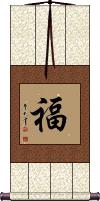
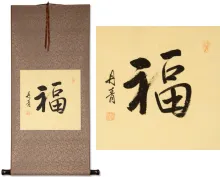
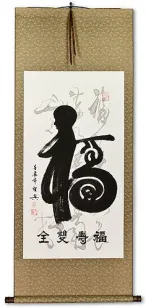
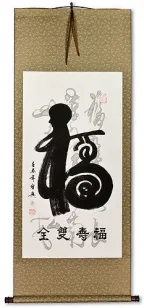
福 is pronounced “fu” in Chinese.
The character “fu” is posted by virtually all Chinese people on the doors of their homes during the Spring Festival (closely associated with the Chinese New Year).
One tradition from the Zhou Dynasty (beginning in 256 B.C.) holds that putting a fu symbol on your front door will keep the goddess of poverty away.
福 literally means good fortune, prosperity, blessed, blessedness, happiness, and fulfillment.
You'll also see this character in Vietnam (where Chinese characters were the written form until a romanization reform) where it is pronounced Phúc - a word commonly used in Vietnamese names because of its good meaning.
See Also: Lucky
House of Good Fortune
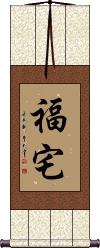
福宅 is perhaps the Chinese equivalent of “This blessed house” or perhaps “home sweet home.”
This phrase literally means “Good fortune house” or “Good luck household.” It makes any Chinese person who sees it feel that good things happen in the home in which this calligraphy is hung.
Good Luck
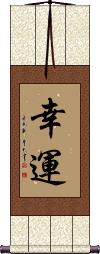
幸運 can be translated as “good luck,” fortunate, lucky, and/or “good fortune” in Chinese, Korean and Japanese.
Occasionally, this is also translated as a type of happiness or a short way to write serendipity.
Opportunity / Good Luck
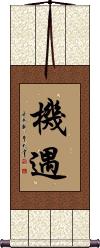
機遇 is the kind of opportunity that comes via good luck or good fortune.
This word is sometimes translated as “stroke of good luck.”
While there are other ways to express “opportunity,” I think this version is best for a calligraphy wall scroll or portrait.
Note: In Korean Hanja, this would also mean “Meeting someone under strange circumstances.”
See Also: Good Luck
100 Years of Happy Marriage
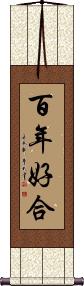
百年好合 is a wish or greeting, often heard at Chinese weddings, for a couple to have 100 good years together.
Some will translate this more naturally into English as: “May you live a long and happy life together.”
The character breakdown:
百 = 100
年 = Years
好 = Good (Happy)
合 = Together
Even a fool may sometimes come up with a good idea
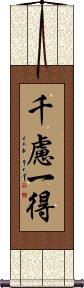
千慮一得 means “1000 tries, one success,” or “[a] thousand tries [leads to] one success.”
This proverb is a humble way to express your success, ideas, or accomplishments. As if you are a fool who just got lucky in inventing or creating something.
Translations for this proverb include:
Even without any notable ability on my part, I may still get it right sometimes by good luck.
Even a fool may sometimes come up with a good idea.
Compare this to the English idiom, “Even a broken clock is right twice a day.”
Year-In Year-Out Have Abundance
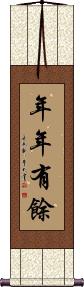
年年有餘 is a common proverb or wish of prosperity you'll hear around the time of Chinese New Year.
Directly translated character by character, it means “Year Year Have Surplus.” A more natural English translation including the deeper meaning would be “Every Year may you Have Abundance in your life.”
On a side note, this phrase often goes with a gift of something related to fish. This is because the last character, “yu” which means surplus or abundance, has exactly the same pronunciation in Mandarin as the word for “fish.”
This is also one of the most common titles for traditional paintings that feature koi fish.
In China, this phrase might make an odd wall scroll - a customer asked especially for this common phrase which is why it appears here. See my other abundance-related words if you want a wall scroll that will seem more comfortable in Chinese culture.
Note: This can be pronounced in Korean, but it's not a commonly used term.
See Also: Prosperity | Good Fortune
Abundance / Prosperous
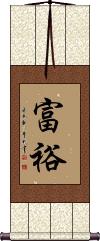
富裕 means prosperous, having an abundance, well-to-do, or well-off.
It's a simple word that suggests “you have made it” in Chinese, Japanese Kanji, and Korean Hanja.
See Also: Good Fortune
Abundance and Prosperity
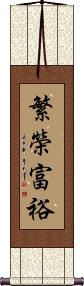
繁榮富裕 is a proverb about “Prosperity and Abundance.”
This presents and reinforces the ideas of being prosperous, a booming economy, well-to-do, well-off, wealthy, riches, and opulence.
While this is the ancient/traditional Chinese way to write this, most Japanese can fully read and understand it. It's also the correct form of old Korean Hanja (though few Koreans of the current generation will be able to read this).
See Also: Good Fortune
1000 good moves ruined by 1 bad
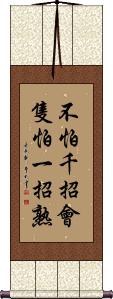
不怕千招会只怕一招熟 is a Chinese proverb that literally translates as: Do not worry about making a thousand clever moves; what [one has to] fear is one bad move.
Figuratively, this means: Even if you have made many clever moves before, one wrong move will ruin the whole game.
I compare this to the English saying, “It takes only one Aw-shit to wipe out a thousand Attaboys.”
Beauty / Beautiful / Handsome
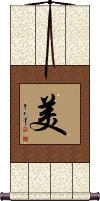
美 is often used to describe the beauty of a woman.
However, when applied to a man, it can mean handsome. It's also the first character in the word for “beauty salon” which you will see all over China and Japan.
This can be used as the given name for a girl (spell it or say it as “Mei” or “May”).
For a bit of trivia: The title for the “USA” in Chinese is “Mei Guo” which literally means “Beautiful Country.” This name was bestowed at a time before Chairman Mao came to power and decided that China didn't like the USA anymore (even though we fought together against the Japanese in WWII). But these days, Chinese people love Americans (but have a distaste for American politics and policy). But I digress...
美 is also how “Beautiful” is written in Japanese Kanji and Korean Hanja. 美 can also mean: very satisfactory; good; to be pleased with oneself; abbreviation for the USA; fine; handsome; admirable; madhura; sweet; and/or pleasant.
See Also: Beautiful Woman | Beautiful Girl
Extremely Good Friends
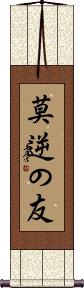
莫逆の友 is Japanese expressing meaning “excellent friends” or “best friends.”
Blessings and Good Wishes
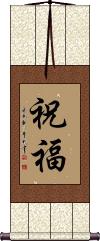
祝福 is a nice way to give good wishes to someone.
It can be a general blessing or used to congratulate someone for a special occasion or graduation.
This has a good meaning in Japanese but is more appropriate when expressed orally. 祝福 is not a natural selection for a wall scroll if your audience is Japanese.
Bright and Promising Future
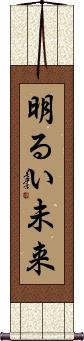
明るい未来 is a Japanese proverb that means “Bright Future.”
It suggests a lot of possibilities and potential awaits in your future. A great gift for a graduate.
The first part of this proverb literally means bright or light. The second part means the future but can also be translated as “the world to come.”
Note: Because this selection contains some special Japanese Hiragana characters, it should be written by a Japanese calligrapher.
The Foundation of Good Conduct
Quote from Confucius
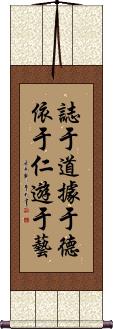
This proverb, 志于道据于德依于仁游于艺, from the Analects of Confucius translates as:
Resolve yourself in the Dao/Tao/Way.
Rely on Virtue.
Reside in benevolence.
Revel in the arts.
According to Confucius, these are the tenets of good and proper conduct.
This was written over 2500 years ago. The composition is in ancient Chinese grammar and phrasing. A modern Chinese person would need a background in Chinese literature to understand this without the aid of a reference.
Courage to do what is right
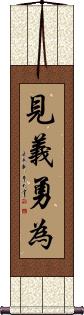
見義勇為 means the courage to do what is right in Chinese.
This could also be translated as “Never hesitate to do what is right.”
This comes from Confucian thought:
Your courage should head in an honorable direction. For example, you should take action when the goal is to attain a just result as, without honorable intent, a person’s gutsy fervor can easily lead them astray.
One who flaunts courage but disregards justice is bound to do wrong; someone who possesses courage and morality is destined to become a hero.
Some text above paraphrased from The World of Chinese - The Character of 勇
See Also: Work Unselfishly for the Common Good | Justice | Bravery
Destiny / Fate
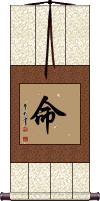
命 is often translated as “destiny.”
Sometimes this character is simply translated as “life” but more in terms of one's lot in life. In a certain context, this can mean command or decree (generally from a king or emperor). Of course, such a decree is part of fate and leads you to fulfill your destiny.
In Chinese, this word leans toward the fate or destiny definition.
In Korean, it is usually read simply as “life.”
In Japanese, it can mean all definitions shown above, depending on context.
See Also: Good Fortune
Fate / Chance Meeting
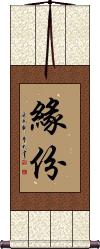
緣份 specifically represents the fate or destiny that brings two people together.
This is like the chance meeting of two people that leads sometime later to marriage.
This could also be the chance meeting of two business people who become partners and build a huge and successful company.
This idea is often associated with a fateful meeting leading to good fortune.
Some will define this word as “Destiny brings you two together” or “Meant to be.”
 Note: The second character can also be written without the left radical, as shown to the right. If you have a preference, please let use know in the special instructions for your project. There is no difference in meaning or pronunciation, just two (alternate) ways to write the same character.
See Also: Soulmates | Good Fortune
Destiny / Fate
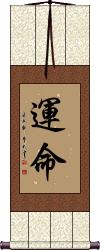
These two characters contain the ideas of fate, destiny, fortune, and luck in Chinese, Japanese Kanji, and old Korean Hanja.
運命 is often defined as “a person's fate” or “personal fate” in various dictionaries.
These two characters can be reversed (written in either order) and yield roughly the same meaning.
This particular character order is more common in old Korean and less common in modern Chinese.
See Also: Good Fortune | Good Luck
Dragon and Phoenix Brings Luck
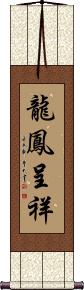
龍鳳呈祥 is often seen at weddings and other celebrations in China.
It suggests that the dragon and phoenix will bring you auspicious tidings.
The first character is a dragon.
The second is a phoenix.
The third is presents or brings.
And the last means auspicious, propitious, or luck.
Throughout China, the dragon and phoenix are symbols of good fortune. You will see these auspicious figures as decorative symbols on everything from buildings, furniture, wedding costumes, and sculptures in public parks to caskets and items used in ceremonies.
Eat Drink and Be Merry
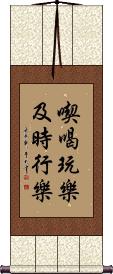
喫喝玩樂及時行樂 is just about the closest proverb to match the western idea of “Eat, drink, and be merry.”
This is a Chinese proverb that more literally means “Eat, drink, play, be merry, enjoy everything as long as you can.”
It's basically a suggestion that you try to enjoy everything in life, as long as you live, or as long as you are able.
A Bright Future
Incredible 10,000-Mile Flight of the Peng
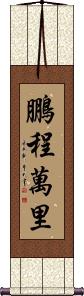
鵬程萬里 is an ancient Chinese proverb used in modern times to wish someone a long and successful career.
It's really about the 10,000 Flight of the Peng (Peng, also known as Roc is a mythical fish that can turn into a bird and take flight).
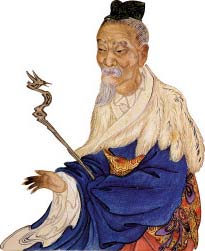
莊子
Zhuangzi or Chuang Tzu
Breaking down each character:
1. Peng or Roc (a kind of bird).
2. Journey (in this case, a flight).
3. 10,000 (Ten Thousand).
4. Li is a unit of distance often referred to as a “Chinese Mile,” though the real distance is about half a kilometer.
Direct Translation: “Peng's Journey [of] 10,000 Li.”
Literal meaning: “The 10,000-Li Flying Range Of The Roc.”
Perceived meaning: “To have a bright future” or “To go far.”
This proverb/idiom comes from the book of Zhuangzi or Chuang Tzu. It tells the tale of a huge fish that could turn into a gigantic bird. This bird was called a “peng” and was many miles long. This legendary size allowed the Peng to fly from the Northern Sea to the Southern Sea in a single bound.
Wishing someone “a Peng's Journey of 10,000 Li” will imply that they can travel far without stopping and will have great success, a long career, and a prosperous future.
Fortune favors the brave
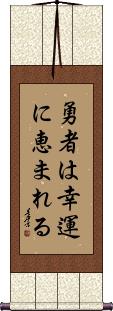
勇者は幸運に恵まれる is a Japanese proverb that suggests that in history, the brave or courageous tend to be the ones who win.
Note: Because this selection contains some special Japanese Hiragana characters, it should be written by a Japanese calligrapher.
Fortune Favors The Brave
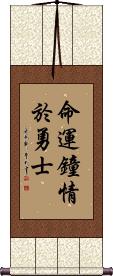
命運鐘情於勇士 means “Fortune favors the brave” in Chinese.
This is not the only way to express the idea of fortune favoring the bold or brave.
It's not originally a Chinese phrase, so it's been translated into Chinese in various ways.
Fortune Favors the Bold
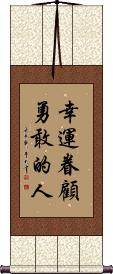
幸运眷顾勇敢的人 can be translated as “Fortune favors the brave/bold/courageous” in Chinese.
Fragrant / Good Smell
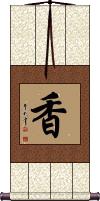
香 is the Chinese, Japanese Kanji, and old Korean Hanja that means: fragrant; sweet smelling; aromatic; savory; appetizing; perfume; incense; aroma; fragrance; scent; good smell.
Fragrance or incense is known to be one of the Buddha's messengers to stimulate faith and devotion.
Gentleness
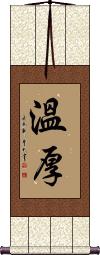
溫厚 is a Chinese, Japanese, and old Korean word for gentle or gentleness.
This can also mean “kindness” (more as an adjective like “kind person”).
 The modern Japanese version of the first character looks like the one to the right. If you want this modern Japanese form, just click on that Kanji instead of the button above.
God is Good
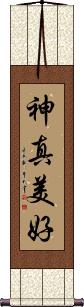
神真美好 means “God is good,” in Chinese.
You can also translate this as “God is really good” or “God is so good.”
The last two characters are a version of good that suggests very strong goodness. The characters read, “beautifully good.”
God is Good
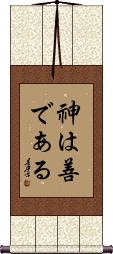
神は善である means “God is Good,” in Japanese.
Note: Because this selection contains some special Japanese Hiragana characters, it should be written by a Japanese calligrapher.
Goodness
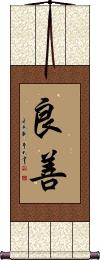
良善 means good or goodness.
This can also be the name Ryōzen in Japanese.
Goodbye
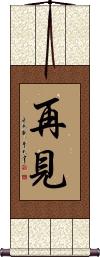
再見 is the most common “goodbye” in Mandarin Chinese.
It literally/directly translates, “again see” or more naturally, “See you again.” It's a lot like the English, “See you later.”
Theoretically, this can be used in Japanese, but in Japanese, it's seen as the Chinese way to say goodbye. It's like English people saying ciao! or ¡adiós!
This is a strange title for a wall scroll. I guess it’s best if you plan to put this by the door where people will see it when they leave your home or business.
One Good Deed Each Day
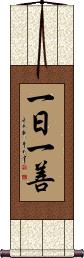
一日一善 is a Chinese, Japanese Kanji, and old Korean Hanja phrase that suggests doing a good deed each day or doing one good turn a day.
It literally reads, “One Day, One Good (Deed).”
Good and Evil
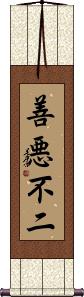
善悪不二 is a Japanese Buddhist expression that states, “Good [and] evil [are], not two [separate things].”
A more natural way to express this in English is, “Good and evil are but two faces of the same coin.”
Good Good Study, Day Day Up
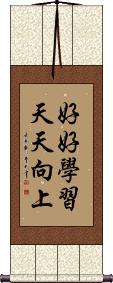
好好學習天天向上 is a famous proverb by Chairman Mao Zedong that sounds really strange when directly translated into English.
I include it in our database of phrases to illustrate how different the construction and grammar can be between Chinese and English. The direct translation is “Good Good Study, Day Day Up.” In Chinese, a repeated character/word can often serve to reinforce the idea (like saying “very” or suggesting “a lot of”). So “good good” really means “a lot of good.” While “day day” can be better translated as “day in day out.” The idea of “up” has a meaning in China of “rising above” or “improving.”
After understanding all of this, we come up with a slightly better translation of “With a lot of good study, day in and day out, we raise above.”
The more natural translation of this proverb would be something like, “study hard, and keep improving.”
Good Health
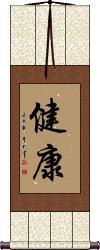
Good Health / Healthy / Vigor
Also suggests being at peace
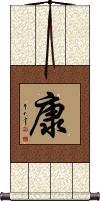
康 is a single character that means good health or vigor in Chinese, Japanese Kanji, and old Korean Hanja.
康 can also mean peaceful, at ease, or abundant in some contexts.
Please note that this is rarely seen alone in Japanese Kanji. In Japanese, it is used both for health-related compound words and to denote the kouhou through koushou eras of Japan.
In Korean, this can also be the family name “Kang” (caution: not the only family name romanized as Kang in Korean).
Good Heart
A heart of kindness, benevolence, and virtuous intentions
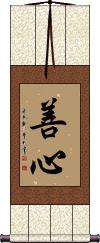
善心 literally reads “Good Heart” but is used to refer to the ideas of kindness, benevolence, philanthropy, virtuous intentions, moral sense, and conscience.
Some will also translate this as the morality of mind (as the character for the heart is often used to mean mind).
In Japanese, this can be the given name Yoshinaka.
Good Intentions
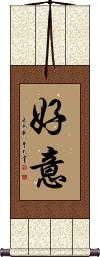
好意 is how to write good intentions in Chinese, Japanese, and old Korean Hanja.
This can also be translated as kindness, goodwill, favor/favour, courtesy, good wishes, friendliness, and/or amity.
Good Intentions / Good Will / Good Faith
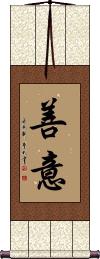
善意 is a word that means good intentions, goodwill, or to things done in good faith in Chinese, Japanese, and old Korean Hanja.
It's the reason you do good deeds or the desire you have inside yourself to do the right thing.
This can also be translated as benevolence, kindness, virtuous mind, positive mindset, or favorable sense.
善意 is also used in the legal context for things done in good faith (regardless of outcome).
In Japanese, this can be the personal name Yoshi or Yoshii.
The Good Life / Beautiful Life
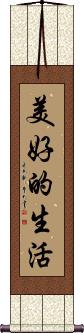
In Chinese, 美好的生活 means “Beautiful Life,” or “The Good Life.”
Good Night
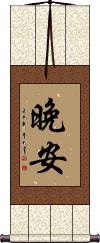
晚安 is how to write “good night” in Chinese.
This literally is a wish for an “evening of peace” or “night of calm.”
晚安 is not a normal title for a calligraphy wall scroll. It might be appropriate for a hotel front desk if anything.
Good Night
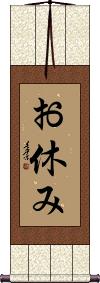
お休み is how to write “good night” in Japanese.
It literally means “taking a rest.”
お休み is not a normal title for a calligraphy wall scroll. It might be appropriate for a hotel front desk, if anything.
Note: Because this selection contains some special Japanese Hiragana characters, it should be written by a Japanese calligrapher.
In Good Order
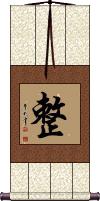
整 is a single Chinese character that can mean: in good order, whole, complete, entire, in order, orderly, to repair, to mend, to renovate, and/or to fix something or somebody.
This was added for a customer who wanted a single character that meant orderly. It's kind of unusual for a wall scroll.
My Korean Hanja dictionary defines it as orderly, neat, tidy, and/or whole.
Note: In Japanese, this Kanji is usually understood as a male given name Hitoshi (other Kanji can also be Hitoshi). It is used in combination with other Kanji or Hiragana to create words about orderliness. Unless your name is Hitoshi, this single character is best if your audience is Chinese.
In Good Order / Organized
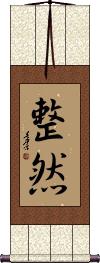
整然 is orderly, systematic, well-organized, trim, neat, tidy, and accurate in Japanese Kanji and old Korean Hanja.
This would be understood but is not used in Chinese languages.
Good Conduct
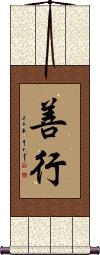
善行 means good actions, good deeds, good conduct, or benevolence.
This can be the given name Yoshiyuki in Japanese.
Doing good is the greatest source of happiness
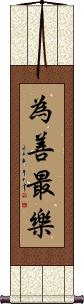
為善最樂 can be translated as “Doing good is the greatest source of happiness” or “doing good deeds brings the greatest joy.”
The origin is not known but is sometimes used in the context of Buddhism. However, this Chinese proverb or philosophy is a relatively mainstream idea of benevolence.
Goodness / Good Deed
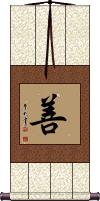
善 means goodness, virtue, good deed, charitable, benevolent, well-disposed, nice, pleasant, kind, or simply, “good.”
善 is the kind of good that applies to someone's good character, or a good person in general.
Referring to someone with this word means that they have a well-aimed moral compass, and are charitable, giving, wise, and honest. Basically, this is a blanket statement for every good trait a human can have or all the things that make someone good.
In another context, it can mean to improve or perfect something or refer to someone who is good at something.
Lucky / Auspicious / Good Omen
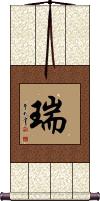
瑞 is a Chinese, Japanese, and old Korean word that means: lucky; auspicious; propitious; freshness; purity; luster; a good omen.
In Japanese, this can be the following female given names: Yutaka; Midzuho; Mizuho; Mizuki; Mizue; Mizu; Mio; Tamami. It can also be a Japanese surname, Zui or Shirushi.
In the Buddhist context, this can represent an auspicious jade token or good omen.
Happiness / Fortune / Lucky
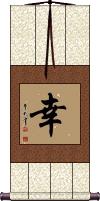
幸 can mean happiness, good fortune, good luck, and in the old days, good harvest or bounty.
Note: From Japanese, this character is sometimes romanized as “sachi,” and is often pronounced “kou” or sometimes “rei” when used in compound words with other Kanji.
Hearing a Hundred Times is Not as Good as Seeing Once
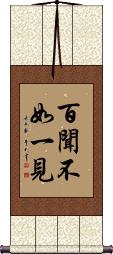
百聞不如一見 is a Chinese proverb that means “Seeing once is better than hearing one hundred times” which is similar to the idea of “Seeing is believing.”
You can also get the idea, “Seeing for oneself is better than hearing from many others.”
If you break it down directly, you get “100 hears/listens (is) not as-good (as) one sight.”
Safety and Well-Being of the Family
Kanai Anzen
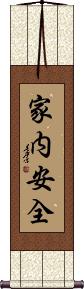
家內安全 is the Japanese way of saying “Family First.”
It's a Japanese proverb about the safety and well-being of your family and/or peace and prosperity in the household.
Some Japanese will hang an amulet in their home with these Kanji. The purpose is to keep your family safe from harm.
According to Shinto followers, hanging this in your home is seen as an invocation to God to always keep family members free from harm.
We were looking for a way to say “family first” in Japanese when this proverb came up in the conversation and research. While it doesn't say “family first,” it shows that the safety and well-being of your family is your first or most important priority. So, this proverb is the most natural way to express the idea that you put your family first.
See Also: Peace and Prosperity
A Life of Happiness and Prosperity
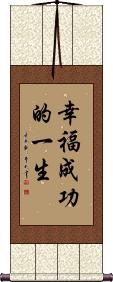
幸福成功的一生 means “A life of happiness and prosperity” or “A life of happiness and success.”
It's a very positive and inspirational wall scroll selection.
See Also: Prosperity
A Life of Happiness and Prosperity
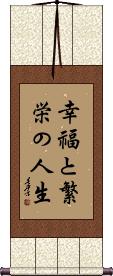
幸福と繁栄の人生 is a Japanese proverb that means “A life of happiness and prosperity” or “A life of happiness and success.”
Note: Because this selection contains some special Japanese Hiragana characters, it should be written by a Japanese calligrapher.
See Also: Prosperity
Life is Good / Life is Beautiful
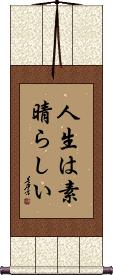
人生は素晴らしい means “life is good,” “life is great,” or “life is beautiful” in Japanese.
The first two characters mean “life” (as in your or a human lifespan).
The third character kind of means “is.”
The last five characters are a long adjective that means wonderful, splendid, and/or magnificent. In the context of life, it reads more like good or beautiful.
Note: Because this selection contains some special Japanese Hiragana characters, it should be written by a Japanese calligrapher.
Life is Good / Life is Beautiful
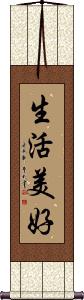
生活美好 means “life is good” in Chinese.
The first two characters mean “life” or “living.”
The last two characters mean “good” or “beautiful.”
Life is Good
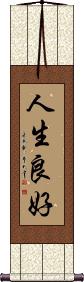
人生良好 means “life is good” in Japanese.
The first two characters mean “life” (as in your or a human lifespan).
The last two characters mean “good.”
This also makes sense in Chinese but it reads more like, “life is all right.”
Life is Good
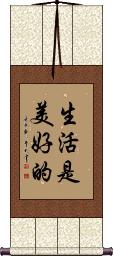
生活是美好的 is “Life is Good” in Mandarin Chinese.
Live in Prosperity
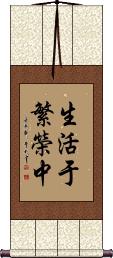
生活于繁榮中 means “live in prosperity.” It's kind of a suggestion to be prosperity the center of your world.
This is the way some people want to live (and you should always live for what you love). However, this phrase does not suggest a peaceful life - rather one that is always busy. It's not for everyone, but it might be for you.
See Also: Prosperity
Lucky / Auspicious
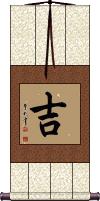
吉 is a simple way to express the state of being lucky.
Also used in conversation to hope that all is well with someone. 吉 is more often seen as part of a compound word with a lucky association (especially in Korean).
Not as often used in Japanese but still means "good luck" but can also mean "joy" in Japanese.
See Also: Good Luck
A House Might be Worth 1 Million Dollars, But Good Neighbors are Worth 10 Million
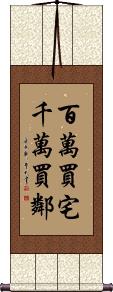
百万买宅千万买邻 is a Chinese proverb that literally translates as:
[It may cost a] million to buy a house, [but] ten million to find [good] neighbors.
Figuratively, this means:
Good neighbors are hard to find.
Good neighbors are even more important than the quality of one's house.
Every day is a good day
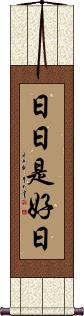
日日是好日 is an old Chinese and Japanese Buddhist proverb.
日日是好日 means “every day is a good day.”
In Japanese, it can be pronounced or romanized as “nichinichi kore koujitsu” or “hibi kore kōjitsu.”
Once in a Lifetime
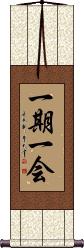
This Japanese title can be translated as “for this time only,” “chance meeting,” “one meeting, one opportunity,” “never again,” or “one chance in a lifetime.”
The characters literally mean “one time one meeting” - of course, the Kanji characters have meaning far beyond a direct translation like this.
Some might use this proverb to talk of an opportunity that presents itself just once in your life. It could also be a one-and-only chance meeting with your true soul mate. An expression of any event that might happen once in a lifetime.
This is primarily a Japanese title, however, there is also a Traditional Chinese (and old Korean) version of this proverb. Just the last character is different. The traditional form was used in Japan before WWII and in Korea prior to 1900. This title is somewhat known in China.
If you want the older traditional form, just click on the character to the right.
Peace and Good Health
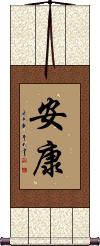
安康 means just what it says. It's a word that expresses both the idea of being at peace and healthy at the same time.
Note: 安康 is a bonafide word in Chinese and Korean, and the characters will at least make sense in Japanese.
Restoration to Good Health
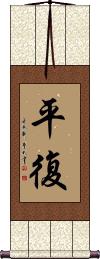
平復 is a Chinese and Japanese expression that means “to be cured,” “to be healed,” “restoration to health,” or “recovery from illness.”
In some contexts, it can mean “to pacify” or “to calm down.”
Seeing is Believing
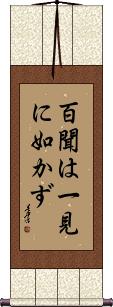
百聞は一見に如かず is the Japanese version of an ancient Chinese proverb that means “Seeing once is better than hearing one hundred times.”
It is the rough equivalent of “seeing is believing,” “one eye-witness is better than many hearsays,” or “a picture is worth a thousand words.”
Sometimes it's simply more prudent to verify with your own eyes.
Note: Because this selection contains some special Japanese Hiragana characters, it should be written by a Japanese calligrapher.
See Also: Hearing a Hundred Times is Not as Good as Seeing Once
Soldier of Fortune
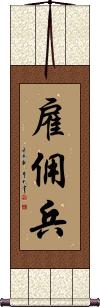
雇佣兵 is “soldier of fortune” in Chinese.
It can also be read as “mercenary” or “hired gun.”
Soldier of Fortune
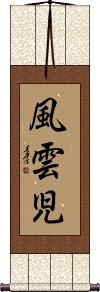
風雲児 is “soldier of fortune” in Japanese.
It can also be read as “lucky adventurer” or “adventurer who takes advantage of troubled times.”
Unselfish: Perfectly Impartial
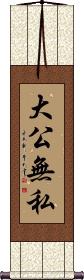
大公無私 is a Chinese proverb that comes from an old story from some time before 476 BC. About a man named Qi Huangyang, who was commissioned by the king to select the best person for a certain job in the Imperial Court.
Qi Huangyang selected his enemy for the job. The king was very confused by the selection, but Qi Huangyang explained that he was asked to find the best person for the job, not necessarily someone that he liked or had a friendship with.
Later, Confucius commented on how unselfish and impartial Qi Huangyang was by saying, “Da Gong Wu Si” which, if you look it up in a Chinese dictionary, is generally translated as “Unselfish” or “Just and Fair.”
If you translate each character, you'd have something like
“Big/Deep Justice Without Self.”
Direct translations like this leave out a lot of what the Chinese characters really say. Use your imagination, and suddenly you realize that “without self” means “without thinking about yourself in the decision” - together, these two words mean “unselfish.” The first two characters serve to drive the point home that we are talking about a concept that is similar to “blind justice.”
One of my Chinese-English dictionaries translates this simply as “just and fair.” So that is the short and simple version.
Note: This can be pronounced in Korean, but it's not a commonly used term.
See Also: Selflessness | Work Unselfishly for the Common Good | Altruism
Distinguish Good and Evil
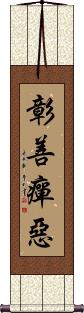
彰善癉惡 is a Chinese proverb that means “distinguish good and evil,” “uphold virtue and condemn evil,” “praise good and expose vice,” or “uphold good condemn evil.”
Wealth / Fortune / Riches / Abundance
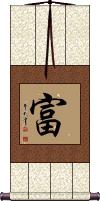
The title says it all; this word is clearly understood in Chinese and Japanese as well as Korean Hanja.
Wealth / Riches / Fortune
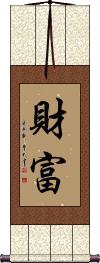
財富 means wealth or riches in Chinese.
Hanging this on your wall will label you as a “lover of money” or a “greedy person.” Order this only if you don't mind being seen in this light.
Work Unselfishly for the Common Good
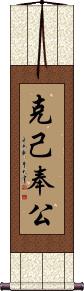
克己奉公 is a Chinese proverb that is often used to express how one should act as a government official. Most of us wish our public officials would hold themselves to higher standards. I wish I could send this scroll, along with the meaning to every member of Congress, and the President (or if I was from the UK, all the members of Parliament, and the PM)
This can also mean: “Place Strict Standards on Oneself in Public Service.”
The story behind this ancient Chinese idiom:
Cai Zun was born in China a little over 2000 years ago. In 24 AD, he joined an uprising led by Liu Xiu, who later became the emperor of the Eastern Han Dynasty.
Later, the new emperor put Cai Zun in charge of the military court. Cai Zun exercised his power in strict accordance with military law, regardless of the offender's rank or background. He even ordered the execution of one of the emperor's close servants after the servant committed a serious crime.
Cai Zun led a simple life but put great demands on himself to do all things honorably. The emperor rewarded him for his honest character and honorable nature by promoting him to the rank of General and granting him the title of Marquis.
Whenever Cai Zun would receive an award, he would give credit to his men and share the reward with them.
Cai Zun was always praised by historians who found many examples of his selfless acts that served the public interest.
Sometime long ago in history, people began to refer to Cai Zun as “ke ji feng gong.”
See Also: Unselfish | Selflessness | Altruism
This in-stock artwork might be what you are looking for, and ships right away...

Gallery Price: $31.00
Your Price: $16.88
Gallery Price: $65.00
Your Price: $39.88

Gallery Price: $90.00
Your Price: $49.88


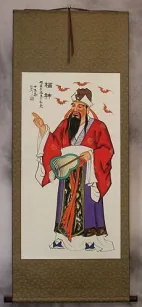
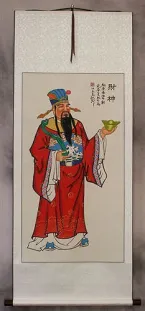
Gallery Price: $71.00
Your Price: $39.00
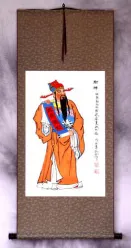
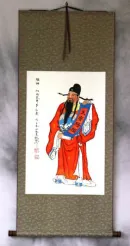
Gallery Price: $54.00
Your Price: $30.00
Gallery Price: $120.00
Your Price: $59.88
Gallery Price: $54.00
Your Price: $30.00
Gallery Price: $53.00
Your Price: $29.00
Gallery Price: $31.00
Your Price: $17.00
The following table may be helpful for those studying Chinese or Japanese...
| Title | Characters | Romaji (Romanized Japanese) | Various forms of Romanized Chinese | |
| Good Luck Good Fortune | 福 | fuku | fú / fu2 / fu | |
| House of Good Fortune | 福宅 | fú zhái / fu2 zhai2 / fu zhai / fuzhai | fu chai / fuchai | |
| Good Luck | 幸運 幸运 | kou un / kouun / ko un | xìng yùn / xing4 yun4 / xing yun / xingyun | hsing yün / hsingyün |
| Opportunity Good Luck | 機遇 机遇 | jī yù / ji1 yu4 / ji yu / jiyu | chi yü / chiyü | |
| 100 Years of Happy Marriage | 百年好合 | bǎi nián hǎo hé bai3 nian2 hao3 he2 bai nian hao he bainianhaohe | pai nien hao ho painienhaoho |
|
| Even a fool may sometimes come up with a good idea | 千慮一得 千虑一得 | senryonoittoku | qiān lǜ yī dé qian1 lv4 yi1 de2 qian lv yi de qianlvyide | ch`ien lü i te chienlüite chien lü i te |
| Year-In Year-Out Have Abundance | 年年有餘 年年有馀 | nián nián yǒu yú nian2 nian2 you3 yu2 nian nian you yu niannianyouyu | nien nien yu yü niennienyuyü |
|
| Abundance Prosperous | 富裕 | fu yuu / fuyuu / fu yu | fù yù / fu4 yu4 / fu yu / fuyu | fu yü / fuyü |
| Abundance and Prosperity | 繁榮富裕 繁荣富裕 | hanei yuuhuku haneiyuuhuku hanei yuhuku | fán róng fù yù fan2 rong2 fu4 yu4 fan rong fu yu fanrongfuyu | fan jung fu yü fanjungfuyü |
| 1000 good moves ruined by 1 bad | 不怕千招會隻怕一招熟 不怕千招会只怕一招熟 | bú pà qiān zhāo huì zhǐ pà yī zhāo shú bu2 pa4 qian1 zhao1 hui4 zhi3 pa4 yi1 zhao1 shu2 bu pa qian zhao hui zhi pa yi zhao shu | pu p`a ch`ien chao hui chih p`a i chao shu pu pa chien chao hui chih pa i chao shu |
|
| Beauty Beautiful Handsome | 美 | bi | měi / mei3 / mei | |
| Extremely Good Friends | 莫逆の友 | bakugyakunotomo | ||
| Blessings and Good Wishes | 祝福 | shukufuku | zhù fú / zhu4 fu2 / zhu fu / zhufu | chu fu / chufu |
| Bright and Promising Future | 明るい未来 | akarui mirai akaruimirai | ||
| The Foundation of Good Conduct | 誌于道據于德依于仁遊于藝 志于道据于德依于仁游于艺 | zhì yú dào jù yú dé yī yú rén yóu yú yì zhi4 yu2 dao4 ju4 yu2 de2 yi1 yu2 ren2 you2 yu2 yi4 zhi yu dao ju yu de yi yu ren you yu yi | chih yü tao chü yü te i yü jen yu yü i | |
| Courage to do what is right | 見義勇為 见义勇为 | jiàn yì yǒng wéi jian4 yi4 yong3 wei2 jian yi yong wei jianyiyongwei | chien i yung wei chieniyungwei |
|
| Destiny Fate | 命 | inochi / mei | mìng / ming4 / ming | |
| Fate Chance Meeting | 緣份 / 緣分 缘份 / 缘分 | yuán fèn / yuan2 fen4 / yuan fen / yuanfen | yüan fen / yüanfen | |
| Destiny Fate | 運命 运命 | un mei / unmei | yùn mìng / yun4 ming4 / yun ming / yunming | yün ming / yünming |
| Dragon and Phoenix Brings Luck | 龍鳳呈祥 龙凤呈祥 | lóng fèng chéng xiáng long2 feng4 cheng2 xiang2 long feng cheng xiang longfengchengxiang | lung feng ch`eng hsiang lungfengchenghsiang lung feng cheng hsiang |
|
| Eat Drink and Be Merry | 喫喝玩樂及時行樂 吃喝玩乐及时行乐 | chī hē wán lè jí shí xíng lè chi1 he1 wan2 le4 ji2 shi2 xing2 le4 chi he wan le ji shi xing le chihewanlejishixingle | ch`ih ho wan le chi shih hsing le chih ho wan le chi shih hsing le |
|
| A Bright Future | 鵬程萬里 鹏程万里 | péng chéng wàn lǐ peng2 cheng2 wan4 li3 peng cheng wan li pengchengwanli | p`eng ch`eng wan li pengchengwanli peng cheng wan li |
|
| Fortune favors the brave | 勇者は幸運に恵まれる | yuusha ha kouun ni megumareru yusha ha koun ni megumareru | ||
| Fortune Favors The Brave | 命運鐘情於勇士 命运钟情于勇士 | mìng yùn zhōng qíng yú yǒng shì ming4 yun4 zhong1 qing2 yu2 yong3 shi4 ming yun zhong qing yu yong shi | ming yün chung ch`ing yü yung shih ming yün chung ching yü yung shih |
|
| Fortune Favors the Bold | 幸運眷顧勇敢的人 幸运眷顾勇敢的人 | xìng yùn juàn gù yǒng gǎn de rén xing4 yun4 juan4 gu4 yong3 gan3 de ren2 xing yun juan gu yong gan de ren | hsing yün chüan ku yung kan te jen | |
| Fragrant Good Smell | 香 | ka / kou / ka / ko | xiāng / xiang1 / xiang | hsiang |
| Gentleness | 溫厚 温厚 | on kou / onkou / on ko | wēn hòu / wen1 hou4 / wen hou / wenhou | |
| God is Good | 神真美好 | shén zhēn měi hǎo shen2 zhen1 mei3 hao3 shen zhen mei hao shenzhenmeihao | shen chen mei hao shenchenmeihao |
|
| God is Good | 神は善である | kami wa zendearu kamiwazendearu | ||
| Goodness | 良善 | ryouzen / ryozen | liáng shàn liang2 shan4 liang shan liangshan | |
| Goodbye | 再見 再见 | shai chien / shaichien | zài jiàn / zai4 jian4 / zai jian / zaijian | tsai chien / tsaichien |
| One Good Deed Each Day | 一日一善 | ichi nichi ichi zen ichinichiichizen | yī rì yī shàn yi1 ri4 yi1 shan4 yi ri yi shan yiriyishan | i jih i shan ijihishan |
| Good and Evil | 善悪不二 | zenakufuni | ||
| Good Good Study, Day Day Up | 好好學習天天向上 好好学习天天向上 | hǎo hǎo xué xí tiān tiān xiàng shàng hao3 hao3 xue2 xi2 tian1 tian1 xiang4 shang4 hao hao xue xi tian tian xiang shang | hao hao hsüeh hsi t`ien t`ien hsiang shang hao hao hsüeh hsi tien tien hsiang shang |
|
| Good Health | 健康 | kenkou / kenko | jiàn kāng jian4 kang1 jian kang jiankang | chien k`ang chienkang chien kang |
| Good Health Healthy Vigor | 康 | kou / ko | kāng / kang1 / kang | k`ang / kang |
| Good Heart | 善心 | yoshinaka | shàn xīn / shan4 xin1 / shan xin / shanxin | shan hsin / shanhsin |
| Good Intentions | 好意 | kou i / koui / ko i | hǎo yì / hao3 yi4 / hao yi / haoyi | hao i / haoi |
| Good Intentions Good Will Good Faith | 善意 | zen i / zeni | shàn yì / shan4 yi4 / shan yi / shanyi | shan i / shani |
| The Good Life Beautiful Life | 美好的生活 | měi hǎo de shēng huó mei3 hao3 de sheng1 huo2 mei hao de sheng huo meihaodeshenghuo | mei hao te sheng huo meihaoteshenghuo |
|
| Good Night | 晚安 | wǎn ān / wan3 an1 / wan an / wanan | ||
| Good Night | お休み | oyasumi | ||
| In Good Order | 整 | hitoshi / hitoshi | zhěng / zheng3 / zheng | cheng |
| In Good Order Organized | 整然 | seizen | ||
| Good Conduct | 善行 | zenkou / zenko | shàn xíng shan4 xing2 shan xing shanxing | shan hsing shanhsing |
| Doing good is the greatest source of happiness | 為善最樂 为善最乐 | wéi shàn zuì lè wei2 shan4 zui4 le4 wei shan zui le weishanzuile | wei shan tsui le weishantsuile |
|
| Goodness Good Deed | 善 | zen | shàn / shan4 / shan | |
| Lucky Auspicious Good Omen | 瑞 | zui | ruì / rui4 / rui | jui |
| Happiness Fortune Lucky | 幸 | saki / sachi / rei / rē | xìng / xing4 / xing | hsing |
| Hearing a Hundred Times is Not as Good as Seeing Once | 百聞不如一見 百闻不如一见 | bǎi wén bù rú yī jiàn bai3 wen2 bu4 ru2 yi1 jian4 bai wen bu ru yi jian baiwenburuyijian | pai wen pu ju i chien paiwenpujuichien |
|
| Safety and Well-Being of the Family | 家內安全 家内安全 | ka nai an zen kanaianzen | ||
| A Life of Happiness and Prosperity | 幸福成功的一生 | xìng fú chéng gōng de yì shēng xing4 fu2 cheng2 gong1 de yi4 sheng1 xing fu cheng gong de yi sheng xingfuchenggongdeyisheng | hsing fu ch`eng kung te i sheng hsingfuchengkungteisheng hsing fu cheng kung te i sheng |
|
| A Life of Happiness and Prosperity | 幸福と繁栄の人生 | kou fuku to ha nei no jin sei koufukutohaneinojinsei ko fuku to ha nei no jin sei | ||
| Life is Good Life is Beautiful | 人生は素晴らしい | jinsei wa subarashii jinseiwasubarashii jinsei wa subarashi | ||
| Life is Good Life is Beautiful | 生活美好 | shēng huó měi hǎo sheng1 huo2 mei3 hao3 sheng huo mei hao shenghuomeihao | ||
| Life is Good | 人生良好 | jin sei ryou kou jinseiryoukou jin sei ryo ko | rén shēng liáng hǎo ren2 sheng1 liang2 hao3 ren sheng liang hao renshenglianghao | jen sheng liang hao jenshenglianghao |
| Life is Good | 生活是美好的 | shēng huó shì měi hǎo de sheng1 huo2 shi4 mei3 hao3 de sheng huo shi mei hao de shenghuoshimeihaode | sheng huo shih mei hao te shenghuoshihmeihaote |
|
| Live in Prosperity | 生活于繁榮中 生活于繁荣中 | shēng huó yú fán róng zhōng sheng1 huo2 yu2 fan2 rong2 zhong1 sheng huo yu fan rong zhong shenghuoyufanrongzhong | sheng huo yü fan jung chung shenghuoyüfanjungchung |
|
| Lucky Auspicious | 吉 | kichi | jí / ji2 / ji | chi |
| A House Might be Worth 1 Million Dollars, But Good Neighbors are Worth 10 Million | 百萬買宅千萬買鄰 百万买宅千万买邻 | bǎi wàn mǎi zhái qiān wàn mǎi lín bai3 wan4 mai3 zhai2 qian1 wan4 mai3 lin2 bai wan mai zhai qian wan mai lin | pai wan mai chai ch`ien wan mai lin pai wan mai chai chien wan mai lin |
|
| Every day is a good day | 日日是好日 | nichinichi kore koujitsu nichinichikorekoujitsu nichinichi kore kojitsu | rì rì shì hǎo rì ri4 ri4 shi4 hao3 ri4 ri ri shi hao ri ririshihaori | jih jih shih hao jih jihjihshihhaojih |
| Once in a Lifetime | 一期一會 一期一会 | ichigo ichie ichigoichie | yī qī yī huì yi1 qi1 yi1 hui4 yi qi yi hui yiqiyihui | i ch`i i hui ichiihui i chi i hui |
| Peace and Good Health | 安康 | ān kāng / an1 kang1 / an kang / ankang | an k`ang / ankang / an kang | |
| Restoration to Good Health | 平復 平复 | byou fuku / byoufuku / byo fuku | píng fù / ping2 fu4 / ping fu / pingfu | p`ing fu / pingfu / ping fu |
| Seeing is Believing | 百聞は一見に如かず | hyakubun wa ikken ni shikazu hyakubunwaikkennishikazu hyakubun wa iken ni shikazu | ||
| Soldier of Fortune | 雇佣兵 | gù yōng bīng gu4 yong1 bing1 gu yong bing guyongbing | ku yung ping kuyungping |
|
| Soldier of Fortune | 風雲児 | fuu un ji / fuuunji / fu un ji | ||
| Unselfish: Perfectly Impartial | 大公無私 大公无私 | dà gōng wú sī da4 gong1 wu2 si1 da gong wu si dagongwusi | ta kung wu ssu takungwussu |
|
| Distinguish Good and Evil | 彰善癉惡 彰善瘅恶 | zhāng shàn dàn è zhang1 shan4 dan4 e4 zhang shan dan e zhangshandane | chang shan tan o changshantano |
|
| Wealth Fortune Riches Abundance | 富 | tomi | fù / fu4 / fu | |
| Wealth Riches Fortune | 財富 财富 | cái fù / cai2 fu4 / cai fu / caifu | ts`ai fu / tsaifu / tsai fu | |
| Work Unselfishly for the Common Good | 克己奉公 | kè jǐ fèng gōng ke4 ji3 feng4 gong1 ke ji feng gong kejifenggong | k`o chi feng kung kochifengkung ko chi feng kung |
|
| In some entries above you will see that characters have different versions above and below a line. In these cases, the characters above the line are Traditional Chinese, while the ones below are Simplified Chinese. | ||||



