Seeking the word for Life in Chinese or Japanese?
Want a word that means the essence of life and existence?
You've come to the right place...
Quick links to words on this page...


This word is hard to define. One dictionary defines this as, "acceptance of fate and happy about it". There is one rare English word equivalent which is sanguinity.
You can also say that this means, "Be happy with whatever Heaven provides", or "Find happiness in whatever fate Heaven bestows upon you". This is kind of a way to suggest being an optimist in life.
Note: This is sometimes used as a given name in China.


This is the word that means alive, as in the state of living or being alive (Chinese only).

This Chinese word means "to be born" and "to give birth". Also it's often used to refer to life itself, and sometimes "to grow".
This character is used in a lot of compound words such as "yi sheng", which means "doctor" (literally "healer of life"), "sheng ri" which means "birthday" (literally "birth day") and "xue sheng" which means student (literally "studying life" or "learner [about] life"). Few Chinese people will think of the literal meaning when this use words like doctor and student - but it is interesting to note.
This character has the same root meaning in Korean Hanja and Japanese. However, in Japanese, there are many possible pronunciations, and this can be used to mean "raw" or "unprocessed" (as in draft beer). Therefore, not be the best if your audience is Japanese.
See Also... Vitality


This is the closest and most natural way to express this idea in Chinese.
The first two characters mean "to seize" but can also be translated as "take control of".
The last two characters mean "today".


These are the last two words from John 3:16 in the Chinese Union Bible.
Although not specifically Christian, this is the way to express ever-lasting life or eternal life in Chinese.
In Japanese this can either mean eternal life or immortality.
See Also... Eternity | Rebirth | Reincarnation | Immortality


This word can be used in many different ways. It is often used to express the next life (life in heaven or wherever your soul is bound for). So it does have a religious overtone. However, it can also be used to express your life in the future - perhaps during your present lifetime. It can also be translated as "the next world", "the next generation", "the time that is to come", "otherworld", or simply "posterity".
See Also... Eternity | Rebirth | Reincarnation | Immortality


This simply means everyday life or regular life. You can also translate it as "Living day to day".


This is a kind of complex ten-character proverb composed by Zhuge Liang about 1800 years ago. The proverb means "Leading a simple life will yield a clear mind, and having inner peace will help you see far (into the world)".
What I have translated as "simple life" means NOT being materialistic and NOT competing in the rat race.
The last word means "far", but the deeper meaning is that you will surpass what you can currently see or understand. Perhaps even the idea of opening up vast knowledge and understanding of complex ideas.
The whole phrase has a theme that suggests if you are NOT an aggressive cut-throat person who fights his way to the top no matter how many people he crushes on the way, and instead seek inner peace, you will have a happier existence and be more likely to understand the meaning of life.
See Also... Serenity


This title suggests that you have, or want to get your life in balance.
The first two characters regard the idea of balance, harmony, and peace.
The second two characters mean "life". More specifically this refers to your livelihood, career, and the daily activities that comprise your life or living. Some would translate those two characters as "one's daily existence".
Note: We have a couple of titles for this idea. This version is more of a noun, thus "The Balanced Life" verses a verb form like "Balancing [Your] Life".
The art of balancing your life
Mandarin: píng héng rén shēng
Japanese: hei kou jin sei


This title suggests that you are actively trying to keep your life in balance. Think of this as being the action-verb of seeking or having a balanced life.
The first two characters mean balance, equilibrium or keeping things equal.
The last two characters mean "life". Literally "human life".
Note: This can be pronounced in Japanese, but this title has not been confirmed by our Japanese translator.

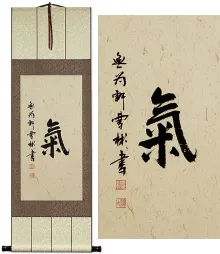
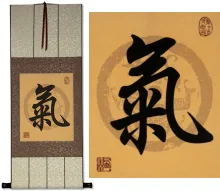
Qi which is also Romanized as Chi in Chinese or Ki in Japanese, is a fundamental concept of traditional Asian culture. Qi is believed to be part of everything that exists, as in “life force” or “spiritual energy”. It is most often translated as “energy flow,” or literally as “air” or “breath”.
The character itself is a representation of steam (or breath) rising from rice.
This was apparently seen as the release of energy from the rice when this concept was first developed. To clarify, the character for rice is shown to the right. The Qi / Chi / Ki character is still used in compound words to mean steam or vapor.
The idea of Qi / Chi / Ki is really a philosophical concept. It's often used to refer to the “flow” of metaphysical energy that sustains living beings. Yet there is much debate that has continued for thousands of years as to whether Qi / Chi / Ki is pure energy, or consists partially, or fully of matter.
You can also see the character for Qi / Chi / Ki in common compound words such as Tai Chi / Tai Qi, Aikido, Reiki and Qi Gong / Chi Kung.
In the modern Japanese Kanji, the rice radical has been changed into two strokes that form an X.
The original and traditional Chinese form is still understood in Japanese, but we can also offer that modern Kanji form in our custom calligraphy. If you want this Japanese Kanji, please click on the character to the right, instead of the “Select and Customize” button above.
More language notes: This is pronounced like “chee” in Mandarin Chinese, and like “key” in Japanese.
This is also the same way to write this in Korean Hanja where it is Romanized as “gi” and pronounced like “gee”, but with a real G-sound, not a J-sound.
Though Vietnamese no longer use Chinese characters in their daily language, this character is still widely known in Vietnam.


This Chinese, Korean and Japanese word means "life force" or simply "life". The first character means "life" or "birth". The second means "life" or "fate". Together they create the meaning of "life force", though some will translate this as "existence" and sometimes "vitality".


No matter what happens, life goes on. For better or worse, life goes one. This is the basic idea behind this modern Chinese phrase which literally says "Life goes on" in these five characters.
A further explanation of this phrase can now be found on our forum here: Life Goes On in Chinese, explained.


Characters shown
above are read
vertically, starting
from the right
This means, "A life of happiness and prosperity" or "A life of happiness and success". It's a great and very positive and inspirational wall scroll selection.
See Also... Prosperity


Characters shown
above are read
vertically, starting
from the right
This phrase means "Life is a Journey".
If this matches your philosophy, this might be the perfect Chinese calligraphy for you.


Characters shown
above are read
vertically, starting
from the right
This literally translates as: [Even a] hundred-year-old [person] is [just a] traveler passing by.
The simple message is, "Human life is short". Of course, there is an unspoken suggestion that you should make the best of the time you have here on earth.


This means life, living, to live, or the state of being alive. It can also refer to your daily existence or livelihood.
This is also the term used in other titles such as "healthy living" or Lance Armstrong's "Livestrong" campaign (Chinese title for Livestrong only).
If you need a reminder that you are alive, and to take a breath, this might be the perfect wall scroll for you.


This is not really an eastern concept, so it does not translate into a phrase that seems natural on a wall scroll. However, if this is your philosophy, the characters shown here do capture your idea of living for today or living in the moment. These characters literally say "Live in today" and they are grammatically correct in Chinese.
Note: This kind of makes sense in Korean Hanja, but the grammar is Chinese, so it's not that natural in Korean.


This Japanese phrase can be translated as "live for the day", "live for the moment", "seize the day", or "make the most of the present".


This is how to say "live without regrets" in Mandarin Chinese. This also makes sense in Japanese, but I don't yet have the pronunciation info.
See Also... Live For Today
A wish for a long and prosperous life
Mandarin: fú rú dōng hǎi shòu bǐ nán shān


This is a phrase that means "May you have good fortune as great as the eastern oceans, and may your life last as long as the southern mountains".
In ancient Chinese mythology, the eastern oceans and southern mountains are where God resides (basically it is the same as saying "heaven"). So it's like saying, "May your good fortune and life be as vast as the heavens".
There is also a longer, 14-character version of this phrase. Also, this can be cut into two scrolls (with half the phrase on each side - great for hanging on either side of a doorway). Just let me know if you'd like a special version (there is an additional cost).


Used as a noun, this word means "longevity" or "the ability to live long". It can also be an adjective meaning "long lived".
Please note that Japanese use a simplified version of the second character of longevity - it also happens to be the same simplification used in mainland China. Click on the character to the right if you want the Japanese/Simplified version of this two-character longevity calligraphy.

Can be defined as "long life" or "longevity" in the simplest form.
Please note that Japanese use a simplified version of this character - it also happens to be the same simplification used in mainland China. Click on the character to the right if you want the Japanese/Simplified version.


This word can be used for motivation - it can also mean power / motion / propulsion / force. It can be anything internal or external that keeps you going.
This is the safest way to express motivation in Chinese. If your audience is Japanese, please see the other entry for motivation. This is a word in Japanese and Korean, but it means "motive power" or "kinetic energy" (without the motivation meaning that you are probably looking for).
See Also... Enthusiasm | Passion
Persistence to overcome all challenges
Mandarin:
bǎi zhé bù náo
Japanese:
hyaku setsu su tou
Korean: 백절불요


This phrase means "Be undaunted in the face of repeated setbacks".
It comes from a long, and occasionally tragic story of a man that lived sometime around 25-220 AD. His name was Qiao Xuan and he never stooped to flattery, but remained an upright person at all times. He fought to expose corruption of higher-level government officials at great risk to himself.
Then when he was at a higher level in the Imperial Court, bandits were regularly capturing hostages and demanding ransoms. But when his own son was captured, he was so focused on his duty to the Emperor and common good that he sent a platoon of soldiers to raid the bandits' hideout, and stop them once and for all even at the risk of his own son's life. While all of the bandits were arrested in the raid, they killed Qiao Xuan's son at first sight of the raiding soldiers.
Near the end of his career a new Emperor came to power, and Qiao Xuan reported to him that one of his ministers was bullying the people and extorting money from them. The new Emperor refused to listen to Qiao Xuan and even promoted the corrupt Minister. Qiao Xuan was so disgusted that in protest he resigned his post as minister (something almost never done) and left for his home village.
His tombstone reads "Bai Zhe Bu Nao" which is now a phrase used in Chinese culture to describe a person of strong will who puts up stubborn resistance against great odds.
My Chinese-English dictionary defines these 4 characters as, "keep on fighting in spite of all setbacks", "be undaunted by repeated setbacks" and "be indomitable".
Our translator says it can mean, "never give up" in modern Chinese.
Although the first two characters are translated correctly as "repeated setbacks", the literal meaning is "100 setbacks" or "a rope that breaks 100 times". The last two characters can mean "do not yield" or "do not give up".
Most Chinese, Japanese, and Korean people will not take this absolutely literal meaning, but will instead understand it as the title suggests above.
See Also... Tenacity | Fortitude | Strength | Perseverance


This means "principles of life" or "The personal obligations and rules that you live by". For instance, if you were a vegetarian, the act of not eating meat fits into this category.
This could also be translated as "Way of living".


This means sacrifice in Chinese, Japanese Kanji, and old Korean Hanja.
There is a suggestion in this word that this regards sacrificing your life.


This word can mean "vitality" or "libido". The first two characters mean "life" or "life force". The last character is a common word that means "strength". So together you get the meaning "life strength" which is the essence of vitality. Some will also translate this word as "good health".
See Also... Health
Wall scroll artwork shown on this page is priced as follows:
1 character $29.88 each
2-3 characters $39.88 each
4 characters $49.88 each
5-10 characters $59.88 each
After you select your calligraphy, our website will take you through the process of customizing your artwork.
Options for other mounting such as portraits are available for $13 less.
We also offer the services of a famous master calligrapher for a $40 fee on any scroll if you are looking for investment-quality calligraphy.
If you chose our famous master-calligrapher, you also get more choices for silk and paper colors and the option for larger artwork.
All of our calligraphy is completely done by hand in the ancient way.
When the calligrapher finishes creating your artwork, it is taken to our art mounting workshop in Beijing where a wall scroll is made by hand from a combination of silk, rice paper, and wood.
After we create your wall scroll, it takes at least two weeks for air mail delivery from Beijing to you.
Therefore, allow at least 3 weeks for delivery from the time you place your order.
When you select your calligraphy, you'll be taken to another page where you can choose various custom options.
The scroll that I am holding in this picture is a "regular size"
4-character wall scroll.
As you can see, it is a great size to hang on your wall.
(We also offer custom wall scrolls in larger sizes)
Professional calligraphers are getting to be hard to find these days.
Instead of drawing characters by hand, the new generation in China merely type roman letters into their computer keyboards and pick the character that they want from a list that pops up.
There is some fear that true Chinese calligraphy may become a lost art in the coming years. Many art institutes in China are now promoting calligraphy programs in hopes of keeping this unique form
of art alive.
Even with the teachings of a top-ranked calligrapher in China, my calligraphy will never be good enough to sell. I will leave that to the experts.
The same calligrapher who gave me those lessons also attracted a crowd of thousands and a TV crew as he created characters over 6-feet high. He happens to be ranked as one of the top 100 calligraphers in all of China. He is also one of very few that would actually attempt such a feat.
The following table is only helpful for those studying Chinese (or Japanese), and perhaps helps search engines to find this page when someone enters Romanized Chinese or Japanese
| Title | Characters Simplified Traditional |
Japanese Romaji (Romanized Japanese) | Various forms of Hanyu-Pinyin (Romanized Chinese) | |||
| Acceptance of Fate / Happy With Your Fate | 乐天 樂天 | n/a | lè tiān le tian | le4 tian1 letian | ||
| Alive | 活着 活著 | n/a | huó zhe huo zhe | huo2 zhe huozhe | ||
| Birth / Life | 生 生 | shou / iku shou/iku sho / iku | shēng sheng | sheng1 sheng | ||
| Carpe Diem / Seize the Day | 把握今日 把握今日 | n/a | bǎ wò jīn rì ba wo jin ri | ba3 wo4 jin1 ri4 bawojinri | ||
| Eternal Life / Everlasting Life / Immortality | 永生 永生 | eisei | yǒng shēng yong sheng | yong3 sheng1 yongsheng | ||
| Eternal Life / Future Life | 来世 來世 | rai-se | lái shì lai shi | lai2 shi4 laishi | ||
| Everyday Life | 日常生活 日常生活 | nichi jou sei katsu nichijouseikatsu nichi jo sei katsu | rì cháng shēng huó ri chang sheng huo | ri4 chang2 sheng1 huo2 richangshenghuo | ||
| A Life of Serenity Yields Understanding | 淡泊以明志宁静而致远 淡泊以明志寧靜而致遠 | n/a | dàn bó yǐ míng zhì, níng jìng ér zhì yuǎn dan bo yi ming zhi, ning jing er zhi yuan | dan4 bo2 yi3 ming2 zhi4, ning2 jing4 er2 zhi4 yuan3 | ||
| Life in Harmony / The Balanced Life | 和谐生活 和諧生活 | n/a | hé xié shēng huó he xie sheng huo | he2 xie2 sheng1 huo2 hexieshenghuo | ||
| Life in Balance / Balancing Life | 平衡人生 平衡人生 | hei kou jin sei heikoujinsei hei ko jin sei | píng héng rén shēng ping heng ren sheng | ping2 heng2 ren2 sheng1 pinghengrensheng | ||
| Life Energy / Spiritual Energy | 气 / 気 氣 | ki | qì qi | qi4 qi | ||
| Life Force | 生命 生命 | seimei / inochi seimei/inochi | shēng mìng sheng ming | sheng1 ming4 shengming | ||
| Life Goes On | 生活在继续 生活在繼續 | n/a | shēng huó zài jì xù sheng huo zai ji xu | sheng1 huo2 zai4 ji4 xu4 shenghuozaijixu | ||
| A Life of Happiness and Prosperity | 幸福而成功的一生 倖福而成功的一生 | n/a | xìng fú ér chéng gōng de yì shēng xing fu er cheng gong de yi sheng | xing4 fu2 er2 cheng2 gong1 de yi4 sheng1 | ||
| Life is a Journey | 人生是一段旅程 人生是一段旅程 | n/a | rén shēng shì yí duàn lǚ chéng ren sheng shi yi duan lv cheng | ren2 sheng1 shi4 yi2 duan4 lv3 cheng2 renshengshiyiduanlvcheng | ||
| Life is Short | 百岁光阴如过客 百歲光陰如過客 | n/a | bǎi suì guāng yīn rú guò kè bai sui guang yin ru guo ke | bai3 sui4 guang1 yin1 ru2 guo4 ke4 baisuiguangyinruguoke | ||
| Life / Living / Live | 生活 生活 | sei katsu seikatsu | shēng huó sheng huo | sheng1 huo2 shenghuo | ||
| Live For The Day | 活在今天 活在今天 | n/a | huó zài jīn tiān huo zai jin tian | huo2 zai4 jin1 tian1 huozaijintian | ||
| Live For The Day / Seize The Day | 今を生きる 今を生きる | ima wo i ki ru imawoikiru | n/a | |||
| Live Without Regret | 生而无悔 生而無悔 | n/a | shēng ér wú huǐ sheng er wu hui | sheng1 er2 wu2 hui3 shengerwuhui | ||
| Longevity / Long Life Wishes | 福如东海寿比南山 福如東海壽比南山 | n/a | fú rú dōng hǎi shòu bǐ nán shān fu ru dong hai shou bi nan shan | fu2 ru2 dong1 hai3 shou4 bi3 nan2 shan1 furudonghaishoubinanshan | ||
| Longevity / Long Life | 长寿 長壽 | chouju choju | cháng shòu chang shou | chang2 shou4 changshou | ||
| Longevity / Long Life | 寿 壽 | ju / kotobuki ju/kotobuki | shòu shou | shou4 shou | ||
| Motivation | 动力 動力 | douryoku doryoku | dòng lì dong li | dong4 li4 dongli | ||
| Undaunted After Repeated Setbacks | 百折不挠 百折不撓 | hyaku setsu su tou hyakusetsusutou hyaku setsu su to | bǎi zhé bù náo bai zhe bu nao | bai3 zhe2 bu4 nao2 baizhebunao | ||
| Principles of Life | 生活信条 生活信條 | n/a | shēng huó xìn tiáo sheng huo xin tiao | sheng1 huo2 xin4 tiao2 shenghuoxintiao | ||
| Sacrifice | 牺牲 犧牲 | gi sei gisei | xī shēng xi sheng | xi1 sheng1 xisheng | ||
| Vitality | 生命力 生命力 | seimeiryoku | shēng mìng lì sheng ming li | sheng1 ming4 li4 shengmingli | ||
| If you have not set up your computer to display Chinese, the characters in this table probably look like empty boxes or random text garbage.
This is why we spent hundreds of hours making images so that you could view the characters in the "Life Force" listings above. If you want your Windows computer to be able to display Chinese characters you can either head to your Regional and Language options in your Win XP control panel, select the [Languages] tab and click on [Install files for East Asian Languages]. This task will ask for your Win XP CD to complete in most cases. If you don't have your Windows XP CD, or are running Windows 98, you can also download/run the simplified Chinese font package installer from Microsoft which works independently with Win 98, ME, 2000, and XP. It's a 2.5MB download, so if you are on dial up, start the download and go make a sandwich. | ||||||
All custom calligraphy items are made-to-order in our little Beijing artwork-mounting workshop.
Normal delivery isjust over 3 weeksfor these handmade items.
Copyright Oriental Outpost 2002-2009 - All Rights Reserved
Image Use Policy | Privacy Policy