Custom Moral Chinese & Japanese Calligraphy Wall Scroll
We have many options to create artwork with Moral characters on a wall scroll or portrait.
If you want to create a cool Moral wall scroll, this is the place. Below you will find a few Asian symbols that express the idea of moral.
1. 4. Right Action / Perfect Conduct
2. You are who you hang out with
3. The Five Tenets of Confucius
5. Ethics / Ethical / Morality
6. Good Heart
9. Katsu Hayabi
12. Where There is a Will, There is a Way
14. Self-Improvement
4. Right Action / Perfect Conduct
Samyak Karmanta / Samma Kammanta
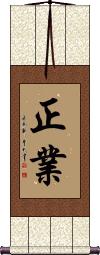
正業 is one of the Noble Eightfold Paths of Buddhism. Right Action, along with Right Speech and Right Living, constitute the path to Virtue.
The five precepts of Right Action are...
1. Refrain from destroying living beings (no murder or any form of taking a life).
2. Refrain from stealing.
3. Refrain from sexual misconduct (adultery, rape, etc.).
4. Refrain from false speech (lying or trickery).
5. Refrain from intoxicants that lead to heedlessness (no drugs or alcohol).
This concept can be summarized as “Avoidance of actions that conflict with moral discipline.”
Note: In Japanese, when read by a non-Buddhist, this will mean “the right job/vocation.”
This term is exclusively used by devout Buddhists. It is not a common term, and is remains an unknown concept to most Japanese and Chinese people.
See Also: Buddhism | Enlightenment | Noble Eightfold Path
You are who you hang out with
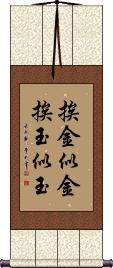
金似金挨玉似玉 is a Chinese proverb that literally translates as: [One who is] close to gold [is] like gold [and one who is] close to jade [is] like jade.
Figuratively, this means:
A good environment produces good people.
People are influenced by the company they keep.
Basically, if you hang out with good people, you are likely to become or stay good yourself. The opposite also is true. 挨This is like the moral version of “You are what you eat.”
Note: In Japanese, they have a similar phrase, 類は友を呼ぶ (rui wa tomo o yobu) Birds of a feather flock together. However, this is not a good meaning, so we’re not offering it for wall scrolls.
The Five Tenets of Confucius
The Five Cardinal Rules / Virtues of Confucius
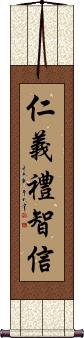
仁義禮智信 are the core of Confucius's philosophy.
Simply stated:
仁 = Benevolence / Charity
義 = Justice / Rectitude
禮 = Courtesy / Politeness / Tact
智 = Wisdom / Knowledge
信 = Fidelity / Trust / Sincerity
Many of these concepts can be found in various religious teachings. It should be clearly understood that Confucianism is not a religion but should instead be considered a moral code for a proper and civilized society.
This title is also labeled “5 Confucian virtues.”
 If you order this from the Japanese calligrapher, expect the middle Kanji to be written in a more simple form (as seen to the right). This can also be romanized as "jin gi rei satoshi shin" in Japanese. Not all Japanese will recognize this as Confucian tenets but they will know all the meanings of the characters.
See Also: Confucius Teachings | Ethics
Courageous Spirit
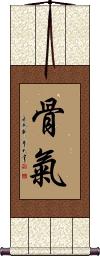
骨氣 is a Chinese title that means “unyielding character,” “courageous spirit,” “integrity,” or “moral backbone.”
Ethics / Ethical / Morality
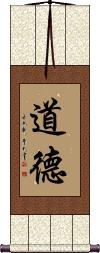
道德 is a Chinese, Japanese, and old Korean word that can also be defined as “moral principles,” morality, ethics, ethical, morals, or virtue.
The first character is the same that is associated with Daoism / Taoism. This word is also used to express morality, virtue, or simply morals.
 There is a slight deviation in the Japanese Kanji form. If you want the modern Japanese version, please click on the special Kanji shown to the right instead of the button above. Note that the traditional Chinese form is still readable and understood by Japanese people.
Good Heart
A heart of kindness, benevolence, and virtuous intentions
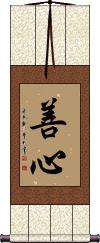
善心 literally reads “Good Heart” but is used to refer to the ideas of kindness, benevolence, philanthropy, virtuous intentions, moral sense, and conscience.
Some will also translate this as the morality of mind (as the character for the heart is often used to mean mind).
In Japanese, this can be the given name Yoshinaka.
Goodness / Good Deed
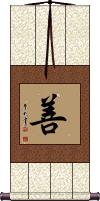
善 means goodness, virtue, good deed, charitable, benevolent, well-disposed, nice, pleasant, kind, or simply, “good.”
善 is the kind of good that applies to someone's good character, or a good person in general.
Referring to someone with this word means that they have a well-aimed moral compass, and are charitable, giving, wise, and honest. Basically, this is a blanket statement for every good trait a human can have or all the things that make someone good.
In another context, it can mean to improve or perfect something or refer to someone who is good at something.
Heart / Mind / Spirit
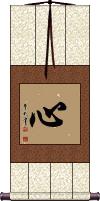
心 would often be translated as “heart.”
However, because it was believed in Chinese culture for thousands of years that your consciousness and thoughts came from the big red organ in the middle of your chest, it also means “mind” or “spirit” and sometimes even “soul.”
In Korean, beyond heart, mind, and spirit, this character can mean moral, nature, mind, affections, intentions, core, and center. In fact, it is used in Chinese to mean “center” as well but only with another character in front of it. For instance, “medical center” or even “shopping center.” Separately and alone, it will not be read with that “center” meaning unless thought of as “the center of your soul.”
Katsu Hayabi
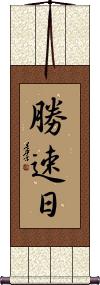
Katsu Hayabi or 勝速日 means victory at the speed of light.
勝速日 is a highly developed state in which an Aikido practitioner has reached spiritual and moral perfection.
Moral and Virtuous
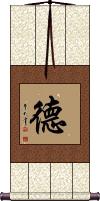
德 is the simple way to express the ideas of having virtue, morals, kindness, benevolence, goodness, etc.
德 also happens to be the first character of the Chinese word for Germany.
There is a slight deviation in the Japanese Kanji form. If you want the modern Japanese version, please click on the special Kanji shown to the right instead of the button above. Note that the traditional Chinese form is still readable and understood by Japanese people.
See Also: Ethics | Chastity | Prudence | Benevolence | Morality
Moral Principles Of Life
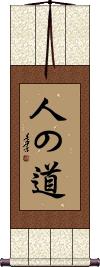
人の道 is the Japanese way to express the “moral way of life,” “correct path,” or “moral principles.”
Where There is a Will, There is a Way
A determined effort can move a mountain
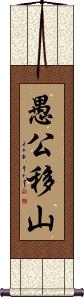
愚公移山 is the Chinese proverb (also somewhat known in Japan and Korea) for “the silly old man moves a mountain.”
Figuratively, this means “where there's a will, there's a way.”
Based on a fable of Lord Yu (愚公). He moved the soil of the mountain in front of his house. After years of effort, he finally moved the entire mountain (some versions of the story have God seeing how determined the man was, and sending two angels to whisk the mountains away).
The moral of the story: Anything can be accomplished if one works at it ceaselessly.
The Japanese version of this is 愚公山を移す (gu kou yama wo utsu su). But better to get the Chinese version, since this is originally a Chinese proverb.
See Also: Nothing is Impossible
The Old Way / Old School
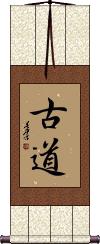
古道 is the Japanese word meaning “The Old Way.” The first character means old or ancient. The second character means “the way” and is the same character as used in Taoism / Daoism (Taoism literally means “the way”).
This second character can also be translated as “method,” as in a way of doing things.
古道 is sometimes Romanized as “Kodo,” though officially, the Romaji should be “Kodou.”
My Japanese-English dictionary further translates this word as the old road, ancient methods, ancient moral teachings, and the way of learning.
Note that this would be understood differently in Chinese. Most Chinese people would just read this as “The old road” without the other meanings derived in Japanese.
Self-Improvement
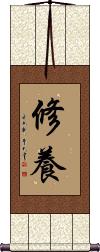
修養 means self-improvement in Chinese, Japanese Kanji, and old Korean Hanja.
Other translations for this word include accomplishment, training, self-cultivation, (mental) training, self-discipline, cultivation, or cultivating moral character.
This in-stock artwork might be what you are looking for, and ships right away...
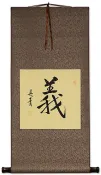
Gallery Price: $65.00
Your Price: $39.88
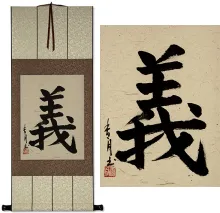
Gallery Price: $200.00
Your Price: $109.88
The following table may be helpful for those studying Chinese or Japanese...
| Title | Characters | Romaji (Romanized Japanese) | Various forms of Romanized Chinese | |
| 4. Right Action Perfect Conduct | 正業 正业 | sei gyou / seigyou / sei gyo | zhèng yè / zheng4 ye4 / zheng ye / zhengye | cheng yeh / chengyeh |
| You are who you hang out with | 挨金似金挨玉似玉 | āi jīn sì jīn āi yù sì yù ai1 jin1 si4 jin1 ai1 yu4 si4 yu4 ai jin si jin ai yu si yu aijinsijinaiyusiyu | ai chin ssu chin ai yü ssu yü aichinssuchinaiyüssuyü |
|
| The Five Tenets of Confucius | 仁義禮智信 仁义礼智信 | jin gi rei tomo nobu jingireitomonobu | rén yì lǐ zhì xìn ren2 yi4 li3 zhi4 xin4 ren yi li zhi xin renyilizhixin | jen i li chih hsin jenilichihhsin |
| Courageous Spirit | 骨氣 骨气 | gǔ qì / gu3 qi4 / gu qi / guqi | ku ch`i / kuchi / ku chi | |
| Ethics Ethical Morality | 道德 道德 / 道徳 | dou toku / doutoku / do toku | dào dé / dao4 de2 / dao de / daode | tao te / taote |
| Good Heart | 善心 | yoshinaka | shàn xīn / shan4 xin1 / shan xin / shanxin | shan hsin / shanhsin |
| Goodness Good Deed | 善 | zen | shàn / shan4 / shan | |
| Heart Mind Spirit | 心 | kokoro | xīn / xin1 / xin | hsin |
| Katsu Hayabi | 勝速日 | katsu hayabi katsuhayabi | ||
| Moral and Virtuous | 德 徳 | toku | dé / de2 / de | te |
| Moral Principles Of Life | 人の道 | hitonomichi | ||
| Where There is a Will, There is a Way | 愚公移山 | yū gōng yí shān yu1 gong1 yi2 shan1 yu gong yi shan yugongyishan | yü kung i shan yükungishan |
|
| The Old Way Old School | 古道 | kodou / kodo | ||
| Self-Improvement | 修養 修养 | shuuyou / shuyo shuyo / shuyo | xiū yǎng / xiu1 yang3 / xiu yang / xiuyang | hsiu yang / hsiuyang |
| In some entries above you will see that characters have different versions above and below a line. In these cases, the characters above the line are Traditional Chinese, while the ones below are Simplified Chinese. | ||||



