Category: South Chinese Folk Art Paintings & Batiks

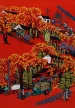
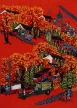
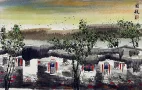
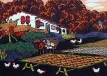
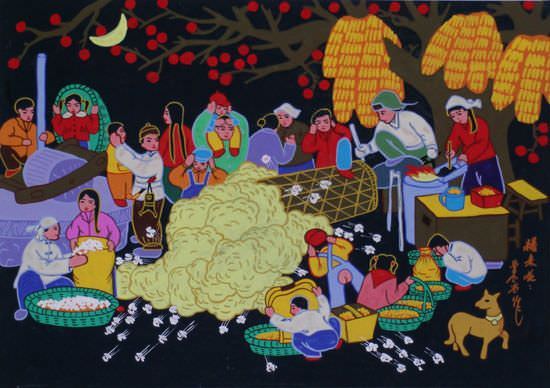
Popcorn Village Scene

Popcorn Village Scene line
arrow
15¼"
(39cm)
arrow
line
arrow 21¼"
(54cm)
arrow


Typical Gallery Price: $70.00

Your Price:
US$29.95U.S. Dollars

GBP £18.18British Pounds
Euro €20.22Euro
Canadian $32.09Canadian Dollars
Australian $32.95Australian Dollars

SOLD

Similar artwork may be available, please post your request on our forum if interested


See how "Popcorn Village Scene" would look after being professionally framed

Want to see what this painting might look like after you frame it?
Frame View

Is your computer monitor too small?
Click below for a smaller framed view
Zoom to 75% | Zoom to 50%

Approximate Measurements:
21¼" x 15¼"   (54cm x 39cm)


Popcorn Village

The true origin of popcorn in history may never be known, but one thing is for sure:
Chinese people have enjoyed popcorn for many generations.

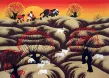
This painting is of a typical scene in a Chinese village. A large drum is spun over a hot fire. The pressure builds inside as the popcorn pops. When it is finally opened and the pressure is release, a huge boom is heard. Everyone in the village knows when the popcorn is ready to eat when they hear that unique sound like a sonic boom when the popcorn explodes out of the drum.

The actual Chinese title is "Bao Mi Hua" which means "Exploding Popcorn".

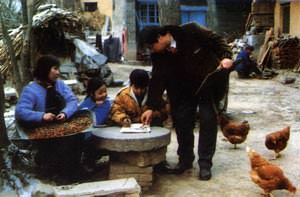
Chinese Folk Artist Cao Quan-Tang in his village

Cao Quan-Tang passes on his artistic talents to his son.


This painting is by a man named Cao Quan-Tang from a small town called Qindu in Huxian County in the Shaanxi Province of China. He was born in 1957 and has been painting since he was 15 years old. He was a struggling peasant artist until the mid-1980's when a revival of folk art began in China, and his work received many awards and acclaim. Some of his painting have achieved top honors at international art exhibitions.

According to Cao Quan-Tang, his paintings all represent experiences in his life as he grew up surrounding by village life in the middle of China.
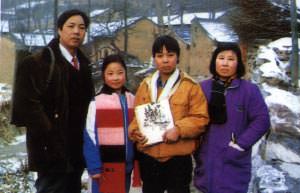
Famous Asian folk art creator, Cao Quan-Tang and his family

The whole Cao family.


Material used in this work are "shui fen" (paint powder and water - similar to gouache), on thick paper.


About Chinese Folk Art and its History

This style of folk art was born in the 1950's just after the Revolution (when Chairman Mao took power). The art developed independently in Huxian (Hu County) in the Shaanxi Province for many years (the same Province where you will find the Terracotta Soldiers).

Things changed a little when the good and bad of the Cultural Revolution came to pass in China. Within a few years, art was only acceptable if it portrayed some form of socialist propaganda, or showed some form of working together in pursuit of Mao's Communist ideals. This propaganda art seldom provided any pay for the artist who were instead forced into working hard in the fields as peasants on communal farms to survive.

Chairman Mao

As the last of the Cultural Revolution sputtered to a stop with the death of Chairman Mao in 1976, freedom began to slowly ring again when Deng Xiao-Ping took power. Deng Xiao-Ping brought China out of the dark ages, and away from "Maoism" and Communism (one of the greatest leaders in Chinese history in my humble opinion). By the 1980's, freedom to once again practice 3000 years of artistic tradition emerged. Chinese folk art was finally allowed to be what it was meant to be, a way to freely express various scenes of daily life and snapshots of Chinese village culture.
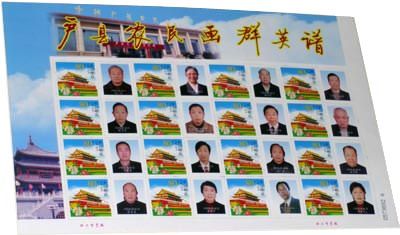
Stamp set of folk artists issued by the Chinese post office.

Chinese Folk Art Today

According to Chinese Government statistics, there are now more than 2000 folk artists in Southern China. Sixteen of these artists have been recognized as the "Famous Masters" of Chinese folk art by the Chinese Cultural Arts Bureau. These sixteen artists were recently honored by China Post with the issuing of a set of commemorative postage stamps. Of these sixteen masters, we represent three of them: Pan Xiao-Ling, Cao Quan-Tang, and Zhang Qing-Yi.

A lot has changed in the folk art community of China since I first started selling these paintings about 4 years ago.

Chinese folk artists have become rather famous, and sought after for exhibitions around the world. Recently these artists formed a labor union of sorts, to ensure that they receive a handsome sum for all of their paintings. Most of them have been able to improve their station in life through the sale of their artwork. One of these artists once said, "We've become good little capitalists, just like President Nixon dreamed of".
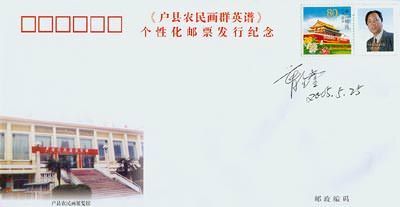
On my last trip to buy more Chinese folk art,
Cao Quan-Tang gave me this signed special edition envelope with his commemorative stamp attached.
Typical Gallery Price: $70.00

Your Price:
US$29.95U.S. Dollars

GBP £18.18British Pounds
Euro €20.22Euro
Canadian $32.09Canadian Dollars
Australian $32.95Australian Dollars

SOLD

Similar artwork may be available, please post your request on our forum if interested


All orders billed in U.S. Dollars.
Other currencies shown for reference at approximate exchange rates.


Item Location: USA
details


Gary's random little facts about China:

Vehicular and Pedestrian Yielding Quotient
When crossing a street, or merely making your way down the road, there is a certain law of physics that comes into play: When two forces meet, one must yield.

Here is the general yielding scheme in China:

Cars yield to big buses and trucks.

Bicycles and cars mingle and narrowly avoid each other. When push comes to shove, the bicyclist knows he will lose the fight. But the car driver knows that the bicycle will scratch his car when he runs it over, and will only yield on that premise.

Cars will not yield to, but are required to avoid pedestrians. When you hit a pedestrian at low speed, it does very little damage, and unlike a bicycle, will almost never scratch your car. Therefore pedestrians are given a smaller margin.
Note: Regardless of green or red stop lights, it is against the law to come to a complete stop when making a right hand turn in China (no matter how many pedestrians are in the way). The rule is "honk and avoid, then continue on your way".

Motor scooters yield to no one, not even when they are being driven on a pedestrian-filled sidewalk. Motor scooters zip around like they have nothing to lose - this may be true, as smaller motor scooters require no license of any kind and are very cheap.

If you are driving on the wrong side of the road, or going the wrong way on a one-way street, you do not have to yield to anyone, no matter what kind of vehicle you are operating.

Cars will yield (not by choice) to pedestrians crossing the street in numbers greater than 10 (it is best in China to invite 9 of your friends for an outing if you plan to cross a lot of streets).

In lieu of yielding, drivers are required to honk at pedestrians. I swear to God, this is the law! It's a safety issue: If you are passing a pedestrian that is walking on the side of the road, you are required by law to honk at them to let them know you are there.
Note: All streets in Chinese cities, sound like a New York traffic jam 24 hours per day with all this "safety honking".

I have not been able to find a traffic law that states you must yield to ambulances. And in practice, very few drivers do.

When two large vehicles come face to face on a narrow roadway, and neither can pass, neither will yield. They will sit there, honking at each other for a while. After several cars are lined up behind them, they will decide that they should have yielded earlier, and start to back up. This is to the great dismay of all the cars behind them who will honk in unison. This could go on for an hour or more. It ends when a police officer arrives, tells both drivers what idiots they are, issues tickets to both of them, and then systematically makes the situation worse by insisting that all the smaller cars turn around (rather than back up) by making 162-point turns in the small roadway. Eventually, two of the cars will hit each other, for which both drivers will be cited and fined on the spot.

Artwork
Search:

Exact
Phrase

Oriental Outpost LogoFlagTowerwatercolor
Chinese Calligraphy Search
ArtPaintingsAsian Art Gallery

Adventures in Asian Art