Many custom options...


And formats...



India in Chinese / Japanese...
Buy an India calligraphy wall scroll here!
Personalize your custom “India” project by clicking the button next to your favorite “India” title below...
India
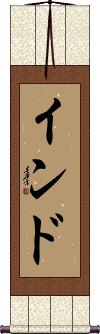
This is India in Japanese Katakana.
Note: Because this title is entirely Japanese Katakana, it should be written by a Japanese calligrapher.
India
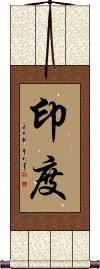
This is the Chinese and Japanese Kanji name for the country of India, occasionally referred to as Hindustan.
See Also: Asia
Indian
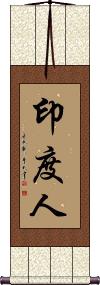
印度人 is the Chinese, Japanese Kanji, and old Korean Hanja for Indian (a person from India).
This is kind of an odd selection to put on a wall scroll, but people keep searching for this title, so I added it.
Not the results for India that you were looking for?
Below are some entries from our dictionary that may match your India search...
| Characters If shown, 2nd row is Simp. Chinese |
Pronunciation Romanization |
Simple Dictionary Definition |
天 see styles |
tiān tian1 t`ien tien hiroshi ひろし |
More info & calligraphy: Heaven(1) sky; (2) {Christn} heaven; (3) God; (4) {Buddh} svarga (heaven-like realm visited as a stage of death and rebirth); (5) {Buddh} deva (divine being of Buddhism); (6) top (of a book); (7) sole (of a Japanese sandal); (8) beginning; start; (9) (abbreviation) (See 天ぷら) tempura; (10) (abbreviation) (obsolete) (See 天竺・1) India; (given name) Hiroshi Heaven; the sky; a day; cf. dyo, dyaus also as 提婆 a deva, or divine being, deity; and as 素羅 sura, shining, bright. |
西 see styles |
xī xi1 hsi nishihama にしはま |
More info & calligraphy: West(1) {mahj} west wind tile (chi: xī); (2) {mahj} winning hand with a pung (or kong) of west wind tiles; (surname) Nishihama paścima, 跛室制麽; west; it is largely used in the limited sense of Kashmir in such terms as 西方 the west, or western regions; but it is also much used for the western heavens of Amitābha; 西天 is India, the western 天竺國. |
こあ see styles |
goa ゴア |
(See ゴアードスカート) gore; triangular piece of fabric, used for making skirts, umbrellas, etc.; (place-name) Goa (India); Gore |
コタ see styles |
kota コタ |
More info & calligraphy: Cota |
フリ see styles |
puri プリ |
More info & calligraphy: Huri |
レー see styles |
ree レー |
More info & calligraphy: Reh |
ロニ see styles |
roni ロニ |
More info & calligraphy: Roni |
三国 see styles |
mikuni みくに |
(1) three countries; (2) (hist) (See 魏・ぎ・1,蜀・しょく・2,呉・ご・3) Three Kingdoms (in China, 220 CE-280 CE); (3) (hist) (See 新羅・しらぎ,百済・くだら,高句麗・こうくり) Three Kingdoms (in Korea, 57 BCE-668 CE); (4) (archaism) Japan, China and India; Japan, Korea and China; the whole world; (p,s,f) Mikuni |
中國 中国 see styles |
zhōng guó zhong1 guo2 chung kuo nakaguni なかぐに |
More info & calligraphy: China(surname) Nakaguni Madhyadesa. 中天 (中天竺); 中梵 The middle kingdom, i. e. Central North India, v. 中印. |
印度 see styles |
yìn dù yin4 du4 yin tu indo いんど |
More info & calligraphy: India(ateji / phonetic) (kana only) India; (place-name) India 印特伽; 身毒; 賢豆; 天竺 Indu (meaning 'moon' in Sanskrit), Hindu, Sindhu; see also 信度 and 閻浮 India in general. In the Tang dynasty its territory is described as extending over 90, 000 li in circuit, being bounded on three sides by the sea; north it rested on the Snow mountains 雪山, i. e. Himālayas; wide at the north, narrowing to the south, shaped like a half-moon; it contained over seventy kingdoms, was extremely hot, well watered and damp; from the centre eastwards to 震旦 China was 58, 000 li; and the same distance southwards to 金地國, westwards to 阿拘遮國, and northwards to 小香山阿耨達. |
德里 see styles |
dé lǐ de2 li3 te li |
More info & calligraphy: Derry |
禪宗 禅宗 see styles |
chán zōng chan2 zong1 ch`an tsung chan tsung Zenshū |
More info & calligraphy: Zen BuddhismThe Chan, meditative or intuitional, sect usually said to have been established in China by Bodhidharma, v. 達, the twenty-eighth patriarch, who brought the tradition of the Buddha-mind from India. Cf. 楞 13 Laṅkāvatāra sūtra. This sect, believing in direct enlightenment, disregarded ritual and sūtras and depended upon the inner light and personal influence for the propagation of its tenets, founding itself on the esoteric tradition supposed to have been imparted to Kāśyapa by the Buddha, who indicated his meaning by plucking a flower without further explanation. Kāśyapa smiled in apprehension and is supposed to have passed on this mystic method to the patriarchs. The successor of Bodhidharma was 慧可 Huike, and he was succeeded by 僧璨 Sengcan; 道信 Daoxin; 弘忍 Hongren; 慧能 Huineng, and 神秀 Shenxiu, the sect dividing under the two latter into the southern and northern schools: the southern school became prominent, producing 南嶽 Nanyue and 靑原 Qingyuan, the former succeeded by 馬祖 Mazu, the latter by 石頭 Shitou. From Mazu's school arose the five later schools, v. 禪門. |
老子 see styles |
lǎo zi lao3 zi5 lao tzu roushi / roshi ろうし |
More info & calligraphy: Lao Tzu / LaoziLaozi; Lao Tzu; Lao Tse; (person) Laozi (semi-legendary Chinese philosopher and deity); Lao Tzu; Lao Tse Laozi, or Laocius, the accepted founder of the Daoists. The theory that his soul went to India and was reborn as the Buddha is found in the 齊書 History of the Qi dynasty 顧歡傳. |
達磨 达磨 see styles |
dá mó da2 mo2 ta mo daruma だるま |
More info & calligraphy: Daruma / Damodharma; also 達摩; 達麼; 達而麻耶; 曇摩; 馱摩 tr. by 法. dharma is from dhara, holding, bearing, possessing, etc.; and means 'that which is to be held fast or kept, ordinance, statute, law, usage, practice'; 'anything right.' M.W. It may be variously intp. as (1) characteristic, attribute, predicate; (2) the bearer, the transcendent substratum of single elements of conscious life; (3) element, i.e. a part of conscious life; (4) nirvāṇa, i.e. the Dharma par excellence, the object of Buddhist teaching; (5) the absolute, the real; (6) the teaching or religion of Buddha; (7) thing, object, appearance. Also, Damo, or Bodhidharma, the twenty-eighth Indian and first Chinese patriarch, who arrived in China A.D. 520, the reputed founder of the Chan or Intuitional School in China. He is described as son of a king in southern India; originally called Bodhitara. He arrived at Guangdong, bringing it is said the sacred begging-bowl, and settled in Luoyang, where he engaged in silent meditation for nine years, whence he received the title of wall-gazing Brahman 壁觀婆羅門, though he was a kṣatriya. His doctrine and practice were those of the 'inner light', independent of the written word, but to 慧可 Huike, his successor, he commended the Laṅkāvatāra-sūtra as nearest to his views. There are many names with Dharma as initial: Dharmapāla, Dharmagupta, Dharmayaśas, Dharmaruci, Dharmarakṣa, Dharmatrāta, Dharmavardhana, etc. |
アラー see styles |
araa / ara アラー |
More info & calligraphy: Allah |
インド see styles |
indo インド |
More info & calligraphy: India |
カイラ see styles |
kaira カイラ |
More info & calligraphy: Kyra |
カシア see styles |
kashia カシア |
More info & calligraphy: Cassia |
コラル see styles |
koraru コラル |
More info & calligraphy: Corral |
シロン see styles |
shiron シロン |
(place-name) Shillong (India) |
タール see styles |
daaru / daru ダール |
dāl (eighth letter of the Arabic alphabet) (ara:); (surname) Dahl; (place-name) Dahl (Germany); Dhar (India); Dael; Dard |
タミル see styles |
tamiru タミル |
More info & calligraphy: Tamil |
テリー see styles |
derii / deri デリー |
More info & calligraphy: Terry |
モレナ see styles |
morena モレナ |
More info & calligraphy: Morena |
コーチン see styles |
koochin コーチン |
More info & calligraphy: Cochin |
バーラト see styles |
baarato / barato バーラト |
More info & calligraphy: Bharat |
バスティ see styles |
basuti バスティ |
More info & calligraphy: Basti |
ハッサン see styles |
hassan ハッサン |
More info & calligraphy: Hassan |
マンディ see styles |
mandi マンディ |
More info & calligraphy: Mundy |
マントラ see styles |
mandora マンドラ |
{Buddh} (See 真言・1) mantra (san:); (place-name) Mandla (India) |
Click here for more India results from our dictionary
The following table may be helpful for those studying Chinese or Japanese...
| Title | Characters | Romaji (Romanized Japanese) | Various forms of Romanized Chinese | |
| India | インド | in do / indo | ||
| India | 印度 | in do / indo | yìn dù / yin4 du4 / yin du / yindu | yin tu / yintu |
| Indian | 印度人 | in do jin / indojin | yìn dù rén yin4 du4 ren2 yin du ren yinduren | yin tu jen yintujen |

Successful Chinese Character and Japanese Kanji calligraphy searches within the last few hours...



