Many custom options...


And formats...



Air in Chinese / Japanese...
Buy an Air calligraphy wall scroll here!
Personalize your custom “Air” project by clicking the button next to your favorite “Air” title below...
6. Heaven
Air / Atmosphere
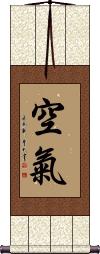
空氣 means air or atmosphere in Chinese, Japanese Kanji, and old Korean Hanja.
This is an unusual title for an Asian calligraphy wall scroll, but many of our western customers have requested it.
 While 空氣 is common in Chinese and Korean Hanja (and ancient Japanese Kanji); please note that in modern Japanese, the second character is written as 気, with slightly fewer strokes. If you want the modern Japanese version, please click on the character to the right. Both versions are understood by native Chinese, Japanese, and many (but not all) Korean people. You should choose the appropriate version based on the intended audience for your calligraphy artwork.
Universe / Space
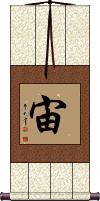
宙 means universe, cosmos, or outer space in Chinese, Japanese Kanji, and old Korean Hanja.
This can also mean air or midair depending on context.
In Korean, this can mean eternity in some contexts.
In Japanese, this can also be the female given name Haruka.
Sky / Air / Ether / Space
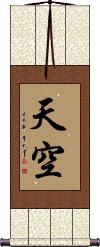
天空 means sky in most contexts but it can also refer to air, space, the heavens, or ether.
Earth Fire Water Air
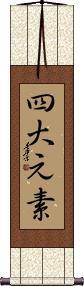
四大元素 is the title for the four classical chemical elements (fire, earth, air, and water) in Japanese.
四大 = four great/big. 元素 = elements. So 四大元素 literally means “Four Great Elements.”
Five Elements
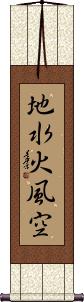
地水火風空 is the specifically-Japanese version of the five elements.
This is a little different than the ancient or original Chinese version.
The elements are written in this order:
1. Earth / Terra / Ground
2. Water
3. Fire
4. Wind / Air
5. Sky / Emptiness / Void / Ether
Note: This set of Kanji can also be romanized as “ji sui ka fuu kuu,” “jisuikafuukuu,” or “jisuikafuku.”
These can also be written in the order 地火風水空 (chi ka sui fuu kuu). Let me know when you place your order if you want the Kanji to be in this character order.
Heaven
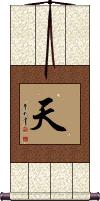
天 means “heaven” or “sky” in Chinese, Japanese Kanji, and old Korean Hanja.
The context determines if you are talking about heaven or the sky above (often they are the same concept).
When combined with other characters, words like “today” and “tomorrow” are created. While sometimes the character for “sun” is used to mean “day,” often “sky” represents “day” in Asian languages.
Example: 今天 (this sky) = “today,” 明天 (next sky) = “tomorrow” in modern Chinese and Japanese.
In Chinese culture, regardless of which religion, it's almost always assumed that God (and any other deities) live up above the sky. The concept of God living in the sky is likely the reason heaven is associated with this character.
The equation goes something like this: God's domain is the sky, thus, the sky is heaven.
Note: As a single character, this is a little ambiguous, so you might want to choose our Kingdom of Heaven selection instead.
Nothingness / Empty / Void
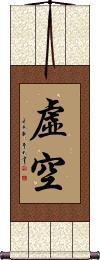
虛空 means empty space, empty sky, or void.
In the Buddhist context, it can mean “emptiness of the material world.” This can also be used as an adjective to modify other words with a meaning of unreal or insubstantial.
This in-stock artwork might be what you are looking for, and ships right away...
Gallery Price: $108.00
Your Price: $59.88
Gallery Price: $200.00
Your Price: $79.88
Gallery Price: $60.00
Your Price: $39.88
These search terms might be related to Air:
A Vast Sky Full of Stars
Air / Atmosphere
Beautiful Clear Sky
Blue Sky
Clear Blue Sky
Inner Strength is Better Than Outward Appearance
Melody
Melody / Song
Misty / Cloudy Sky
Sky / Air / Ether / Space
Sky / Ether / Void / Emptiness / Unreality
Sky / Void
Universe / Space
Not the results for air that you were looking for?
Below are some entries from our dictionary that may match your air search...
| Characters If shown, 2nd row is Simp. Chinese |
Pronunciation Romanization |
Simple Dictionary Definition |
宙 see styles |
zhòu zhou4 chou hiroshi ひろし |
More info & calligraphy: Universe / Space(1) space; air; midair; (2) (See 空・そら・5) (from) memory; (by) heart; (male given name) Hiroshi |
氣 气 see styles |
qì qi4 ch`i chi ki き |
More info & calligraphy: Life Energy / Spiritual Energy(out-dated kanji) (1) spirit; mind; heart; (2) nature; disposition; (3) motivation; intention; (4) mood; feelings; (5) ambience; atmosphere; mood energy |
空 see styles |
kòng kong4 k`ung kung ron ろん |
More info & calligraphy: Sky / Ether / Void / Emptiness / Unreality(1) empty air; sky; (2) {Buddh} shunyata (the lack of an immutable intrinsic nature within any phenomenon); emptiness; (3) (abbreviation) (See 空軍) air force; (noun or adjectival noun) (4) fruitlessness; meaninglessness; (noun or adjectival noun) (5) (See 五大・1) void (one of the five elements); (can be adjective with の) (6) {math} empty (e.g. set); (female given name) Ron śūnya, empty, void, hollow, vacant, nonexistent. śūnyatā, 舜若多, vacuity, voidness, emptiness, non-existence, immateriality, perhaps spirituality, unreality, the false or illusory nature of all existence, the seeming 假 being unreal. The doctrine that all phenomena and the ego have no reality, but are composed of a certain number of skandhas or elements, which disintegrate. The void, the sky, space. The universal, the absolute, complete abstraction without relativity. There are classifications into 2, 3, 4, 6, 7, 11, 13, 16, and 18 categories. The doctrine is that all things are compounds, or unstable organisms, possessing no self-essence, i.e. are dependent, or caused, come into existence only to perish. The underlying reality, the principle of eternal relativity, or non-infinity, i.e. śūnya, permeates all phenomena making possible their evolution. From this doctrine the Yogācārya school developed the idea of the permanent reality, which is Essence of Mind, the unknowable noumenon behind all phenomena, the entity void of ideas and phenomena, neither matter nor mind, but the root of both. |
風 风 see styles |
fēng feng1 feng fuwari ふわり |
More info & calligraphy: Wind(adj-na,n,n-suf) (1) method; manner; way; style; (adj-na,n,n-suf) (2) appearance; air; (adj-na,n,n-suf) (3) tendency; (adj-na,n,n-suf) (4) (See 六義・1) folk song (genre of the Shi Jing); (adj-na,n,n-suf) (5) (See 五大・1) wind (one of the five elements); (female given name) Fuwari vāyu. Wind, air; rumour, repute; custom; temper, lust. |
五行 see styles |
wǔ xíng wu3 xing2 wu hsing gogyou / gogyo ごぎょう |
More info & calligraphy: Five Elements(1) (See 五大・ごだい・1) the five elements (in Chinese philosophy: wood, fire, earth, metal and water); the five phases; wu xing; (2) {Buddh} five practices of the Bodhisattvas; (3) (See 六信五行) the five pillars of Islam; (surname, given name) Gogyou The five lines of conduct. I. According to the 起信論 Awakening of Faith they are almsgiving; keeping the commandments; patience under insult; zeal or progress; meditation. II. According to the 涅槃經 Nirvana Sutra they are saintly or bodhisattva deeds; arhat, or noble deeds; deva deeds; children's deeds (i. e. normal good deeds of men, devas, and Hinayanists); sickness conditions, e. g. illness, delusion, etc.; — into all these lines of conduct and conditions a Bodhisattva enters. III. The five elements, or tanmātra— wood, fire, earth, metal, and water; or earth, water, ire, air, and ether (or space) as taught by the later Mahāyāna philosophy; idem 五大. |
伊達 see styles |
yakata やかた |
More info & calligraphy: Ida |
四大 see styles |
sì dà si4 da4 ssu ta shidai しだい |
More info & calligraphy: Shidai / Sida / Mahabhuta(1) {Buddh} the four elements (earth, water, fire, wind); (2) the human body; (3) Tao, heaven, earth and king mahābhūta, 四界; 四大界. The four elements of which all things are made; or the four realms; i. e. earth, water, fire, and wind (or air); they represent 堅, 濕, 煖, and 動 solid, liquid, heat, and motion; motion produces and maintains life. As 實 active or formative forces they are styled 四界 (四大界) ; as 假 passive or material objects they are 四大; but the 成實論 Satyasiddhi śāstra disputes the 實 and recognizes only the 假. |
夜叉 see styles |
yè chā ye4 cha1 yeh ch`a yeh cha yasha やしゃ |
More info & calligraphy: Yakshayaksha (Buddhist guardian deities sometimes depicted as demonic warriors) (san: yaksa); (given name) Yasha 乞叉; 藥叉; 閱叉 yakṣa, (1) demons in the earth, or in the air, or in the lower heavens; they are malignant, and violent, and devourers (of human flesh). (2) The 八大將, the eight attendants of Kuvera, or Vaiśravaṇa, the god of wealth; those on earth bestow wealth, those in the empyrean houses and carriages, those in the lower heavens guard the moat and gates of the heavenly city. There is another set of sixteen. The names of all are given in 陀羅尼集經 3. See also 羅 for rakṣa and 吉 for kṛtya. yakṣa-kṛtya are credited with the powers of both yakṣa and kṛtya. |
天空 see styles |
tiān kōng tian1 kong1 t`ien k`ung tien kung hirari ひらり |
More info & calligraphy: Sky / Air / Ether / Spacesky; air; ether; firmament; the heavens; (female given name) Hirari |
毒蛇 see styles |
dú shé du2 she2 tu she dokuja; dokuhebi どくじゃ; どくへび |
More info & calligraphy: Vipervenomous snake; poisonous snake A poisonous snake.; Poisonous snakes, the four elements of the body— earth, water, fire, wind (or air)— which harm a man by their variation, i. e. increase and decrease. Also, gold. |
空氣 空气 see styles |
kōng qì kong1 qi4 k`ung ch`i kung chi |
More info & calligraphy: Air / Atmosphere |
空軍 空军 see styles |
kōng jun kong1 jun1 k`ung chün kung chün kuugun / kugun くうぐん |
More info & calligraphy: Air Forceair force |
エアー see styles |
eaa / ea エアー |
More info & calligraphy: Ayer |
四大元素 see styles |
yondaigenso よんだいげんそ |
More info & calligraphy: Earth Fire Water Air |
做 see styles |
zuò zuo4 tso tooru とおる |
to make; to produce; to write; to compose; to do; to engage in; to hold (a party etc); (of a person) to be (an intermediary, a good student etc); to become (husband and wife, friends etc); (of a thing) to serve as; to be used for; to assume (an air or manner) (given name) Tooru |
印 see styles |
yìn yin4 yin in いん |
to print; to mark; to engrave; a seal; a print; a stamp; a mark; a trace; image (1) stamp; seal; chop; (2) seal impression; seal; sealing; stamp; mark; print; (3) {Buddh} mudra (symbolic hand gesture); (4) ninja hand sign; (5) (abbreviation) (See 印度・インド) India; (surname) In mudrā; seal, sign, symbol, emblem, proof, assurance, approve; also 印契; 契印; 印相. Manual signs indicative of various ideas, e. g. each finger represents one of the five primary elements, earth, water, fire, air, and space, beginning with the little finger; the left hand represents 定 stillness, or meditation, the right hand 慧 discernment or wisdom; they have also many other indications. Also, the various symbols of the Buddhas and Bodhisattvas, e. g. the thunderbolt; cf. 因.; (度) The five Indias, or five regions of India, idem 五天竺 q. v. |
嘶 see styles |
sī si1 ssu sai |
hiss; neigh; Ss! (sound of air sucked between the teeth, indicating hesitation or thinking over) To neigh; a crashing noise. |
坲 see styles |
fó fo2 fo |
(of dust) to rise in the air |
壕 see styles |
háo hao2 hao hori ほり |
moat; (military) trench (1) moat; fosse; (2) canal; ditch; (1) moat; fosse; trench; ditch; (2) underground air-raid shelter; dugout; (surname) Hori |
外 see styles |
wài wai4 wai hoka ほか |
outside; in addition; foreign; external (1) outside; exterior; (2) the open (air); (3) (ant: うち・6) other place; somewhere else; outside one's group (family, company, etc.); (surname) Hoka bāhya. Outside, external; opposite to 内 within, inner, e. g. 内證 inner witness, or realization and 外用 external manifestation, function, or use. |
大 see styles |
dài dai4 tai yutaka ゆたか |
see 大夫[dai4 fu5] (pref,adj-na,n) (1) large; big; great; huge; vast; major; important; serious; severe; (prefix) (2) great; prominent; eminent; distinguished; (suffix) (3) -sized; as big as; the size of; (suffix noun) (4) (abbreviation) (See 大学・1) university; (5) large (e.g. serving size); large option; (6) (abbreviation) (See 大の月) long month (i.e. having 31 days); (given name) Yutaka Maha. 摩訶; 麼賀. Great, large, big; all pervading, all-embracing; numerous 多; surpassing ; mysterious 妙; beyond comprehension 不可思議; omnipresent 體無不在. The elements, or essential things, i.e. (a) 三大 The three all-pervasive qualities of the 眞如 q.v. : its 體, 相 , 用 substance, form, and functions, v. 起信論 . (b) 四大 The four tanmātra or elements, earth, water, fire, air (or wind) of the 倶舍論. (c)五大 The five, i.e. the last four and space 空, v. 大日經. (d) 六大 The six elements, earth, water, fire, wind, space (or ether), mind 識. Hīnayāna, emphasizing impersonality 人空, considers these six as the elements of all sentient beings; Mahāyāna, emphasizing the unreality of all things 法空, counts them as elements, but fluid in a flowing stream of life, with mind 識 dominant; the esoteric sect emphasizing nonproduction, or non-creation, regards them as universal and as the Absolute in differentiation. (e) 七大 The 楞嚴經 adds 見 perception, to the six above named to cover the perceptions of the six organs 根. |
晾 see styles |
liàng liang4 liang |
to dry in the air; (fig.) to cold-shoulder |
曝 see styles |
pù pu4 p`u pu sarashi さらし |
to air; to sun (1) bleaching; bleached cotton; (2) public humiliation (punishment) |
檔 档 see styles |
dàng dang4 tang |
(bound form) shelves (for files); pigeonholes; (bound form) files; crosspiece (of a table etc); (bound form) (of goods) grade; vendor's open-air stall; (Tw) timeslot for a show or program; classifier for shows; classifier for events, affairs etc; Taiwan pr. [dang3] |
沖 冲 see styles |
chōng chong1 ch`ung chung fukashi ふかし |
(of water) to dash against; to mix with water; to infuse; to rinse; to flush; to develop (a film); to rise in the air; to clash; to collide with open sea; (surname) Fukashi empty |
涼 凉 see styles |
liàng liang4 liang riyou / riyo りよう |
to let something cool down (See 涼を取る・りょうをとる) cool breeze; cool air; refreshing coolness; (female given name) Riyou cool |
線 线 see styles |
xiàn xian4 hsien sen せん |
thread; string; wire; line; CL:條|条[tiao2],股[gu3],根[gen1]; (after a number) tier (unofficial ranking of a Chinese city) (n,n-suf) (1) line; stripe; stria; (n,n-suf) (2) line (e.g. telephone line); wire; (n,n-suf) (3) (See X線) ray (e.g. X-ray); beam; (n,n-suf) (4) line (e.g. of a railroad); track; route; lane; (n,n-suf) (5) outline; contours; form; (n,n-suf) (6) level; (n,n-suf) (7) division; (n,n-suf) (8) (See いい線) line (of action); position; approach; policy; principle; (n,n-suf) (9) (See 線が太い,線が細い) impression one leaves; air one gives off; (surname) Sen A thread, wire, clue, spy, lead, connection. |
色 see styles |
shǎi shai3 shai shiki しき |
(coll.) color; used in 色子[shai3 zi5] (counter) counter for colours; (female given name) Shiki rūpa, outward appearance, form, colour, matter, thing; the desirable, especially feminine attraction. It is defined as that which has resistance; or which changes and disappears, i. e. the phenomenal; also as 顯, 形 and 表色 colour and quality, form or the measurable, and mode or action. There are divisions of two, i. e. inner and outer, as the organs and objects of sense; also colour and form; of three, i. e. the visible object, e. g. colour, the invisible object, e. g. sound, the invisible and immaterial; of eleven, i. e. the five organs and five objects of sense and the immaterial object; of fourteen, the five organs and five objects of sense and the four elements, earth, water, fire, air. rūpa is one of the six bāhya-āyatana, the 六塵; also one of the five skandhas, 五蘊, i. e. the 色身. Keith refers to rūpa as 'material form or matter which is underived (no-utpādā) and which is derived (utpādā)', the underived or independent being the tangible; the derived or dependent being the senses, e. g. of hearing; most of their objects, e. g. sound; the qualities or faculties of feminity, masculinity, vitality; intimation by act and speech, space; qualities of matter, e. g. buoyancy and physical nutriment. |
被 see styles |
bèi bei4 pei hi ひ |
quilt; to cover (with); (literary) to suffer (a misfortune); used to indicate passive voice (placed before the doer of the action like "by" in English passive-voice sentences, or, if the doer is not mentioned, before the verb); (since c. 2009) (sarcastic or jocular) used to indicate that the following word should be regarded as being in air quotes (as in 被旅遊|被旅游[bei4 lu : 3 you2] to "go on a trip") (prefix noun) indicates being the subject or receiver of an action, decision, etc.; -ee (e.g. employee, examinee, trustee) A quilt, coverlet; to cover; to suffer; sign of the passive. |
韛 see styles |
bài bai4 pai |
bellows (for blowing air into a fire) |
Click here for more air results from our dictionary
The following table may be helpful for those studying Chinese or Japanese...
| Title | Characters | Romaji (Romanized Japanese) | Various forms of Romanized Chinese | |
| Air Atmosphere | 空氣 空气 / 空気 | kuu ki / kuuki / ku ki | kōng qì / kong1 qi4 / kong qi / kongqi | k`ung ch`i / kungchi / kung chi |
| Universe Space | 宙 | chuu / haruka chu / haruka | zhòu / zhou4 / zhou | chou |
| Sky Air Ether Space | 天空 | ten kuu / tenkuu / ten ku | tiān kōng tian1 kong1 tian kong tiankong | t`ien k`ung tienkung tien kung |
| Earth Fire Water Air | 四大元素 | yondaigenso | ||
| Five Elements | 地水火風空 地水火风空 | chi sui ka fuu kuu chisuikafuukuu chi sui ka fu ku | ||
| Heaven | 天 | ten | tiān / tian1 / tian | t`ien / tien |
| Nothingness Empty Void | 虛空 虚空 | kokuu / koku | xū kōng / xu1 kong1 / xu kong / xukong | hsü k`ung / hsükung / hsü kung |
| In some entries above you will see that characters have different versions above and below a line. In these cases, the characters above the line are Traditional Chinese, while the ones below are Simplified Chinese. | ||||

Successful Chinese Character and Japanese Kanji calligraphy searches within the last few hours...



