Many custom options...


And formats...



Burn in Chinese / Japanese...
Buy a Burn calligraphy wall scroll here!
Personalize your custom “Burn” project by clicking the button next to your favorite “Burn” title below...
Phoenix Rise from the Ashes
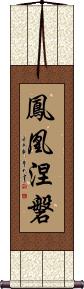
鳳凰涅磐 is a proverb that suggests “Legendary Phoenix rises from the ashes.” It means “Legendary Phoenix [reaches] Nirvana.”
There is a legend in China of a great bird reborn once every 500 years. This bird gathers all the ill will, suffering, desire, and other negative things of the world. The bird then plunges into the fire to burn away all negative things, sacrificing itself in the process (achieving Nirvana, or perhaps allowing others the opportunity to reach Nirvana).
500 years later, the phoenix is reborn from the ashes again, and the cycle repeats.
Drain the pond to get all the fish
Kill the goose that lays the golden eggs
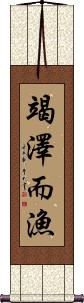
In 632 BC, Duke Wen of the Kingdom of Jin was about to lead an army against the forces of the Kingdom of Chu.
The Duke asked one of his advisers, Jiu Fan, how they could win the impending battle, as they were drastically outnumbered.
Jiu Fan said, “All is fair in war,” and suggested a plan of dishonorable tactics (cheating).
The Duke was unsure of this advice, so he asked another adviser, Yong Ji, who replied, “If you catch fish by draining the pond, you can certainly get all the fish. But there will be no fish the following year. You can cheat this one time in battle, but such tactics can only be used once, as the enemy will be wise in future encounters.”
The Duke heard the words of his wiser adviser but cheated to gain victory in the battle. However, he rewarded Yong Ji more than Jiu Fan at the victory celebration, stating that while Jiu Fan's advice gained one victory, the wise words of Yong Ji would last forever.
This Chinese idiom/proverb is still used, over 2600 years later to remind people not to burn bridges, cheat, or dishonor themselves in exchange for a short-term gain while sacrificing the future.
竭澤而漁 is very similar to the meaning of the English phrase, “Kill the goose that lays the golden eggs.”
Not the results for burn that you were looking for?
Below are some entries from our dictionary that may match your burn search...
| Characters If shown, 2nd row is Simp. Chinese |
Pronunciation Romanization |
Simple Dictionary Definition |
惔 see styles |
tán tan2 t`an tan |
to burn |
灼 see styles |
zhuó zhuo2 cho shaku |
to burn; to sear; to scorch; (bound form) bright; luminous burn, scorch, cauterize |
炙 see styles |
zhì zhi4 chih sha |
to broil; to roast Broil, burn, roast, dry; intimate. |
炷 see styles |
zhù zhu4 chu shu |
wick of an oil lamp; to burn (incense etc); classifier for lit incense sticks a wick |
烗 see styles |
kài kai4 k`ai kai |
to burn; to blaze |
焌 see styles |
qū qu1 ch`ü chü |
to extinguish a burning object; to singe something with a smoldering object (e.g. burn a hole in one's trousers with a cigarette); to stir-fry; to pour a mixture of hot oil and flavorings over food |
焚 see styles |
fén fen2 fen mineoka みねおか |
to burn (personal name) Mineoka To burn, consume by fire. |
然 see styles |
rán ran2 jan ran らん |
correct; right; so; thus; like this; -ly (suffix) (often as 〜然とする) -like; (female given name) Ran To burn, simmer; so, yes; but, however. |
熾 炽 see styles |
chì chi4 ch`ih chih shi おき |
to burn; to blaze; splendid; illustrious embers; live charcoal Blaze, flame, burn, effulgent. |
燃 see styles |
rán ran2 jan moyu もゆ |
to burn; to ignite; to light; fig. to spark off (hopes); to start (debate); to raise (hopes) (female given name) Moyu To set fire to, light, burn; idem 然 12 q.v. |
燋 see styles |
jiāo jiao1 chiao shō |
to cauterize; to scorch cook, burn |
燒 烧 see styles |
shāo shao1 shao shō |
to burn; to cook; to stew; to bake; to roast; to heat; to boil (tea, water etc); fever; to run a temperature; (coll.) to let things go to one's head To burn. |
燔 see styles |
fán fan2 fan |
burn; to roast meat for sacrifice |
燙 烫 see styles |
tàng tang4 t`ang tang |
to scald; to burn (by scalding); to blanch (cooking); to heat (something) up in hot water; to perm; to iron; scalding hot |
燶 㶶 see styles |
nóng nong2 nung |
(dialect) to burn; to scorch |
爇 see styles |
ruò ruo4 jo |
burn; heat |
辣 see styles |
là la4 la |
hot (spicy); pungent; (of chili pepper, raw onions etc) to sting; to burn |
上香 see styles |
shàng xiāng shang4 xiang1 shang hsiang ueka うえか |
to offer incense (at a temple etc) (surname) Ueka to stand or burn incense |
冒火 see styles |
mào huǒ mao4 huo3 mao huo |
to get angry; to burn with rage |
刻錄 刻录 see styles |
kè lù ke4 lu4 k`o lu ko lu |
to record on a CD or DVD; to burn a disc |
呑酸 see styles |
donsan どんさん |
{med} (See 胸焼け・むねやけ) acid reflux; heart-burn |
壞法 坏法 see styles |
huài fǎ huai4 fa3 huai fa ehō |
Any process of destruction, or decay to burn the bones of a deceased person so that they may not draw him to rebirth. |
女人 see styles |
nǚ ren nu:3 ren5 nü jen nyonin; jojin にょにん; じょじん |
wife woman Woman, described in the Nirvāṇa sūtra 浬槃經 9 as the "abode of all evil", 一切女人皆是衆惡之所住處 The 智度論 14 says: 大火燒人是猶可近, 淸風無形是亦可捉, 蚖蛇含毒猶亦可觸, 女人之心不可得實 "Fierce fire that would burn men may yet be approached, clear breezes without form may yet be grasped, cobras that harbour poison may yet be touched, but a woman's heart is never to be relied upon." The Buddha ordered Ānanda: "Do not Look at a woman; if you must, then do not talk with her; if you must, then call on the Buddha with all your mind"— an evidently apocryphal statement of 文句 8. |
女色 see styles |
nǚ sè nu:3 se4 nü se joshoku; nyoshoku; joshiki じょしょく; にょしょく; じょしき |
female charms; femininity woman's beauty or charms; love affair with a woman; lust for women Female beauty— is a chain, a serious delusion, a grievous calamity. The 智度論 14 says it is better to burn out the eyes with a red-hot iron than behold woman with unsteady heart. |
封火 see styles |
fēng huǒ feng1 huo3 feng huo |
to cover a fire (to make it burn slowly) |
差す see styles |
sasu さす |
(v5s,vi) (1) (See 射す) to shine; (v5s,vi) (2) to be visible; (v5s,vi) (3) to be tinged with; (v5s,vi) (4) to rise (of water levels); to flow in; (v5s,vi) (5) (See 気が差す,魔が差す) to be felt (i.e. as an emotion); to come over one; (transitive verb) (6) to hold up (an umbrella, etc.); to put up; to raise; (transitive verb) (7) (See 指す・5) to extend one's arm straight ahead (in dance); (transitive verb) (8) (See 挿す・1) to insert; to put in; (transitive verb) (9) (See 挿す・4) to wear (a sword) in one's belt; to wear at one's side; to carry under one's arm; (transitive verb) (10) {sumo} to insert one's arm under an opponent's arm; (transitive verb) (11) (See 刺す・4) to pole (a boat); (transitive verb) (12) (See 注す・1) to pour; to add (liquid); to serve (drinks); (transitive verb) (13) (See 点す・2) to put on (lipstick, etc.); to apply; to colour; to dye; (transitive verb) (14) to light (a fire); to burn; (transitive verb) (15) (See 鎖す) to shut; to close; to lock; to fasten; (suf,v5s) (16) (after the -masu stem of a verb) (See 止す) to stop in the midst of; to leave undone |
拈香 see styles |
niān xiāng nian1 xiang1 nien hsiang nenkō |
burn incense To take and offer incense. |
擦傷 擦伤 see styles |
cā shāng ca1 shang1 ts`a shang tsa shang sasshou / sassho さっしょう |
to abrade; to scrape; to chafe; to graze; abrasion; friction burn; scratch abrasion; chafe; graze |
斫畬 斫畲 see styles |
zhuó shē zhuo2 she1 cho she |
(literary) slash-and-burn agriculture |
断線 see styles |
dansen だんせん |
(n,vs,vi) disconnection; interruption; burn-out |
Click here for more burn results from our dictionary
The following table may be helpful for those studying Chinese or Japanese...
| Title | Characters | Romaji (Romanized Japanese) | Various forms of Romanized Chinese | |
| Phoenix Rise from the Ashes | 鳳凰涅磐 凤凰涅磐 | fèng huáng niè pán feng4 huang2 nie4 pan2 feng huang nie pan fenghuangniepan | feng huang nieh p`an fenghuangniehpan feng huang nieh pan |
|
| Drain the pond to get all the fish | 竭澤而漁 竭泽而渔 | jié zé ér yú jie2 ze2 er2 yu2 jie ze er yu jiezeeryu | chieh tse erh yü chiehtseerhyü |
|
| In some entries above you will see that characters have different versions above and below a line. In these cases, the characters above the line are Traditional Chinese, while the ones below are Simplified Chinese. | ||||

Successful Chinese Character and Japanese Kanji calligraphy searches within the last few hours...



