Many custom options...


And formats...



Chai in Chinese / Japanese...
Buy a Chai calligraphy wall scroll here!
Personalize your custom “Chai” project by clicking the button next to your favorite “Chai” title below...
Scorpion
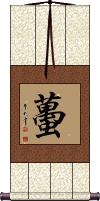
蠆 is a very ancient Chinese word meaning scorpion.
This can also mean insect depending on the context. 蠆 is a very old character, so modern Chinese people might not recognize it immediately.
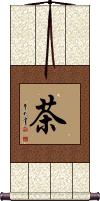
茶 means tea. It can refer to prepared tea (ready-to-drink) or dry tea leaves.
The origin of tea is China but the same character is used in Japanese Kanji, and old Korean Hanja with the exact same meaning. Japanese and Korean even borrowed the pronunciation from Chinese (pronounced “cha” in all three languages).
It's said that an early doctor (or herbologist) in ancient China kept poisoning himself as he tried different new herb concoctions. He invented tea as a means to detoxify himself as he recovered from 1 of the 76 times he nearly poisoned himself to death. Tea is seen not just as a drink but as a form of medicine used to remove impurities from the body.
The word “chai” (used in many languages to refer to various teas) is derived from this Chinese word.
茶 also means camellia, as Asian teas are often based on the leaves of camellia plant varieties.
Chay
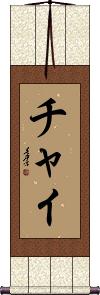
チャイ is the name Chay in Japanese Katakana.
Note: Because this title is entirely Japanese Katakana, it should be written by a Japanese calligrapher.
Not the results for chai that you were looking for?
Below are some entries from our dictionary that may match your chai search...
| Characters If shown, 2nd row is Simp. Chinese |
Pronunciation Romanization |
Simple Dictionary Definition |
寨 see styles |
zhài zhai4 chai toride とりで |
More info & calligraphy: Strongholdfort; fortress; stronghold; fortification |
蠆 虿 see styles |
chài chai4 ch`ai chai |
More info & calligraphy: Scorpion |
柴田 see styles |
chái tián chai2 tian2 ch`ai t`ien chai tien tsubata つばた |
More info & calligraphy: Shibata / Shida(surname) Tsubata |
柬埔寨 see styles |
jiǎn pǔ zhài jian3 pu3 zhai4 chien p`u chai chien pu chai Kanhosai カンボジア |
More info & calligraphy: Cambodia(ateji / phonetic) (kana only) Cambodia Cambodia |
亝 斋 see styles |
zhāi zhai1 chai |
old variant of 齋|斋[zhai1] |
側 侧 see styles |
zhāi zhai1 chai soba そば |
lean on one side (See 永字八法) first principle of the Eight Principles of Yong; tiny dash or speck; (surname) Soba lean to one side |
債 债 see styles |
zhài zhai4 chai sai さい |
debt; CL:筆|笔[bi3] (n,n-suf) debt; loan debt |
儕 侪 see styles |
chái chai2 ch`ai chai bara ばら tomogara ともがら |
a class; a company; companion (suffix noun) suffixed to words indicating a class of people to create a plural (esp. in impolite contexts); comrade; fellow |
囆 see styles |
chài chai4 ch`ai chai |
(used in an ancient given name) |
宅 see styles |
zhái zhai2 chai taku たく |
residence; (coll.) to stay in at home; to hang around at home (n,n-suf) (1) house; home; (2) one's house; one's home; (3) one's husband; (surname, given name) Taku Residential part of a palace, or mansion; a residence. |
拆 see styles |
chāi chai1 ch`ai chai |
to tear open; to tear down; to tear apart; to open |
摘 see styles |
zhāi zhai1 chai |
to take; to pick (flowers, fruit etc); to pluck; to remove; to take off (glasses, hat etc); to select; to pick out; to borrow money at a time of urgent need |
斎 see styles |
zhāi zhai1 chai watari わたり |
Japanese variant of 齋|斋[zhai1] meals exchanged by parishioners and priests; (surname) Watari |
柴 see styles |
chái chai2 ch`ai chai murasaki むらさき |
firewood; lean (of meat); thin (of a person) brushwood; firewood; (surname) Murasaki Fuel, firewood, brushwood.; See under Ten Strokes. |
瘵 see styles |
zhài zhai4 chai |
(literary) disease (esp. tuberculosis) |
砦 寨 see styles |
zhài zhai4 chai aza あざ |
variant of 寨[zhai4] fort; fortress; stronghold; fortification; (personal name) Aza |
窄 see styles |
zhǎi zhai3 chai sako さこ |
narrow; narrow-minded; badly off (surname) Sako narrow |
茝 see styles |
chǎi chai3 ch`ai chai |
aromatic plant, possibly Dahurian angelica 白芷[bai2 zhi3] (archaic) |
豺 see styles |
chái chai2 ch`ai chai sai やまいぬ |
dog-like animal; ravenous beast; dhole (Cuon Alpinus); jackal (1) Japanese wolf (Canis lupus hodophilax, extinct); (2) wild dog jackal |
釵 钗 see styles |
chāi chai1 ch`ai chai sai さい |
hairpin sai (Okinawan weapon) |
齋 斋 see styles |
zhāi zhai1 chai hitoshi ひとし |
to fast or abstain from meat, wine etc; vegetarian diet; study room; building; to give alms (to a monk) (surname) Hitoshi To reverence: abstinence; to purify as by fasting, or abstaining, e.g. from flesh food; religious or abstinential duties, or times; upavasatha (uposatha), a fast; the ritual period for food, i.e. before noon; a room for meditation, a study, a building, etc., devoted to abstinence, chastity, or the Buddhist religion; mourning (for parents). |
丹寨 see styles |
dān zhài dan1 zhai4 tan chai |
see 丹寨縣|丹寨县[Dan1 zhai4 Xian4] |
九齋 九斋 see styles |
jiǔ zhāi jiu3 zhai1 chiu chai kusai |
nine days of abstinence |
了債 了债 see styles |
liǎo zhài liao3 zhai4 liao chai |
to repay one's debt |
五寨 see styles |
wǔ zhài wu3 zhai4 wu chai |
Wuzhai county in Xinzhou 忻州[Xin1 zhou1], Shanxi |
交差 see styles |
jiāo chāi jiao1 chai1 chiao ch`ai chiao chai kousa / kosa こうさ |
to report back after completion of one's mission (n,vs,adj-no) (1) crossing; intersection; (2) (genetic) crossing over |
住宅 see styles |
zhù zhái zhu4 zhai2 chu chai sumitaku すみたく |
residence; dwelling; abode residence; housing; residential building; (surname) Sumitaku |
信差 see styles |
xìn chāi xin4 chai1 hsin ch`ai hsin chai |
messenger |
借債 借债 see styles |
jiè zhài jie4 zhai4 chieh chai |
to borrow money |
債主 债主 see styles |
zhài zhǔ zhai4 zhu3 chai chu saishu さいしゅ |
creditor creditor |
Click here for more chai results from our dictionary
The following table may be helpful for those studying Chinese or Japanese...
| Title | Characters | Romaji (Romanized Japanese) | Various forms of Romanized Chinese | |
| Scorpion | 蠆 虿 | chài / chai4 / chai | ch`ai / chai | |
| Tea | 茶 | cha | chá / cha2 / cha | ch`a / cha |
| Chay | チャイ | chai | ||
| In some entries above you will see that characters have different versions above and below a line. In these cases, the characters above the line are Traditional Chinese, while the ones below are Simplified Chinese. | ||||

Successful Chinese Character and Japanese Kanji calligraphy searches within the last few hours...



