Many custom options...


And formats...



Equal in Chinese / Japanese...
Buy an Equal calligraphy wall scroll here!
Personalize your custom “Equal” project by clicking the button next to your favorite “Equal” title below...
Equality
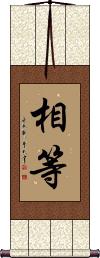
相等 is a Chinese and Japanese word that means equal, equally, equivalent, equality, or the state of being equal.
Home is where the heart is
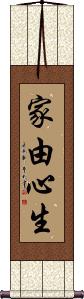
家由心生 is an old Chinese proverb that is roughly equal to the English idiom “Home is where the heart is.”
If you know Chinese, you may recognize the first character as home and the third as the heart.
Uniform / Complete / Perfect / Order
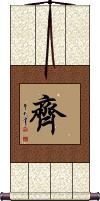
齊 is a single Chinese character that can mean: neat; even; level with; identical; simultaneous; altogether; to even something out; equal; uniform; complete; perfect; equalize; alike; at the same time; altogether.
齊 is used in the typical Chinese language as well as in Chinese Buddhism. It also has the same meaning in old Korean Hanja.
Chinese Note: This can be Qi or Chi kingdom in China during the Spring and Autumn Period and the Period of the Warring States. It can also be the Chinese surname Qi or Chi.
Japanese Note: In Japanese, this Kanji is usually read as a male given name romanized as Hitoshi (there are other Hitoshi characters) or the Chinese kingdom of Qi / Chi.
it’s
not often understood in Japanese with the same meaning described above. Thus, this character is best if your audience is Chinese.
Life in Balance / Balancing Life
The art of balancing your life
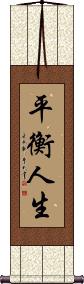
This 平衡人生 title suggests that you are actively trying to keep your life in balance.
Think of this as the action verb of seeking or having a balanced life.
The first two characters mean balance, equilibrium, or keeping things equal.
The last two characters mean “life.” Literally “human life.”
Win / Victory
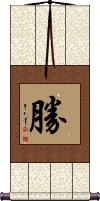
勝 is a single character that means to win or be victorious.
This can also be translated: To overcome; success; to beat; to defeat; to surpass; superior to; to get the better of; better than; surpassing; superb.
In another context, this can mean beautiful (scenery); scenic spot; or scenic beauty.
In Taiwanese Mandarin, this can be pronounced with the first tone (sheng1) and mean: Able to bear; equal to (a task).
In Japan, this can also be the name Masaru.
In Korea, this has the same meaning but can also be the surname Sŭng.
Peace and Tranquility
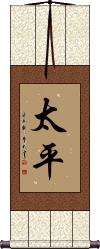
太平 means “peace and tranquility” or “peace and security” in Chinese, Japanese Kanji, and old Korean Hanja.
The literal translation would be “very balanced” or “very peaceful.”
The first character means very, much, too much, or extremely.
The second character means balanced, peaceful, calm, equal, even, level, or smooth.
Learn from Wisdom
(When you see a wise person, try to be like them)
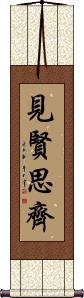
When you meet a wise person, you should learn from them and be inspired to become as wise as they are.
見賢思齊 is a pretty long proverb in English, but in Chinese, it's only four characters.
However, in Chinese, the deeper meaning often surpasses the dictionary definition of each character.
In this case, you should seek wise people to learn from throughout your life...
Always try to learn enough to become equal to them. It also suggests that learning and seeking wisdom is a non-ending cycle.
See Also: Knowledge
No Guts, No Glory
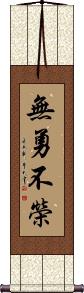
While difficult to translate “No guts no glory,” into Mandarin Chinese, 無勇不榮 is kind of close.
The first two characters mean “without bravery,” or “without courage.” In this case, bravery/courage is a stand-in for “guts.”
The last two characters mean “no glory.”
The idea that guts (internal organs) are somehow equal to courage, does not crossover to Chinese. However, translating the phrase back from Chinese to English, you get, “No Courage, No Glory,” which is pretty close to the intended idea.
Balance / Peace
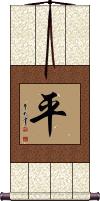
平 is a single character that means balance in Chinese but it's not too direct or too specific about what kind of balance.
Chinese people often like calligraphy art that is a little vague or mysterious. In this way, you can decide what it means to you, and you'll be right.
平 is also part of a word that means peace in Chinese, Japanese, and old Korean.
Some alternate translations of this single character include: balanced, peaceful, calm, equal, even, level, smooth, or flat.
Note that in Japanese, this just means “level” or “flat” by itself (not the best choice for balance if your audience is Japanese).
Dynasty
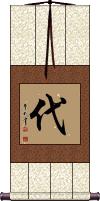
代 is the word used to designate dynasties in Asia.
代 alone can mean generation; age; period; historical era; eon; world; society; reign; era. 代 comes after the name of the dynasty, for example, the Tang Dynasty is the “Tang Dai” in Chinese.
Some have suggested that the word dynasty comes from the Chinese word “dai” (as “dai” sounds like the first syllable of a dynasty). However, the word dynasty is derived from the Greek word δυναστεία (dunasteia) meaning lordship and/or domination.
Sometimes this word is used in a different context where it can mean to represent or substitute. In this case, it can mean representative of; on behalf of; acting for, e.g. to offer incense in place of another.
In ancient Japan, this could also be a “shiro” (a unit of land area equal to one-fiftieth of a tan or about 20 square miles).
These search terms might be related to Equal:
A Journey of 1000 Miles Feels Like One
Be Like Water
Even a Fool May Sometimes Come Up With a Good Idea
Even an Iron Bar Can Be Ground to a Needle
Even Monkeys Fall From Trees
Even the 100-Foot Bamboo Can Grow One More Foot
If You Have Not Been a Monk, How Can You Know What It is Like to Be a Vegetarian?
Mind Like Water
No Place Like Home
One Day Seems Like 1000 Years
Peer
Same / Similar / Alike
There’s No Place Like Home
To Come / to Arrive
Tsuki No Kokoro / Mind Like the Moon
Uniform / Complete / Perfect / Order
Walking 100 Miles: Stopping at 90 Miles, is the Same as Stopping Half-Way
The following table may be helpful for those studying Chinese or Japanese...
| Title | Characters | Romaji (Romanized Japanese) | Various forms of Romanized Chinese | |
| Equality | 相等 | soutou / soto soto / soto | xiāng děng xiang1 deng3 xiang deng xiangdeng | hsiang teng hsiangteng |
| Home is where the heart is | 家由心生 | jiā yóu xīn shēng jia1 you2 xin1 sheng1 jia you xin sheng jiayouxinsheng | chia yu hsin sheng chiayuhsinsheng |
|
| Uniform Complete Perfect Order | 齊 齐 | hitoshi / hitoshi | qí / qi2 / qi | ch`i / chi |
| Life in Balance Balancing Life | 平衡人生 | hei kou jin sei heikoujinsei hei ko jin sei | píng héng rén shēng ping2 heng2 ren2 sheng1 ping heng ren sheng pinghengrensheng | p`ing heng jen sheng pinghengjensheng ping heng jen sheng |
| Win Victory | 勝 胜 | shou / sho | shèng / sheng4 / sheng | |
| Peace and Tranquility | 太平 | tai hei / taihei | tài píng / tai4 ping2 / tai ping / taiping | t`ai p`ing / taiping / tai ping |
| Learn from Wisdom | 見賢思齊 见贤思齐 | jiàn xián sī qí jian4 xian2 si1 qi2 jian xian si qi jianxiansiqi | chien hsien ssu ch`i chienhsienssuchi chien hsien ssu chi |
|
| No Guts, No Glory | 無勇不榮 无勇不荣 | wú yǒng bù róng wu2 yong3 bu4 rong2 wu yong bu rong wuyongburong | wu yung pu jung wuyungpujung |
|
| Balance Peace | 平 | hira | píng / ping2 / ping | p`ing / ping |
| Dynasty | 代 | dai | dài / dai4 / dai | tai |
| In some entries above you will see that characters have different versions above and below a line. In these cases, the characters above the line are Traditional Chinese, while the ones below are Simplified Chinese. | ||||

Successful Chinese Character and Japanese Kanji calligraphy searches within the last few hours...



