Many custom options...


And formats...



Giving in Chinese / Japanese...
Buy a Giving calligraphy wall scroll here!
Personalize your custom “Giving” project by clicking the button next to your favorite “Giving” title below...
1. Walking 100 Miles: Stopping at 90 miles, is the same as stopping half-way
2. Caring
3. Generosity
4. Man of Remarkable Character / Hero
5. Charity
6. Excellence
8. God Bless You / May God Protect You
10. Pure Heart
12. Brahmavihara - The Four Immeasurables
13. Dripping Water Penetrates Stone
14. The Spirit of the Dragon Horse and Power of a Tiger
15. Always Striving for Inner Strength
16. Glory and Honor
20. The Spirit of the Dragon Horse
21. Dana: Almsgiving and Generosity
22. Commitment
23. Mercy / Compassion / Buddhist Loving Kindness
Walking 100 Miles: Stopping at 90 miles, is the same as stopping half-way
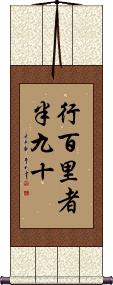
行百里者半九十 is an old Chinese proverb that speaks to the act of giving up. This phrase suggests that no matter how close you are to finishing your task or journey, giving up just before you finish is just as bad as giving up halfway.
50% finished or 90% finished, the result is the same: “You are not finished.”
You can take what you want from this proverb, but I think it suggests that you should finish what you start, and especially finish that last 10% of your journey or project so that you can honestly say “it's finished.”
Some notes: The character, 里, that I am translating as “mile” is an ancient “Chinese mile” which is actually about half a kilometer - it just doesn't sound right to say “When walking 100 half-kilometers...”
Caring
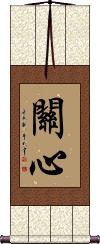
關心 means caring in Chinese.
Caring is giving love and attention to people and things that matter to you and anyone who needs help. When you care about people, you help them. You do a careful job, giving your very best effort. You treat people and things gently and respectfully. Caring makes the world a safer place.
Note: 關心 is also a word in Korean Hanja, but in Korean, it means taking interest or concern. In Korean, it's still a good word, but it doesn't quite have the “caring for a person” meaning that it does in Chinese.
See Also: Benevolence | Altruism
Generosity
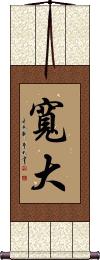
寬大 is a Chinese, Japanese, and Korean word that means Generosity.
Generosity is giving and sharing. You share freely, not with the idea of receiving something in return. You find ways to give others happiness and give just for the joy of giving. Generosity is one of the best ways to show love and friendship.
寬大 can also be translated as charitable, magnanimity, liberality, or in some contexts, broad-mindedness.
Note: There is a tiny deviation in the first character when written in Japanese. If you choose our Japanese master calligrapher, the little dot on the lower right of the first character will be omitted. With or without the dot, this can be read in Chinese, Japanese Kanji, and old Korean Hanja.
See Also: Benevolence | Altruism | Charity
Man of Remarkable Character / Hero
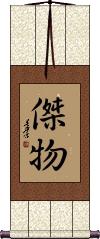
傑物 is a Japanese title that can mean “great man,” “heroic figure,” or “remarkable character.”
You would be giving someone a great honor by presenting this wall scroll to them as a gift.
Charity
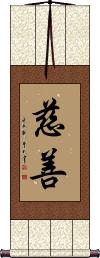
There are a few different words used to express charity in Chinese characters, Japanese Kanji and old Korean Hanja but 慈善 is the most common.
Some of the other words describe acts such as “giving alms” etc.
Note: Sometimes this is translated as benevolence or benevolent.
Also, this considered to be one of the Seven Heavenly Virtues.
If you need a different meaning, just contact me.
See Also: Benevolence | Altruism
Excellence
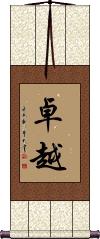
Release of Desires
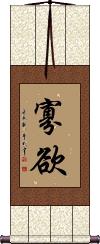
寡欲 is a Buddhist word meaning unselfishness, wanting little, giving up desires, or achieving a reduction of desires in one's life.
When one achieves this, one has a more content and happy life.
God Bless You / May God Protect You
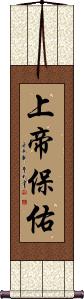
上帝保佑 is a blessing exchanged between Chinese Christians.
The first two characters mean God (The God of Zion). The second two characters express the idea of giving protection. Another way to translate this is “May God protect you.”
See Also: Guardian Angel
Life-Saving Sword
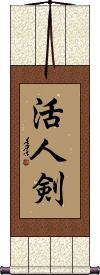
活人剣 is a Japanese title for “life-saving sword” or “katsujinken.”
This title suggests that a sword used for killing can also be used for saving or giving life.
See Also: Satsujinken
Pure Heart
Pure and Innocent
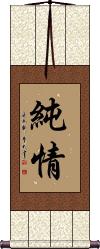
純情 means “Pure Heart” in Chinese, Japanese Kanji, and old Korean Hanja.
It's used to reflect the ideas of being “pure and innocent.”
Depending on the context in which this title is used, it can relay “self-sacrificing devotion” or, in some cases, “naïveté.”
This would be in the same way we might refer to a young girl giving her lunch money to a beggar on the street. She has a pure and precious heart but perhaps is also a bit naive.
Respect / Honor / Esteem
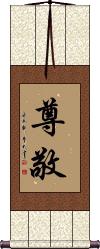
尊敬 is how to express the ideas of respect, honor, reverence, esteem, nobility, and sometimes the state of being noble, all in one word. Most of the time, this is used as “giving respect,” but depending on the context, it can suggest that you should try to be “worthy of respect.”
Although pronounced differently, the Chinese characters, Japanese Kanji, and Korean Hanja are the same across these languages. This is an indication that this word is very old and crosses many barriers and cultures in the Orient (East Asia).
Brahmavihara - The Four Immeasurables
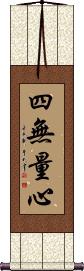
四無量心 is the cattāri brahmavihārā or catvāri apramāṇāni.
The four immeasurables, or infinite Buddha-states of mind. These four dhyānas include:
1. 慈無量心 boundless kindness, maitrī, or bestowing of joy or happiness.
2. 悲無量心 boundless pity, karuṇā, to save from suffering.
3. 喜無量心 boundless joy, muditā, on seeing others rescued from suffering.
4. 捨無量心 limitless indifference, upekṣā, i.e., rising above these emotions or giving up all things.
Dripping Water Penetrates Stone
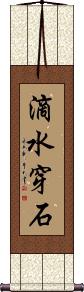
滴水穿石 is a Chinese proverb that means, dripping water penetrates stone.
The figurative meaning can be translated as:
Constant perseverance yields success.
You can achieve your aim if you try hard without giving up.
Persistent effort overcomes any difficulty.
While 滴水穿石 is the most common character order, you will likely see 水滴石穿, might see 滴水石穿, and will rarely see 小水穿石 in the wild.
The Spirit of the Dragon Horse and Power of a Tiger
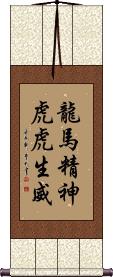
龍馬精神虎虎生威 is an old proverb that is used to wish someone great health and success combined as a great compliment.
The meaning is “The vigor and spirit of the legendary dragon-horse and the power and prestige of the tiger.”
By giving a wall scroll like this to someone, you were either wishing or telling them that they have these qualities. There is also a suggestion of good health - at least anyone with the vigor of a dragon horse would seem to also be in good health.
Always Striving for Inner Strength
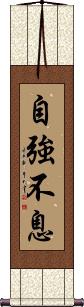
自強不息 is a proverb or idiom that suggests that the pursuit of self-improvement is eternal. It can also be a suggestion to strive unremittingly in life.
The first two characters mean inner strength with the idea of self-improvement. The last two characters mean “never rest” or “striving without giving up.”
Some will translate these four characters as “Exert and strive hard without any let-up.”
Glory and Honor
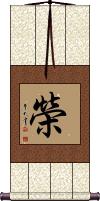
榮 relates to giving someone a tribute or praise.
It's a little odd as a gift, so this may not be the best selection for a wall scroll.
I've made this entry because this character is often misused as “honorable” or “keeping your honor.” It's not quite the same meaning, as this usually refers to a tribute or giving an honor to someone.
榮 is often found in tattoo books incorrectly listed as the western idea of personal honor or being honorable. Check with us before you get a tattoo that does not match the meaning you are really looking for. As a tattoo, this suggests that you either have a lot of pride in yourself or that you have a wish for prosperity for yourself and/or your family.
 In modern Japanese Kanji, glory and honor look like the image to the right.
There is a lot of confusion about this character, so here are some alternate translations for this character: prosperous, flourishing, blooming (like a flower), glorious beauty, proud, praise, rich, or it can be the family name “Rong.” The context in which the character is used can change the meaning between these various ideas.
In the old days, this could be an honor paid to someone by the Emperor (basically a designation by the Emperor that a person has high standing).
To sum it up: 榮 has a positive meaning; however, it's a different flavor than the idea of being honorable and having integrity.
Sworn Friend / Ally
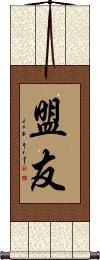
盟友 means a sworn friend or ally. If you stand on the same side of an issue with someone and perhaps fight for the same cause together, this is the term you would use to describe such a partner.
There may not be a personal relationship, as this term is also used to describe whole countries that make a coalition or fight against a common enemy.
This would be most appropriate if you are a high-level military officer, giving this wall scroll to an officer of another country as you join forces together and go to war.
Goodness / Good Deed
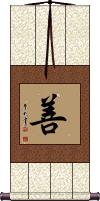
善 means goodness, virtue, good deed, charitable, benevolent, well-disposed, nice, pleasant, kind, or simply, “good.”
善 is the kind of good that applies to someone's good character, or a good person in general.
Referring to someone with this word means that they have a well-aimed moral compass, and are charitable, giving, wise, and honest. Basically, this is a blanket statement for every good trait a human can have or all the things that make someone good.
In another context, it can mean to improve or perfect something or refer to someone who is good at something.
Life Of A Samurai

The 12th century phrase, 一所懸命 (Issho Kenmei) is often referred to as “Life Of A Samurai.”
Breaking it down:
一 = one
所 = place
懸 = devote
命 = life
一所懸命 literally means “to stake your life on one place.” Today, Japanese people use it to mean giving your full effort to something.
Other translations of 一所懸命 include: Very hard, with utmost effort, as hard as one can, with all one's might, for dear life, eagerly, and/or desperately.
In the context of the Samurai, it is devoting oneself to the defense of one's territory.
Originally 一生懸命 meaning “to stake your life on one birth.”
The Spirit of the Dragon Horse
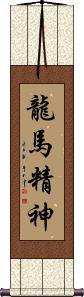
龍馬精神 is an old proverb that is used to wish someone good health and success combined as a great compliment.
The meaning is “The vigor and spirit of the legendary dragon-horse.” These four characters are often accompanied by four more which mean “...and the power and prestige of the tiger.” Here we are just offering the first part which is considered the short version.
By giving a wall scroll like this to someone, you were either wishing or telling them that they have an amazing quality. There is also a suggestion of good health - at least anyone with the vigor of a dragon horse would seem to also be in good health.
Note: In Japanese, this would be read as the spirit of 坂本龍馬 (Sakamoto_Ryōma), a beloved rebel who help abolish the old Japanese feudal system. This can be confusing, so I am declaring this proverb to be Chinese only.
Dana: Almsgiving and Generosity
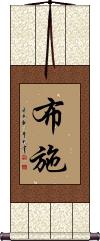
布施 is the Buddhist practice of giving known as Dāna or दान from Pali and Sanskrit.
Depending on the context, this can be alms-giving, acts of charity, or offerings (usually money) to a priest for reading sutras or teachings.
Some will put Dāna in these two categories:
1. The pure or unsullied charity, which looks for no reward here but only in the hereafter.
2. The sullied almsgiving whose object is personal benefit.
The first kind is, of course, the kind that a liberated or enlightened person will pursue.
Others will put Dāna in these categories:
1. Worldly or material gifts.
2. Unworldly or spiritual gifts.
You can also separate Dāna into these three kinds:
1. 財布施 Goods such as money, food, or material items.
2. 法布施 Dharma, as an act to teach or bestow the Buddhist doctrine onto others.
3. 無畏布施 Courage, as an act of facing fear to save someone or when standing up for someone or standing up for righteousness.
The philosophies and categorization of Dāna will vary among various monks, temples, and sects of Buddhism.
Breaking down the characters separately:
布 (sometimes written 佈) means to spread out or announce, but also means cloth. In ancient times, cloth or robs were given to the Buddhist monks annually as a gift of alms - I need to do more research, but I believe there is a relationship here.
施 means to grant, to give, to bestow, to act, to carry out, and by itself can mean Dāna as a single character.
Dāna can also be expressed as 檀那 (pronounced “tán nà” in Mandarin and dan-na or だんな in Japanese). 檀那 is a transliteration of Dāna. However, it has colloquially come to mean some unsavory or unrelated things in Japanese. So, I think 布施 is better for calligraphy on your wall to remind you to practice Dāna daily (or whenever possible).
Commitment
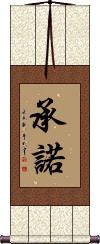
承諾 embodies the idea of commitment but also means to make a big effort or to undertake a great task.
Commitment is caring deeply about something or someone. It is deciding carefully what you want to do and then giving it 100%, holding nothing back. You give your all to a friendship, a task, or something you believe in. You finish what you start. You keep your promises.
In Chinese, this word directly means to undertake something or to make a promise to do something.
Outside of the commitment idea, this particular word can also mean approval, acceptance, consent, assent, acquiescence, or agreement, depending on context (especially in Japanese and Korean). Therefore, this word is probably best if your audience is Chinese.
See Also: Partnership | Hard Work | Dedication
Mercy / Compassion / Buddhist Loving Kindness
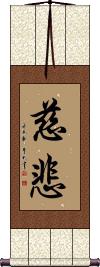
Besides the title above, 慈悲 can also be defined as clemency or lenience and sometimes the act of giving charity.
In the Buddhist context, it can be defined as “benevolence,” “loving-kindness and compassion,” or “mercy and compassion.”
This Buddhist virtue is perhaps the most important to employ in your life. All sentient beings that you encounter should be given your loving kindness. And trust me, however much you can give, it comes back. Make your life and the world a better place!
This Chinese/Japanese Buddhist term is the equivalent of Metta Karuna from Pali or Maitri Karuna from Sanskrit.
慈 can mean loving-kindness by itself.
悲 adds a component of sorrow, empathy, compassion, and sympathy for others.
See Also: Benevolence
Seven Heavenly Virtues
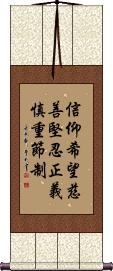
信仰希望慈善堅忍正義慎重節制 is a list in Chinese and Japanese Kanji of an interpretation of the Seven Heavenly Virtues.
1. Faith is belief in God, and the right virtues.
2. Hope is taking a positive future view that good will prevail.
3. Charity is a concern for, and active helping of, others.
4. Fortitude is never giving up.
5. Justice is being fair and equitable with others.
6. Prudence is care of and moderation with money.
7. Temperance is moderation of needed things and abstinence from things that are not needed.
The full list is here. 信仰希望慈善堅忍正義慎重節制 is a word list, not a common phrase. While all Chinese and Japanese people will recognize the words in the list, they may not understand what the list is about (unless they are familiar with the Seven Heavenly Virtues).
don’t get this as a tattoo or anything like that without first consulting a native translator in the target language. These are fine for a wall scroll but a long discussion is needed before you commit to this for a lifetime inking commitment.
Kowtow - The deepest bow
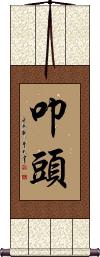
叩頭 is the term that seems to be known worldwide as kowtow.
In Japanese and Chinese, it simply means a deep bow, especially one so low that one's head touches the ground in submission. However, in western culture, it has sometimes come to mean “giving in” or “surrendering to someone else's will.” Sometimes even said of a person who stoops to flattery at the expense of their dignity.
I don't know if you would really want this on a wall scroll, but enough people have searched for this term on our website that I guess it was time to add it. It just feels strange to see such a word on a wall scroll, so please order with caution. 叩頭 is antiquated in both Japanese and Chinese. The act is seldom done anymore and is seen as an ancient ritual.
Sacrifice / Devotion / Dedication
(complete bodily devotion)
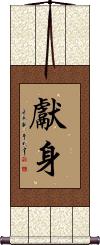
獻身 is used to describe being so devoted to something that you will make sacrifices for that goal/thing/person.
You can also translate this word as any of the following:
Sacrifice one's life for...
To dedicate oneself to...
Self-devotion
Dedication
Devote to...
Self-sacrifice
Giving your whole body to...
This can be a dedication to or for someone but is often used as a dedication or making sacrifices for your country, public service, or a cause. For instance, an Olympic athlete makes great sacrifices to train in his/her sport for their country and compatriots.

 While the form shown to the upper-left is considered an ancient Japanese version, in modern Japan, they use the simplified version of the first Kanji (shown to the right). Click on the Kanji at the right instead of the button above if you want this modern Japanese version.
If you are looking for a more religious meaning of devotion, see Faith.
See Also: Confidence | Dedication
Ultimate Loyalty to Your Country
The most famous tattoo in Chinese history
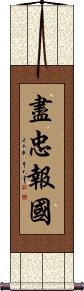
盡忠報國 is a proverb that is the tattoo worn on the back of Yue Fei, a famous Chinese warrior who lived until 1142 A.D.
The tattoo can be translated as “Serve the country with the utmost loyalty.” More literally, it means “[The] Ultimate Loyalty [is too] Duty [of] Country.”
Legend has it that this tattoo once saved his life when he was accused of treason.
The first two characters have come to create a word that means “serve the country faithfully” or “die for the country.” Note: It's more a willingness to die for one's country than the actual act of dying.
The last two characters have come to mean “Dedicate oneself to the service of one's country.”
Both of these words are probably only in the Chinese lexicon because of this famous tattoo.
If you break it down, character-by-character, here is what you get:
1. To the utmost, to the limit of something, the ultimate.
2. Loyalty or duty (a sense of duty to one's master, lord, country, or job).
3. Report, recompense, give back to (in this case, you are giving yourself to your country as payback).
4. Country, state, nation, kingdom.
These search terms might be related to Giving:
Benevolent and Skilled Doctor
Benevolent Heart
Benevolent Love
Compassionate Heart / Benevolent Heart
The following table may be helpful for those studying Chinese or Japanese...
| Title | Characters | Romaji (Romanized Japanese) | Various forms of Romanized Chinese | |
| Walking 100 Miles: Stopping at 90 miles, is the same as stopping half-way | 行百里者半九十 | xíng bǎi lǐ zhě bàn jiǔ shí xing2 bai3 li3 zhe3 ban4 jiu3 shi2 xing bai li zhe ban jiu shi xingbailizhebanjiushi | hsing pai li che pan chiu shih hsingpailichepanchiushih |
|
| Caring | 關心 关心 | guān xīn / guan1 xin1 / guan xin / guanxin | kuan hsin / kuanhsin | |
| Generosity | 寬大 宽大 | kandai | kuān dà / kuan1 da4 / kuan da / kuanda | k`uan ta / kuanta / kuan ta |
| Man of Remarkable Character Hero | 傑物 杰物 | ketsubutsu | ||
| Charity | 慈善 | ji zen / jizen | cí shàn / ci2 shan4 / ci shan / cishan | tz`u shan / tzushan / tzu shan |
| Excellence | 卓越 | taku etsu / takuetsu | zhuó yuè / zhuo2 yue4 / zhuo yue / zhuoyue | cho yüeh / choyüeh |
| Release of Desires | 寡欲 | keyoku | guǎ yù / gua3 yu4 / gua yu / guayu | kua yü / kuayü |
| God Bless You May God Protect You | 上帝保佑 | shàng dì bǎo yòu shang4 di4 bao3 you4 shang di bao you shangdibaoyou | shang ti pao yu shangtipaoyu |
|
| Life-Saving Sword | 活人剣 | katsu jin ken katsujinken | ||
| Pure Heart | 純情 纯情 | jun jou / junjou / jun jo | chún qíng chun2 qing2 chun qing chunqing | ch`un ch`ing chunching chun ching |
| Respect Honor Esteem | 尊敬 | sonkei | zūn jìng / zun1 jing4 / zun jing / zunjing | tsun ching / tsunching |
| Brahmavihara - The Four Immeasurables | 四無量心 四无量心 | shi mur you shin shimuryoushin shi mur yo shin | sì wú liàng xīn si4 wu2 liang4 xin1 si wu liang xin siwuliangxin | ssu wu liang hsin ssuwulianghsin |
| Dripping Water Penetrates Stone | 滴水穿石 | dī shuǐ chuān shí di1 shui3 chuan1 shi2 di shui chuan shi dishuichuanshi | ti shui ch`uan shih tishuichuanshih ti shui chuan shih |
|
| The Spirit of the Dragon Horse and Power of a Tiger | 龍馬精神虎虎生威 龙马精神虎虎生威 | lóng mǎ jīng shén hǔ hǔ shēng wēi long2 ma3 jing1 shen2 hu3 hu3 sheng1 wei1 long ma jing shen hu hu sheng wei | lung ma ching shen hu hu sheng wei | |
| Always Striving for Inner Strength | 自強不息 自强不息 | zì qiáng bú xī zi4 qiang2 bu2 xi1 zi qiang bu xi ziqiangbuxi | tzu ch`iang pu hsi tzuchiangpuhsi tzu chiang pu hsi |
|
| Glory and Honor | 榮 荣 / 栄 | ei | róng / rong2 / rong | jung |
| Sworn Friend Ally | 盟友 | meiyuu / meiyu | méng yǒu / meng2 you3 / meng you / mengyou | meng yu / mengyu |
| Goodness Good Deed | 善 | zen | shàn / shan4 / shan | |
| Life Of A Samurai | 一所懸命 | issho kenmei isshokenmei isho kenmei | ||
| The Spirit of the Dragon Horse | 龍馬精神 龙马精神 | lóng mǎ jīng shén long2 ma3 jing1 shen2 long ma jing shen longmajingshen | lung ma ching shen lungmachingshen |
|
| Dana: Almsgiving and Generosity | 布施 | fuse | bù shī / bu4 shi1 / bu shi / bushi | pu shih / pushih |
| Commitment | 承諾 承诺 | shoudaku / shodaku | chéng nuò cheng2 nuo4 cheng nuo chengnuo | ch`eng no chengno cheng no |
| Mercy Compassion Buddhist Loving Kindness | 慈悲 | ji hi / jihi | cí bēi / ci2 bei1 / ci bei / cibei | tz`u pei / tzupei / tzu pei |
| Seven Heavenly Virtues | 信仰希望慈善堅忍正義慎重節制 信仰希望慈善坚忍正义慎重节制 | shinkou kibou jizen kennin seigi shinchou sessei shinko kibo jizen kennin seigi shincho sesei | xìn yǎng xī wàng cí shàn jiān rěn zhèng yì shèn zhòng jié zhì xin4 yang3 xi1 wang4 ci2 shan4 jian1 ren3 zheng4 yi4 shen4 zhong4 jie2 zhi4 xin yang xi wang ci shan jian ren zheng yi shen zhong jie zhi | hsin yang hsi wang tz`u shan chien jen cheng i shen chung chieh chih hsin yang hsi wang tzu shan chien jen cheng i shen chung chieh chih |
| Kowtow - The deepest bow | 叩頭 叩头 | koutou / koto | kòu tóu / kou4 tou2 / kou tou / koutou | k`ou t`ou / koutou / kou tou |
| Sacrifice Devotion Dedication | 獻身 献身 | ken shin / kenshin | xiàn shēn xian4 shen1 xian shen xianshen | hsien shen hsienshen |
| Ultimate Loyalty to Your Country | 盡忠報國 尽忠报国 | jìn zhōng bào guó jin4 zhong1 bao4 guo2 jin zhong bao guo jinzhongbaoguo | chin chung pao kuo chinchungpaokuo |
|
| In some entries above you will see that characters have different versions above and below a line. In these cases, the characters above the line are Traditional Chinese, while the ones below are Simplified Chinese. | ||||

Successful Chinese Character and Japanese Kanji calligraphy searches within the last few hours...



