Many custom options...


And formats...



Hands in Chinese / Japanese...
Buy a Hands calligraphy wall scroll here!
Personalize your custom “Hands” project by clicking the button next to your favorite “Hands” title below...
4. Rose Flowers Given, Frangrance Remains on Hands of Giver
5. Hold Hands with You, Grow Old with You
6. Kempo Karate / Law of the Fist Empty Hand
7. Tang Hand
8. Tang Soo Do / Tang Hand Way
9. Hand-to-Hand Fighting / Grappling
Healing Hands
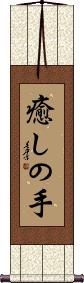
癒しの手 can be translated as “healing hands” in Japanese.
The first two characters mean healing, to heal, to cure, soothing, therapy, comfort, and solace.
The third character is a possessive particle that connects the ideas.
The last Kanji means hand or hands.
Note: Because this selection contains some special Japanese Hiragana characters, it should be written by a Japanese calligrapher.
Healing Hands
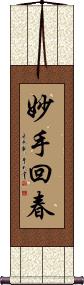
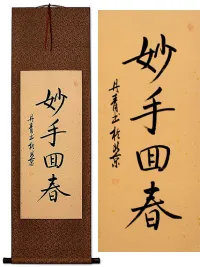
妙手回春 can be translated as “healing hands.”
The first two characters are used to describe a doctor or medical professional who has admirable skills in curing disease. Literally: Wonderful or skilled hands.
The last two characters mean “Springing back to life.”
Altogether, it suggests that these skilled hands can cure whatever ails you and bring you back to life. 妙手回春 is a great honor to bestow on your doctor or other healthcare professionals that have helped you.
Pushing Hands / Tui Sau
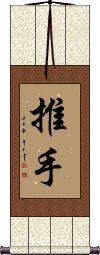
推手 is the martial arts title “Pushing Hands.”
推手 is the title for two-person training routines practiced in internal Chinese martial arts such as Baguazhang, Xingyiquan, Tai Chi Chuan (Taijiquan), Liuhebafa, Chuan Fa, and Yiquan.
The first character means “pushing.”
The second character means “hand” (or “hands”).
This term can be romanized as “Tui Sau,” “Tui Sao,” or from Mandarin, “Tui Shou.”
If you are looking for this term, chances are, you already know the meaning within the context of Tai Chi and other martial arts.
Sticky Hands / Chi Sau
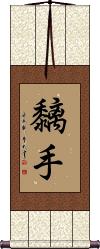
The first character means “wood glue” or can be understood as “sticky” or “sticking.”
The second character means “hand” (or “hands”).
This term can be romanized as “Chi Sau,” “Chi Sao,” or from Mandarin, “Chi Shou.”
黐手 is a concept that comes from the Wing Chun (AKA: Ving Tsun, Wing Tsun, or Yong Chun) style of martial arts. If you are looking for this term, chances are, you already know the meaning within the context of Wing Chun.
Rose Flowers Given, Frangrance Remains on Hands of Giver
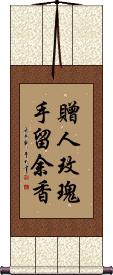
赠人玫瑰手留余香 is a proverb that has been translated several ways:
1. Roses given, fragrance in hand.
2. You present others roses, and the fragrance remains.
3. The fragrance of the rose always remains on the hand of those that bestow them.
4. A little bit of fragrance always clings to the hands which gives the flowers
However, this literally translates as “Give someone rose flowers, [your] hands keep [the] remaining fragrance.”
Hold Hands with You, Grow Old with You
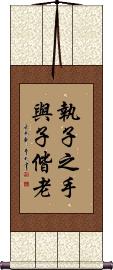
執子之手, 與子偕老 is a sweet Chinese phrase that means “Hold hands with you, grow old with you.”
Kempo Karate / Law of the Fist Empty Hand
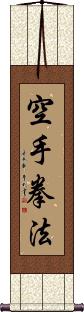
空手拳法 is the Kanji title for Kempo Karate.
The first two characters mean “karate” - technically they express “empty hand.”
The last two express “fist law” which is Romanized from Japanese as “Kenpo” or “Kempo.”
That “empty hand” translation can be understood better when you grasp the idea that karate is a martial art without weapons (other than the weapons organic to your body, such as your foot, hand, fist, etc). When you practice karate, you do so with empty hands (no weapons).
Note: There is also an antiquated way to write karate. It has the same pronunciation but a different first character which means “Tang” as in the Tang Dynasty. Some dojos use that form - let us know if you need that alternate form, and we'll add it.
Tang Hand
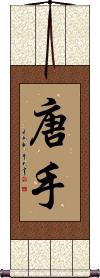
唐手 is a very seldom-used title for Karate.
This title uses a character that represents the Tang Dynasty of China. Thus, this is often translated as the “Tang Hand” or, incorrectly, “Tang Fist.”
I have also seen some call it “China Hand.”
There is not a lot of information on this title but some believe that a simplified form of Kung Fu that started in China, and ended up very popular in Japan used this title initially. It was later changed in Japan to a different Karate title which means "Empty Hand" (as in, without weapons).
I am sure that some will suggest a different history or argue a different origin. I think that nobody can be sure.
Note: Just like the more conventional Karate title, this one can have the "way" or "method" character added to the end, as in Karate-Do.
Tang Soo Do / Tang Hand Way
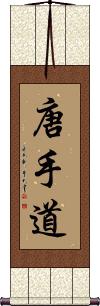
唐手道 is the alternate title for Karate-do.
This title uses a character, 唐, which represents the Tang Dynasty of China. Thus, this is often translated as the “Tang Hand Way” or incorrectly, “Tang Fist Way.”
I have also seen some call it “China Hand Way.”
Many in Korea refer to and romanize these characters as “Tang Soo Do” (당수도) where these characters refer to a kind of Korean style of Karate.
There is not a lot of information on this title but some believe that a simplified form of Kung Fu that started in China and ended up very popular in Japan used this title initially. It was later changed in Japan to a different Karate title which means “Empty Hand” (as in, without weapons).
Note: When used in Korean, this is pronounced 당수도. This title is often romanized as “Tang Soo Do,” “Tangsudo,” “Dang Su Do,” or “Dangsudo.” The last two romanizations on that list are the official Korean government romanization, though martial arts schools tend to use other non-standard versions.
Hand-to-Hand Fighting / Grappling
Kakuto
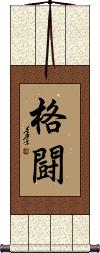
挌闘 is a Japanese word that means hand-to-hand fighting, grappling, or scuffling.
In the old days, this might refer to a street fight but now it can apply to martial arts and MMA techniques or bouts.
Sometimes written as 挌闘 instead of 格闘 (first Kanji varies slightly)
Always with a Book in Hand
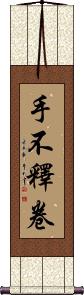
手不釋卷 is a Chinese proverb that literally means “always with a book in hand.”
It's a proverb said of a hardworking scholar or student.
This may refer to a student or scholar who is diligent and hardworking. It's a great gift for a student or scholar who loves books.
I give you my hand
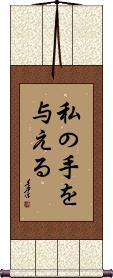
私の手を与える means “I give you my hand,” in Japanese.
Note: Because this selection contains some special Japanese Hiragana characters, it should be written by a Japanese calligrapher.
This in-stock artwork might be what you are looking for, and ships right away...

Gallery Price: $200.00
Your Price: $95.88
The following table may be helpful for those studying Chinese or Japanese...
| Title | Characters | Romaji (Romanized Japanese) | Various forms of Romanized Chinese | |
| Healing Hands | 癒しの手 | iyashi no te iyashinote | ||
| Healing Hands | 妙手回春 | miào shǒu huí chūn miao4 shou3 hui2 chun1 miao shou hui chun miaoshouhuichun | miao shou hui ch`un miaoshouhuichun miao shou hui chun |
|
| Pushing Hands Tui Sau | 推手 | tuī shǒu / tui1 shou3 / tui shou / tuishou | t`ui shou / tuishou / tui shou | |
| Sticky Hands Chi Sau | 黐手 | chī shǒu / chi1 shou3 / chi shou / chishou | ch`ih shou / chihshou / chih shou | |
| Rose Flowers Given, Frangrance Remains on Hands of Giver | 贈人玫瑰手留余香 赠人玫瑰手留余香 | zèng rén méi guī shǒu liú yú xiāng zeng4 ren2 mei2 gui1 shou3 liu2 yu2 xiang1 zeng ren mei gui shou liu yu xiang | tseng jen mei kuei shou liu yü hsiang | |
| Hold Hands with You, Grow Old with You | 執子之手與子偕老 执子之手与子偕老 | zhí zǐ zhī shǒu yǔ zǐ xié lǎo zhi2 zi3 zhi1 shou3 yu3 zi3 xie2 lao3 zhi zi zhi shou yu zi xie lao zhizizhishouyuzixielao | chih tzu chih shou yü tzu hsieh lao | |
| Kempo Karate Law of the Fist Empty Hand | 空手拳法 | kara te ken pou karatekenpou kara te ken po | kōng shǒu quán fǎ kong1 shou3 quan2 fa3 kong shou quan fa kongshouquanfa | k`ung shou ch`üan fa kungshouchüanfa kung shou chüan fa |
| Tang Hand | 唐手 | kara te / karate | táng shǒu tang2 shou3 tang shou tangshou | t`ang shou tangshou tang shou |
| Tang Soo Do Tang Hand Way | 唐手道 | kara te do / karatedo | táng shǒu dào tang2 shou3 dao4 tang shou dao tangshoudao | t`ang shou tao tangshoutao tang shou tao |
| Hand-to-Hand Fighting Grappling | 格闘 / 挌闘 格闘 | kakutou / kakuto kakuto / kakuto | ||
| Always with a Book in Hand | 手不釋卷 手不释卷 | shǒu bù shì juàn shou3 bu4 shi4 juan4 shou bu shi juan shoubushijuan | shou pu shih chüan shoupushihchüan |
|
| I give you my hand | 私の手を與える 私の手を与える | watashi no te o ataeru watashinoteoataeru | ||
| In some entries above you will see that characters have different versions above and below a line. In these cases, the characters above the line are Traditional Chinese, while the ones below are Simplified Chinese. | ||||

Successful Chinese Character and Japanese Kanji calligraphy searches within the last few hours...



