Many custom options...


And formats...



Not what you want?
Try other similar-meaning words, fewer words, or just one word.
High Character in Chinese / Japanese...
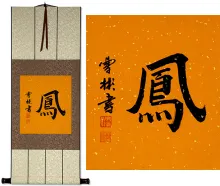
Buy a High Character calligraphy wall scroll here!
Personalize your custom “High Character” project by clicking the button next to your favorite “High Character” title below...
3. Speed
4. Aung
5. When the sun rises it first shines on the highest mountain
6. Motivation
7. Zeng
9. Great Aspirations / Ambition
10. Better to be Happy than Rich
13. Namu Dai Bosa
14. Hailey
15. Haily
16. Hot / Heat
18. Chong
19. Grand Master / Great Teacher
20. Attack When The Enemy Has Low Morale
21. Do not fear the task: Cooperation will lead to success
22. Taoist / Daoist
23. Fu Dog / Foo Dog
24. Mutual Respect
25. Choi
26. 8. Right Concentration / Perfect Concentration
27. Warriors: Quality Over Quantity
28. Forgiveness
30. A Wise Man Changes His Mind
31. Flying Tigers
32. Beauty Shop / Beauty Salon
34. Student
35. Corinthians 13:4
36. Ronin / Masterless Samurai
37. Ten Commandments
38. Mountain Travels Poem by Dumu
39. Glory and Honor
40. Corinthians 13:4
41. Reiki
Having High Principles
Do not bow down for the sake of five pecks of rice
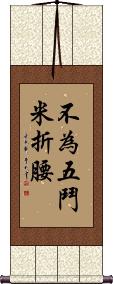
不为五斗米折腰 is a Chinese idiom/proverb that speaks of being above bribes and not losing face or honor for short-term gain.
Some may also translate the perceived meaning as “high-hearted” or “integrity beyond reproach.”
The more literal meaning is “Do not bow down for the sake of five pecks of rice.”
High Mountain Long River
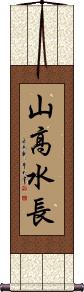
山高水長 is a Chinese idiom that means “high as the mountain and long as the river.”
It figuratively means “noble and far-reaching.”
Not sure this is valid or commonly used in Korean. It probably was borrowed into Korean a few hundred years ago but is obscure now.
Speed
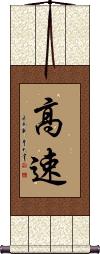
高速 means “high speed” or “in high gear” in Chinese and Japanese Kanji.
In old Korean Hanja, it also means “high speed” but can also be a nickname for “rapid transit.”
高速 is the best selection if you want to say “speed” in regard to your race car, race boat, or lifestyle. You need this word, which literally means “high speed,” as the Asian word for “speed” alone does not suggest whether you mean fast or slow.
Aung
Burmese Surname
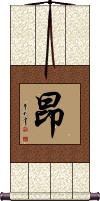
昂 is often used to represent the Burmese surname Aung.
The actual meaning is to lift, raise, high, high spirits, soar, or soaring.
In Japanese, this can be the given name Hisashi.
When the sun rises it first shines on the highest mountain
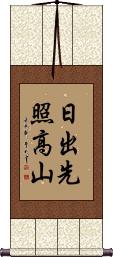
This old Buddhist phrase means, “When the sun rises it always shines first on the highest mountain,” or “When the sun appears, it first casts its light upon the highest mountain.”
This comes from the Avatamsaka Sutra and has been used as the name or portion of the name for temples in Japan and sites in China.
The Buddha's first round of teaching (Avatamsaka period) is likened to the time when the sun rises from the east horizon. When the sun first rises it illuminates the high mountains. In this analogy, the high mountains represent the great Bodhisattvas and/or those most ready to receive enlightenment and liberation.
This can be romanized from Japanese as “Nichi shutsu sen shō kō san,” “Nisshutsu saki teru takayama,” or “Hide temazu kōzan wo terasu yama.” The last one is probably the most common. Ask three Japanese people what they think the pronunciation is, and you will get three different opinions.
Motivation
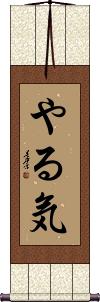
やる気 means motivation in Japanese.
It also can be translated as willingness (e.g., to do something), eagerness, inspiration, determination, totally willing, fully motivated, and high aspirations.
Note: Because this selection contains some special Japanese Hiragana characters, it should be written by a Japanese calligrapher.
See Also: Enthusiasm | Passion
Zeng
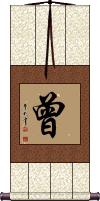
The surname Zeng (曾) is predominantly Chinese, originating from an ancient state, meaning "high" or "add," and is a very common name, especially in southern China and Taiwan, with variations like Tsang (Cantonese) or Chen/Chan (Southeast Asia).
Origin: Descendants of the ancient State of Zeng (鄫) from the Xia Dynasty (c. 2070–1600 BC).
Meaning: "High" or "add" in ancient Chinese.
History: The state was granted to a son of Emperor Shao Kang; the name was simplified to 曾 (Zeng) by a prince fleeing to the Lu Kingdom.
Prevalence: 32nd most common in mainland China, 16th in Taiwan.
Variations: Tsang (Cantonese), Tsen, Chen, Cheng (Malaysia/Singapore), Tjan (Indonesia), Jung (Thailand), Chan (Philippines).
Dragon Ball Kai
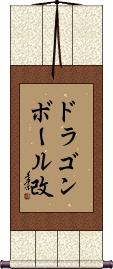
ドラゴンボール改 is the name for Doragon Bōru Kai (Dragon Ball Revised), a high-definition remastered and recut of the original Dragon Ball Z, released on the 20th anniversary.
Note: Because this selection contains some special Japanese Katakana characters, it should be written by a Japanese calligrapher.
Great Aspirations / Ambition
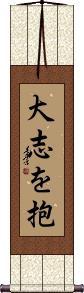
大志を抱 is a single Japanese word that kind of reads like a short proverb.
It suggests that you should have “high aims,” “ambitions,” or “aspirations” in your life.
Better to be Happy than Rich
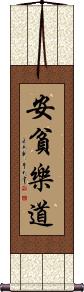
安貧樂道 means “It's better to be happy than rich” in Chinese.
Even if you are poor, you should still feel satisfied in your life...
...Satisfaction, happiness and the meaning of your life come from within yourself and not from money or riches of the world.
In Chinese, there are a lot of four-character proverbs which express some very old philosophies.
Though there are only four characters on this scroll, in Chinese, the meanings often surpass the dictionary definition of each character.
In this case, you should not set your expectations too high for the money or riches you wish to have. One who sets their expectations too high is almost always disappointed. Instead, you should cherish what you have, seek to improve yourself from within, and not measure your worth by the size of your bank account.
Scops Owl / Black Kite
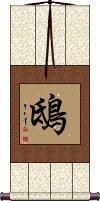
In Chinese, 鴟 is the Scops Owl. In Japanese, this is the black kite (Milvus migrans).
Colloquially in Japanese, this can refer to a construction worker who walks on or erects scaffolding. It can also be a firefighter up high on a ladder or building.
Big Dream / Great Hope
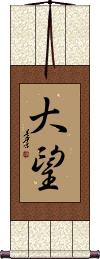
大望 is one of a few ways to write “dream big” in Japanese.
This is a good title if you want that to inspire ambition or high aspirations. 大望 is also a way to say “great expectations.”
Namu Dai Bosa
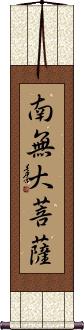
南無大菩薩 means to submit to or pay homage to the great Bodhisattva.
The last three characters, 大菩薩, can mean bodhisattva-mahāsattva, refer to one who has reached enlightenment but vows to save all beings before becoming a buddha or a high and noble monk.
Hailey
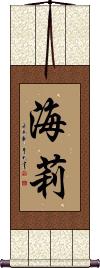
海莉 is a transliteration to Mandarin Chinese for the name Hailey.
Use this form if you pronounce your name like “High-Lee.”
If in doubt, we suggest you use this version.
Haily
(Name - Version 1)
海莉 is the transliteration to Mandarin Chinese for the name Haily.
Use this form if you pronounce your name like “High-Lee.”
If in doubt, we suggest you use this version.
Hot / Heat
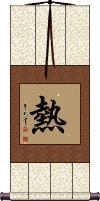
熱 means hot in Chinese, Japanese Kanji, and old Korean Hanja.
This can also be translated as: to warm up; to heat up; hot weather; fervent; fever; (high) temperature.
In some contexts, it can mean zeal, passion, enthusiasm, craze, or rage.
Wing Chun Kung Fu
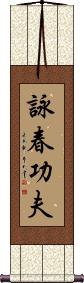
詠春功夫 is Wing Chun Kung Fu.
The first two characters literally mean “Singing Spring” (as in springtime).
The last two are “Kung Fu” (high skill).
Chong
Surname
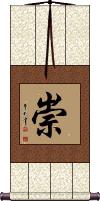
This is the surname “Chong” or “Zhong” in Mandarin Chinese, “Sung” in Cantonese and Korean, and Su in Japanese.
崇 is used in other Chinese words and other Asian languages with the following meanings:
high; sublime; lofty; to esteem; to worship; eminent; honorable; honourable; reverence; adore/adoration.
Grand Master / Great Teacher
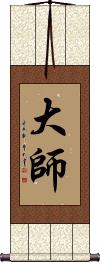
大師 is a way to title a great master, grand master, or great teacher.
This can be used in the context of martial arts or a Buddhist teacher. Thus, it can be used to title a living Buddha, Bodhisattva, or high-ranking monk.
Attack When The Enemy Has Low Morale
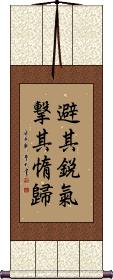
避其鋭氣擊其惰歸 is a Chinese proverb that literally translates as: Avoid [your enemy's] fighting spirit [and] attack [when] his [morale is] declining.
Figuratively, this means: Avoid the enemy when his morale is high and strike him when his morale is flagging.
Do not fear the task: Cooperation will lead to success
Do not fear strong winds waves; just be sure to row in unison
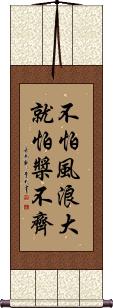
不怕风浪大就怕桨不齐 is a Chinese proverb that literally translates as: Do not fear strong winds [and] high waves; what [one should] worry about whether or not you're rowing in unison.
Figuratively, this means: However difficult the task, the key to success lies in making collective efforts.
I like to translate this as “Don't sweat the details, just get together and get it done.”
Taoist / Daoist
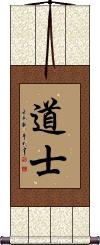
道士 is a Japanese Kanji, Korean Hanja, and Chinese title that means Daoist or Taoist.
This can refer to a Taoist priest or a person of high morals. This can also be applied to Buddhists and Śākyamuni (especially in Japanese). It suggests a person (or soldier) who follows the way or the right path. Thus a person who follows a path of virtue.
Fu Dog / Foo Dog
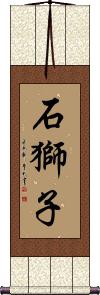
While known in the west as fu dogs or foo dogs, these are actually guardian lions.
These are the lion statues traditionally placed at the entrance of Chinese imperial palaces, imperial tombs, temples, and high-ranking officials' homes. These days, you are more likely to see them at the entrance to a fancy Chinese restaurant.
石獅子 means “stone lion(s).”
Mutual Respect
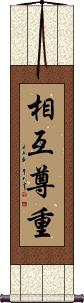
相互尊重 means mutual respect in Chinese, Japanese Kanji, and old Korean Hanja.
The first two characters are a word that means each other, mutual or reciprocal.
The last two characters are a word that means to respect, honor, value, eminent, or hold in high esteem.
Choi
Surname
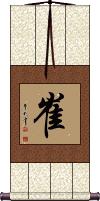
崔 is both a word and surname in Chinese and Korean.
In Korean, this romanizes as Choi. Occasionally, some have romanized it as Choe.
In Chinese, this is romanized as Cui in the mainland and Tsui in Taiwan.
The meaning of this characters is high mountain or precipitous.
崔 is also a rarely used Japanese surname or given name. From Japanese, this has the following possible romanizations: Chiyoi; Chioe; Chiejiyon; Chiei; Chie; Che; Takashi; Sun; Sa.
8. Right Concentration / Perfect Concentration
Samyak Samadhi / Samma Samadhi
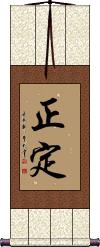
正定 is one of the Noble Eightfold Paths of Buddhism. Right Concentration, along with Right Effort and Right Mindfulness, constitute the path to Concentration or Perfect Thought.
Right Concentration has to do with leaving behind sensuality, unwholesome states, as well as pleasure and pain. 正定 is a complex idea, but once you have achieved the shedding of worldly sensation, you can truly concentrate and find a higher level of awareness.
Another definition: Concentration of mind that finds its high point in the four absorptions.
This term is exclusively used by devout Buddhists. It is not a common term, and is remains an unknown concept to most Japanese and Chinese people.
See Also: Buddhism | Enlightenment | Noble Eightfold Path
Warriors: Quality Over Quantity
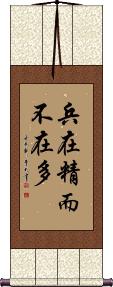
兵在精而不在多 is a Chinese proverb that means: [The value of] soldiers/warriors lies in [their] quality, not [just] in [their] quantity.
In simple terms, this says that regarding warriors, quality is better than quantity.
Most tacticians will agree that this can aid in the factor known as “force multiplication.” Having good troops of high morale, excellent training, and good discipline is like having a force that is three times larger.
See Also: 兵在精
Forgiveness (from the top down)
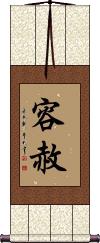
容赦 is the kind of forgiveness that a king might give to his subjects for crimes or wrong-doings.
容赦 is a rather high-level forgiveness. Meaning that it goes from a higher level to a lower (not the reverse).
Alone, the first character can mean “to bear,” “to allow,” and/or “to tolerate,” and the second can mean “to forgive,” “to pardon,” and/or “to excuse.”
When you put both characters together, you get forgiveness, pardon, mercy, leniency, or going easy (on someone).
See Also: Benevolence
Sworn Friend / Ally
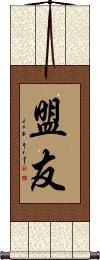
盟友 means a sworn friend or ally. If you stand on the same side of an issue with someone and perhaps fight for the same cause together, this is the term you would use to describe such a partner.
There may not be a personal relationship, as this term is also used to describe whole countries that make a coalition or fight against a common enemy.
This would be most appropriate if you are a high-level military officer, giving this wall scroll to an officer of another country as you join forces together and go to war.
A Wise Man Changes His Mind (but a fool never will)
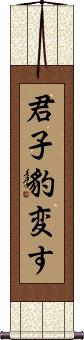
君子豹変す is a Japanese proverb that suggests that a wise man is willing to change his mind, but a fool will stubbornly never change his.
The first word is 君子 (kunshi), a man of virtue, a person of high rank, a wise man.
The second word is 豹変 (hyouhen), sudden change, complete change.
The last part, す (su), modifies the verb to a more humble form.
The “fool” part is merely implied or understood. So if wise and noble people are willing to change their minds, it automatically says that foolish people are unwilling to change.
Flying Tigers
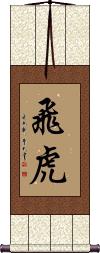
飛虎 is the short, or rather, Korean title of the “Flying Tigers.”
This short title is not very often used in China but is a title used in Korea. When the Flying Tigers volunteers were in China, Korea was also occupied by Japanese forces. Because many Korean civilians were enslaved and killed at the hands of the Japanese soldiers, any group that fought against the Japanese at that time was held in high esteem by the Korean people.
Note: I suggest the other 3-character entry since this group was so strongly related to China.
飛虎 is also used as an adjective in Korean to describe a courageous person.
Beauty Shop / Beauty Salon
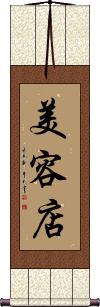
美容店 is how to write “Beauty Shop” or “Beauty Salon.”
If you own such a business, this will make a nice wall scroll to hang up - and many of your Asian customers will be able to read and appreciate it.
When traveling in China, you will see signs like this in the window of any place that offers full services of hair styling, manicures, pedicures, and often shampoo with head and back massage.
However, as a handmade wall scroll, this becomes a very fancy piece of artwork that shows the high class of your business (a great sign for your window if you don't get direct sunlight).
Construction Crane
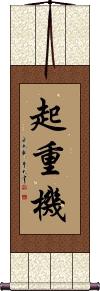
起重機 refers to the huge machine that lifts materials high into the air as crews construct huge buildings.
A customer requested this specifically after some confusion over the bird by the same name.
In an odd twist, while they don't know this name in English sounds like a bird; the building crane is jokingly called “The real national bird of China” because of the accelerated level of construction in Beijing and elsewhere ever since preparations began for the 2008 Olympics. As of 2018, construction has barely slowed.
If you want the type of construction crane that drives down the road, please note that the word is totally different for that kind of “vehicle crane.”
Student
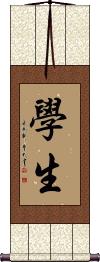
學生 is how to write “student” in Chinese, pre-WWII Japanese Kanji, and old Korean Hanja.
If you are a “student of life,” this might be an interesting wall scroll to hang in your reading room.
The first character means “study” or “learning.”
The second character means “life” or “birth.” Don't read too much into that second character unless you decide that this means “the birth of studies” or “the life of learning.” Everyone in China, Japan (and those who can read Hanja in Korea) will just read this word with the meaning of “student.”
If you put the character for “little” in front of this word, it becomes “elementary school student.” Prefixed with “middle,” it becomes “middle school student.” Prefixed with “big,” it becomes “university student” (though when these two characters for student are seen alone, it often suggests “university student”). The term “high school student” is written differently.
 There is a very common simplified version of the first character for this word. You will see this form in modern Japan and mainland China, Singapore, and other places. If you want this simplified version, please click on the character shown to the right instead of the "select and customize" button above.
Corinthians 13:4

愛は忍耐強い。愛は情け深い。ねたまない。愛は自慢せず、高ぶらない。is 1st Corinthians 13:4 in Japanese.
In English, this reads:
1st Corinthians 13:4 (KJV) Charity suffereth long, and is kind; charity envieth not; charity vaunteth not itself, is not puffed up...
1st Corinthians 13:4 (NIV) Love is patient, love is kind. It does not envy, it does not boast, it is not proud.
1st Corinthians 13:4 (Basic English) Love is never tired of waiting; love is kind; love has no envy; love has no high opinion of itself, love has no pride.
If you want a big “love” character written above the verse on your artwork, just make a note in the “special instructions” tab when you are customizing your artwork. There is no extra charge for that service on this special verse.
Note: Because this selection contains some special Japanese Hiragana characters, it should be written by a Japanese calligrapher.
Ronin / Masterless Samurai
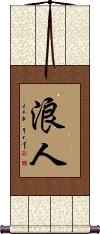
The 浪人 or Ronin have no master - The most famous are the 47 ronin created after their Lord committed suicide. This term was not a positive title for the Samurai of ancient Japan. However, in recent years, movies and video games have glorified the term Ronin.
In Chinese, this term has the original meaning of a hobo, vagabond, or ruffian.
In Korean Hanja, these characters would be read as adventurer, wanderer, someone without a steady job, or someone who is wasting away time.
In modern Japan, this term is used as a nickname for a high school student who has failed a college entry exam (and is trying again).
In Chinese and Korean, the Japanese definition of “Masterless Samurai” is known because of the historical context. Even in Japanese, the literal translation is closer to the Chinese and Korean definitions shown above.
This will make a fine wall scroll if you are a fan of the Ronin or see yourself as a Ronin of sorts. However, please think twice before getting a Ronin tattoo!
Ten Commandments
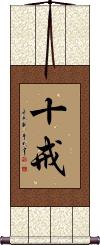
十戒 means Ten Commandments or Ten Precepts.
In the Buddhist context, these are prohibitions consisting of five commandments for the layman:
1. Not to destroy life 不殺生 Pāṇātipātāveramaṇi.
2. Not to steal 不倫盜 Adinnādānāver.
3. Not to commit adultery 不婬慾 Abrahmacaryaver.
4. Not to lie 不妄語 Musāvādāver.
5. Not to take intoxicating liquor 不飮酒 Suramereyya-Majjapamādaṭṭhānāver.
The ten commandments for the monk are the preceding five plus:
6. Not to eat food outside of regulated hours 不非時食 Vikāla-Bhojanāver.
7. Not to use garlands or perfumes 不著華鬘好香塗身 Mālā- Gandha-Vilepana-Dhāraṇa-Maṇḍana-Vibhūṣanaṭṭhānā.
8. Not to sleep on high or broad beds (chastity) 不坐高廣大牀 Uccāsayanā-Mahāsayanā.
9. Not to take part in singing, dancing, musical or theatrical performances 不歌舞倡伎不往觀聽 Nacca-Gīta-Vādita-Visūkadassanāver.
10. To refrain from acquiring uncoined or coined gold, or silver, or jewels 不得捉錢金銀寶物 Jātarūpa-Rajata-Paṭīggahaṇāver.
These original Buddhist commandments date back to about 2500 years ago. The English definitions above are followed by Chinese characters and original Pali pronunciation.
Under the Māhayāna Buddhism, these ten commands for the monk were changed, to accord with the new environment of the monk, to the following: not to kill, not to steal, to avoid all unchastity, not to lie, not to slander, not to insult, not to chatter, not to covet, not to give way to anger, to harbor no skepticism.
Mountain Travels Poem by Dumu

This poem was written almost 1200 years ago during the Tang dynasty.
It depicts traveling up a place known as Cold Mountain, where some hearty people have built their homes. The traveler is overwhelmed by the beauty of the turning leaves of the maple forest that surrounds him just as night overtakes the day, and darkness prevails. His heart implores him to stop, and take in all of the beauty around him.
First, before you get to the full translation, I must tell you that Chinese poetry is a lot different than what we have in the west. Chinese words simply don't rhyme in the same way that English or other western languages do. Chinese poetry depends on rhythm and a certain beat of repeated numbers of characters.
I have done my best to translate this poem keeping a certain feel of the original poet. But some of the original beauty of the poem in its original Chinese will be lost in translation.
Far away on Cold Mountain, a stone path leads upwards.
Among white clouds, people's homes reside.
Stopping my carriage I must, as to admire the maple forest at nights fall.
In awe of autumn leaves showing more red than even flowers of early spring.
Hopefully, this poem will remind you to stop, and “take it all in” as you travel through life.
The poet's name is “Du Mu” in Chinese that is: 
 .
.
The title of the poem, “Mountain Travels” is: 

You can have the title, poet's name, and even “Tang Dynasty” written as an inscription on your custom wall scroll if you like.
More about the poet:
Dumu lived from 803-852 AD and was a leading Chinese poet during the later part of the Tang dynasty.
He was born in Chang'an, a city in central China and the former capital of the ancient Chinese empire in 221-206 BC. In present-day China, his birthplace is currently known as Xi'an, the home of the Terracotta Soldiers.
He was awarded his Jinshi degree (an exam administered by the emperor's court which leads to becoming an official of the court) at the age of 25 and went on to hold many official positions over the years. However, he never achieved a high rank, apparently because of some disputes between various factions, and his family's criticism of the government. His last post in the court was his appointment to the office of Secretariat Drafter.
During his life, he wrote scores of narrative poems, as well as a commentary on the Art of War and many letters of advice to high officials.
His poems were often very realistic and often depicted everyday life. He wrote poems about everything, from drinking beer in a tavern to weepy poems about lost love.
The thing that strikes you most is the fact even after 1200 years, not much has changed about the beauty of nature, toils, and troubles of love and beer drinking.
Glory and Honor
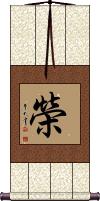
榮 relates to giving someone a tribute or praise.
It's a little odd as a gift, so this may not be the best selection for a wall scroll.
I've made this entry because this character is often misused as “honorable” or “keeping your honor.” It's not quite the same meaning, as this usually refers to a tribute or giving an honor to someone.
榮 is often found in tattoo books incorrectly listed as the western idea of personal honor or being honorable. Check with us before you get a tattoo that does not match the meaning you are really looking for. As a tattoo, this suggests that you either have a lot of pride in yourself or that you have a wish for prosperity for yourself and/or your family.
 In modern Japanese Kanji, glory and honor look like the image to the right.
There is a lot of confusion about this character, so here are some alternate translations for this character: prosperous, flourishing, blooming (like a flower), glorious beauty, proud, praise, rich, or it can be the family name “Rong.” The context in which the character is used can change the meaning between these various ideas.
In the old days, this could be an honor paid to someone by the Emperor (basically a designation by the Emperor that a person has high standing).
To sum it up: 榮 has a positive meaning; however, it's a different flavor than the idea of being honorable and having integrity.
Corinthians 13:4
All you need to know about LOVE
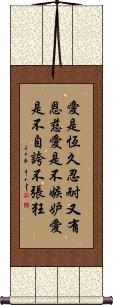
愛是恆久忍耐又有恩慈愛是不嫉妒愛是不自誇不張狂 is 1st Corinthians 13:4 in Chinese.
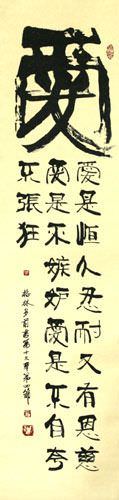
With large “love” character added.
In English, this reads:
1st Corinthians 13:4 (KJV) Charity suffereth long, and is kind; charity envieth not; charity vaunteth not itself, is not puffed up...
1st Corinthians 13:4 (NIV) Love is patient, love is kind. It does not envy, it does not boast, it is not proud.
1st Corinthians 13:4 (Basic English) Love is never tired of waiting; love is kind; love has no envy; love has no high opinion of itself, love has no pride.
The Chinese translation follows the love meaning, rather than the King James' use of “charity.” I was a little confused when writing this description with the significant differences between the NIV vs. KJV translations. After speaking to a Greek scholar about this, it would seem that the KJV has an almost errant translation with the use of “charity” in place of “love.”
We used the most popular Christian Chinese Bible, which is the Chinese Union Version (CUV). The CUV was first published in 1919. We use this so that the Chinese translation would be as accurate and standard as possible. Any Chinese Christian worth their salt will easily be able to identify this verse when they see these characters.
If you want a big “love” character written above the verse on your artwork, just make a note in the “special instructions” tab when you are customizing your artwork. There is no extra charge for that service on this special verse.
Reiki
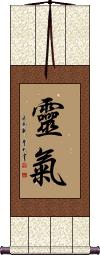
靈氣 is the title of a healing practice now found globally but with origins in Japan.
Special note: Outside of the context of the healing practice of Reiki, this means “aura” or “spiritual essence that surrounds all living things.” A Japanese person unfamiliar with the practice will take the “aura” meaning.
Reiki is a technique for stress reduction and relaxation that also heals. It can be compared to massage but is based on the idea that an unseen “life force energy” flows through us and is what causes us to be alive. If your life force energy is low, you'll be more likely to get sick or feel stressed. If your life force energy is abundant and flowing well, you become more capable of being happy and healthy.
There is a lot of information available if you want to Google this term - my job is to offer the calligraphy while you can decide if it is right for you.


Note: We are showing the ancient (traditional) form of the Reiki Kanji. I have seen Reiki written with the slightly simplified version and this more classic form. If you want the form of Reiki with the two strokes in the shape of an X on the second character and the modern first character, simply click on the Kanji characters to the right.
Note: 靈氣 is also a Chinese word, but in Chinese, these characters create a word that refers to a smart person or someone with high aspirations. It is not read as a healing method in Chinese.
In Korean Hanja, this can be read as a “mysterious atmosphere” by a Korean who is not familiar with the practice of Reiki (still has a cool meaning in Korean).
This in-stock artwork might be what you are looking for, and ships right away...

Gallery Price: $36.00
Starting at: $20.00

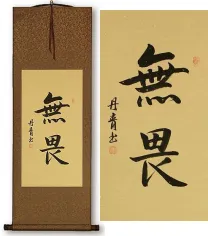

Gallery Price: $65.00
Your Price: $39.88
Gallery Price: $65.00
Your Price: $39.88
Gallery Price: $72.00
Your Price: $39.88

Gallery Price: $31.00
Your Price: $16.88

Gallery Price: $200.00
Your Price: $98.88
The following table may be helpful for those studying Chinese or Japanese...
| Title | Characters | Romaji (Romanized Japanese) | Various forms of Romanized Chinese | |
| Having High Principles | 不為五斗米折腰 不为五斗米折腰 | bù wèi wǔ dǒu mǐ zhé yāo bu4 wei4 wu3 dou3 mi3 zhe2 yao1 bu wei wu dou mi zhe yao buweiwudoumizheyao | pu wei wu tou mi che yao puweiwutoumicheyao |
|
| High Mountain Long River | 山高水長 山高水长 | shān gāo shuǐ cháng shan1 gao1 shui3 chang2 shan gao shui chang shangaoshuichang | shan kao shui ch`ang shankaoshuichang shan kao shui chang |
|
| Speed | 高速 | kousoku / kosoku | gāo sù / gao1 su4 / gao su / gaosu | kao su / kaosu |
| Aung | 昂 | hisashi | áng / ang2 / ang | |
| When the sun rises it first shines on the highest mountain | 日出先照高山 | hiide temazu kousan wo terasu yama hide temazu kosan wo terasu yama | rì chū xiān zhào gāo shān ri4 chu1 xian1 zhao4 gao1 shan1 ri chu xian zhao gao shan richuxianzhaogaoshan | jih ch`u hsien chao kao shan jihchuhsienchaokaoshan jih chu hsien chao kao shan |
| Motivation | やる気 | yaruki | ||
| Zeng | 曾 | zēng / zeng1 / zeng | tseng | |
| Dragon Ball Kai | ドラゴンボール改 | doragon bouru kai doragonbourukai doragon boru kai | ||
| Great Aspirations Ambition | 大志を抱 | tai shi wo idaku taishiwoidaku | ||
| Better to be Happy than Rich | 安貧樂道 安贫乐道 | ān pín lè dào an1 pin2 le4 dao4 an pin le dao anpinledao | an p`in le tao anpinletao an pin le tao |
|
| Scops Owl Black Kite | 鴟 鸱 | tonbi / tobi | chī / chi1 / chi | ch`ih / chih |
| Big Dream Great Hope | 大望 | tai mou / taimou / tai mo | ||
| Namu Dai Bosa | 南無大菩薩 南无大菩萨 | namu dai bosa namudaibosa | ||
| Hailey | 海莉 | hǎi lì / hai3 li4 / hai li / haili | ||
| Haily | 海莉 | hǎi lì / hai3 li4 / hai li / haili | ||
| Hot Heat | 熱 热 | netsu | rè / re4 / re | je |
| Wing Chun Kung Fu | 詠春功夫 咏春功夫 | yǒng chūn gōng fu yong3 chun1 gong1 fu yong chun gong fu yongchungongfu | yung ch`un kung fu yungchunkungfu yung chun kung fu |
|
| Chong | 崇 | sū | chóng / chong2 / chong | ch`ung / chung |
| Grand Master Great Teacher | 大師 大师 | daishi | dà shī / da4 shi1 / da shi / dashi | ta shih / tashih |
| Attack When The Enemy Has Low Morale | 避其鋭氣擊其惰歸 避其锐气击其惰归 | bì qí ruì qì jī qí duò guī bi4 qi2 rui4 qi4 ji1 qi2 duo4 gui1 bi qi rui qi ji qi duo gui biqiruiqijiqiduogui | pi ch`i jui ch`i chi ch`i to kuei pichijuichichichitokuei pi chi jui chi chi chi to kuei |
|
| Do not fear the task: Cooperation will lead to success | 不怕風浪大就怕槳不齊 不怕风浪大就怕桨不齐 | bù pà fēng làng dà jiù pà jiǎng bù qí bu4 pa4 feng1 lang4 da4 jiu4 pa4 jiang3 bu4 qi2 bu pa feng lang da jiu pa jiang bu qi | pu p`a feng lang ta chiu p`a chiang pu ch`i pu pa feng lang ta chiu pa chiang pu chi |
|
| Taoist Daoist | 道士 | dou shi / doushi / do shi | dào shì / dao4 shi4 / dao shi / daoshi | tao shih / taoshih |
| Fu Dog Foo Dog | 石獅子 石狮子 | shí shī zi shi2 shi1 zi5 shi shi zi shishizi | shih shih tzu shihshihtzu |
|
| Mutual Respect | 相互尊重 | sougo sonchou sougosonchou sogo soncho | xiāng hù zūn zhòng xiang1 hu4 zun1 zhong4 xiang hu zun zhong xianghuzunzhong | hsiang hu tsun chung hsianghutsunchung |
| Choi | 崔 | cuī / cui1 / cui | ts`ui / tsui | |
| 8. Right Concentration Perfect Concentration | 正定 | sei jou / seijou / sei jo | zhèng dìng zheng4 ding4 zheng ding zhengding | cheng ting chengting |
| Warriors: Quality Over Quantity | 兵在精而不在多 | bīng zài jīng ér bú zài duō bing1 zai4 jing1 er2 bu2 zai4 duo1 bing zai jing er bu zai duo bingzaijingerbuzaiduo | ping tsai ching erh pu tsai to pingtsaichingerhputsaito |
|
| Forgiveness (from the top down) | 容赦 | you sha / yousha / yo sha | róng shè / rong2 she4 / rong she / rongshe | jung she / jungshe |
| Sworn Friend Ally | 盟友 | meiyuu / meiyu | méng yǒu / meng2 you3 / meng you / mengyou | meng yu / mengyu |
| A Wise Man Changes His Mind (but a fool never will) | 君子豹変す | kun shi hyou hen su kunshihyouhensu kun shi hyo hen su | ||
| Flying Tigers | 飛虎 飞虎 | fēi hǔ / fei1 hu3 / fei hu / feihu | ||
| Beauty Shop Beauty Salon | 美容店 | měi róng diàn mei3 rong2 dian4 mei rong dian meirongdian | mei jung tien meijungtien |
|
| Construction Crane | 起重機 起重机 | kijuuki / kijuki | qǐ zhòng jī qi3 zhong4 ji1 qi zhong ji qizhongji | ch`i chung chi chichungchi chi chung chi |
| Student | 學生 学生 | gakusei | xué shēng xue2 sheng1 xue sheng xuesheng | hsüeh sheng hsüehsheng |
| Corinthians 13:4 | 愛は忍耐強い。愛は情け深い。ねたまない。愛は自慢せず、高ぶらない。 | ai ha nintai tsuyoi. ai ha nasakebukai. netama nai. ai ha jiman se zu, takabura nai. | ||
| Ronin Masterless Samurai | 浪人 | rou nin / rounin / ro nin | làng rén / lang4 ren2 / lang ren / langren | lang jen / langjen |
| Ten Commandments | 十戒 | jukkai / jukai | shí jiè / shi2 jie4 / shi jie / shijie | shih chieh / shihchieh |
| Mountain Travels Poem by Dumu | 遠上寒山石徑斜白雲生處有人家停車坐愛楓林晚霜葉紅於二月花 远上寒山石径斜白云生处有人家停车坐爱枫林晚霜叶红于二月花 | yuǎn shàng hán shān shí jìng xiá bái yún shēng chù yǒu rén jiā tíng chē zuò ài fēng lín wǎn shuàng yè hóng yú èr yuè huā yuan3 shang4 han2 shan1 shi2 jing4 xia2 bai2 yun2 sheng1 chu4 you3 ren2 jia1 ting2 che1 zuo4 ai4 feng1 lin2 wan3 shuang4 ye4 hong2 yu2 er4 yue4 hua1 yuan shang han shan shi jing xia bai yun sheng chu you ren jia ting che zuo ai feng lin wan shuang ye hong yu er yue hua | yüan shang han shan shih ching hsia pai yün sheng ch`u yu jen chia t`ing ch`e tso ai feng lin wan shuang yeh hung yü erh yüeh hua yüan shang han shan shih ching hsia pai yün sheng chu yu jen chia ting che tso ai feng lin wan shuang yeh hung yü erh yüeh hua |
|
| Glory and Honor | 榮 荣 / 栄 | ei | róng / rong2 / rong | jung |
| Corinthians 13:4 | 愛是恆久忍耐又有恩慈愛是不嫉妒愛是不自誇不張狂 爱是恒久忍耐又有恩慈爱是不嫉妒爱是不自夸不张狂 | ài shì héng jiǔ rěn nài yòu yǒu én cí ài shì bú jì dù ài shì bú zì kuā bù zhāng kuáng ai4 shi4 heng2 jiu3 ren3 nai4 you4 you3 en2 ci2 ai4 shi4 bu2 ji4 du4 ai4 shi4 bu2 zi4 kua1 bu4 zhang1 kuang2 ai shi heng jiu ren nai you you en ci ai shi bu ji du ai shi bu zi kua bu zhang kuang | ai shih heng chiu jen nai yu yu en tz`u ai shih pu chi tu ai shih pu tzu k`ua pu chang k`uang ai shih heng chiu jen nai yu yu en tzu ai shih pu chi tu ai shih pu tzu kua pu chang kuang |
|
| Reiki | 靈氣 灵气 霊気 | reiki | líng qì / ling2 qi4 / ling qi / lingqi | ling ch`i / lingchi / ling chi |
| In some entries above you will see that characters have different versions above and below a line. In these cases, the characters above the line are Traditional Chinese, while the ones below are Simplified Chinese. | ||||

Successful Chinese Character and Japanese Kanji calligraphy searches within the last few hours...



