Many custom options...


And formats...



Not what you want?
Try other similar-meaning words, fewer words, or just one word.
Meditation Buddhism in Chinese / Japanese...
Buy a Meditation Buddhism calligraphy wall scroll here!
Personalize your custom “Meditation Buddhism” project by clicking the button next to your favorite “Meditation Buddhism” title below...
2. Appreciation of Truth by Meditation
4. Meditation
5. Inner Bliss and Peace from Meditation
6. Reach Peace and Calm Through Meditation
8. Namu Myoho Renge Kyo / Homage to Lotus Sutra
9. 6. Right Effort / Right Endeavor / Perfect Effort
11. Om
Zen / Chan / Meditation
...as in Zen Buddhism
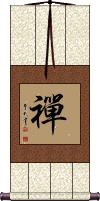
First, let's correct something: The Japanese romanization for this character, “Zen” has penetrated the English language. In English, it's almost always incorrectly used for phrases like “That's so zen.” Nobody says, “That's so meditation” - right? As the title of a sect, this would be like saying, “That's so Baptist!"
禪 by itself just means “meditation.” In that context, it should not be confined to use by any one religion or sect.
Regardless of the dictionary definition, more often than not, this character is associated with Buddhism. And here is one of the main reasons:
Zen is used as the title of a branch of Mahayana Buddhism, which strongly emphasizes meditation practice.
However, it should be noted that Buddhism came from India, and “Chan Buddhism” evolved and developed in medieval China. The Chinese character “Chan” was eventually pronounced as “Zen” in Japanese. Chan Buddhists in China have much in common with Zen Buddhists in Japan.
More about the history of Zen Buddhism here.
Please also note that the Japanese Kanji character for Zen has evolved a little in Japan, and the two boxes (kou) that you see at the top of the right side of the character have been replaced by three dots with tails.
 The original character would still be generally understood and recognized in Japanese (it's considered an ancient version in Japan) but if you want the specifically modern Japanese version, please click on the zen Kanji to the right. Technically, there is no difference between the Tensho and Reisho versions of Zen since they are ancient character styles that existed long before Japan had a written language.
 There is also an alternate/shorthand/simplified Chinese version, which has two dots or tails above the right-side radical. This version is also popular for calligraphy in China. If you want this version, just click the character to the right.
Further notes: Zen is just one of seven sects of Buddhism practiced in Japan. The others are 律 Ritsu (or Risshū), 法相 Hossō, 論 Sanron 華嚴 Kegon, 天台 Tendai, and 眞言 Shingon.
Appreciation of Truth by Meditation
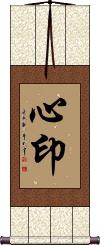
心印 is a Buddhist concept that simply stated is “appreciation of truth by meditation.”
It's a deep subject, but my understanding is that you can find truth through meditation, and once you've found the truth, you can learn to appreciate it more through further meditation. This title is not commonly used outside of the Buddhist community (your Asian friends may or may not understand it). The literal translation would be something like “the mind seal,” I've seen this term translated this way from Japanese Buddhist poetry. But apparently, the seal that is stamped deep in your mind is the truth. You just have to meditate to find it.
Soothill defines it this way: Mental impression, intuitive certainty; the mind is the Buddha-mind in all, which can seal or assure the truth; the term indicates the intuitive method of the Chan (Zen) school, which was independent of the spoken or written word.
Reference: Soothill-Hodous Dictionary of Chinese Buddhism
See Also: Zen
Sit in Meditation
Zazen
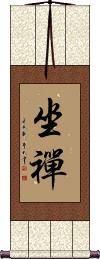
坐禪 describes the act of sitting in a state of deep meditation.
You'll notice that the second character is Chan/Zen (often used to title the meditative form of Buddhism).
In Korean Hanja, this means “religious meditation” (roughly the same as the Chinese definition).
Buddhists may define this as sitting in dhyāna, abstract meditation, fixed abstraction, or contemplation.
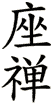 Japanese note: This will make sense in Japanese but the Kanji shown to the left are partially in ancient/traditional Japanese form. Japanese Buddhists may use 坐禪, 坐禅, 座禪, or 座禅. The most standard/modern Japanese form of this word is shown to the right. Click on the Kanji to the right (instead of the button above) if you want this specifically Japanese version.
Meditation
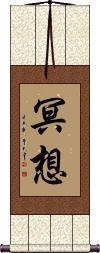
This encompasses the idea of meditation.
It's also a term used to describe a deep form of daydreaming, exploring one's imagination, the act of contemplating, or the idea of contemplation. 冥想 is often associated with Buddhism; however, the word “Zen” in Japanese (or “Chan” in Chinese) is probably more commonly used (or better known in the west).
See Also: Zen
Inner Bliss and Peace from Meditation
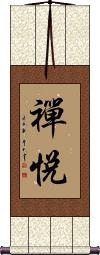
禪悅 is a title that refers to the inner bliss and peace you can achieve from meditation.
This term transcends a few religions, including Taoism and Buddhism. It can also be translated as “joy of the mystic trance” or simply “meditative bliss.”
Amazing that such a complex idea can be expressed in just two Chinese characters. Note that the first character is Chan/Zen (Chinese/Japanese), which means “meditation” in both languages.
Reach Peace and Calm Through Meditation
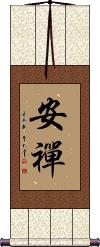
安禪 creates a title that means to reach peace and calm through meditation.
安禪 is an excellent wall scroll for your relaxation or meditation room.
This is also a Buddhist-related term that encompasses the idea of entering into dhyana meditation.
This is also used in Japanese, but in modern times, the second character has changed, so it's 安禅 now. If you want the modern Japanese version, just choose a Japanese calligrapher, and let me know when you place your order.
Ten perfect Mahayana rules
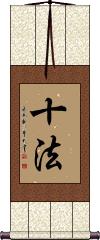
十法 is the title of the ten perfect or perfecting Mahāyāna rules.
The order of rules is as follows:
1. right belief.
2. right conduct.
3. right spirit.
4. the joy of the bodhi mind.
5. joy in the dharma.
6. joy in meditation.
7. pursuing the correct dharma.
8. obedience to, or accordance with dharma.
9. departing from pride, desire, etc.
10. comprehending the inner teaching of Buddha and taking no pleasure in attaining such knowledge or noting the ignorance of others.
This title is only used in the context of Buddhism. Japanese and Chinese people who are not familiar with Buddhism will not recognize this title.
Namu Myoho Renge Kyo / Homage to Lotus Sutra
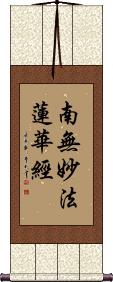
南無妙法蓮華經 is sometimes translated as the “Devotion to the Law of the Lotus Flower Scripture.”
This is a meditation chant and homage to the Lotus Sutra, used by Nichiren Buddhists in Japan.
This is also a chant used in China by certain sects of Buddhism that celebrate the deity Guanyin.
Also romanized as “Nam Myōhō Renge Kyō” or without accents as “Nam Myoho Renge Kyo.”


Original
Traditional
Version
The last character was originally written as seen on the left. Sometimes, you will see it written in the Japanese variant form as shown on the right. If you want this Japanese variant, click on the "Modern Japanese Variant" text instead of the button up by the main title of this entry.
6. Right Effort / Right Endeavor / Perfect Effort
Samyag Vyayama / Samma Vayama
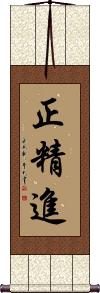
正精進 is one of the Noble Eightfold Paths of Buddhism. Right Effort, along with Right Mindfulness and Right Concentration, constitute the path to Concentration or Perfect Thought.
The proper effort is not the effort to make something particular happen. It is the effort to be aware and awake in each moment, the effort to overcome laziness and defilement, and the effort to make each activity of our daily meditation. This concept is about pursuing wholesome things that promote good karma.
Another definition: Cultivation of what is karmically wholesome and avoidance of what is karmically unwholesome.
This term is exclusively used by devout Buddhists. It is not a common term, and is remains an unknown concept to most Japanese and Chinese people.
See Also: Buddhism | Enlightenment | Noble Eightfold Path
Zen Contemplation
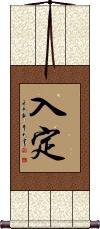
入定 is a title that can be defined as Zen contemplation in Japanese or sitting quietly in (Buddhist) meditation in Chinese. It also carries a similar meaning in Korean Hanja. Therefore, this is a universal term for meditation in the context of Buddhism throughout the Orient.
Can also be translated as “Meditatively equipoised” or “enter into meditation by stilling the karmic activities of deed, speech, and thought.”
The original Sanskrit word is samapanna. In Tibetan: snyoms par zhugs pa.
Om
Meditation Chant
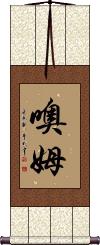
噢姆 is how to write the phonetic way to say “om” in Chinese.
噢姆 is “om” as in the meditation sound used in yoga, Buddhism, and other meditation styles.
Truth Flashed Through The Mind
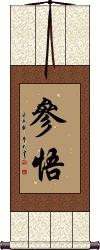
參悟 is a Chan / Zen Buddhism concept that means “to understand (mystery) from meditation” or “to see truth flash through the mind.”
參悟 is a pretty deep idea; therefore, your study and contemplation may be required before fully appreciating it.
Zen Understanding
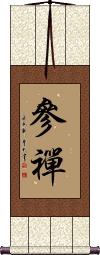
參禪 is a title that speaks of reaching an understanding (of Zen or the world). It also means “to practice meditation.” The two concepts lead you to the idea that meditation leads to understanding. 參禪 is pretty deep, so you can do your research or decide what this means for you.
This can also be defined in a more complex way as “thoroughly penetrating with meditative insight.”
This in-stock artwork might be what you are looking for, and ships right away...

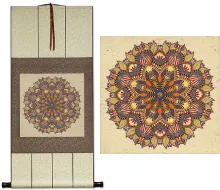
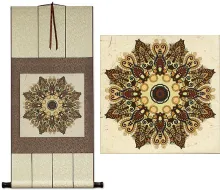
Gallery Price: $96.00
Your Price: $52.88

Starting at: $28.88

Gallery Price: $108.00
Your Price: $59.88


Gallery Price: $101.00
Your Price: $55.88

Gallery Price: $108.00
Your Price: $59.88

Gallery Price: $101.00
Your Price: $55.88
The following table may be helpful for those studying Chinese or Japanese...
| Title | Characters | Romaji (Romanized Japanese) | Various forms of Romanized Chinese | |
| Zen Chan Meditation | 禪 禅 | zen | chán / chan2 / chan | ch`an / chan |
| Appreciation of Truth by Meditation | 心印 | shin nin / shinnin | xīn yìn / xin1 yin4 / xin yin / xinyin | hsin yin / hsinyin |
| Sit in Meditation | 坐禪 坐禅 | za zen / zazen | zuò chán / zuo4 chan2 / zuo chan / zuochan | tso ch`an / tsochan / tso chan |
| Meditation | 冥想 | mei sou / meisou / mei so | míng xiǎng ming2 xiang3 ming xiang mingxiang | ming hsiang minghsiang |
| Inner Bliss and Peace from Meditation | 禪悅 禅悦 | chán yuè / chan2 yue4 / chan yue / chanyue | ch`an yüeh / chanyüeh / chan yüeh | |
| Reach Peace and Calm Through Meditation | 安禪 安禅 | an zen / anzen | ān chán / an1 chan2 / an chan / anchan | an ch`an / anchan / an chan |
| Ten perfect Mahayana rules | 十法 | jippou / jipo | shí fǎ / shi2 fa3 / shi fa / shifa | shih fa / shihfa |
| Namu Myoho Renge Kyo Homage to Lotus Sutra | 南無妙法蓮華經 / 南無妙法蓮華経 南无妙法莲华经 | na mu myou hou ren ge kyou namumyouhourengekyou na mu myo ho ren ge kyo | nán wú miào fǎ lián huá jīng nan2 wu2 miao4 fa3 lian2 hua2 jing1 nan wu miao fa lian hua jing nanwumiaofalianhuajing | nan wu miao fa lien hua ching nanwumiaofalienhuaching |
| 6. Right Effort Right Endeavor Perfect Effort | 正精進 正精进 | sei shou jin seishoujin sei sho jin | zhèng jīng jìn zheng4 jing1 jin4 zheng jing jin zhengjingjin | cheng ching chin chengchingchin |
| Zen Contemplation | 入定 | rù dìng / ru4 ding4 / ru ding / ruding | ju ting / juting | |
| Om | 噢姆 | mū / o1 mu1 / o mu / omu | ||
| Truth Flashed Through The Mind | 參悟 参悟 | cān wù / can1 wu4 / can wu / canwu | ts`an wu / tsanwu / tsan wu | |
| Zen Understanding | 參禪 参禅 | cān chán / can1 chan2 / can chan / canchan | ts`an ch`an / tsanchan / tsan chan | |
| In some entries above you will see that characters have different versions above and below a line. In these cases, the characters above the line are Traditional Chinese, while the ones below are Simplified Chinese. | ||||

Successful Chinese Character and Japanese Kanji calligraphy searches within the last few hours...



