Many custom options...


And formats...



One Day at a Time in Chinese / Japanese...
Buy an One Day at a Time calligraphy wall scroll here!
Personalize your custom “One Day at a Time” project by clicking the button next to your favorite “One Day at a Time” title below...
One Good Deed Each Day
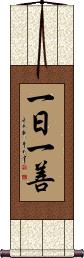
一日一善 is a Chinese, Japanese Kanji, and old Korean Hanja phrase that suggests doing a good deed each day or doing one good turn a day.
It literally reads, “One Day, One Good (Deed).”
Progress Day by Day
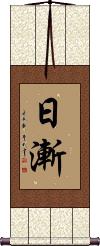
This Chinese word means to progress, increase, or change day by day.
It suggests something getting better one day at a time or with each passing day.
One Day Seems Like 1000 Years
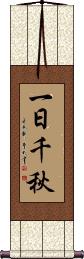
一日千秋 is a Japanese and Chinese proverb about missing someone.
一日千秋 is often used to express how hard it is to wait for someone's return or to be away from someone.
Some will translate this as “one day feels like a very long time” or “waiting for someone (something) is hard.”
You might see this romanized as a single word, Ichijitsusenshuu, or as “Ichijitsu Senshuu” from Japanese.
If you break down the characters one-by-one, we get:
一 = one/a
日 = day/sun (can also represent time or date)
千 = 1000/thousand
秋 = autumn/fall
Together, 千秋 can mean “autumn comes thousand times” (or 1000 years). It can also be read as 1000 periods of time.
However, it relays the idea of heartache as you wait for someone you miss.
Better Late Than Never
It's Never Too Late Too Mend
Long ago in what is now China, there were many kingdoms throughout the land. This time period is known as “The Warring States Period” by historians because these kingdoms often did not get along with each other.
Sometime around 279 B.C. the Kingdom of Chu was a large but not particularly powerful kingdom. Part of the reason it lacked power was the fact that the King was surrounded by “yes men” who told him only what he wanted to hear. Many of the King's court officials were corrupt and incompetent which did not help the situation.
The King was not blameless himself, as he started spending much of his time being entertained by his many concubines.
One of the King's ministers, Zhuang Xin, saw problems on the horizon for the Kingdom, and warned the King, “Your Majesty, you are surrounded by people who tell you what you want to hear. They tell you things to make you happy and cause you to ignore important state affairs. If this is allowed to continue, the Kingdom of Chu will surely perish, and fall into ruins.”
This enraged the King who scolded Zhuang Xin for insulting the country and accused him of trying to create resentment among the people. Zhuang Xin explained, “I dare not curse the Kingdom of Chu but I feel that we face great danger in the future because of the current situation.” The King was simply not impressed with Zhuang Xin's words.
Seeing the King's displeasure with him and the King's fondness for his court of corrupt officials, Zhuang Xin asked permission from the King that he may take leave of the Kingdom of Chu, and travel to the State of Zhao to live. The King agreed, and Zhuang Xin left the Kingdom of Chu, perhaps forever.
Five months later, troops from the neighboring Kingdom of Qin invaded Chu, taking a huge tract of land. The King of Chu went into exile, and it appeared that soon, the Kingdom of Chu would no longer exist.
The King of Chu remembered the words of Zhuang Xin and sent some of his men to find him. Immediately, Zhuang Xin returned to meet the King. The first question asked by the King was “What can I do now?”
Zhuang Xin told the King this story:
A shepherd woke one morning to find a sheep missing. Looking at the pen saw a hole in the fence where a wolf had come through to steal one of his sheep. His friends told him that he had best fix the hole at once. But the Shepherd thought since the sheep is already gone, there is no use fixing the hole.
The next morning, another sheep was missing. And the Shepherd realized that he must mend the fence at once. Zhuang Xin then went on to make suggestions about what could be done to reclaim the land lost to the Kingdom of Qin, and reclaim the former glory and integrity of the Kingdom of Chu.
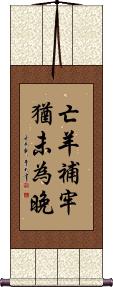
The Chinese idiom shown above came from this reply from Zhuang Xin to the King of Chu almost 2,300 years ago.
It translates roughly into English as...
“Even if you have lost some sheep, it's never too late to mend the fence.”
This proverb, 亡羊补牢犹未为晚, is often used in modern China when suggesting in a hopeful way that someone change their ways, or fix something in their life. It might be used to suggest fixing a marriage, quitting smoking, or getting back on track after taking an unfortunate path in life among other things one might fix in their life.
I suppose in the same way that we might say, “Today is the first day of the rest of your life” in our western cultures to suggest that you can always start anew.
Note: This does have Korean pronunciation but is not a well-known proverb in Korean (only Koreans familiar with ancient Chinese history would know it). Best if your audience is Chinese.
Push or Knock
To weigh one's words
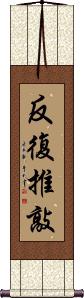
During the Tang Dynasty, a man named Jia Dao (born in the year 779), a well-studied scholar and poet, went to the capital to take the imperial examination.
One day as he rides a donkey through the city streets, a poem begins to form in his mind. A portion of the poem comes into his head like this:
“The bird sits on the tree branch near a pond,
A monk approaches and knocks at the gate...”
At the same time, he wondered if the word “push” would be better than “knock” in his poem.
As he rides down the street, he imagines the monk pushing or knocking. Soon he finds himself making motions of pushing and shaking a fist in a knocking motion as he debates which word to use. He is quite a sight as he makes his way down the street on his donkey with hands and fists flying about as the internal debate continues.
As he amuses people along the street, he becomes completely lost in his thoughts and does not see the mayor's procession coming in the opposite direction. Jia Bao is blocking the way for the procession to continue down the road, and the mayor's guards immediately decide to remove Jia Bao by force. Jia Bao, not realizing that he was in the way, apologizes, explains his poetic dilemma and awaits his punishment for blocking the mayor's way.
The mayor, Han Yu, a scholar and author of prose himself, finds himself intrigued by Jia Dao's poem and problem. Han Yu gets off his horse and addresses Jia Bao, stating, “I think knock is better.” The relieved Jia Bao raises his head and is invited by the mayor to join the procession, and are seen riding off together down the street, exchanging their ideas and love of poetry.
In modern Chinese, this 反復推敲 idiom is used when someone is trying to decide which word to use in their writing or when struggling to decide between two things when neither seems to have a downside.
This in-stock artwork might be what you are looking for, and ships right away...
Gallery Price: $90.00
Your Price: $49.88
Gallery Price: $108.00
Your Price: $59.88

Gallery Price: $72.00
Your Price: $39.88

Gallery Price: $60.00
Your Price: $36.88
Gallery Price: $60.00
Your Price: $39.88
Gallery Price: $268.00
Your Price: $148.77

Gallery Price: $61.00
Your Price: $33.88

Gallery Price: $61.00
Your Price: $33.88

Gallery Price: $61.00
Your Price: $33.88

Gallery Price: $61.00
Your Price: $33.88

Gallery Price: $60.00
Your Price: $36.88
Not the results for one day at a time that you were looking for?
Below are some entries from our dictionary that may match your one day at a time search...
| Characters If shown, 2nd row is Simp. Chinese |
Pronunciation Romanization |
Simple Dictionary Definition |
劫 see styles |
jié jie2 chieh kou; gou; kou / ko; go; ko こう; ごう; コウ |
to rob; to plunder; to seize by force; to coerce; calamity; abbr. for kalpa 劫波[jie2 bo1] (1) (こう, ごう only) {Buddh} kalpa (eon, aeon); (2) (kana only) {go} (usu. コウ) ko; position that allows for eternal capture and recapture of the same stones 刧 A kalpa, aeon, age; also translit. ka; 'a fabulous period of time, a day of Brahmā or 1, 000 Yugas, a period of four hundred and thirty-two million years of mortals, measuring the duration of the world; (a month of Brahmā is supposed to contain thirty such kalpas; according to the Mahābhārata twelve months of Brahmā constitute his year, and one hundred such years his lifetime; fifty years of Brahmā are supposed to have elapsed... ).' M. W. An aeon of incalculable time, therefore called a 大時節 great time-node. v. 劫波.; The three asaṃkhyeya kalpas, the three countless aeons, the period of a bodhisattva's development; also the past 莊嚴劫, the present 賢劫, and the future 星宿劫 kalpas. There are other groups. 三劫三千佛 The thousand Buddhas in each of the three kalpas. |
暇 see styles |
xiá xia2 hsia ka ひま |
leisure (noun or adjectival noun) (1) spare time; free time; leisure; (2) time (e.g. time it takes to do something); (noun or adjectival noun) (3) time off; day off; vacation; holiday; leave; (4) quitting (one's job); firing someone; divorcing (one's spouse); (adjectival noun) (5) (of one's time) free; (of one's business) slow; (noun or adjectival noun) (1) spare time; free time; leisure; (noun or adjectival noun) (2) time off; day off; vacation; holiday; leave; (3) quitting (one's job); firing someone; divorcing (one's spouse); (4) leaving; departing a leisure moment |
遑 see styles |
huáng huang2 huang itoma いとま |
leisure (noun or adjectival noun) (1) spare time; free time; leisure; (noun or adjectival noun) (2) time off; day off; vacation; holiday; leave; (3) quitting (one's job); firing someone; divorcing (one's spouse); (4) leaving; departing; (female given name) Itoma |
ヒマ see styles |
hima ヒマ |
(noun or adjectival noun) (1) spare time; free time; leisure; (2) time (e.g. time it takes to do something); (noun or adjectival noun) (3) time off; day off; vacation; holiday; leave; (4) quitting (one's job); firing someone; divorcing (one's spouse); (adjectival noun) (5) (of one's time) free; (of one's business) slow |
一旦 see styles |
yī dàn yi1 dan4 i tan ittan いったん |
in case (something happens); if; once (something happens, then...); when; in a short time; in one day (adverb) (1) (kana only) once; (adverb) (2) (kana only) for a short time; briefly; temporarily; (3) (archaism) one morning; (place-name) Ittan once (something should happen...) |
時分 时分 see styles |
shí fēn shi2 fen1 shih fen jibun じぶん |
time; period during the day; one of the 12 two-hour periods enumerated by the earthly branches 地支 (1) time; hour; season; (2) suitable time; opportunity; chance Time-division of the day, variously made in Buddhist works: (1) Three periods each of day and night. (2) Eight periods of day and night, each divided into four parts. (3) Twelve periods, each under its animal, as in China. (4) Thirty hours, sixty hours, of varying definition. |
時辰 时辰 see styles |
shí chen shi2 chen5 shih ch`en shih chen jishin じしん |
time; one of the 12 two-hour periods of the day time; hour |
非時 非时 see styles |
fēi shí fei1 shi2 fei shih hiji ひじ |
(1) {Buddh} monk's fasting period (noon till 4am next day); priest's fasting period; (2) {Buddh} meal taken in after noon; meal breaking one's fast; (3) food offered to attendants of a funeral Untimely; not the proper, or regulation time (for meals), which is: from dawn to noon; hence 非時食 to eat out of hours, i.e. after noon. |
何時か see styles |
itsuka いつか |
(adverb) (kana only) sometime; someday; one day; some time or other; the other day; in due course; in time; (female given name) Itsuka |
一日一夜 see styles |
yī rì yī yè yi1 ri4 yi1 ye4 i jih i yeh ichinichiichiya / ichinichichiya いちにちいちや |
all day and night ahorātra. One day one night, a day and night, a division of time. |
一朝一夕 see styles |
yī zhāo yī xī yi1 zhao1 yi1 xi1 i chao i hsi icchouisseki / icchoisseki いっちょういっせき |
lit. one morning and one evening (idiom); fig. in a short period of time; overnight (yoji) in a day; in a brief space of time |
半日工作 see styles |
bàn rì gōng zuò ban4 ri4 gong1 zuo4 pan jih kung tso |
part-time work in which one works each day for a half-day, typically a morning or an afternoon |
度日如年 see styles |
dù rì rú nián du4 ri4 ru2 nian2 tu jih ju nien |
a day drags past like a year (idiom); time hangs heavy; time crawls when one is wretched |
明け暮れ see styles |
akekure あけくれ |
(n,adv) (1) morning and evening; daily routine; (vs,vi) (2) to spend all one's time doing; to do day in, day out; (adverb) (3) all the time; always; constantly; day and night |
法華八講 see styles |
hokkehakkou / hokkehakko ほっけはっこう |
Buddhist service in which the eight scrolls of the Lotus Sutra are read one scroll at a time (one morning and one evening reading each day for four days with a different reciter each time) |
オフタイム see styles |
ofutaimu オフタイム |
one's free time (wasei: off time); one's time off; day off; time-out |
その日暮し see styles |
sonohigurashi そのひぐらし |
(1) financially scraping by; meagre existence (meager); hand to mouth existence; (2) living one's life without plan; living life day-by-day; taking life one day at a time |
其の日暮し see styles |
sonohigurashi そのひぐらし |
(1) financially scraping by; meagre existence (meager); hand to mouth existence; (2) living one's life without plan; living life day-by-day; taking life one day at a time |
明け暮れる see styles |
akekureru あけくれる |
(v1,vi) (1) to spend all one's time doing; to do day in, day out; to do nothing but ...; to be absorbed (in); (v1,vi) (2) to pass (of days) |
非一日之功 see styles |
fēi yī rì zhī gōng fei1 yi1 ri4 zhi1 gong1 fei i jih chih kung |
lit. cannot be done in one day (idiom); fig. will take much time and effort to accomplish |
オフ・タイム |
ofu taimu オフ・タイム |
one's free time (wasei: off time); one's time off; day off; time-out |
その日暮らし see styles |
sonohigurashi そのひぐらし |
(1) financially scraping by; meagre existence (meager); hand to mouth existence; (2) living one's life without plan; living life day-by-day; taking life one day at a time |
其の日暮らし see styles |
sonohigurashi そのひぐらし |
(1) financially scraping by; meagre existence (meager); hand to mouth existence; (2) living one's life without plan; living life day-by-day; taking life one day at a time |
家族サービス see styles |
kazokusaabisu / kazokusabisu かぞくサービス |
(noun/participle) (colloquialism) spending time with one's family on one's day off work; family duty |
Variations: |
hima(暇, 閑)(p); itoma(暇, 遑); hima ひま(暇, 閑)(P); いとま(暇, 遑); ヒマ |
(noun or adjectival noun) (1) spare time; free time; leisure; (2) (ひま, ヒマ only) time (e.g. time it takes to do something); (noun or adjectival noun) (3) time off; day off; vacation; holiday; leave; (noun or adjectival noun) (4) quitting (one's job); firing someone; divorcing (one's spouse); (adjectival noun) (5) (ひま, ヒマ only) (being) inactive; (of one's business) slow; (6) (いとま only) (See 御暇・1) leaving; departing |
Variations: |
kurasu くらす |
(v5s,vi) (1) to live (on, by, etc.); to lead a life; to get along; to get by; (v5s,vi) (2) to make a living; to earn a livelihood; (v5s,vt,vi) (3) (dated) to spend one's time (doing); to pass one's days (doing); to live; to get on (doing); (suf,v5s) (4) (after the -masu stem of a verb) to do daily; to do all day long; to continue doing |
Variations: |
ofutaimu; ofu taimu オフタイム; オフ・タイム |
(See オンタイム・2) one's free time (wasei: off time); one's time off; day off; time-out |
Variations: |
daminomusaboru だみんをむさぼる |
(exp,v5r) to sleep all day; to idle away one's time; to loaf all day |
Variations: |
sonohigurashi そのひぐらし |
(exp,n) (1) financially scraping by; meagre existence (meager); hand to mouth existence; (exp,n) (2) living one's life without plan; living life day-by-day; taking life one day at a time |
The following table may be helpful for those studying Chinese or Japanese...
| Title | Characters | Romaji (Romanized Japanese) | Various forms of Romanized Chinese | |
| One Good Deed Each Day | 一日一善 | ichi nichi ichi zen ichinichiichizen | yī rì yī shàn yi1 ri4 yi1 shan4 yi ri yi shan yiriyishan | i jih i shan ijihishan |
| Progress Day by Day | 日漸 日渐 | rì jiàn / ri4 jian4 / ri jian / rijian | jih chien / jihchien | |
| One Day Seems Like 1000 Years | 一日千秋 | ichi jitsu sen shuu ichijitsusenshuu ichi jitsu sen shu | yí rì qiān qiū yi2 ri4 qian1 qiu1 yi ri qian qiu yiriqianqiu | i jih ch`ien ch`iu ijihchienchiu i jih chien chiu |
| Better Late Than Never | 亡羊補牢猶未為晚 亡羊补牢犹未为晚 | wáng yáng bǔ láo yóu wèi wéi wǎn wang2 yang2 bu3 lao2 you2 wei4 wei2 wan3 wang yang bu lao you wei wei wan | wang yang pu lao yu wei wei wan wangyangpulaoyuweiweiwan |
|
| Push or Knock | 反復推敲 反复推敲 | fǎn fù tuī qiāo fan3 fu4 tui1 qiao1 fan fu tui qiao fanfutuiqiao | fan fu t`ui ch`iao fanfutuichiao fan fu tui chiao |
|
| In some entries above you will see that characters have different versions above and below a line. In these cases, the characters above the line are Traditional Chinese, while the ones below are Simplified Chinese. | ||||

Successful Chinese Character and Japanese Kanji calligraphy searches within the last few hours...



