Many custom options...


And formats...



One of a Kind in Chinese / Japanese...
Buy an One of a Kind calligraphy wall scroll here!
Personalize your custom “One of a Kind” project by clicking the button next to your favorite “One of a Kind” title below...
Loving Heart / One’s Love
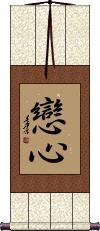
戀心 literally means “loving heart.” It can also be translated as “one's love” or “awakening of love.”
戀心 is used exclusively for love between boyfriends and girlfriends or husband and wife.
Breaking down the meaning of each Kanji, the first means love, affection, or tender passion. The second Kanji means heart, mind, or soul (most will read it as the heart).
See Also: Compassion | Love
Once in a Lifetime
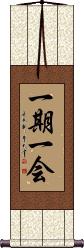
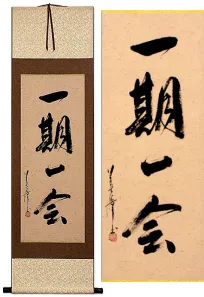
This Japanese title can be translated as “for this time only,” “chance meeting,” “one meeting, one opportunity,” “never again,” or “one chance in a lifetime.”
The characters literally mean “one time one meeting” - of course, the Kanji characters have meaning far beyond a direct translation like this.
Some might use this proverb to talk of an opportunity that presents itself just once in your life. It could also be a one-and-only chance meeting with your true soul mate. An expression of any event that might happen once in a lifetime.
This is primarily a Japanese title, however, there is also a Traditional Chinese (and old Korean) version of this proverb. Just the last character is different. The traditional form was used in Japan before WWII and in Korea prior to 1900. This title is somewhat known in China.
If you want the older traditional form, just click on the character to the right.
This in-stock artwork might be what you are looking for, and ships right away...

Gallery Price: $72.00
Your Price: $39.88
Gallery Price: $268.00
Your Price: $148.77

Gallery Price: $144.00
Your Price: $79.88

Gallery Price: $61.00
Your Price: $33.88

Gallery Price: $61.00
Your Price: $33.88

Gallery Price: $61.00
Your Price: $33.88

Gallery Price: $60.00
Your Price: $36.88
Gallery Price: $140.00
Your Price: $89.77
Not the results for one of a kind that you were looking for?
Below are some entries from our dictionary that may match your one of a kind search...
| Characters If shown, 2nd row is Simp. Chinese |
Pronunciation Romanization |
Simple Dictionary Definition |
切 see styles |
qiè qie4 ch`ieh chieh setsu せつ |
More info & calligraphy: Che(noun or adjectival noun) (1) (See 切に,切なる) eager; earnest; ardent; kind; keen; acute; (interjection) (2) (abbreviation) (also きり) (See 切る・3) OFF (on switch) To cut, carve; a whole; urgent; the 反切 system of spelling, i. e. the combination of the initial sound of one Chinese word with the final sound of another to indicate the sound of a third, a system introduced by translators of Buddhist works; v. 反. |
釋迦牟尼 释迦牟尼 see styles |
shì jiā móu ní shi4 jia1 mou2 ni2 shih chia mou ni Shakamuni |
More info & calligraphy: Shakyamuni / The Buddha釋迦文 (釋迦文尼); 釋伽文 Śākyamuni, the saint of the Śākya tribe. muni is saint, holy man, sage, ascetic monk; it is: intp. as 仁 benevolent, charitable, kind, also as 寂默 one who dwells in seclusion. After '500 or 550' previous incarnations, Śākyamuni finally attained to the state of Bodhisattva, was born in the Tuṣita heaven, and descended as a white elephant, through her right side, into the womb of the immaculate Māyā, the purest woman on earth; this was on the 8th day of the 4th month; next year on the 8th day of the 2nd month he was born from her right side painlessly as she stood under a tree in the Lumbinī garden. For the subsequent miraculous events v. Eitel. also the 神通遊戲經 (Lalitavistara), the 釋迦如來成道記, etc. Simpler statements say that he was born the son of Śuddhodana, of the kṣatriya caste, ruler of Kapilavastu, and Māyā his wife; that Māyā died seven days later, leaving him to be brought up by her sister Prājapati; that in due course he was married to Yaśodharā who bore him a son, Rāhula; that in search of truth he left home, became an ascetic, severely disciplined himself, and finally at 35 years of age, under a tree, realized that the way of release from the chain of rebirth and death lay not in asceticism but in moral purity; this he explained first in his four dogmas, v. 四諦 and eightfold noble way 八正道, later amplified and developed in many sermons. He founded his community on the basis of poverty, chastity, and insight or meditation, ad it became known as Buddhism, as he became known as Buddha, the enlightened. His death was probably in or near 487 B.C., a few years before that of Confucius in 479. The sacerdotal name of his family is Gautama, said to be the original name of the whole clan, Śākya being that of his branch, v. 瞿, 喬.; his personal name was Siddhārtha, or Sarvārthasiddha, v. 悉. |
宗 see styles |
zōng zong1 tsung motoi もとい |
school; sect; purpose; model; ancestor; clan; to take as one's model (in academic or artistic work); classifier for batches, items, cases (medical or legal), reservoirs (1) (rare) origin; source; (2) (rare) virtuous ancestor; (given name) Motoi Ancestors, ancestral; clan; class, category. kind; school, sect; siddhānta, summary, main doctrine, syllogism, proposition, conclusion, realization. Sects are of two kinds: (1) those founded on principles having historic continuity, as the twenty sects of the Hīnayāna, the thirteen sects of China, and the fourteen sects of Japan: (2) those arising from an individual interpretation of the general teaching of Buddhism, as the sub-sects founded by Yongming 永明 (d. 975), 法相宗, 法性宗, 破相宗, or those based on a peculiar interpretation of one of the recognized sects, as the Jōdo-shinshū 淨土眞宗 found by Shinran-shōnin. There are also divisions of five, six, and ten, which have reference to specific doctrinal differences. Cf. 宗派. |
手 see styles |
shǒu shou3 shou tezaki てざき |
hand; (formal) to hold; person engaged in certain types of work; person skilled in certain types of work; personal(ly); convenient; classifier for skill; CL:雙|双[shuang1],隻|只[zhi1] (1) (occ. pronounced た when a prefix) (See お手・おて・1) hand; arm; (2) (colloquialism) (See お手・おて・3) forepaw; foreleg; (3) handle; (4) hand; worker; help; (5) trouble; care; effort; (6) means; way; trick; move; technique; workmanship; (7) hand; handwriting; (8) kind; type; sort; (9) (See 手に入る) one's hands; one's possession; (10) (See 手に余る) ability to cope; (11) hand (of cards); (12) (See 山の手・1) direction; (n,n-suf,ctr) (13) move (in go, shogi, etc.); (surname) Tezaki pāṇī; hasta; kara; hand, arm. |
玶 see styles |
píng ping2 p`ing ping |
name of one kind of jade |
番 see styles |
fān fan1 fan ban ばん |
(bound form) foreign (non-Chinese); barbarian; classifier for processes or actions that take time and effort; (classifier) a kind; a sort; (classifier) (used after the verb 翻[fan1] to indicate how many times a quantity doubles, as in 翻一番[fan1 yi1 fan1] "to double") (n,n-suf) (1) number (in a series); (2) (one's) turn; (3) watch; guard; lookout; (suffix noun) (4) rank; standing; position; (n,n-suf) (5) {sumo} bout; match; (suffix noun) (6) pieces (in a collection); (surname) Ban Barbarian, foreign; a time, a turn. |
痴 see styles |
chī chi1 ch`ih chih chi ち oko おこ |
imbecile; sentimental; stupid; foolish; silly (1) foolishness; fool; (2) (Buddhist term) moha (ignorance, folly); (noun or adjectival noun) foolish thing; stupid thing; absurdity moha, 'unconsciousness,' 'delusion,' 'perplexity,' 'ignorance, folly,' 'infatuation,' etc. M.W. Also, mūḍha. In Chinese it is silly, foolish, daft, stupid. It is intp. by 無明 unenlightened, i.e. misled by appearances, taking the seeming for real; from this unenlightened condition arises every kind of kleśa, i.e. affliction or defilement by the passions, etc. It is one of the three poisons, desire, dislike, delusion. |
識 识 see styles |
zhì zhi4 chih tsuguhide つぐひで |
to record; to write a footnote (1) acquaintanceship; (2) {Buddh} vijnana; consciousness; (3) (after a signature) written by ...; (personal name) Tsuguhide vijñāna, "the art of distinguishing, or perceiving, or recognizing, discerning, understanding, comprehending, distinction, intelligence, knowledge, science, learning . . . wisdom." M.W. parijñāna, "perception, thorough knowledge," etc. M.W. It is intp. by 心 the mind, mental discernment, perception, in contrast with the object discerned; also by 了別 understanding and discrimination. There are classifications of 一識 that all things are the one mind, or are metaphysical; 二識 q. v. discriminating the ālaya-vijñāna or primal undivided condition from the mano-vijñāna or that of discrimination; 三識 in the Laṅkāvatāra Sutra, fundamental, manifested and discriminate; 五識 q.v. in the 起信論, i.e. 業, 轉, 現, 知, and 相續識; 六識 the perceptions and discernings of the six organs of sense; also of 8, 9, 10, and 11 識. The most important is the eight of the 起信論, i.e. the perceptions of the six organs of sense, eye, ear, nose, tongue, body (or touch), and mind, together with manas, intp. as 意識 the consciousness of the previous moment, on which the other six depend; the eighth is the ālaya-vijñāna, v. 阿賴耶, in which is contained the seed or stock of all phenomena and which 無沒 loses none, or nothing, is indestructible; a substitute for the seventh is ādāna 'receiving' of the 唯識, which is intp. as 無解 undiscriminated, or indefinite perception; there is a difference of view between the 相 and the 性 schools in regard to the seventh and eight 識; and the latter school add a ninth called the amala, or pure vijñāna, i.e. the non-phenomenal 眞如識. The esoterics add that all phenomena are mental and all things are the one mind, hence the one mind is 無量識 unlimited mind or knowledge, every kind of knowledge, or omniscience. vijñāna is one of the twelve nidānas.; Ālaya-vijñāna and mano-vijñāna; i. e. 阿梨耶 | and 分別事 |; v. 識. |
路 see styles |
lù lu4 lu rou / ro ろう |
road (CL:條|条[tiao2]); journey; route; line (bus etc); sort; kind (suffix) (1) route; road; (suffix) (2) distance travelled in a day; (suffix) (3) (See 七十路) one's ... (age, e.g. 40s, 60s); (surname) Rou A road, way. |
一味 see styles |
yī wèi yi1 wei4 i wei kazumi かずみ |
persistently; stubbornly; blindly (1) clan; partisans; conspirators; gang; ring; crew; (n,vs,vi) (2) participation (e.g. in a plot); (3) one flavour; one charm; (4) one ingredient (in traditional Chinese medicine); (5) {Buddh} universality (of the teachings of Buddha); (given name) Kazumi One, or the same flavour, kind or character, i.e. the Buddha's teaching. |
一種 一种 see styles |
yī zhǒng yi1 zhong3 i chung isshu いっしゅ |
one kind of; one type of (1) a kind; a sort; a variety; a species; (2) (as 一種の...) of sorts; something of a; a sort of; (adverb) (3) sort of; somewhat one type |
一色 see styles |
yī sè yi1 se4 i se hitotsuiro ひとついろ |
(1) one color; (2) one kind; (surname) Hitotsuiro A colour, the same colour; the same; especially a thing, or a form, v. rūpa 色; minute, trifling, an atom. |
一解 see styles |
yī jiě yi1 jie3 i chieh ichige |
one (kind of) liberation |
一類 一类 see styles |
yī lèi yi1 lei4 i lei ichirui いちるい |
same type; category 1 (i.e. class A) same kind; accomplices; companions one type |
二業 二业 see styles |
èr yè er4 ye4 erh yeh nigyou / nigyo にぎょう |
(archaism) restaurants and geisha establishments Two classes of karma. (1) (a) 引業 leads to the 總報, i.e. the award as to the species into which one is to be born, e.g. men, gods, etc.; (6) 滿業 is the 別報 or fulfillment in detail, i.e. the kind or quality of being e.g. clever or stupid, happy or unhappy, etc. (2) (a) 善業 and (b) 惡業 Good and evil karma, resulting in happiness or misery. (3) (a) 助業 Aids to the karma of being reborn in Amitābha's Pure—land e. g. offerings, chantings, etc.; (b) 正業 thought and invocation of Amitābha with undivided mind, as the direct method. |
六因 see styles |
liù yīn liu4 yin1 liu yin rokuin |
The six causations of the 六位 six stages of Bodhisattva development, q. v. Also, the sixfold division of causes of the Vaibhāṣikas (cf. Keith, 177-8); every phenomenon depends upon the union of 因 primary cause and 緣 conditional or environmental cause; and of the 因 there are six kinds: (1) 能作因 karaṇahetu, effective causes of two kinds: 與力因 empowering cause, as the earth empowers plant growth, and 不障因 non-resistant cause, as space does not resist, i. e. active and passive causes; (2) 倶有因 sahabhūhetu, co-operative causes, as the four elements 四大 in nature, not one of which can be omitted; (3) 同類因 sabhāgahetu, causes of the same kind as the effect, good producing good, etc.; (4) 相應因 saṃprayuktahetu, mutual responsive or associated causes, e. g. mind and mental conditions, subject with object; Keith gives 'faith and intelligence'; similar to (2); (5) 遍行因 sarvatragahetu, universal or omnipresent cause, i. e. of illusion, as of false views affecting every act; it resembles (3) but is confined to delusion; (6) 異熟因 vipākahetu, differental fruition, i. e. the effect different from the cause, as the hells are from evil deeds. |
四三 see styles |
yomi よみ |
(1) {hanaf} (See 手役) one four-of-a-kind and one three-of-a-kind in a dealt hand; (2) three and a four (in dice games); (personal name) Yomi |
息慈 see styles |
xí cí xi2 ci2 hsi tz`u hsi tzu sokuji |
At rest and kind, an old translation of śramaṇa, one who has entered into the life of rest and shows loving-kindness to all. |
牟娑 see styles |
móu suō mou2 suo1 mou so musa |
(or 摩娑 or 目娑 ) (牟娑羅); 牟娑洛 (牟娑洛揭婆); 摩沙羅; 謨薩羅 or 牟薩羅 musāragalva, a kind of coral, white coral, M. W.; defined as 瑪瑙 cornelian, agate; and 硨磲 mother of pearl; it is one of the 七寳 sapta ratna q. v. |
百福 see styles |
bǎi fú bai3 fu2 pai fu momofuku ももふく |
(given name) Momofuku The hundred blessings, every kind of happiness. |
直掇 see styles |
zhí duō zhi2 duo1 chih to jikitotsu |
a kind of a robe 直裰 A monk's garment, upper and lower in one. |
茂泥 see styles |
mào ní mao4 ni2 mao ni moni |
文尼; 牟尼 muni, a solitary, a recluse, e. g. Śākyamuni, the recluse of the Śākya family; genī; intp. as one who seeks solitude, and one who is able to be kind. |
首款 see styles |
shǒu kuǎn shou3 kuan3 shou k`uan shou kuan |
to confess one's crime; first model, version, kind etc (of gadgets, software, cars etc) |
鹿車 鹿车 see styles |
lù chē lu4 che1 lu ch`e lu che |
Deer carts, one of the three kinds of vehicle referred to in the Lotus Sūtra, the medium kind; v. 三車. |
タイフ see styles |
taifu タイフ |
(1) type; kind; sort; style; (2) type (of person); (ideal) type; one's type; (3) (abbreviation) (See タイプライター) typewriter; (noun, transitive verb) (4) typing (on a typewriter); (place-name) At Ta'if |
一点物 see styles |
ittenmono いってんもの |
(noun - becomes adjective with の) one-of-a-kind item |
個性派 see styles |
koseiha / koseha こせいは |
unique type; one of a kind |
双ポン see styles |
shanpon シャンポン |
(mahj) (kana only) wait to turn either of two pairs into a three-of-a-kind to finish one's hand (chi:) |
親孝行 see styles |
oyakoukou / oyakoko おやこうこう |
(n,vs,vi,adj-na) (ant: 親不孝) filial piety; being kind to one's parents; taking care of one's parents |
逆恨み see styles |
sakaurami さかうらみ |
(noun, transitive verb) (1) being resented (by someone one holds resentment towards); (noun, transitive verb) (2) responding to kindness with resentment; thinking ill of someone who meant to be kind; resentment caused by a misunderstanding; (noun, transitive verb) (3) (colloquialism) unjustified resentment; unreasonable grudge |
Click here for more one of a kind results from our dictionary
The following table may be helpful for those studying Chinese or Japanese...
| Title | Characters | Romaji (Romanized Japanese) | Various forms of Romanized Chinese | |
| Loving Heart One’s Love | 戀心 恋心 | koi gokoro / koigokoro | ||
| Once in a Lifetime | 一期一會 一期一会 | ichigo ichie ichigoichie | yī qī yī huì yi1 qi1 yi1 hui4 yi qi yi hui yiqiyihui | i ch`i i hui ichiihui i chi i hui |
| In some entries above you will see that characters have different versions above and below a line. In these cases, the characters above the line are Traditional Chinese, while the ones below are Simplified Chinese. | ||||

Successful Chinese Character and Japanese Kanji calligraphy searches within the last few hours...



