Many custom options...


And formats...



Practice in Chinese / Japanese...
Buy a Practice calligraphy wall scroll here!
Personalize your custom “Practice” project by clicking the button next to your favorite “Practice” title below...
Training / Practice / Cultivation
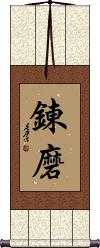
錬磨 is a Japanese word that means training, practice/practise, or cultivation.
Practice / Train / Drill
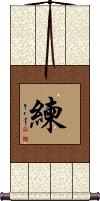
練 is a Chinese, Japanese, and Korean word that is the simplest way to say practice, train, drill, exercise, or to describe the effort taken to perfect one's skill.
Training / Drill
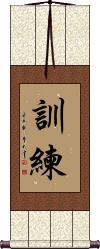
If training or drill is important to you (especially for military drill and training), 訓練 might be just the thing for a drill master to hang behind his/her desk.
This term is universal in Chinese, Japanese Kanji, and old Korean Hanja. It can also mean practice or exercise, depending on context.
Perseverance is the Key
Skills cannot be perfected without perseverance in practice
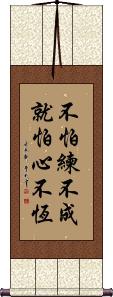
不怕练不成就怕心不恒 literally translates as: Do not worry about not being able to master [a skill]; What [one should] be concerned about is lack of perseverance.
Figuratively, this means: One's skills cannot be perfected without perseverance in practice.
For me, I've learned that you can only get so much from school or studying. You've really got to do “on-the-job training” to perfect your ability and skill.
For martial arts students: You can read about a kick in a book, or someone can tell you about a certain kick but until you practice the kick, there's no way you'll master it.
This in-stock artwork might be what you are looking for, and ships right away...

Starting at: $28.88
Gallery Price: $220.00
Your Price: $112.88

Gallery Price: $31.00
Your Price: $16.88

Gallery Price: $72.00
Your Price: $39.88

Gallery Price: $50.00
Your Price: $29.88

Gallery Price: $72.00
Your Price: $39.88

Gallery Price: $50.00
Your Price: $29.88

These search terms might be related to Practice:
Always Try to Do Better
Buddha Way
Bushido / the Way of the Samurai
Discipline / Training / Tempering Character
Exercise
Fierce and Courageous Training Defeats the Strong and Protects the Body.
Follow Your Heart
Godo / the Hard Way
Immovable Mind Way / Fudoshin Way
Kendo / the Way of the Sword
Let Us Try
Listen to Your Heart / Follow Your Heart
Love Will Find a Way
Milky Way Galaxy
Move on / Change Way of Thinking
Patience and Preparation
Preparation Yields No Fear or Worries
Preparation Yields No Regrets
Skill Acquired Through Hard Training
Tang Soo Do / Tang Hand Way
The Middle Way
The More We Sweat in Training, the Less We Bleed in Battle
The Old Way / Old School
The Way of Five Pecks of Rice
The Way of Learning Has No End
The Way of Light
The Way of Tea
The Way of the Dragon
The Way of the Wave
There is Always a Way Out
There is One Single Thread Binding My Way Together
Training / Drill
Training / Practice / Cultivation
Walk in the Way
Walking 100 Miles: Stopping at 90 Miles, is the Same as Stopping Half-Way
Way of Life / Art of Life
Where There is a Will, There is a Way
Where There’s a Will There’s a Way
Zendo / the Zen Way
Not the results for practice that you were looking for?
Below are some entries from our dictionary that may match your practice search...
| Characters If shown, 2nd row is Simp. Chinese |
Pronunciation Romanization |
Simple Dictionary Definition |
力 see styles |
lì li4 li riki りき |
More info & calligraphy: Power / Strength(suffix) strength; power; proficiency; ability; (given name) Riki bala; power, strength, of which there are several categories: 二力 power of choice and of practice; 三力 the power of Buddha; of meditation (samādhi) and of practice. 五力 pañcabala, the five powers of faith, zeal, memory (or remembering), meditation, and wisdom. 六力 A child's power is in crying; a woman's in resentment; a king's in domineering; an arhat's in zeal (or progress); a Buddha's in mercy; and a bhikṣu's in endurance (of despite) . 十力 q.v. The ten powers of Buddhas and bodhisattvas. |
媛 see styles |
yuàn yuan4 yüan hime ひめ |
More info & calligraphy: Beauty / Beautiful Princess(out-dated kanji) (1) princess; young lady of noble birth; (n-suf,n) (2) girl; (prefix) (3) small; cute; lesser (in names of species); (4) (archaism) (kyb:) prostitute; (female given name) Hime |
法 see styles |
fǎ fa3 fa minori みのり |
More info & calligraphy: Dharma / The Law(n,n-suf) (1) law; act; principle; (n,n-suf) (2) method; (n,n-suf) (3) {gramm} mood; (n,n-suf) (4) {Buddh} dharma; law; (female given name) Minori Dharma, 達磨; 曇無 (or 曇摩); 達摩 (or 達謨) Law, truth, religion, thing, anything Buddhist. Dharma is 'that which is held fast or kept, ordinance, statute, law, usage, practice, custom'; 'duty'; 'right'; 'proper'; 'morality'; 'character'. M. W. It is used in the sense of 一切 all things, or anything small or great, visible or invisible, real or unreal, affairs, truth, principle, method, concrete things, abstract ideas, etc. Dharma is described as that which has entity and bears its own attributes. It connotes Buddhism as the perfect religion; it also has the second place in the triratna 佛法僧, and in the sense of 法身 dharmakāya it approaches the Western idea of 'spiritual'. It is also one of the six media of sensation, i. e. the thing or object in relation to mind, v. 六塵. |
練 练 see styles |
liàn lian4 lien ren れん |
More info & calligraphy: Practice / Train / Drill(surname) Ren To train, practise, drill, exercise. |
修行 see styles |
xiū xíng xiu1 xing2 hsiu hsing nobuyuki のぶゆき |
More info & calligraphy: Shugyo(noun, transitive verb) (1) training; practice; discipline; study; (noun, transitive verb) (2) {Buddh} ascetic practices; (personal name) Nobuyuki caryā, conduct; to observe and do; to end one's ways; to cultivate oneself in right practice; be religious, or pious. |
參禪 参禅 see styles |
cān chán can1 chan2 ts`an ch`an tsan chan noshi wo ri |
More info & calligraphy: Zen UnderstandingTo inquire, discuss, seek religious instruction. |
善行 see styles |
shàn xíng shan4 xing2 shan hsing yoshiyuki よしゆき |
More info & calligraphy: Good Conduct(noun - becomes adjective with の) (ant: 悪行) good deed; good conduct; benevolence; (given name) Yoshiyuki practice of good deeds |
安心 see styles |
ān xīn an1 xin1 an hsin anshin あんしん |
More info & calligraphy: Peaceful Heart / Peace of Mind / Calm Mind{Buddh} obtaining peace of mind through faith or ascetic practice; (female given name) Anshin To quiet the heart, or mind; be at rest. |
布施 see styles |
bù shī bu4 shi1 pu shih fuho ふほ |
More info & calligraphy: Dana: Almsgiving and Generosity(n,vs,vi) (1) {Buddh} alms-giving; charity; (n,vs,vi) (2) {Buddh} offerings (usu. money) to a priest (for reading sutras, etc.); (surname) Fuho dāna 檀那; the sixth pāramitā, almsgiving, i. e. of goods, or the doctrine, with resultant benefits now and also hereafter in the forms of reincarnation, as neglect or refusal will produce the opposite consequences. The 二種布施 two kinds of dāna are the pure, or unsullied charity, which looks for no reward here but only hereafter; and the sullied almsgiving whose object is personal benefit. The three kinds of dāna are goods, the doctrine, and courage, or fearlessness. The four kinds are pens to write the sutras, ink, the sutras themselves, and preaching. The five kinds are giving to those who have come from a distance, those who are going to a distance, the sick, the hungry, those wise in the doctrine. The seven kinds are giving to visitors, travellers, the sick, their nurses, monasteries, endowments for the sustenance of monks or nuns, and clothing and food according to season. The eight kinds are giving to those who come for aid, giving for fear (of evil), return for kindness received, anticipating gifts in return, continuing the parental example of giving, giving in hope of rebirth in a particular heaven, in hope of an honoured name, for the adornment of the heart and life. 倶舍論 18. |
求道 see styles |
qiú dào qiu2 dao4 ch`iu tao chiu tao motomichi もとみち |
More info & calligraphy: Seeking Truthto seek (practice for, strive for) enlightenment |
瑜伽 see styles |
yú jiā yu2 jia1 yü chia yuga ゆが |
More info & calligraphy: Yoga{Buddh} (See ヨーガ) yoga; (surname) Yuga yoga; also 瑜誐; 遊迦; a yoke, yoking, union, especially an ecstatic union of the individual soul with a divine being, or spirit, also of the individual soul with the universal soul. The method requires the mutual response or relation of 境, 行, 理, 果 and 機; i.e. (1) state, or environment, referred to mind; (2) action, or mode of practice; (3) right principle; (4) results in enlightenment; (5) motivity, i.e. practical application in saving others. Also the mutual relation of hand, mouth, and mind referring to manifestation, incantation, and mental operation; these are known as 瑜伽三密, the three esoteric (means) of Yoga. The older practice of meditation as a means of obtaining spiritual or magical power was distorted in Tantrism to exorcism, sorcery, and juggling in general. |
真剣 see styles |
honki ほんき |
More info & calligraphy: Intense / Serious |
練功 练功 see styles |
liàn gōng lian4 gong1 lien kung renkou / renko れんこう |
More info & calligraphy: Skill Acquired Through Hard Training{MA} skills acquired through hard training; feats of practice |
薩蒂 萨蒂 see styles |
sà dì sa4 di4 sa ti |
More info & calligraphy: Sadie |
行德 see styles |
xíng dé xing2 de2 hsing te gyō toku |
More info & calligraphy: Morality of Deed |
訓練 训练 see styles |
xùn liàn xun4 lian4 hsün lien kunren くんれん |
More info & calligraphy: Training / Drill(noun, transitive verb) training; drill; practice; discipline |
道場 道场 see styles |
dào chǎng dao4 chang3 tao ch`ang tao chang michiba みちば |
More info & calligraphy: Dojo / Martial Arts Studio(1) dojo; hall used for martial arts training; (2) (abbreviation) {Buddh} (See 菩提道場) manda (place of Buddhist practice or meditation, esp. the place under the bodhi tree where Buddha attained enlightenment); (surname) Michiba Truth-plot. bodhimaṇḍala, circle, or place of enlightenment. The place where Buddha attained enlightenment. A place, or method, for attaining to Buddha-truth. An object of or place for religious offerings. A place for teaching, learning, or practising religion. |
達磨 达磨 see styles |
dá mó da2 mo2 ta mo daruma だるま |
More info & calligraphy: Daruma / Damodharma; also 達摩; 達麼; 達而麻耶; 曇摩; 馱摩 tr. by 法. dharma is from dhara, holding, bearing, possessing, etc.; and means 'that which is to be held fast or kept, ordinance, statute, law, usage, practice'; 'anything right.' M.W. It may be variously intp. as (1) characteristic, attribute, predicate; (2) the bearer, the transcendent substratum of single elements of conscious life; (3) element, i.e. a part of conscious life; (4) nirvāṇa, i.e. the Dharma par excellence, the object of Buddhist teaching; (5) the absolute, the real; (6) the teaching or religion of Buddha; (7) thing, object, appearance. Also, Damo, or Bodhidharma, the twenty-eighth Indian and first Chinese patriarch, who arrived in China A.D. 520, the reputed founder of the Chan or Intuitional School in China. He is described as son of a king in southern India; originally called Bodhitara. He arrived at Guangdong, bringing it is said the sacred begging-bowl, and settled in Luoyang, where he engaged in silent meditation for nine years, whence he received the title of wall-gazing Brahman 壁觀婆羅門, though he was a kṣatriya. His doctrine and practice were those of the 'inner light', independent of the written word, but to 慧可 Huike, his successor, he commended the Laṅkāvatāra-sūtra as nearest to his views. There are many names with Dharma as initial: Dharmapāla, Dharmagupta, Dharmayaśas, Dharmaruci, Dharmarakṣa, Dharmatrāta, Dharmavardhana, etc. |
錬磨 see styles |
renma れんま |
More info & calligraphy: Training / Practice / Cultivation |
バッセン see styles |
bassen バッセン |
(abbreviation) {baseb} (See バッティングセンター) batting practice facility; batting practice center; batting cage |
事 see styles |
shì shi4 shih tsutomu つとむ |
matter; thing; item; work; affair; CL:件[jian4],樁|桩[zhuang1],回[hui2] {Buddh} (See 理・2) individual concrete phenomenon (as opposed to a general principle); (male given name) Tsutomu artha 日迦他 (迦 being an error for 遏); affair, concern, matter; action, practice; phenomena; to serve. It is 'practice' or the thing, affair, matter, in contrast with 理 theory, or the underlying principle. |
例 see styles |
lì li4 li kiyosaki きよさき |
example; precedent; rule; case; instance (1) example; instance; illustration; case; (2) precedent; (3) custom; habit; practice; usage; (surname) Kiyosaki an example |
修 see styles |
xiū xiu1 hsiu yoshimi よしみ |
to decorate; to embellish; to repair; to build; to write; to cultivate; to study; to take (a class) (given name) Yoshimi To put in order, mend, cultivate, observe. Translit. su, sū. Cf. 須; 蘇. |
果 see styles |
guǒ guo3 kuo minoru みのる |
fruit; result; resolute; indeed; if really (1) {Buddh} (See 因・2) phala (attained state, result); (2) {Buddh} (See 悟り・2) enlightenment (as the fruits of one's Buddhist practice); (3) (See 果物) fruit; (counter) (4) counter for pieces of fruit; (male given name) Minoru phala, 頗羅 fruit; offspring; result, consequence, effect; reward, retribution; it contrasts with cause, i. e. 因果 cause and effect. The effect by causing a further effect becomes also a cause. |
止 see styles |
zhǐ zhi3 chih tomeru とめる |
to stop; to prohibit; until; only (given name) Tomeru To stop, halt, cease; one of the seven definitions of 禪定 dhyāna described as 奢摩他 śamatha or 三摩地 samādhi; it is defined as 靜息動心 silencing, or putting to rest the active mind, or auto-hypnosis; also 心定止於一處 the mind centred, lit. the mind steadily fixed on one place, or in one position. It differs from 觀 which observes, examines, sifts evidence; 止 has to do with 拂妄 getting rid of distraction for moral ends; it is abstraction, rather than contemplation; see 止觀 In practice there are three methods of attaining such abstraction: (a) by fixing the mind on the nose, navel, etc.; (b) by stopping every thought as it arises; (c) by dwelling on the thought that nothing exists of itself, but from a preceding cause. |
溜 see styles |
liù liu4 liu ryuu / ryu りゅう |
swift current; rapids; (dialect) (of speech, actions etc) skilled; proficient; (of movements) quick; speedy; (bound form) rain runoff from a roof; (bound form) roof gutter; classifier for rows, lines etc; surroundings; neighborhood; (dialect) to practice; (dialect) to plaster; to fill in the cracks (with cement, lime plaster etc) (surname) Ryū |
習 习 see styles |
xí xi2 hsi shii / shi シー |
(bound form) to practice; to study; habit; custom (surname) Xi Repetition, practice, habit, skilled; u.f. 習氣 intp. vāsanā. |
肄 see styles |
yì yi4 i |
to learn; to practice or study (old) |
臘 腊 see styles |
là la4 la rou / ro ろう |
ancient practice of offering sacrifices to the gods in the 12th lunar month; the 12th lunar month; (bound form) (of meat, fish etc) cured in winter, esp. in the 12th lunar month (1) {Buddh} offering ceremony held on the third day of the dog after the winter solstice; (2) twelfth month of the lunisolar calendar; (3) (See 臈) year in the Buddhist order (after the completion of the first meditation retreat) Dried flesh; to sacrifice to the gods three days after the winter solstice; the end of the year; a year; a monastic year, i.e. the end of the annual summer retreat, also called 戒臘; 夏臘; 法臘. |
荒 see styles |
huāng huang1 huang susamu すさむ |
desolate; shortage; scarce; out of practice; absurd; uncultivated; to neglect (1) leftovers (after filleting a fish); (2) rice chaff; (3) (kana only) flaw (esp. of a person); (prefix) (4) rough; roughly; (5) crude; raw; natural; wild; (given name) Susamu Wild, waste; wilds; empty; famine; reckless; to nullify; an angry appearance. |
Click here for more practice results from our dictionary
The following table may be helpful for those studying Chinese or Japanese...
| Title | Characters | Romaji (Romanized Japanese) | Various forms of Romanized Chinese | |
| Training Practice Cultivation | 錬磨 | ren ma / renma | ||
| Practice Train Drill | 練 练 | ren | liàn / lian4 / lian | lien |
| Training Drill | 訓練 训练 | kunren | xùn liàn / xun4 lian4 / xun lian / xunlian | hsün lien / hsünlien |
| Perseverance is the Key | 不怕練不成就怕心不恆 不怕练不成就怕心不恒 | bú pà liàn bù chéng jiù pà xīn bù héng bu2 pa4 lian4 bu4 cheng2 jiu4 pa4 xin1 bu4 heng2 bu pa lian bu cheng jiu pa xin bu heng | pu p`a lien pu ch`eng chiu p`a hsin pu heng pu pa lien pu cheng chiu pa hsin pu heng |
|
| In some entries above you will see that characters have different versions above and below a line. In these cases, the characters above the line are Traditional Chinese, while the ones below are Simplified Chinese. | ||||

Successful Chinese Character and Japanese Kanji calligraphy searches within the last few hours...



