Many custom options...


And formats...



Security in Chinese / Japanese...
Buy a Security calligraphy wall scroll here!
Personalize your custom “Security” project by clicking the button next to your favorite “Security” title below...
1. Police / Public Security Bureau
4. Worldwide Wish for Peace and Prosperity
5. Peaceful Heart / Peace of Mind / Calm Mind
7. No Fear
8. Tiger Rumor
9. The Confident Helmsman Inspires Confidence in the Passengers
10. No Pain No Gain
Police / Public Security Bureau
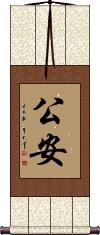
公安 is the Chinese, Japanese Kanji, and old Korean Hanja title for (The Ministry of) Public Security. 公安 can also generally mean public safety, public security, or public welfare. It is a positive term in Japan, where some even name their daughters “Kouan” (this title).
In China, this is the kinder name for the PSB or Public Security Bureau. It's really the national police of China - occasionally brutal and seldom properly-trained or educated. Once in a while, you find a PSB officer who lives up to the title of 公安. Before the 1989 massacre, it was the PSB officers who refused to stop nor kill any of the protesting college students (so they're not all bad). The Chinese government had to call in soldiers from Inner Mongolia to kill thousands of protesters.
Peace and Tranquility
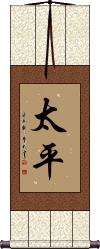
太平 means “peace and tranquility” or “peace and security” in Chinese, Japanese Kanji, and old Korean Hanja.
The literal translation would be “very balanced” or “very peaceful.”
The first character means very, much, too much, or extremely.
The second character means balanced, peaceful, calm, equal, even, level, or smooth.
Peace and Tranquility
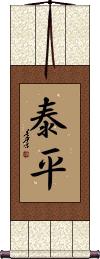
泰平 means peace and/or tranquility in Japanese and Korean (also understood but not as common in Chinese).
Safe / Secure
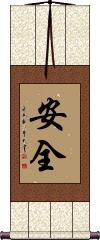
安全 is the word that represents the idea of safety and security in Chinese, Japanese Kanji, and old Korean Hanja.
Everyone wants to have some form of safety in their lives. This conveys how important the feeling of safety and security is to you.
Worldwide Wish for Peace and Prosperity
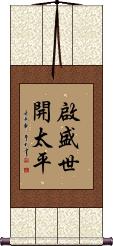
啟盛世開太平 means “To bring flourishing peace and security to the world (our current era).”
It's a wish that a new door leading to peace and prosperity could be opened to mankind.
Character and word breakdown:
啟 to open; to start; to initiate; to enlighten or awaken.
盛世 a flourishing period; period of prosperity; a golden age.
開 to open; to start; to turn on.
太平 peace and security; peace and tranquility; peace; tranquility.
I don't like to do breakdowns like this, as the words altogether create their unique meaning (encompassed in the main title above).
Peaceful Heart / Peace of Mind / Calm Mind
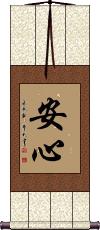
安心 can be defined as relief, peace of mind, feeling at ease, to be relieved, to set one's mind at rest, and easiness.
安心 is a nice word that encompasses great meanings within just two characters. Some of the other meanings include pacifying, settling the mind, and peace of mind. It's also the idea of feeling a sense of security, safety, and confidence in your state of well-being.
This can be used by everyone, but some consider it to be a Buddhist concept (You'll find it in your Zen dictionary).
Note: Can be romanized as Anshin or Anjin in Japanese.
Strength: Strong and Solid
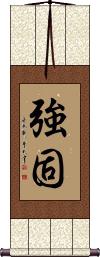
強固 means firmness, stability, security, and strength in Japanese.
It's not used commonly in China, but it means “powerful,” “firm,” “solid,” “strong,” or “better than others” in Chinese. There is a slight variation in the top of the first character between Chinese and Japanese. Because this is more of a Japanese word, we are showing the Japanese form here.
強固 is also a Korean word, but Korean Hanja uses the Chinese form of the first character (one tiny stroke is a little different), so just let me know if your audience is Korean when you place your order, and we'll have it written in the Chinese/Korean version.
No Fear
(2 characters)
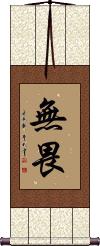
無畏 literally means “No Fear.” But perhaps not the most natural Chinese phrase (see our other “No Fear” phrase for a complete thought). However, this two-character version of “No Fear” seems to be a very popular way to translate this into Chinese when we checked Chinese Google.
Note: This also means “No Fear” in Japanese and Korean, but this character pair is not often used in Japan or Korea.
This term appears in various Chinese dictionaries with definitions like “without fear,” intrepidity, fearless, dauntless, and bold.
In the Buddhist context, this is a word derived from the word Abhaya, meaning: Fearless, dauntless, secure, nothing, and nobody to fear. Also, from vīra meaning: courageous, bold.
See Also: Never Give Up | No Worries | Undaunted | Bravery | Courage | Fear No Man
Tiger Rumor
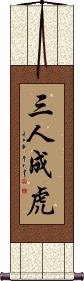
These four characters together relay the meaning that can be expressed in English as “When three people say there's a tiger running in the street, you believe it.”
Of course, there is an ancient story behind this idiom...
三人成虎 is actually a proverb that resulted from a conversation that occurred around 300 B.C.
The conversation was between the king of the Wei kingdom and one of the king's ministers named Pang Cong.
It was near the end of one of many wars, this time with the Zhao kingdom. Pang Cong was to be sent by the king to the Zhao kingdom with the king's son, who was to be held hostage. It was common at the time for a king to make his son a hostage to secure stable peace between warring kingdoms.
Before minister Pang Cong departed, he asked his king, “If one person told you a tiger was running in the street, would you believe it?.”
“No,” the king said.
The minister continued, “What if two people told you?”
The king replied, “Well, I would have my doubts but I might believe it.”
The minister continued, “So, what if three people told you that a tiger is running in the streets?”
The king replied, “Yes, I would believe it. It must be true if three people say it.”
The minister then reminded the king, “Your son and I are now traveling far away to live in the distant Zhao kingdom - much farther from your palace than the street. Rumors may fly about me in my absence, so I hope your majesty will weight such rumors appropriately.”
The king replied, “I have every trust in you, do not worry”
While the minister was gone, the king's enemies gossiped about minister Pang Cong on many occasions. At first, the king thought nothing of these comments and rumors. But slowly, as the rumors mounted, the king began to suspect ill of his minister.
Sometime later, when peace was well-established, the minister and prince were freed and returned to the kingdom of Wei. The king received his son BUT DID NOT EVEN SUMMON MINISTER PANG CONG TO THE PALACE!
Hopefully, this story will help you see how dangerous words can be when used to promote rumors or create ill will. And perhaps will inspire you not to believe everything you hear.
There is also a secondary suggestion in this idiom that gossip is as ferocious as a tiger. Some Chinese people who don't know the ancient story above may believe that this scroll means that rumors are as vicious as three tigers.
Note: This proverb appears in my Korean dictionary but is not well-known in Korea.
The Confident Helmsman Inspires Confidence in the Passengers
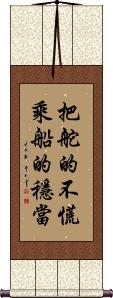
把舵的不慌乘船的稳当 is a Chinese proverb that literally translates as: [If the] helmsman is not nervous, the passengers [will feel] secure.
Figuratively, this means: If the leader appears confident, his/her followers will gain confidence also.
This is a great suggestion that a confident leader inspires confidence in his/her troops or followers. Of course, a nervous leader will create fear in troops or followers.
No Pain No Gain
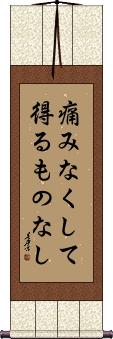
痛みなくして得るものなし is a Japanese phrase that means “no pain, no gain.”
This suggests that with pain, a gain must follow.
The pain Kanji here can also be translated as sorrow or suffering. The gain can also mean profit, advantage, or benefit. In the Japanese Buddhist context, that gain Kanji can mean rebirth in paradise, entering nirvana.
The character breakdown:
痛みなく (itami naku) pain; ache; sore; grief; distress. The naku part adds the meaning of “a lot of” or “extended”
して (shite) and then. (indicates a causative expression; acts as a connective particle)
得る (eru) to get; to acquire; to obtain; to procure; to earn; to win; to gain; to secure; to attain.
もの (mono) conjunctive particle indicating a cause or reason.
なし (nashi) none of; -less; without; no.
Note: Because this selection contains some special Japanese Hiragana characters, it should be written by a Japanese calligrapher.
Daodejing / Tao Te Ching - Chapter 54
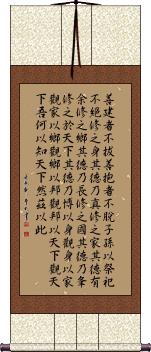
This is the Mawangdui version of Daodejing chapter 54.
By its virtue alone can one generation after another carry on the ancestral sacrifice.
Apply it to yourself, and by its power, you will be freed from dross.
Apply it to your household, and your household shall thereby have abundance.
Apply it to the village, and the village will be made secure.
Apply it to the kingdom, and the kingdom shall thereby be made to flourish.
Apply it to an empire, and the empire shall thereby be extended.
Therefore just as through oneself, one may contemplate Oneself;
So through the household one may contemplate the Household;
And through the village, one may contemplate the Village;
And through the kingdom, one may contemplate the Kingdom;
And through the empire, one may contemplate the Empire.
How do I know that the empire is so? By this.
What is firmly rooted cannot be pulled out;
What is tightly held in the arms will not slip loose;
Through this, the offering of sacrifice by descendants will never come to an end.
Cultivate it in your person, and its virtue will be genuine;
Cultivate it in the family, and its virtue will be more than sufficient;
Cultivate it in the hamlet, and its virtue will endure;
Cultivate it in the state, and its virtue will abound;
Cultivate it in the empire, and its virtue will be pervasive.
Hence look at the person through the person;
Look at the family through the family;
Look at the hamlet through the hamlet;
Look at the state through the state;
Look at the empire through the empire.
How do I know that the empire is like that?
By means of this.
These search terms might be related to Security:
...And This Above All to Thine Own Self Be True
Blessings and Protection
Changing Oneself / Self Reformation
Confidence / Faithful Heart
Consciousness of Self
Defense / Defend
Divine Protection
Engage With Confidence
Inner Strength / Self-Improvement
Introspection / Self-Awareness
Jiko No Kansei / Self-Completion
Power of Oneself / Self-Sufficient
Prideful Mind / Self-Respecting Heart
Protection
Safety and Well-Being of the Family
Self Actualization
Self Awareness Becomes a Buddha
Self Consciousness
Self Sacrifice
Self-Confidence
Self-Control
Self-Defense
Self-Discipline / Will-Power
Self-Discipline and Martial Virtue
Self-Discipline Martial Arts
Self-Improvement
Self-Love / Love Yourself / Love Oneself
Self-Reliance
Self-Respect / Self-Esteem
Self-Restraint / Self-Control
Take Refuge in the Three Treasures
The Confident Helmsman Inspires Confidence in the Passengers
To Thine Own Self Be True
Under the Protection of the Dragon Saint
Unyielding Self-Reliance
Will-Power / Self-Control
The following table may be helpful for those studying Chinese or Japanese...
| Title | Characters | Romaji (Romanized Japanese) | Various forms of Romanized Chinese | |
| Police Public Security Bureau | 公安 | kou an / kouan / ko an | gōng ān / gong1 an1 / gong an / gongan | kung an / kungan |
| Peace and Tranquility | 太平 | tai hei / taihei | tài píng / tai4 ping2 / tai ping / taiping | t`ai p`ing / taiping / tai ping |
| Peace and Tranquility | 泰平 | taihei | ||
| Safe Secure | 安全 | an zen / anzen | ān quán / an1 quan2 / an quan / anquan | an ch`üan / anchüan / an chüan |
| Worldwide Wish for Peace and Prosperity | 啟盛世開太平 启盛世开太平 | qǐ shèng shì kāi tài píng qi3 sheng4 shi4 kai1 tai4 ping2 qi sheng shi kai tai ping qishengshikaitaiping | ch`i sheng shih k`ai t`ai p`ing chishengshihkaitaiping chi sheng shih kai tai ping |
|
| Peaceful Heart Peace of Mind Calm Mind | 安心 | an shin / anshin | ān xīn / an1 xin1 / an xin / anxin | an hsin / anhsin |
| Strength: Strong and Solid | 強固 强固 | kyouko / kyoko | qiáng gù / qiang2 gu4 / qiang gu / qianggu | ch`iang ku / chiangku / chiang ku |
| No Fear | 無畏 无畏 | mui | wú wèi / wu2 wei4 / wu wei / wuwei | |
| Tiger Rumor | 三人成虎 | sān rén chéng hǔ san1 ren2 cheng2 hu3 san ren cheng hu sanrenchenghu | san jen ch`eng hu sanjenchenghu san jen cheng hu |
|
| The Confident Helmsman Inspires Confidence in the Passengers | 把舵的不慌乘船的穩當 把舵的不慌乘船的稳当 | bǎ tuò de bù huāng chéng chuán de wěn dang ba3 tuo4 de bu4 huang1 cheng2 chuan2 de wen3 dang ba tuo de bu huang cheng chuan de wen dang | pa t`o te pu huang ch`eng ch`uan te wen tang pa to te pu huang cheng chuan te wen tang |
|
| No Pain No Gain | 痛みなくして得るものなし | itami naku shite erumono wa nashi | ||
| Daodejing Tao Te Ching - Chapter 54 | 善建者不拔善抱者不脫子孫以祭祀不絕修之身其德乃真修之家其德有余修之鄉其德乃長修之國其德乃夆修之於天下其德乃博以身觀身以家觀家以鄉觀鄉以邦觀邦以天下觀天下吾何以知天下然茲以此 善建者不拔善抱者不脱子孙以祭祀不绝修之身其德乃真修之家其德有余修之乡其德乃长修之国其德乃夆修之于天下其德乃博以身观身以家观家以乡观乡以邦观邦以天下观天下吾何以知天下然兹以此 | shàn jiàn zhě bù bá shàn bào zhě bù tuō zǐ sūn yǐ jì sì bù jué xiū zhī shēn qí dé nǎi zhēn xiū zhī jiā qí dé yǒu yú xiū zhī xiāng qí dé nǎi zhǎng xiū zhī guó qí dé nǎi féng xiū zhī yú tiān xià qí dé nǎi bó yǐ shēn guān shēn yǐ jiā guān jiā yǐ xiāng guān xiāng yǐ bāng guān bāng yǐ tiān xià guān tiān xià wú hé yǐ zhī tiān xià rán zī yǐ cǐ shan4 jian4 zhe3 bu4 ba2 shan4 bao4 zhe3 bu4 tuo1 zi3 sun1 yi3 ji4 si4 bu4 jue2 xiu1 zhi1 shen1 qi2 de2 nai3 zhen1 xiu1 zhi1 jia1 qi2 de2 you3 yu2 xiu1 zhi1 xiang1 qi2 de2 nai3 zhang3 xiu1 zhi1 guo2 qi2 de2 nai3 feng2 xiu1 zhi1 yu2 tian1 xia4 qi2 de2 nai3 bo2 yi3 shen1 guan1 shen1 yi3 jia1 guan1 jia1 yi3 xiang1 guan1 xiang1 yi3 bang1 guan1 bang1 yi3 tian1 xia4 guan1 tian1 xia4 wu2 he2 yi3 zhi1 tian1 xia4 ran2 zi1 yi3 ci3 shan jian zhe bu ba shan bao zhe bu tuo zi sun yi ji si bu jue xiu zhi shen qi de nai zhen xiu zhi jia qi de you yu xiu zhi xiang qi de nai zhang xiu zhi guo qi de nai feng xiu zhi yu tian xia qi de nai bo yi shen guan shen yi jia guan jia yi xiang guan xiang yi bang guan bang yi tian xia guan tian xia wu he yi zhi tian xia ran zi yi ci | shan chien che pu pa shan pao che pu t`o tzu sun i chi ssu pu chüeh hsiu chih shen ch`i te nai chen hsiu chih chia ch`i te yu yü hsiu chih hsiang ch`i te nai chang hsiu chih kuo ch`i te nai feng hsiu chih yü t`ien hsia ch`i te nai po i shen kuan shen i chia kuan chia i hsiang kuan hsiang i pang kuan pang i t`ien hsia kuan t`ien hsia wu ho i chih t`ien hsia jan tzu i tz`u shan chien che pu pa shan pao che pu to tzu sun i chi ssu pu chüeh hsiu chih shen chi te nai chen hsiu chih chia chi te yu yü hsiu chih hsiang chi te nai chang hsiu chih kuo chi te nai feng hsiu chih yü tien hsia chi te nai po i shen kuan shen i chia kuan chia i hsiang kuan hsiang i pang kuan pang i tien hsia kuan tien hsia wu ho i chih tien hsia jan tzu i tzu |
|
| In some entries above you will see that characters have different versions above and below a line. In these cases, the characters above the line are Traditional Chinese, while the ones below are Simplified Chinese. | ||||

Successful Chinese Character and Japanese Kanji calligraphy searches within the last few hours...



