Many custom options...


And formats...



Sky in Chinese / Japanese...
Buy a Sky calligraphy wall scroll here!
Personalize your custom “Sky” project by clicking the button next to your favorite “Sky” title below...
2. Blue Sky
3. Sky / Void
10. Sky / Ether / Void / Emptiness / Unreality
11. Five Elements
12. No Limitations
14. Heaven
Nothingness / Empty / Void
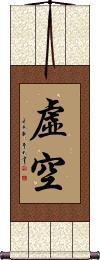
虛空 means empty space, empty sky, or void.
In the Buddhist context, it can mean “emptiness of the material world.” This can also be used as an adjective to modify other words with a meaning of unreal or insubstantial.
Blue Sky
The Blue Dome of Heaven
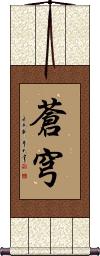
蒼穹 is a poetic way to express “sky” in Chinese and Japanese Kanji.
It's like saying, “The blue dome of heaven,” or a way to say “blue sky” within a poem.
Sky / Void
虛空 means void, hollow, empty, space, sky, atmosphere, heaven, or ether.
虛空 is the Chinese and Japanese version of the Sanskrit word ākāśa (or akasa / akash) which, beyond the sky or space meaning can be the immaterial universe behind all phenomena in the Buddhist context.
Clear Blue Sky
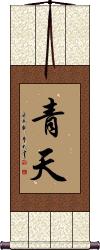
青天 means clear sky and/or blue sky in Chinese and Japanese Kanji.
Sometimes this term is used in Chinese to refer to an upright and honorable official or politician (a very rare thing).
In Japanese, this can also be the name Harutaka.
Sky / Air / Ether / Space
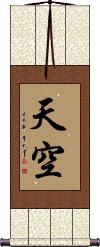
天空 means sky in most contexts but it can also refer to air, space, the heavens, or ether.
A Vast Sky Full of Stars
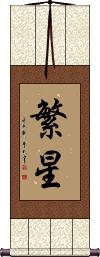
繁星 is a title that literally means a cluster or huge number of stars in the sky.
Misty / Cloudy Sky
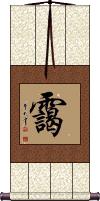
靄 is the Chinese, Japanese Kanji, and old Korean Hanja for misty mist; haze; cloudy sky.
When pronounced “Ai” in Japanese, it can be a female given name.
靄 is probably a good character to represent “Misty” if that is your name.
A Vast Sky Full of Stars
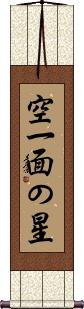
空一面の星 is a Japanese phrase that refers to the sky being like a vast page or face full of stars.
Beautiful Clear Sky
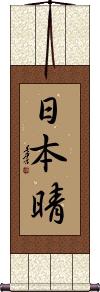
日本晴 is a Japanese Kanji title that means beautiful weather, clear and cloudless sky, or clear weather.
It's a little odd, but if you literally translated this phrase, it says, “Japanese weather,” as if that was an indication of perfect weather (maybe a little arrogant on behalf of Japan - I've experienced a monsoon there, which was unpleasant).
Sky / Ether / Void / Emptiness / Unreality
(Used in Japanese version of five elements)
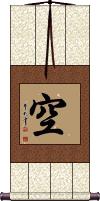
空 is a single character that means empty, void, hollow, vacant, vacuum, blank, nonexistent, vacuity, voidness, emptiness, non-existence, immateriality, unreality, the false or illusory nature of all existence, and being unreal.
In the Buddhist context, this relates to the doctrine that all phenomena and the ego have no reality but are composed of a certain number of skandhas or elements, which disintegrate. The void, the sky, space. The universal, the absolute, complete abstraction without relativity. The doctrine further explains that all things are compounds, or unstable organisms, possessing no self-essence, i.e. are dependent, or caused, come into existence only to perish. The underlying reality, the principle of eternal relativity, or non-infinity, i.e. śūnya, permeates all phenomena making possible their evolution.
From Sanskrit and/or Pali, this is the translation to Chinese and Japanese of the title śūnya or śūnyatā.
In Japanese, when pronounced as “ron” (sounds like “roan”) this can be a given name. It should be noted that this Kanji has about 5 different possible pronunciations in Japanese: kuu, kara, sora, ron, and uro. 空 is also an element in the Japanese version of the five elements.
Five Elements
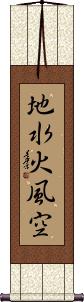
地水火風空 is the specifically-Japanese version of the five elements.
This is a little different than the ancient or original Chinese version.
The elements are written in this order:
1. Earth / Terra / Ground
2. Water
3. Fire
4. Wind / Air
5. Sky / Emptiness / Void / Ether
Note: This set of Kanji can also be romanized as “ji sui ka fuu kuu,” “jisuikafuukuu,” or “jisuikafuku.”
These can also be written in the order 地火風水空 (chi ka sui fuu kuu). Let me know when you place your order if you want the Kanji to be in this character order.
No Limitations
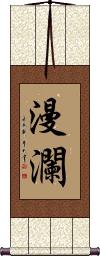
漫瀾 is the Chinese, Japanese Kanji, and old Korean Hanja for “Having no boundaries or limitations.”
This literally talks of the vastness of an ocean or river.
Character breakdown:
漫 = free; unrestrained; to inundate; overflowing; boundless.
澜 = swelling water; large wave.
Endless / Without Limit
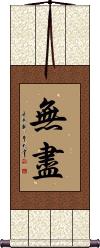
無盡 is the Chinese, Japanese Kanji, and old Korean Hanja for endless; inexhaustible; without limits; infinite.
In the Buddhist context, this can refer to the infinitude of living beings, of worlds, of space, of the dharmadhātu, of nirvāṇa, etc.
Heaven
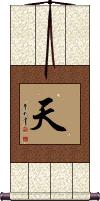
天 means “heaven” or “sky” in Chinese, Japanese Kanji, and old Korean Hanja.
The context determines if you are talking about heaven or the sky above (often they are the same concept).
When combined with other characters, words like “today” and “tomorrow” are created. While sometimes the character for “sun” is used to mean “day,” often “sky” represents “day” in Asian languages.
Example: 今天 (this sky) = “today,” 明天 (next sky) = “tomorrow” in modern Chinese and Japanese.
In Chinese culture, regardless of which religion, it's almost always assumed that God (and any other deities) live up above the sky. The concept of God living in the sky is likely the reason heaven is associated with this character.
The equation goes something like this: God's domain is the sky, thus, the sky is heaven.
Note: As a single character, this is a little ambiguous, so you might want to choose our Kingdom of Heaven selection instead.
This in-stock artwork might be what you are looking for, and ships right away...

Gallery Price: $72.00
Your Price: $39.88

Gallery Price: $63.00
Your Price: $34.88
The following table may be helpful for those studying Chinese or Japanese...
| Title | Characters | Romaji (Romanized Japanese) | Various forms of Romanized Chinese | |
| Nothingness Empty Void | 虛空 虚空 | kokuu / koku | xū kōng / xu1 kong1 / xu kong / xukong | hsü k`ung / hsükung / hsü kung |
| Blue Sky | 蒼穹 苍穹 | sou kyuu / soukyuu / so kyu | cāng qióng cang1 qiong2 cang qiong cangqiong | ts`ang ch`iung tsangchiung tsang chiung |
| Sky Void | 虛空 虚空 | kokū | xū kōng / xu1 kong1 / xu kong / xukong | hsü k`ung / hsükung / hsü kung |
| Clear Blue Sky | 青天 | seiten | qīng tiān qing1 tian1 qing tian qingtian | ch`ing t`ien chingtien ching tien |
| Sky Air Ether Space | 天空 | ten kuu / tenkuu / ten ku | tiān kōng tian1 kong1 tian kong tiankong | t`ien k`ung tienkung tien kung |
| A Vast Sky Full of Stars | 繁星 | fán xīng / fan2 xing1 / fan xing / fanxing | fan hsing / fanhsing | |
| Misty Cloudy Sky | 靄 霭 | moya | ǎi / ai3 / ai | |
| A Vast Sky Full of Stars | 空一面の星 | sora ichimen no hoshi soraichimennohoshi | ||
| Beautiful Clear Sky | 日本晴 | nihonbare | ||
| Sky Ether Void Emptiness Unreality | 空 | kuu / kara / sora / ron ku / kara / sora / ron | kōng / kong1 / kong | k`ung / kung |
| Five Elements | 地水火風空 地水火风空 | chi sui ka fuu kuu chisuikafuukuu chi sui ka fu ku | ||
| No Limitations | 漫瀾 漫澜 | man ran / manran | màn lán / man4 lan2 / man lan / manlan | |
| Endless Without Limit | 無盡 无尽 | mu jin / mujin | wú jìn / wu2 jin4 / wu jin / wujin | wu chin / wuchin |
| Heaven | 天 | ten | tiān / tian1 / tian | t`ien / tien |
| In some entries above you will see that characters have different versions above and below a line. In these cases, the characters above the line are Traditional Chinese, while the ones below are Simplified Chinese. | ||||

Successful Chinese Character and Japanese Kanji calligraphy searches within the last few hours...



