Artwork
Search:

Exact
Phrase

Oriental Outpost LogoFlagTowerwatercolor
Chinese Calligraphy Search
ArtPaintingsAsian Art Gallery

Adventures in Asian Art

Didn't find what you want?
Try these methods:

1. Make your search more specific.
2. Use other similar-meaning words.
3. Use less words or just one word.
4. Post your request on our forum so that we can translate/create what you want.


Selections for Well-being in Chinese and/or Japanese...

We'll build you a handmade custom "Well-being" calligraphy wall scroll if you wish!


Quick links to words on this page...


Select

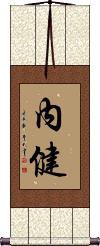
Good Health

Mandarin: jiàn kāng
Japanese: kenkou
Korean: 건강

健
康

This is the best way to express good health in Chinese, Korean and Japanese.

These characters also suggest the ideas of being solid, strong, sound, wholesome and at peace.

Can also be used to express "healthy", "vitality", or "well-being".

See Also...  Health | Vitality | Wellness

Score: 15/100

Select

Good Health / Healthy / Vigor

Also suggests being at peace

Mandarin: kāng
Japanese: kou
Korean:

康

This is a single character that means good health or vigor in Chinese, Japanese Kanji, and old Korean Hanja.

This character can also mean peaceful, at ease, or abundant in some contexts.

Please note that this is rarely seen alone in Japanese Kanji. In Japanese, it is used both for health-related compound words and to denote the kouhou through koushou eras of Japan.

In Korean, this can also be the family name "Kang" (caution: not the only family name romanized as Kang in Korean).

See Also...  Health | Vitality | Wellness

Score: 14/100

Select

Happiness / Contentment

Mandarin: mǎn zú
Japanese: man zoku
Korean: 만족

滿
足

This is the kind of happiness that involves being satisfied and content. This can also suggest the actions of "to satisfy" or "to meet the needs of".

満In Japanese, the Kanji for this word is an alternate Chinese form. You can see and select this version at the right (recommended only if your audience is specifically Japanese).

See Also...  Satisfaction | Contentment | Pleasure | Well-Being

Score: 14/100

Select

Safe and Sound

Mandarin: píng ān wú shì
Japanese: heian buji
Korean: 평안무사

平
安
無
事

This phrase means "safe and sound without toil or trouble". It kind of means that all is well with a feeling of complete safety. The ideas contained in these characters include well-being, peace, tranquility, quietness, calmness, and non-problematic.

Score: 4/100

Select

Self-Reliance

Mandarin: zì shì
Korean: 자시

自
恃

This means self-reliance, but is often used to mean self-confidence or the state of being self-assured.

Basically this means you can rely on yourself (with a slight suggestion that others can rely on you as well).

The first character means "oneself" while the second means "to rely upon".

See Also...  Confidence | Self-Confidence

Score: 3/100

Select

Life in Balance / Balancing Life

The art of balancing your life

Mandarin: píng héng rén shēng
Japanese: hei kou jin sei

平
衡
人
生

This title suggests that you are actively trying to keep your life in balance. Think of this as being the action-verb of seeking or having a balanced life.

The first two characters mean balance, equilibrium or keeping things equal.

The last two characters mean "life". Literally "human life".

Note: This can be pronounced in Japanese, but this title has not been confirmed by our Japanese translator.

Score: 2/100

Select

Bodhisattva

A deity in Buddhism that exists to
help you reach enlightenment

Mandarin: pú sà
Japanese: bosatsu
Korean: 보살

菩
薩

In Buddhist beliefs, a bodhisattva (bodhisatta) is a being who is dedicated to helping us achieve enlightenment. Bodhisattva literally means enlightenment truth which is bodhi sattva in Sanskrit.

I am not a Buddhist, so I am not sure if this is appropriate to hang on your wall. But a lot of people have been searching our website for bodhisattva, so I figured it is time to add it.

Sometimes used to refer to a kindhearted person.

See Also...  Buddha | Namo Amitabha

Score: 2/100

Back to the top of this page

Select

Art of War: 5 Points of Analysis

Mandarin: dào tiān dì jiàng fǎ
Japanese: dou ten chi shou hou
Korean: 도천지장법

道
天
地
將
法

The first chapter of Sun Tzu's Art of War lists five key points to analyzing your situation. Sun Tzu says that to sharpen your skills, you must plan. To plan well, you must know your situation. Therefore, you must consider and discuss the following:

1. Philosophy and Politics: Make sure your way or your policy is agreeable among all of your troops (and the citizens of your kingdom as well). For when your soldiers believe in you and your way, they will follow you to their deaths without hesitation, and will not question your orders.

2. Heaven/Sky: Consider climate / weather. This can also mean to consider whether God is smiling on you. In the modern military, this could be waiting for clear skies so that you can have air support for an amphibious landing.

3. Ground/Earth: Consider the terrain in which the battle will take place. This includes analyzing defensible positions, exit routes, and using varying elevation to your advantage. When you plan an ambush, you must know your terrain, and the best location from which to stage that ambush. This knowledge will also help you avoid being ambushed, as you will know where the likely places in which to expect an ambush from your enemy.

4. Leadership: This applies to you as the general, and also to your lieutenants. A leader should be smart and be able to develop good strategies. Leaders should keep their word, and if they break a promise, they should punish themselves as harshly as they would punish subordinates. Leaders should be benevolent to their troops, with almost a fatherly love for them. Leaders must have the ability to make brave and fast decisions. Leaders must have steadfast principles.

5. [Military] Methods: This can also mean laws, rules, principles, model, or system. You must have an efficient organization in place to manage both your troops and supplies. In the modern military, this would be a combination of how your unit is organized, and your SOP (Standard Operating Procedure).

Notes: This is a simplistic translation and explanation. Much more is suggested in the actual text of the Art of War (Bing Fa). It would take a lot of study to master all of these aspects. In fact, these five characters can be compared to the modern military acronyms such as BAMCIS or SMEAC.

CJK notes: I have included the Japanese and Korean pronunciations, but in Chinese, Korean and Japanese, this does not make a typical phrase (with subject, verb and object) it is a list that only someone familiar with Sun Tzu's writings would understand.

Score: 4/100

Select

Abundance and Prosperity

Mandarin: fán róng fù yù
Japanese: hanei yuuhuku
Korean: 번영부유

繁
榮
富
裕

This is a strong way to say "Prosperity and Abundance".

The characters shown here present and reinforce the ideas of being prosperous, a booming economy, well-to-do, well-off, wealth, riches and opulence.

This is the ancient / traditional Chinese way to write this, but most Japanese can fully read and understand it. It's also the correct form of old Korean Hanja (though few Koreans of the current generation will be able to read this).


See Also...  Good Fortune

Score: 4/100

Select

Alone with only your shadow for company

Mandarin: qióng qióng jié lì xíng yǐng xiāng diào

形
影
相
吊
煢
煢
孑
立


Characters shown
above are read
vertically, starting
from the right

This phrase is about the state of being as alone as you possibly can be. It can be translated as, "Alone with only your shadow for comfort/company".

See Also...  I Miss You

Score: 2/100

Back to the top of this page

Select

Active Duty Military (person)

Mandarin: xiàn yì jūn rén
Japanese: geneki gunjin
Korean: 현역군인

現
役
軍
人

This means "Active Duty Soldier" or literally "Active Duty Military Person". It's a great way to show your pride in being an active duty member of the armed forces.

The first two characters mean "active duty" and the second two characters can be translated as "military personnel", "soldier", or "serviceman" (it is unisex, so male or female is not indicated).

If anyone is looking for "reservist" just post your request on our Asian calligraphy forum.

See Also...  Military | Warrior

Score: 2/100

Select

Alive

Mandarin: huó zhe

活
著

This is the word that means alive, as in the state of living or being alive (Chinese only).

Score: 2/100

Select

Sorry / Feel Apologetic / Regret

Mandarin: bào qiàn

抱
歉

This is the feeling of being or feeling sorry or apologetic. Basically the idea of being regretful. Not quite the same thing as sorrow.

Note: This is a strange thing to write on a wall scroll for Chinese people - but you can bend the rules if you want in the west.

Score: 2/100

Back to the top of this page

Select

Bamboo

Mandarin: zhú
Japanese: take
Korean:

竹

This is the character that means bamboo in Chinese, Japanese Kanji, and old Korean Hanja. In Asian cultures, bamboo is often seen as a symbol of a noble gentleman (being tall, straight, and honest).

There are also some multi-character bamboo words that regard individual bamboo plants, species of bamboo, bamboo as lumber, and edible bamboo shoots. However, this single-character seems most appropriate for a wall scroll, and covers the whole category of Asian bamboo.

Score: 2/100

Select

Calm / Cool

Mandarin: zhèn jìng
Japanese: chin sei
Korean: 진정

鎮
靜

These two characters represent the idea of being calm or cool in Chinese, Japanese Kanji and old Korean Hanja.

My Korean dictionary further defines this as quiet, calm, tranquility, pacification.
From my Japanese dictionary: calm, quiet, tranquility, appeasement, pacification.

Note: This term is also used in Korean Hanja, but there is a slight deviation in the way they write the second character in Korean. Still, a Korean person who can read Hanja, will be able to read this word. We can write it in the Korean form if you wish (just let us know when you place your order). In Korean, this is the word you might use to tell someone to "calm down" or "take it easy".

Score: 2/100

Select

Chastity

Mandarin: zhēn jié
Japanese: teisetsu
Korean: 정절

貞
節

In Chinese, this would be defined as "The state of being sexually pure" or "chaste". Culturally, this especially applies to young women. This is not actually far off from our western view on this subject. In Japanese and Korean, this could also be used to express virtue, faithfulness and fidelity.

See Also...  Modesty

Score: 2/100

Back to the top of this page

Select

You are who you hang out with.

Mandarin: āi jīn sì jīn āi yù sì yù

挨
玉
似
玉
挨
金
似
金


Characters shown
above are read
vertically, starting
from the right

This literally translates as: [One who is] close to gold [is] like gold [and one who is] close to jade [is] like jade.

Figuratively, this means:
A good environment produces good people.
People are in influenced by the company they keep.

Basically, if you hang out with good people, you are likely to become or stay good yourself. The opposite also being true. This is like the moral version of "You are what you eat".

Score: 2/100

Select

Confucius: Golden Rule

Do not do to others what you
do not want done to yourself

Mandarin: jǐ suǒ bú yù, wù shī yú rén
Korean: 기소불욕물시어인

己
所
不
欲
勿
施
於
人

Some may think of this as a "Christian trait" but actually it transcends many religions.

This Chinese teaching dates back to about 2,500 years ago in China. Confucius had always taught the belief in being benevolent (ren) but this idea was hard to grasp for some of his students, as benevolence could be kind-heartedness, or an essence of humanity itself.

When answering Zhong Gong's question as to what "ren" actually meant, Confucius said:

"When you go out, you should behave as if you were in the presents of a distinguished guest, when people do favors for you, act as if a great sacrifice was made for you. Whatever you wouldn't like done to you, do not do that thing to others. Don't complain at work or at home."

Hearing this, Zhong Gong said humbly, "Although I am not clever, I will do what you say."

From this encounter, the Chinese version of the Golden Rule came to be.
The characters you see above express, "Do not do to others whatever you do not want done to yourself."

See Also...  Confucius Teachings | Benevolence

Score: 2/100

Select

Courtesy / Politeness

Mandarin: lǐ mào
Korean: 예모 or 례모

禮
貌

Courtesy is being polite and having good manners. When you speak and act courteously, you give others a feeling of being valued and respected. Greet people pleasantly. Bring courtesy home. Your family needs it most of all. Courtesy helps life to go smoothly.

If you put the words "fēi cháng bù" in front of this, it is like adding "very much not". It's a great insult in China, as nobody wants to be called "extremely discourteous" or "very much impolite".

See Also...  Kindness | Respect

Score: 2/100

Back to the top of this page

Select

Unbridled Creativity

Mandarin: bù jū yī gé

不
拘
一
格

This Chinese idiom speaks of exploring different styles and not being stuck in conventional thinking. It can also be translated as "not sticking to one pattern" or "not limited to one type (or style)". The most simple translation is "being creative", or "unbridled creativity". Some may also say this means, "not being stuck in a rut", in the context of a designer or artist.

If you literally translate this, the first two characters mean, "not stick to", or "not confine oneself to".
The second two characters mean, "one mode", "one pattern", "one form", "one style", or "one rule".

Score: 2/100

Select

Death Before Surrender

Rather die than compromise

Mandarin: níng sǐ bù qū

寧
死
不
屈

This is often translated as "Death Before Dishonor". The more literal translation is more like, "Better to die than compromise". The last two characters mean "not to bend" or "not to bow down". Some might even say that it means "not to surrender". Thus, you could say this phrase means, "Better to die than live on my knees" or simply "no surrender" (with the real idea being that you would rather die than surrender).

Score: 2/100

Select

Death Before Dishonor

You can die or kill, but never dishonor or disgrace yourself

Mandarin: kě shā bù kě rǔ

可
殺
不
可
辱

This almost directly matches the idea of "Death Before Dishonor", while also being an ancient Chinese phrase.

The direct meaning is, "[you] can die/kill [but you] cannot [allow] dishonor/disgrace [upon yourself]". Chinese grammar, and especially ancient grammar is a little different than English. Not nearly as many articles are needed, and a lot is implied.

There are a lot of ways to express ideas similar to "Death Before Dishonor" in Chinese, and I would rate this one in the top two.

Score: 2/100

Back to the top of this page

Select

Death Before Dishonor

A soldier can die or kill, but never dishonor or disgrace himself

Mandarin: shì kě shā bù kě rǔ

士
可
殺
不
可
辱

This almost directly matches the military idea of "Death Before Dishonor", while also being an ancient Chinese phrase.

The direct meaning is, "[A] soldier/warrior can die/kill [but he/she] cannot [allow] dishonor/disgrace [upon himself/herself]". Chinese grammar, and especially ancient grammar is a little different than English. Not nearly as many articles are needed, and a lot is implied.

There are a lot of ways to express ideas similar to "Death Before Dishonor" in Chinese, and I would rate this one in the top two.

This is the original form of this phrase with the character for "soldier/warrior" at the beginning. Most of the time, this character is dropped, and this becomes a five-character phrase (the soldier/warrior part is implied, even without the character being present in the phrase). We also offer the shorter version.

Score: 2/100

Select

Determination

Mandarin: jué xīn
Japanese: kesshin
Korean: 결심

決
心

You focus your energy and efforts on a task and stick with it until it is finished. Determination is using your will power to do something when it isn't easy. You are determined to meet your goals even when it is hard or you are being tested. With determination we make our dreams come true.

The first characters means "to determine" or "determined". The second character means "heart" or "soul", so you can imagine that this form of "determination" partially means to put your heart into something. It can also be translated as resolve, resolution, or decision (as in a decision made and followed).

See Also...  Devotion | Tenacious | Passion | Dedication | Will-Power

Score: 2/100

Select

Discipline

Mandarin: jì lǜ
Korean: 기율

紀
律

Discipline: There are a few different ways to define this word in English. This Asian word conveys the idea of extreme self-control and perhaps self-sacrifice, and obedience. This matches what I was taught as the meaning of "discipline" when I was in the Marine Corps. There is also an additional idea of maintaining order or being orderly in your tasks.

This idea would also fit an athlete training for the Olympics who gives up many pleasures to stay focused on their training.

See Also...  Self-Control | Will-Power

Score: 2/100

Back to the top of this page

Select

Enthusiasm

Mandarin: rè qíng
Korean: 열정

熱
情

This is the same as the translation of "Passion for a cause" in Chinese. Enthusiasm is being cheerful, happy, and full of spirit. It is doing something wholeheartedly and eagerly. When you are enthusiastic, you have a positive attitude.

In some context, this could have a meaning of being extremely fond of something, or having fondness for a cause or person.

This Chinese word can also be translated as "sincere and warm" or literally "warm sentiment / affection".

See Also...  Motivation | Passion | Commitment | Tenacity | Happiness

Score: 2/100

Select

Destiny Determined by Heaven

Mandarin: tiān yì
Japanese: teni
Korean: 천의

天
意

This is a way to express destiny in a slightly religious way. Literally this means "Heaven's Wish" or "Heaven's Desire" with the idea of fate and destiny being derived as well. It suggests that your destiny comes from God / Heaven and that your path has already been chosen by a higher power.

My Japanese dictionary defines this word as "divine will" or "providence" but it also holds the meaning of "the will of the emperor". Therefore I don't suggest this phrase if your audience is Japanese - it feels a little strange in Japanese anyway.

Score: 3/100

Select

Flexibility

Mandarin: líng huó xìng
Korean: 령활성 or 영활성

靈
活
性

Flexibility is being open to change. You consider others' ideas and feelings and don't insist on your own way. Flexibility gives you creative new ways to get things done. Flexibility helps you to keep changing for the better. This Chinese word could also be defined as "flexible nature".

See Also...  Cooperation

Score: 2/100

Back to the top of this page

Select

Freedom / Liberty

Mandarin: zì yóu
Japanese: jiyuu
Korean: 자유

自
由

This is a common word to express the idea of freedom in both Chinese and Japanese.

This word is the essence of "being free" but also acts as the suffix to create words like freestyle swimming, free trade, civil liberties, free will, freedom fighter, religious freedom, and liberal.

Note: If you need any of these other words or meanings, just post your request on our Asian calligraphy forum.

Score: 2/100

Select

Goddess of Mercy and Compassion

Mandarin: guān yīn
Cantonese: kwun yum
Japanese: kan non
Korean: 관음

觀
音

This is the Buddhist deity known as the Goddess of Mercy or Bodhisattva of Compassion. In Chinese, the proper name of this being is Guan Yin. There is some debate as to whether Guan Yin is female. The argument comes from some scripture that suggests Buddhist deities take on male form. Others say that Guan Yin has no sex. And still others are okay with the female representation of Guan Yin.

This bodhisattva is also known or Romanized in the following ways:
Mandarin Chinese: Guan Yin, Kuan Yin, Kwan Yin.
Japanese: Kannon, Kwannon.
Sanskrit: Bodhisattva Avalokitesvara.
Korean: Gwan-eum.
Vietnamese: Quan Âm.
Thai: Kuan Eim.
English: Bodhisattva of Mercy and Salvation, Goddess of Compassion, Buddha of Mercy, et al.

Note: The first character has a slight variation in Japanese. If your audience is specifically Japanese, you may want to select that version.

See Also...  Buddhism | Goddess | Namo Amitabha | Bodhisattva

Score: 2/100

Select

Happiness

(in general - Chinese, Korean and Japanese)

Mandarin: xìng fú
Japanese: koufuku
Korean: 행복

幸
福

This is simple "happiness" which can also be translated as blessed, welfare, well-being, or fortunate.

Score: 3/100

Back to the top of this page

Select

Healthy Living

Mandarin: jiàn kāng shēng huó
Japanese: kenkou seikatsu
Korean: 건강생활

健
康
生
活

If you are into healthy living, this might be a great selection for a wall scroll to hang in your home. The first two characters speak of health, vitality, vigor and being of sound body. The second two mean living or life (daily existence).

See Also...  Strength | Vitality | Health

Score: 2/100

Select

Helpfulness

Mandarin: lè yú zhù rén

樂
於
助
人

Helpfulness is being of service to others, doing thoughtful things that make a difference in their lives. Offer your help without waiting to be asked. Ask for help when you need it. When we help each other, we get more done. We make our lives easier.

See Also...  Caring | Charity | Benevolence

Score: 2/100

Select

Having High Principles

Do not bow down for the sake of five pecks of rice

Mandarin: bù wèi wǔ dǒu mǐ zhé yāo

米
折
腰
不
為
五
鬥


Characters shown
above are read
vertically, starting
from the right

This Chinese idiom/proverb speaks of being above bribes, and not losing face or honor for a short-term gain. Some may also translate the perceived meaning as, "high-hearted", or "integrity beyond reproach".

The more literal meaning is "Do not bow down for the sake of five pecks of rice".

Score: 2/100

Back to the top of this page

Select

Honesty

Mandarin: zhèng zhí
Japanese: shoujiki
Korean: 정직

正
直

Honesty is being truthful and sincere. It is important because it builds trust. When people are honest, they can be relied on not to lie, cheat or steal. Being honest means that you accept yourself as you are. When you are open and trustworthy, others can believe in you.

Japanese jikiPlease note that the second Kanji sometimes has an alternate form in Japanese. Let us know if you want the alternate form shown to the right.

Note: This entry is cross-listed as "integrity" because it also fits that definition.

See Also...  Truth | Trust | Integrity

Score: 2/100

Select

Honor (Japanese / Simplified version)

Mandarin: míng yù
Japanese: meiyo
Korean: 명예

名
誉

This version of honor is about having or earning the respect of others and about your reputation. It is the status of being worthy of honor (not to be confused with doing honorable things or specific actions - see our other "honor" listing for that).

譽Both modern Japanese and modern mainland Chinese use the same simplified version of the second character of honor. We will automatically use the simplified version shown to the left, unless you make a special request for the traditional second character as shown to the right (just click on that character to order the traditional Chinese version). Before WWII, both Japan and China used the traditional form, but modern Japanese and Chinese are more likely to identify this simplified form. Koreans still use the traditional form when they are not writing in their modern Hangul glyphs.

This is also a virtue of the Samurai Warrior
See our page with just Code of the Samurai / Bushido here

See Also...  Integrity | Respect

Score: 2/100

Select

Glory and Honor

Mandarin: róng
Japanese: ei
Korean:

榮

This character relates to giving someone a tribute or praise. It's a little odd as a gift, so this may not be the best selection for a wall scroll. I've made this entry just because this character is often misused as "honorable" or "keeping your honor". It is not quite the same meaning, as this can only be a tribute or giving an honor to someone.

This is often found in tattoo books incorrectly listed as the western idea of personal honor or being honorable. Check with us before you make a big tattoo mistake.

栄In modern Japanese Kanji, glory and honor looks like the image to the right.

Score: 2/100

Back to the top of this page

Select

Humble / Modest

Mandarin: qiān xū
Japanese: ken kyo
Korean: 겸허

謙
虛

In Chinese and Korean, the first character means "modest". The second means "empty". Together these characters reinforce the ideas of modesty and being empty of ego.

This can also be translated as humbleness or humility.

In Japan, they tend to use a slightly-simplified version of the second Kanji for this word. It also happens to be an alternate/simplified version used in China too. If you want to order the modern Japanese/simplified version, just click in the Kanji image shown to the right, instead of the button above.

See Also...  Moderation

Score: 2/100

Select

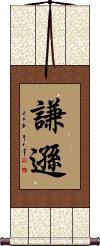
Humility / Being Humble

Mandarin: qiān xùn
Japanese: kenson
Korean: 겸손

謙
遜

Being humble is considering others to be as important as yourself. You are thoughtful of their needs and willing to be of service. You don't expect others or yourself to be perfect. You learn from your mistakes. When you do great things, humility reminds you to be thankful instead of boastful.

These characters can also be translated as modesty.

Also sometimes used in Japanese to express humility with an essence of modesty.

See Also...  Modesty | Humility

Score: 2/100

Select

Ice / Frost (Japanese)

Mandarin: bīng
Japanese: koori
Korean:

氷

This is the Japanese Kanji for "ice" or "frost".

This is also the way to write "ice" in old Korean Hanja.

Note: This form is not commonly used anymore in Chinese - though still understood for the most part.

FYI: There was a time when Japan did not have a written language and simply absorbed Chinese characters into their language by meaning. When this occurred around the 5th century, the character shown here was a common but alternate way to write "ice" in Chinese, so it was the one that ended up being absorbed into the Japanese language. Not long after that, a similar thing happened in Korea - although Korea has replaced virtually all of the Chinese characters they once used with the new Hangul writing system.

Score: 2/100

Back to the top of this page

Select

Impartial and Fair to the Brotherhood
and Sisterhood of the World

AKA: Universal Benevolence

Mandarin:
yí shì tóng rén

Japanese:
isshidoujin

Korean: 일시동인

一
視
同
仁

This is how to write "universal benevolence". This is also how to express the idea that you see all people the same.

If you are kind and charitable to all people, this is the best way to state that virtue. It is the essence of being impartial to all mankind, regardless of social standing, background, race, sex, etc. You do not judge others, but rather you see them eye to eye on the same level with you.

See Also...  Benevolence | Compassion | Equality | Justice | Right Decision | Selflessness | Work Unselfishly For The Common

Score: 2/100

Select

Impermanence

Mandarin: wú cháng
Japanese: mujou
Korean: 무상

無
常

This is the state of being "not permanent", "not enduring", transitory, or evolving. It can also mean variable or changeable. In some context, it can refer to a ghost that is supposed to take a soul upon death. Following that, this term can also mean to pass away or die.

In Buddhist context, this is a reminder that everything in this world is ever-changing and all circumstances of your life are temporary. If you take the Buddhist philosophy further, none of your circumstances are real, and your existence is an illusion anyway.

Language notes:
In Korean Hanja, this means uncertainty, transiency, mutability, or evanescent.
In Japanese, the definition orbits closer to the state of being uncertain.

Score: 2/100

Select

Indomitable / Persistence / Fortitude

Mandarin: bù qū
Japanese: fukutsu
Korean: 불굴

不
屈

This is the short form of a longer Chinese word, and also a word used in Korean and Japanese to express the idea of being indomitable. It literally means, "will not bend", "will not crouch", "will not yield", "will not flinch", or "will not submit".

Note: Some will translate this as "indomitable spirit"; however, technically, there is no character to suggest the idea of "spirit" in this word.

See Also...  Tenacity | Fortitude | Strength | Undaunted

Score: 2/100

Back to the top of this page

Select

Infinity

Japanese = Infinity / Chinese = No limits

Mandarin: wú xiàn
Japanese: mugen
Korean: 무한

無
限

This is the Chinese and Japanese word meaning infinity, unlimited or unbounded.

The first character means "never" or "not" or like a prefix "un-". The second means "limited", "restricted", or "bound".

Please note that the Japanese definition leans more toward "infinity" and the Chinese is more about being "boundless" or "without limits".
In Korean, this means infinity, infinitude, or boundlessness. But in Korean, this term has many interpretations or contexts, so your intended meaning might come out a little vague or ambiguous.

Score: 2/100

Select

A Life of Serenity
Yields Understanding

Mandarin:
dàn bó yǐ míng zhì,
níng jìng ér zhì yuǎn

淡
泊
以
明
志
寧
靜
而
致
遠

This is a kind of complex ten-character proverb composed by Zhuge Liang about 1800 years ago. The proverb means "Leading a simple life will yield a clear mind, and having inner peace will help you see far (into the world)".

What I have translated as "simple life" means NOT being materialistic and NOT competing in the rat race.

The last word means "far", but the deeper meaning is that you will surpass what you can currently see or understand. Perhaps even the idea of opening up vast knowledge and understanding of complex ideas.

The whole phrase has a theme that suggests if you are NOT an aggressive cut-throat person who fights his way to the top no matter how many people he crushes on the way, and instead seek inner peace, you will have a happier existence and be more likely to understand the meaning of life.

See Also...  Serenity

Score: 2/100

Select

Inner Peace

Mandarin: nèi xīn píng jìng
Japanese: naishin heizyou
Korean: 내심평정

內
心
平
靜

This Chinese and Japanese phrase is a direct translation for the western idea of inner peace.

The first two characters contain the idea of "heart" and "innermost being",

The last two characters mean "tranquil" and "serene".

I have seen this phrase used as "inner peace" for art prints and even on the side of coffee cups. But I think the translation is too literal. It feels like a direct translation from English rather than a nicely composed Chinese or Japanese phrase. See my other entries for "inner peace".

See Also...  Serenity | Simplicity | Peace

Score: 2/100

Back to the top of this page

Select

Integrity

Mandarin: zhèng zhí
Japanese: shoujiki
Korean: 정직

正
直

Integrity is living by your highest values. It is being honest and sincere. Integrity helps you to listen to your conscience, to do the right thing, and to tell the truth. You act with integrity when your words and actions match. Integrity gives you self-respect and a peaceful heart.

Japanese jikiPlease note that the second Kanji sometimes has an alternate form in Japanese. Let us know if you want the alternate form shown to the right.

Note: This entry is cross-listed as "honesty" because it also fits that definition.

Beyond Integrity, this word also means "upright" and "honest" in Chinese. Means "integrity", "honesty" or "frankness" in Japanese.

See Also...  Honor | Honesty | Truth | Trust

Score: 2/100

Select

Isshin-Ryu / Isshinryu

Japanese: i sshin ryuu

一
心
流

This is the title for Isshin-Ryu Karate. The literal meaning is "one heart method". You could also translate it as "unified hearts methods". It implies people doing things as if with one heart and mind. In fact, the second Kanji can be defined as heart, mind, or the essence of your being. So there's a multitude of ways you can define this title in English.

Score: 2/100

Select

Jesus Christ

Mandarin: yē sū jī dū

耶
穌
基
督

This is the full version, with the name "Jesus" being the first two characters and the meaning of "Christ" as the last two. You can't get more specific than this when referring to the Messiah.

Score: 2/100

Back to the top of this page

Select

John 14:18

Mandarin: wǒ bù piě xià nǐ mén wéi gū ér wǒ bì dào nǐ mén zhè lǐ lái

你
們
這
裡
來
為
孤
兒
我
必
到
我
不
撇
下
你
們


Characters shown
above are read
vertically, starting
from the right

This is the translation of John 14:18 into Chinese.

This translation comes from the Chinese Union Bible which comes from a revised version of the King James. This Chinese Bible was originally translated and printed in 1919 (several revisions since then).

Because of the origin being the KJV, I'll say that in English, this would be, "I will not leave you comfortless: I will come to you.".

In basic English, this would be, "I will not let you be without a friend: I am coming to you."

Score: 2/100

Select

John 3:16


Mandarin: shén ài shì rén shèn zhì jiāng tā de dú shēng zǐ cì gè tā mén jiào yí qiè xìn tā de bú zhì miè wáng fǎn dé yǒng shēng

他
的
不
至
滅
亡
反
得
永
生
生
子
賜
給
他
們
叫
一
切
信
神
愛
世
人
甚
至
將
他
的
獨


Characters shown
above are read
vertically, starting
from the right

This is the full translation of John 3:16 into Chinese.

This translation comes from the Chinese Union Bible which comes from a revised version of the King James. This Chinese Bible was originally translated and printed in 1919 (several revisions since then).

Because of the origin being the KJV, I'll say that in English, this would be, "For God so loved the world, that he gave his only begotten Son, that whosoever believeth in him should not perish, but have everlasting life".

As with any translation, there are interesting cultural and linguistic issues. For instance, the word used for "world" in Chinese can also mean "common people". So you could say that it means "For God so loved the common people..."
This does not take away from the text, as it will be understood with the same meaning and connotation.

There is no direct Greek to Chinese translation in print (that I know of), so this is the best available. Of course, you can ask any Greek person of faith, and they will claim that a bit is lost from the original Greek of the New Testament to any of the English versions of the Bible in print.

Score: 2/100

Select

Happy

Mandarin: xīn
Japanese: kin
Korean:

欣

This is the type of happiness that you feel on the inside. It is the feeling of being released and delighted as well as being in a state of contentment. This is a more internal happiness that perhaps only shows by the smile on your face. It can also be translated as "to take pleasure in" or "to rejoice".

Note: This character is often used in compound words - especially in Korean Hanja.
As Japanese Kanji, this is so rare, that most Japanese people are not aware of its existence.

See Also...  Happiness

Score: 3/100

Back to the top of this page

Select

Justice

Mandarin: zhèng yì
Japanese: sei gi
Korean: 정의

正
義

Practicing justice is being fair. It is solving problems so everyone wins. You don't prejudge. You see people as individuals. You don't accept it when someone acts like a bully, cheats or lies. Being a champion for justice takes courage. Sometimes when you stand for justice, you stand alone.

Note: These characters can also be translated as righteousness.

Note: This is also considered to be one of the Seven Heavenly Virtues.

Score: 2/100

Select

Kenpo / Kempo / Quan Fa / Chuan Fa

Mandarin: quán fǎ
Japanese: kenpou
Korean: 권법

拳
法

This form of martial arts can be translated in several ways. Some will call it "fist principles" or "the way of the fist", or even "law of the fist". The first character literally means fist. The second can mean law, method, way, principle or Buddhist teaching.

Kempo is really a pot luck of martial arts. Often a combination of Chinese martial arts such as Shaolin Kung Fu with Japanese martial arts such as Karate, Jujutsu (Jujitsu), Aikido, and others. You may see the term "Kempo Karate" which basically means Karate with other disciplines added. In this way, Kempo becomes an adjective rather than a title or school of martial arts.

These facts will long be argued by various masters and students of Kempo. Even the argument as to whether it should be spelled "kenpo" or "Kempo" ensues at dojos around the world (the correct Romaji should actually be "kenpou" if you precisely follow the rules).

The benefit of Kempo is that the techniques are easier to learn and master compared to pure Kung Fu (wu shu). Students are often taught basic Karate moves, kicks, and punches before augmenting the basic skills with complex Kung Fu techniques. This allows students of Kempo achieve a level where they can defend themselves or fight in a relatively short amount of time (a few years rather than a decade or more).

Because the definition of this word is so fluid, I should make some notes here:

1. Purists in Okinawa will claim that "Okinawa Kenpo" or "Ryukyu Hon Kenpo" is the original and true version of this martial art from the old kingdom. There is actually little or no connection between Okinawa Kenpo and the way the word is used elsewhere.

2. In Chinese, where these characters are pronounced "quan fa" (sometimes Romanized as "chuan fa" because the Chinese-pinyin "q" actually sounds like an English "ch" sound), these characters do not hold the connotation of being a mixed martial art. It is simply defined as "the law of the fist".

3. In my Japanese dictionary, it oddly defines Kenpo as "Chinese art of self-defense". I personally don't feel this is the most common way that people perceive the word, but just something you should know.

Score: 2/100

Select

Life Energy / Spiritual Energy

Essense of Life

Mandarin:
Japanese: ki
Korean:

氣

Qi which is also Romanized as Chi in Chinese or Ki in Japanese, is a fundamental concept of traditional Asian culture. Qi is believed to be part of everything that exists, as in “life force” or “spiritual energy”. It is most often translated as “energy flow,” or literally as “air” or “breath”.

The character itself is a representation of steam (or breath) rising from rice.
米This was apparently seen as the release of energy from the rice when this concept was first developed. To clarify, the character for rice is shown to the right. The Qi / Chi / Ki character is still used in compound words to mean steam or vapor.

The idea of Qi / Chi / Ki is really a philosophical concept. It's often used to refer to the “flow” of metaphysical energy that sustains living beings. Yet there is much debate that has continued for thousands of years as to whether Qi / Chi / Ki is pure energy, or consists partially, or fully of matter.

You can also see the character for Qi / Chi / Ki in common compound words such as Tai Chi / Tai Qi, Aikido, Reiki and Qi Gong / Chi Kung.

In the modern Japanese Kanji, the rice radical has been changed into two strokes that form an X.

The original and traditional Chinese form is still understood in Japanese, but we can also offer that modern Kanji form in our custom calligraphy. If you want this Japanese Kanji, please click on the character to the right, instead of the “Select and Customize” button above.

More language notes: This is pronounced like “chee” in Mandarin Chinese, and like “key” in Japanese.
This is also the same way to write this in Korean Hanja where it is Romanized as “gi” and pronounced like “gee”, but with a real G-sound, not a J-sound.
Though Vietnamese no longer use Chinese characters in their daily language, this character is still widely known in Vietnam.

See Also...  Life Force | Vitality | Life | Birth | Soul

Score: 2/100

Back to the top of this page

Select

Life / Living / Live

Mandarin: shēng huó
Japanese: sei katsu
Korean: 생활

生
活

This means life, living, to live, or the state of being alive. It can also refer to your daily existence or livelihood.

This is also the term used in other titles such as "healthy living" or Lance Armstrong's "Livestrong" campaign (Chinese title for Livestrong only).

If you need a reminder that you are alive, and to take a breath, this might be the perfect wall scroll for you.

Score: 2/100

Select

Loyalty

Japanese Chinese Korean

Mandarin: zhōng chéng
Japanese: chuu sei
Korean: 충성

忠
誠

Loyalty is staying true to someone. It is standing up for something you believe in without wavering. It is being faithful to your family, country, school, friends or ideals, when the going gets tough as well as when things are good. With loyalty, you build relationships that last forever.

Notes:
1. This written form of loyalty is universal in Chinese, Japanese Kanji, and old Korean Hanja.

2. There is also a Japanese version that is part of the Bushido Code which may be more desirable depending on whether your intended audience is Japanese or Chinese.

3. This version of loyalty is sometimes translated as devotion, sincerity, fidelity, or allegiance.

See Also...  Honor | Trust | Integrity | Sincerity

Score: 3/100

Select

Loyalty / Devotion

Chinese, Korean, and Japanese

Mandarin: zhōng yì
Japanese: chuu gi
Korean: 충의

忠
義

This is another form of loyalty or devotion.

In Chinese, this is more specifically about being loyal and devoted to your friends.

In Japanese, this is more often used to mean loyalty to your country or nation.

Except for the slight difference noted above between Japanese and Chinese, this word is understood universally in Chinese, Japanese Kanji, and old Korean Hanja. It can also be used to describe devotion or fidelity.

It should be noted that this Kanji combination is being used less and less in modern Japan (this is a better choice if your audience is Chinese, though any Japanese person will clearly understand it).

Score: 2/100

Back to the top of this page

Select

Loyalty / Faithful / Devoted

Japanese: chuujitsu

忠
実

This is a Japanese way to write "Loyalty" - it also contains the ideas of being faithful, devoted, true, and obedient.

The second character is a modified form only used in the Japanese lexicon, however, Chinese speakers can easily guess the meaning.

This is also a virtue of the Samurai Warrior
See our page with just Code of the Samurai / Bushido here

Score: 2/100

Select

Lucky / Auspicious

Mandarin:
Japanese: kichi
Korean:

吉

A simple way to express the state of being lucky. Also used in conversation to hope that all is well with someone. This is more often seen as part of a compound word with a lucky association (especially in Korean).

Not as often used in Japanese, but still means "good luck" but can also mean "joy" in Japanese.

See Also...  Good Luck

Score: 3/100

Select

Martial Morality
Martial Arts Ethics / Virtue

Mandarin: wǔ dé
Japanese: butoku
Korean: 무덕

武
德

This refers to the virtue, morality, and ethics that any practitioner of martial arts should posses. This can be used in both Chinese and Japanese in lieu of English terms such as "soldierly virtue", "good conduct" (military), "warrior ethics", and being honorable in regards to any fight or competition.

See Also...  Morality Of Mind | Morality Of Deed

Score: 2/100

Back to the top of this page

Select

Better Late Than Never

It's Never Too Late Too Mend

Mandarin:
wáng yáng bǔ láo yóu wèi wéi wǎn

Korean: 망양보뢰유미위만

亡
羊
補
牢
猶
未
為
晚

Long ago in what is now China, there were many kingdoms throughout the land. This time period is known as "The Warring States Period" by historians because these kingdoms often did not get along with each other.

Some time around 279 B.C. the Kingdom of Chu was a large, but not particularly powerful kingdom. Part of the reason it lacked power was the fact that the King was surrounded by "yes men" who told him only what he wanted to hear. Many of the King\’s court officials were corrupt and incompetent which did not help the situation.

The King was not blameless himself, as he started spending much of his time being entertained by his many concubines.

One of the King\’s ministers, Zhuang Xin, saw problems on the horizon for the Kingdom, and warned the King, "Your Majesty, you are surrounded by people who tell you what you want to hear. They tell you things to make you happy, and cause you to ignore important state affairs. If this is allowed to continue, the Kingdom of Chu will surely perish, and fall into ruins".

This enraged the King who scolded Zhuang Xin for insulting the country and accused him of trying to create resentment among the people. Zhuang Xin explained, "I dare not curse the Kingdom of Chu, but I feel that we face great danger in the future because of the current situation". The King was simply not impressed with Zhuang Xin\’s words.
Seeing the King\’s displeasure with him and the King\’s fondness for his court of corrupt officials, Zhuang Xin asked permission of the King that he may take leave of the Kingdom of Chu, and travel to the State of Zhao to live. The King agreed, and Zhuang Xin left the Kingdom of Chu, perhaps forever.

Five months later, troops from the neighboring Kingdom of Qin invaded Chu, taking a huge tract of land. The King of Chu went into exile, and it appeared that soon, the Kingdom of Chu would no longer exist.

The King of Chu remembered the words of Zhuang Xin, and sent some of his men to find him. Immediately, Zhuang Xin returned to meet the King. The first question asked by the King was, "What can I do now?"

Zhuang Xin told the King this story:

A shepherd woke one morning to find a sheep missing. Looking at the pen saw a hole in the fence where a wolf had come through to steal one of his sheep. His friends told him that he had best fix the hole at once. But the Shepherd thought since the sheep is already gone, there is no use fixing the hole.
The next morning, another sheep was missing. And the Shepherd realized that he must mend the fence at once. Zhuang Xin then went on to make suggestions about what could be done to reclaim the land lost to the Kingdom of Qin, and reclaim the former glory and integrity in the Kingdom of Chu.

The Chinese idiom shown above came from this reply from Zhuang Xin to the King of Chu almost 2,300 years ago.
It translates roughly into English as...
"Even if you have lost some sheep, it\’s never too late to mend the fence".

This phrase is often used in modern China when suggesting in a hopeful way that someone change their ways, or fix something in their life. It might be used to suggest fixing a marriage, quit smoking, or getting back on track after taking an unfortunate path in life among other things one might fix in their life.

I suppose in the same way that we might say, "Today is the first day of the rest of your life" in our western cultures to suggest that you can always start anew.

Note: This does have Korean pronunciation, but is not a well-known phrase in Korean (only Koreans familiar with ancient Chinese history would know it). Best if your audience is Chinese.

Score: 3/100

Select

4. Right Action / Perfect Conduct

Samyak Karmanta / Samma Kammanta

Mandarin: zhèng yè
Japanese: sei gyou
Korean: 정업

正
業

This is one of the Noble Eightfold Paths of Buddhism. Right Action, along with Right Speech and Right Living constitute the path to Virtue.

The five precepts of Right Action are:
1. To refrain from destroying living beings (no murder, or any form of taking a life).
2. To refrain from stealing.
3. To refrain from sexual misconduct (adultery, rape, etc.).
4. To refrain from false speech (lying or trickery).
5. To refrain from intoxicants which lead to heedlessness (no drugs or alcohol).

This concept can be summarized as, "Avoidance of actions that conflict with moral discipline".

Note: In Japanese, when read by a non-Buddhist, this will mean "the right job/vocation".

This term is exclusively used by devout Buddhists. It is not a common term, and is remains an unknown concept to most Japanese and Chinese people.

See Also...  Buddhism | Enlightenment

Score: 2/100

Select

5. Right Living / Right Livelihood / Perfect Livelihood

Samyag Ajiva / Samma Ajiva

Mandarin: zhèng mìng
Japanese: sei myou
Korean: 정명

正
命

This is one of the Noble Eightfold Paths of Buddhism. Right Living, along with Right Speech and Right Action constitute the path to Virtue.

Right Living means that a Buddhist should only take a job or pursue a career in a field that does no harm. Buddhists should not work in the arms trade, as pimps or in the field of prostitution, as a butcher or in a shop that kills or sells meat, in a laboratory that does animal research, or any other business that involves scheming or unethical behavior.

Another definition: Avoidance of professions that are harmful to sentient beings, such as slaugterer, hunter, dealer in weaponry or narcotics, etc.

This term is exclusively used by devout Buddhists. It is not a common term, and is remains an unknown concept to most Japanese and Chinese people.

See Also...  Buddhism | Enlightenment

Score: 2/100

Back to the top of this page

Select

7. Right Mindfulness / Right Memory / Perfect Mindfulness

Samyak Smriti / Samyak Smrti / Samma Sati

Mandarin: zhèng niàn
Japanese: sei nen
Korean: 정념

正
念

This is one of the Noble Eightfold Paths of Buddhism. Right Mindfulness, along with Right Effort and Right Concentration constitute the path to Concentration or Perfect Thought.

Right Mindfulness is about remaining focused on one's body, feelings, mind and mental qualities. It's also about being ardent, aware, and mindful, and supposes that you've already put aside worldly desire and aversion.

Monk Bhikkhu Bodhi described this as: The mind is deliberately kept at the level of bare attention, a detached observation of what is happening within us and around us in the present moment. In the practice of right mindfulness the mind is trained to remain in the present, open, quiet, and alert, contemplating the present event.

Another definition: Ongoing mindfulness of body, feelings, thinking, and objects of thought.

This term is exclusively used by devout Buddhists. It is not a common term, and is remains an unknown concept to most Japanese and Chinese people.

See Also...  Buddhism | Enlightenment

Score: 2/100

Select

2. Right Resolve / Right Thought
Right Intention / Perfect Resolve

Samyak Samkalpa / Samma Sankappa

Mandarin: zhèng sī wéi
Japanese: sei shi yui
Korean: 정사유

正
思
唯

This is one of the Noble Eightfold Paths of Buddhism. Right Thought, along with Right View constitute the path to Wisdom.

In Buddhism, Right Thought in simple terms means to free yourself from having ill-will towards anyone or anything. It also suggests that you remain harmless to other living creatures.

This can also be defined as, "Resolve in favor of renunciation, good will, and non-harming of sentient beings".

惟"There is an ancient/alternate version of the third character for this selection. You can see that alternation third character to the right. If you want your selection to use that older character, just click on the character to the right, instead of the button above.

Note: This term is exclusively used by devout Buddhists. It is not a common term, and is remains an unknown concept to most Japanese and Chinese people.

See Also...  Buddhism | Enlightenment

Score: 2/100

Select

North Korea

Mandarin: běi cháo xiǎn

北
朝
鮮

This is the Chinese name for the country of North Korea. The official English name being Democratic People's Republic of Korea.

See Also...  South Korea | Asia

Score: 2/100

Back to the top of this page

Select

Pain is Weakness Leaving the Body

Mandarin: téng tòng jiù shì shuāi ruò lí nǐ ér qù de shí hòu

而
去
的
時
候
衰
弱
離
你
疼
痛
就
是


Characters shown
above are read
vertically, starting
from the right

I remember this being shouted a lot during U.S. Marine Corps boot camp. This is how to write that phrase in Chinese. At least, this is as close as we could compose/translate it, and hold the full original meaning and connotations.

The version shown here is really, "Pain is weakness leaving your body". Although, it's said in English both ways (the or your), it works better in Chinese with "your".

Score: 2/100

Select

Peace and Good Health

Mandarin: ān kāng
Korean: 안강

安
康

This means just what it says. It's a word that expresses both the idea of being at peace and healthy at the same time.

Note: This is a bona-fide word in Chinese and Korean, and the characters will at least make sense in Japanese.

Score: 2/100

Select

Peace of Mind

(five character version)

Mandarin: nèi xīn de níng jìng
Korean: 내심적령정

內
心
的
寧
靜

This is the longer way to express the idea of "peace of mind" in Chinese.

The first two characters mean heart or "innermost being",
The middle character is a connecting modifier.
The last two characters mean peace, tranquility, or serenity.

Some may also translate this as "inner peace", but I like our other inner-peace options for that idea.

This kind of makes sense in Korean, but will have an archaic read - even by those who can understand Korean Hanja.

Score: 2/100

Back to the top of this page

Select

Peaceful / Tranquil
Calm / Free From Worry

Mandarin: ān níng
Japanese: an nei
Korean: 안녕

安
寧

This is a nice word that means peaceful, tranquil, calm, composed, "free from worry", "public peace", tranquility, good health, well-being, or welfare in Chinese and Korean.

Note: The definition in Japanese is not so broad, but still means peaceful or "public peace".

Score: 3/100

Select

Perseverance

(Chinese)

Mandarin: jiān rèn bù bá
Korean: 견인불발

堅
韌
不
拔

Perseverance is being steadfast and persistent. You commit to your goals and overcome obstacles, no matter how long it takes. When you persevere, you don't give up...you keep going. Like a strong ship in a storm, you don't become battered or blown off course. You just ride the waves.


This translation literally means, "something so persistent or steadfast, that it is not uprootable / movable / surpassable".

See Also...  Tenacious | Devotion | Persistence | Indomitable

Score: 2/100

Select

Power of Understanding and Wisdom

Mandarin: wù xìng
Japanese: gosei
Korean: 오성

悟
性

This means the power of understanding and insight in Chinese. It is often associated with Neo-Confucianism. In that regard, it means to realize man's true nature or to find your soul, the soul of others, or the soul of the world. Some will translate this simply as the state of being "savvy".

In Japanese, this is often translated as wisdom and understanding.

Score: 2/100

Back to the top of this page

Select

Prosperity / Salary

(single character)

Mandarin:
Japanese: fuchi
Korean:

祿

This character is occasionally used in China to mean "prosperity".
This character once meant the "official's salary" in old feudal China and Korea (obviously, the officials lived well, so you can imagine how this was associated with the idea of being prosperous).

This is only used in Korean historical documents for "salary". In old Japanese, this means "fief", "allowance", "pension", "grant" and sometimes "happiness" depending on context. It's very obscure in modern Japanese.

We have other entries that are better-suited for a wall scroll. This entry just addresses "the coffee cup issue" where this character has been used on coffee cups and tee-shirts in a naive manner.
In other words: Don't order this!

Score: 3/100

Select

Qi Gong / Chi Kung

Mandarin: qì gōng
Japanese: kikou
Korean: 기공

氣
功

Qigong is the title of a technique that is somewhere between a medical practice, meditation, and in some cases a religion. The definition is blurred depending on which school of Qigong you are following. In some cases, it is even incorporated with martial arts.

Some people (even Chinese people) mix this title with Tai Chi (Tai Qi) exercises.

Lately in China, people will claim to practice Tai Chi rather than Qigong because the Qigong title was recently used as a cover for an illegal pseudo-religious movement in China with the initials F.G. or F.D. (I can not write those names here for fear of our website being banned in China).

You can learn those names and more here: Further info about Qigong

If you are wondering about why I wrote "Qi Gong" and "Chi Kung" as the title of this calligraphy entry, I should teach you a little about the various ways in which Chinese can be Romanized. One form writes this as "Chi Kung" or "Chikung" (Taiwan). In the mainland and elsewhere, it is Romanized as "Qi Gong" or "Qigong". The actual pronunciation is the same in Taiwan, mainland, and Singapore Mandarin. Neither Romanization is exactly like English. If you want to know how to say this with English rules, it would be something like "Chee Gong" (but the "gong" has a vowel sound like the "O" in "go").

Romanization is a really confusing topic and has caused many Chinese words to be mispronounced in the west. One example is "Kung Pao Chicken" which should actually be more like "Gong Bao" with the "O" sounding like "oh" for both characters. Neither system of Romanization in Taiwan or the Mainland is perfect in my opinion and lead to many misunderstandings.


Score: 2/100

Select

Reiki

Mandarin: líng qì
Japanese: reiki
Korean: 령기 or 영기

靈
氣

This is the title of a healing practice that is now found throughout the world but with origins in Japan.

Special note: Outside of the context of the healing practice of Reiki, this means "aura" or "spiritual essence that surrounds all living things". A Japanese person not familiar with the practice will take the "aura" meaning.

Reiki is a technique for stress reduction and relaxation that also heals. It can be compared to massage, but is based on the idea that an unseen "life force energy" flows through us and is what causes us to be alive. If your life force energy is low, you'll be more likely to get sick or feel stress. If your life force energy is abundant and flowing well, you become more capable of being happy and healthy.

There is a lot of information available if you want to Google this term - my job is to offer the calligraphy, while you can decide if it is right for you.

霊
気

Note: We are showing the ancient (traditional) form of the Reiki Kanji. I have seen Reiki written with both the slightly simplified version and this more classic form. If you want the form of Reiki with the two strokes in the shape of an X on the second character and reformed first character, simply click on the Kanji characters to the right.

Note: This is also a Chinese word, but in Chinese, these characters create a word that refers to a smart person, or someone with high aspirations. It is not read as a healing method in Chinese.
In Korean Hanja, this can be read as "mysterious atmosphere" by a Korean who is not familiar with the practice of Reiki (still has a cool meaning in Korean).

Score: 3/100

Back to the top of this page

Select

Respect / Honor / Esteem

Mandarin: zūn jìng
Japanese: sonkei
Korean: 존경

尊
敬

This is how to express the ideas of respect, honor, reverence, esteem, nobility, and sometimes the state of being noble, all in one word. Most of the time this is used in the form of "giving respect", but depending on context, it can suggest that you should try to be "worthy of respect".

Although pronounced differently, the Chinese characters, Japanese Kanji, and Korean Hanja are the same across these languages. This is an indication that this word is very old, and crosses many barriers and cultures in the Orient (East Asia).

Score: 2/100

Select

Responsibility

Mandarin: zé rèn
Japanese: sekinin
Korean: 책임

責
任

Being responsible means others can trust you to do things with excellence. Responsibility is the ability to respond ably and to make smart choices.

This word can also refer to someone who is willing to take the blame when things go wrong (instead of making excuses or passing the blame to someone else). While this is a noble idea, I think it is getting more rare these days in both eastern and western cultures.

Also associated with the idea of "duty".

Score: 2/100

Select

Robust / Sturdy

Mandarin: qiáng jiàn
Japanese: kyouken
Korean: 강건

強
健

This means robustness or sturdiness in regards to being healthy and fit. This can also be used to say "persistently good health".

Score: 2/100

Back to the top of this page

Select

Safe and Sound

Mandarin: píng ān
Japanese: heian
Korean: 평안

平
安

This word means "safe and sound" in Chinese, Japanese, and Korean.

Can also be translated as well-being, peace, tranquility, quietness, and calmness.

Note: There is also a longer four-character version in our calligraphy database.

See Also...  Tranquility | Peace

Score: 3/100

Select

Consciousness of Self

Mandarin: zì jué
Japanese: jikaku
Korean: 자각

自
覺

This is the idea of being conscious, self-aware and sometimes "on one's own initiative".

覚After WWII, they started using a simplified form of the second Kanji for this word in Japan. That version is shown to the right, and you can click on that Kanji if you want the modern Japanese form. Otherwise, the characters shown in the upper left are the correct ones for ancient/old/traditional Chinese, Japanese, and Korean.

Score: 2/100

Select

Self Consciousness

Japanese: jiishiki
Korean: 자의식

自
意
識

This is the idea of being conscious and self-aware in Japanese Kanji and old Korean Hanja.

This is not a normal word in Chinese.

Score: 2/100

Back to the top of this page

Select

Self-Discipline / Will-Power

Mandarin: zì lǜ
Japanese: jiritsu
Korean: 자율

自
律

Self-discipline means self-control. It is doing what you really want to do, rather than being tossed around by your feelings like a leaf in the wind. You act instead of react. You get things done in an orderly and efficient way. With self-discipline, you take charge of yourself.

Not sure if this one works for a Japanese audience.

See Also...  Discipline | Self-Control

Score: 2/100

Select

Selflessness

Mandarin: wú sī
Japanese: mushi
Korean: 무사

無
私

This would be literally translated as "none self" in Chinese, Korean, and Japanese. It is used to express "selflessness" or "unselfish". This is a popular term for the idea of being selfless or unselfish in modern China and Japan.
This term is not as commonly-used in Korea, but still has good meaning.

See Also...  Unselfish | Altruism

Score: 2/100

Select

Sincere Heart

Mandarin: xuě xīn
Korean: 혈심

血
心

When you take this word apart, you find the sum is a little different than the parts. The first character means blood and the second means heart. It is important to note that for thousands of years, it was believed that your heart was both your soul and your mind in Asian culture. When you add blood to the heart, it is your whole being - it is pure and clean dedication with your whole soul.

Most Chinese dictionaries define this as sincerity of heart or a MEDICAL TERM!!!
Please think carefully before ordering this selection - it was only added as others have used this for coffee cups and other novelties (though perhaps naively).

Score: 2/100

Back to the top of this page

Select

South Korea

Mandarin: nán hán

南
韓

This is the common Chinese name for the country of South Korea. The official English name being Republic of Korea.

See Also...  North Korea | Asia

Score: 2/100

Select

Spirit

Mandarin: jīng shén
Japanese: sei shin
Korean: 정신

精
神

This is the kind of spirit that you have if you perform well in sports or competition. It is the idea of having a good attitude, and putting your all into something - so much so that others can see or feel your spirit. It is the essence of your being that can only be subjectively described because there are no words that can fully explain what "spirit" really is.

For your information:
My Japanese dictionary further tries to explain this word by comparing it to mind, soul, heart or intention.
My Chinese dictionary compares these characters to meanings like vigor, vitality, drive and mentality.
My Korean dictionary defines this as mind, spirit and soul.

See Also...  Vitality | Heart | Soul

Score: 3/100

Select

Spirit / Spiritual Essence

Mandarin: shén
Japanese: kami / shin
Korean:

神

This is the simplest form of spirit. This single character alone will conjure up ideas of the spiritual world. This character can also be translated as "vital awareness" as in the fact that one must know they exist to exist (I think, therefore I am).

Other translations include:
God, mysterious, divine essence, lively, spiritual being, divinity, supernatural, soul, mind, nerves, and energy. In some extended context it can mean genius or unusual.

Score: 2/100

Back to the top of this page

Select

Tactics of War

Mandarin: zh n shù
Japanese: senjutsu
Korean:

戰
術

This can mean "tactics of war", "battle tactics" or simply "tactics" (being that warfare is implied in that English word).

This word is written in the ancient and traditional form of Chinese, Japanese, and Korean.


In modern Japan, the first character has been simplified or modified. If you want the modern Japanese Kanji version, just click on that character shown to the right.

Score: 2/100

Select

Taekwondo

Mandarin: tái quán dào
Japanese: te kon do
Korean: 태권도

跆
拳
道

This is one of the most widespread types of martial arts in the world as well as being an Olympic sport. Taekwondo was born in Korea with influences of Chinese and Japanese styles, combined with traditional Korean combat skills. Some will define it as the "Korean art of empty-handed self-defense".

In the simplest translation, the first character means "kick", the second character can mean either "fist" or "punching" the third means "way" or "method". Altogether, you could say this is "Kick Punch Method". When heard or read in various Asian languages, all will automatically think of this famous Korean martial art. It is written the same in Japanese Kanji, Chinese, and Korean Hanja characters - so the appearance of the characters are rather universal. However, you should note that there is another way to write this in modern Korean Hangul characters which looks like the image to the right. Taekwondo Hangul Characters

We suggest the original Korean Hanja (Chinese characters) for a wall scroll, but if you really need the Hangul version, just select master calligrapher Xing An-Ping, and make a note in the special instructions box when you place your order.

Note: Taekwondo is sometimes Romanized as Tae-Kwondo, Tae Kwon Do, Taekwon-do, Taegwondo, Tae Gweon Do, Tai Kwon Do, Taikwondo, Taekwando, Tae Kwan Do and in Chinese Taiquandao, Tai Quan Dao, Taichuando, or Tai Chuan Tao.

Score: 3/100

Select

The Tao or Dao of Being Human / Humanity
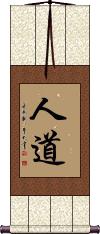
Mandarin: rén dào
Japanese: jindou
Korean: 인도

人
道

This is literally the "The Way of Being Human", or "The Human Way". It can also be translated as "humanity".

This word has a secondary meaning of "sidewalk" as in "the way for people to walk" (in Japanese and Korean only). But as calligraphy artwork, nobody will read it with that translation.

Please note that there are two ways to Romanized Dao or Tao as in Daoism = Taoism. It's the same word in Chinese.

Score: 2/100

Back to the top of this page

Select

Thankfulness

Mandarin: gǎn jī
Japanese: kangeki
Korean: 감격

感
激

Thankfulness is being grateful for what we have. It is an attitude of gratitude for learning, loving and being. Appreciate the little things that happen around you and within you every day. Think positively. Thankfulness brings contentment.

Different meaning in Japanese - more like "deep emotion", "impression", "inspiration" - not recommended for a Japanese audience.

Score: 2/100

Select

Tolerance

Mandarin: kuān róng
Japanese: kanyou
Korean: 관용

寬
容

Being tolerant is accepting differences. You don't expect others to think, look, speak or act just like you. You are free of prejudice, knowing that all people have feelings, needs, hopes and dreams. Tolerance is also accepting things you wish were different with patience and flexibility.

These characters can also be translated as magnanimity, generosity, or leniency.

Note: There is a tiny deviation in the first character when written in Japanese. If you choose our Japanese master calligrapher, the little dot on the lower right of the first character will be omitted. With or without the dot, this can be read in Chinese, Japanese, and old Korean.

See Also...  Patience

Score: 2/100

Select

Tranquil Midnight

Mandarin: yōu jìng de wǔ yè

幽
靜
的
午
夜

This is a way to express the emotions that you might feel at midnight. Beyond peaceful, quiet or tranquil, there is an idea of being remote or lonesome, buried in the meaning of the first two characters.

Score: 2/100

Back to the top of this page

Select

True Victory is Victory Over Oneself

Japanese: masa katsu a gatsu

正
勝
吾
勝

This is often translated as, "True victory is victory over oneself".
However, literally, it means, "True victory (is) my victory". At least the way I read it - Japanese not being my first language.
We'll have this checked by our Japanese translator during our next annual review.

Score: 2/100

Select

Turtle

...also means tortoise

Mandarin: guī
Japanese: kame
Korean:

龜

This is the generic term for turtle in Chinese, and old Korean Hanja. It's like saying "turtle" (or "tortoise") without being specific about species of turtle.

Please note that there are many special characters in Chinese and a few in Japanese that denote specific species of turtle, and do not include this character. We can't possibly cover all of these species, but if you want a certain one, such as "loggerhead" or a "leatherback", just post your request for a special Chinese / Japanese Kanji / Korean Hanja calligraphy word and we'll do our best to research your special species.

If you noticed, I said species names that do not include this character. This is because, in much the same way we can do it in English by just saying, "loggerhead", instead of "loggerhead turtle", the same can be done in Chinese and Japanese.

亀This may be hard to believe, but the image shown to the right is an alternate version of this character, which is currently used in Japan. This was originally an alternate form in ancient China for turtle - but it's so obscure now, that most Chinese people would just think this is the Japanese version of turtle (I did a lot of research on this). The version shown in the upper left is traditional Chinese (also used in Korea, prior to 100 years ago). It will generally not be recognized by the new generation of Japanese people. If your audience is Japanese, please click on the Kanji image shown to the right to have the calligrapher write that version (instead of clicking the button above).

Score: 2/100

Select

Unlimited / Unbounded

Mandarin: wú xiàn
Japanese: mu gen
Korean: 무한

無
限

This means unlimited or unbounded. Literally, this means "without limits" or "without (being) bound".

Score: 2/100

Back to the top of this page

Select

Wealth / Riches / Fortune

Mandarin: cái fù
Korean: 재부

財
富

This means wealth or riches in Chinese.

Hanging this on your wall will label you as a "lover of money" or a "greedy person". Order this, only if you don't mind being seen in this light.

Score: 2/100

Select

Wedding

Mandarin: hūn
Korean:

婚

This character is related to the ideas of getting married, being in a marriage, or taking a wife (could also mean take a husband, as "take a wife" is a western term, and this is just a general Chinese term regarding a wedding).

See Also...  Double Happiness

Score: 2/100

Select

Wisdom

(single character)

Mandarin: zhì
Japanese: chi / akira
Korean:

智

This is the simplest way to write wisdom in Chinese, Korean Hanja and Japanese Kanji.
Being a single character, the meaning is open to interpretation, and can also mean intellect, knowledge or reason.

This character is also one of the five tenets of Confucius.

Beyond the title definitions, this also can mean, resourcefulness, or wit.

This character is sometimes included in the Bushido code, but usually not considered part of the seven key concepts of the code.

See our Wisdom in Chinese, Japanese and Korean page for more wisdom-related calligraphy.

See Also...  Learn From Wisdom | Confucius

Score: 2/100

Back to the top of this page

Select

Acceptance of Fate / Happy With Your Fate

Mandarin: lè tiān

樂
天

This word is hard to define. One dictionary defines this as, "acceptance of fate and happy about it". There is one rare English word equivalent which is sanguinity.

You can also say that this means, "Be happy with whatever Heaven provides", or "Find happiness in whatever fate Heaven bestows upon you". This is kind of a way to suggest being an optimist in life.

Note: This is sometimes used as a given name in China.

Score: 2/100

Select

Sun / Solar

Also means Day, Sunshine, Sunlight, or Japan

Mandarin:
Japanese: hi / nichi
Korean:

日

This is the word for sun. It also means day, and can refer to the day of the month when expressing the date.
Example: October 1st would be "10 Moons, 1 Sun".

This character is also the first Kanji for the title of Japan (in Chinese, Japanese Kanji and Korean Hanja). Thus, this character is used as an adjective for things that are Japanese.
Ever heard of Japan being called, "The land of the rising sun"? Well, that's what the full title of Japan means.

Depending on context, this character can mean Sunshine or Sunlight.

Note: In Japanese, this Kanji has a variety of possible pronunciations. The pronunciation changed depending on context and how this Kanji is combined with other Kanji. When used alone, this is usually "hi" (pronounced like "hee"), but sometimes it's "nichi". When combined, it can be "tsu", "ni", "ka", and a few others.

Score: 3/100

Select

Jew / Jewish

Mandarin: yóu tài

猶
太

This is the title for Jews or the adjective for being Jewish in Chinese.

You may be surprised to learn that there are still a few native Jews in China (though many ethnic Jews moved to Israel). It's believed that they are descendants of traders who traveled the silk road between the Middle East and the Orient.

Score: 2/100

Back to the top of this page

Select

Heaven / Sky

Mandarin: tiān
Japanese: ten
Korean:

天

This is the character which means "heaven" or "sky" in Chinese, Japanese Kanji, and old Korean Hanja.

Context of how this character is used determines if you are talking about heaven or the sky above (often they are the same concept anyway).

When combined with other characters, words like "today" and "tomorrow" are created. While sometimes the character for "sun" is used to mean "day", often "sky" represents "day" in Asian languages.
Example: "this sky" = "today", "next sky" = "tomorrow" in modern Chinese and Japanese (they also use "sun" in the same way - but the use of the "sun" character in words like today and tomorrow feels more ancient).

In Chinese culture, regardless of which religion, it's almost always assumed that God (and any other deities) live up above in the sky. This is probably how the idea of heaven being associated with this character began.
The equation goes something like this: God's domain is the sky, thus, the sky is heaven.

Note: As a single character, this is a little ambiguous, so you might want to choose our Kingdom of Heaven selection instead.

See Also...  Heaven | God | Today | Sun

Score: 2/100

Select

Enthusiasm (Japanese Only)

Japanese: jou netsu
Korean: 정열

情
熱

This is the Japanese word that means enthusiasm, or "passion for a cause".

In some context, this could have a meaning of being extremely fond of something, or having fondness for a cause or person.

Can also be translated as passion, zeal, ardour, or fervor.

See Also...  Motivation | Passion | Commitment | Tenacity | Happiness

Score: 2/100

Select

Bloodless Victory

Mandarin: bīng bù xuè rèn
Korean: 병불혈인

兵
不
血
刃

Perhaps a pacifist view or perhaps the best kind of victory; these characters reflect this idea:
The edges of the swords not being stained with blood.

You could also translate it as: Win victory without firing a shot.

The first character means army or force. The second character means without or none. The last two characters mean bloodstained knives. So it represents a returning victorious army without bloodstained knives. This is the very literal sense of this word/phrase. The title definition is more accurate to the way this phrase is understood.

Asking yourself why the direct or literal translation is different?
...Think of compound words in English such as "nevertheless" if we break it apart to "never the less" we will have trouble getting the real definition of "in spite of that". Similar things happen when multiple-characters are used to create a compounded word in Chinese.

Score: 2/100

Back to the top of this page

Select

Brief and to the point

Speak simply, while expressing your idea completely

Mandarin: yán jiǎn yì gāi

言
簡
意
賅

This Chinese idiom is a suggestion that is it better to be brief, use fewer words, while still expressing your main point or idea. In another way to explain this, one should not use 100 words when 50 will do, Or, being more concise with your speech.

This can also be translated as concise, compendious, "brief in form but comprehensive in scope" or succinct.

This is a bit more positive than our other idiom for brevity.

Score: 2/100


Wall scroll artwork shown on this page is priced as follows:

1 character $29.88 each

2-3 characters $39.88 each

4 characters $49.88 each

5-10 characters $59.88 each

11 or more characters $69.88 each


We dispatch any size order to any country worldwide for a flat rate US$9.80 P&P

After you select your calligraphy, our website will take you through the process of customizing your artwork.

Options for other mounting such as portraits are available for $13 less.

We also offer the services of a famous master calligrapher for a $40 fee on any scroll if you are looking for investment-quality calligraphy.

If you chose our famous master-calligrapher, you also get more choices for silk and paper colors and the option for larger artwork.


All of our calligraphy is completely done by hand in the ancient way.

When the calligrapher finishes creating your artwork, it is taken to our art mounting workshop in Beijing where a wall scroll is made by hand from a combination of silk, rice paper, and wood.

After we create your wall scroll, it takes at least two weeks for air mail delivery from Beijing to you.

Therefore, allow at least 3 weeks for delivery from the time you place your order.

When you select your calligraphy, you'll be taken to another page where you can choose various custom options.


A nice Chinese calligraphy wall scroll

The scroll that I am holding in this picture is a "regular size"
4-character wall scroll.
As you can see, it is a great size to hang on your wall.
(We also offer custom wall scrolls in larger sizes)

A professional Chinese Calligrapher

Professional calligraphers are getting to be hard to find these days.
Instead of drawing characters by hand, the new generation in China merely type roman letters into their computer keyboards and pick the character that they want from a list that pops up.

There is some fear that true Chinese calligraphy may become a lost art in the coming years. Many art institutes in China are now promoting calligraphy programs in hopes of keeping this unique form of art alive.

Trying to learn Chinese calligrapher - a futile effort

Even with the teachings of a top-ranked calligrapher in China, my calligraphy will never be good enough to sell. I will leave that to the experts.


A high-ranked Chinese master calligrapher that I met in Zhongwei

The same calligrapher who gave me those lessons also attracted a crowd of thousands and a TV crew as he created characters over 6-feet high. He happens to be ranked as one of the top 100 calligraphers in all of China. He is also one of very few that would actually attempt such a feat.


Successful Chinese and Japanese calligraphy searches within the last few hours...

If your search is not successful, just post your request on our forum, and we'll be happy to do research or translation for any reasonable request.

aikido
alex
alexandre
always
古道
believer
chloe
craig
creativity
creature
daisy
dedicated
demon
dragon
eagle
element
father
felipe
filip
forever
friend
gabriel
good luck
happiness
honesty
hope
iaido
josue
life
little
live
live laugh love
love
mell
mister
next generation
passion
peace
pheonix
ray
sandra
sham
shop
soul mate
spirit
strength
thank you
tiger
warrior
wisdom
With so many searches, we had to upgrade to our own Linux server.
Of course, only one in 500 searches results in a purchase - Hey buy a wall scroll!!!


See: Our list of specifically Japanese Kanji Calligraphy Wall Scrolls. And, check out Our list of specifically old Korean Hanja Calligraphy Wall Scrolls.


The following table is only helpful for those studying Chinese (or Japanese), and perhaps helps search engines to find this page when someone enters Romanized Chinese or Japanese

Title
 
Characters
Simplified
Traditional
Japanese Romaji
(Romanized Japanese)
Various forms of Hanyu-Pinyin
(Romanized Chinese)
Good Health健康
健康
kenkou
kenko
jiàn kāng
jian kang
jian4 kang1
jiankang
Good Health / Healthy / Vigor
kou
ko
kāng
kang
kang1
kang
Happiness / Contentment满足
滿足 / 満足
man zoku
manzoku
mǎn zú
man zu
man3 zu2
manzu
Safe and Sound平安无事
平安無事
heian buji
heianbuji
píng ān wú shì
ping an wu shi
ping2 an1 wu2 shi4
pinganwushi
Self-Reliance自恃
自恃
n/azì shì
zi shi
zi4 shi4
zishi
Life in Balance / Balancing Life平衡人生
平衡人生
hei kou jin sei
heikoujinsei
hei ko jin sei
píng héng rén shēng
ping heng ren sheng
ping2 heng2 ren2 sheng1
pinghengrensheng
Bodhisattva菩萨
菩薩
bosatsupú sà
pu sa
pu2 sa4
pusa
Art of War: 5 Points of Analysis道天地将法
道天地將法
dou ten chi shou hou
doutenchishouhou
do ten chi sho ho
dào tiān dì jiàng fǎ
dao tian di jiang fa
dao4 tian1 di4 jiang4 fa3
daotiandijiangfa
Abundance and Prosperity繁荣富裕
繁榮富裕
hanei yuuhuku
haneiyuuhuku
hanei yuhuku
fán róng fù yù
fan rong fu yu
fan2 rong2 fu4 yu4
fanrongfuyu
Alone with only your shadow for company茕茕孑立形影相吊
煢煢孑立形影相吊
n/aqióng qióng jié lì xíng yǐng xiāng diào
qiong qiong jie li xing ying xiang diao
qiong2 qiong2 jie2 li4 xing2 ying3 xiang1 diao4
Active Duty Military (person)现役军人
現役軍人
geneki gunjin
genekigunjin
xiàn yì jūn rén
xian yi jun ren
xian4 yi4 jun1 ren2
xianyijunren
Alive活着
活著
n/ahuó zhe
huo zhe
huo2 zhe
huozhe
Sorry / Feel Apologetic / Regret抱歉
抱歉
n/abào qiàn
bao qian
bao4 qian4
baoqian
Bamboo
takezhú
zhu
zhu2
zhu
Calm / Cool镇静
鎮靜
chin sei
chinsei
zhèn jìng
zhen jing
zhen4 jing4
zhenjing
Chastity贞节
貞節
teisetsuzhēn jié
zhen jie
zhen1 jie2
zhenjie
You are who you hang out with.挨金似金挨玉似玉
挨金似金挨玉似玉
n/aāi jīn sì jīn āi yù sì yù
ai jin si jin ai yu si yu
ai1 jin1 si4 jin1 ai1 yu4 si4 yu4
aijinsijinaiyusiyu
Confucius: Golden Rule己所不欲勿施于人
己所不欲勿施於人
n/ajǐ suǒ bú yù, wù shī yú rén
ji suo bu yu, wu shi yu ren
ji3 suo3 bu2 yu4, wu4 shi1 yu2 ren2
jisuobuyu,wushiyuren
Courtesy / Politeness礼貌
禮貌
n/alǐ mào
li mao
li3 mao4
limao
Unbridled Creativity不拘一格
不拘一格
n/abù jū yī gé
bu ju yi ge
bu4 ju1 yi1 ge2
bujuyige
Death Before Surrender宁死不屈
寧死不屈
n/aníng sǐ bù qū
ning si bu qu
ning2 si3 bu4 qu1
ningsibuqu
Death Before Dishonor可杀不可辱
可殺不可辱
n/akě shā bù kě rǔ
ke sha bu ke ru
ke3 sha1 bu4 ke3 ru3
keshabukeru
Death Before Dishonor士可杀不可辱
士可殺不可辱
n/ashì kě shā bù kě rǔ
shi ke sha bu ke ru
shi4 ke3 sha1 bu4 ke3 ru3
shikeshabukeru
Determination决心
決心
kesshin
keshin
jué xīn
jue xin
jue2 xin1
juexin
Discipline纪律
紀律
n/ajì lǜ
ji lv
ji4 lv4
jilv
Enthusiasm热情
熱情
n/arè qíng
re qing
re4 qing2
reqing
Destiny Determined by Heaven天意
天意
tenitiān yì
tian yi
tian1 yi4
tianyi
Flexibility灵活性
靈活性
n/alíng huó xìng
ling huo xing
ling2 huo2 xing4
linghuoxing
Freedom / Liberty自由
自由
jiyuu
jiyu
zì yóu
zi you
zi4 you2
ziyou
Goddess of Mercy and Compassion观音
觀音 / 観音
kan non
kannon
guān yīn
guan yin
guan1 yin1
guanyin
Happiness幸福
幸福
koufuku
kofuku
xìng fú
xing fu
xing4 fu2
xingfu
Healthy Living健康生活
健康生活
kenkou seikatsu
kenkouseikatsu
kenko seikatsu
jiàn kāng shēng huó
jian kang sheng huo
jian4 kang1 sheng1 huo2
jiankangshenghuo
Helpfulness乐于助人
樂於助人
n/alè yú zhù rén
le yu zhu ren
le4 yu2 zhu4 ren2
leyuzhuren
Having High Principles不为五斗米折腰
不為五斗米折腰
n/abù wèi wǔ dǒu mǐ zhé yāo
bu wei wu dou mi zhe yao
bu4 wei4 wu3 dou3 mi3 zhe2 yao1
buweiwudoumizheyao
Honesty正直
正直
shoujiki
shojiki
zhèng zhí
zheng zhi
zheng4 zhi2
zhengzhi
Honor (Japanese / Simplified version)名誉
名譽
meiyomíng yù
ming yu
ming2 yu4
mingyu
Glory and Honor
eiróng
rong
rong2
rong
Humble / Modest谦虚
謙虛
ken kyo
kenkyo
qiān xū
qian xu
qian1 xu1
qianxu
Humility / Being Humble谦逊
謙遜
kensonqiān xùn
qian xun
qian1 xun4
qianxun
Ice / Frost (Japanese)
koori
kori
bīng
bing
bing1
bing
Impartial and Fair to the Brotherhood
and Sisterhood of the World
一视同仁
一視同仁

isshidoujin

ishidojin
yí shì tóng rén
yi shi tong ren
yi2 shi4 tong2 ren2
yishitongren
Impermanence无常
無常
mujou
mujo
wú cháng
wu chang
wu2 chang2
wuchang
Indomitable / Persistence / Fortitude不屈
不屈
fukutsubù qū
bu qu
bu4 qu1
buqu
Infinity无限
無限
mugenwú xiàn
wu xian
wu2 xian4
wuxian
A Life of Serenity
Yields Understanding
淡泊以明志宁静而致远
淡泊以明志寧靜而致遠
n/adàn bó yǐ míng zhì, níng jìng ér zhì yuǎn
dan bo yi ming zhi, ning jing er zhi yuan
dan4 bo2 yi3 ming2 zhi4, ning2 jing4 er2 zhi4 yuan3
Inner Peace内心平静
內心平靜
naishin heizyou
naishinheizyou
naishin heizyo
nèi xīn píng jìng
nei xin ping jing
nei4 xin1 ping2 jing4
neixinpingjing
Integrity正直
正直
shoujiki
shojiki
zhèng zhí
zheng zhi
zheng4 zhi2
zhengzhi
Isshin-Ryu / Isshinryu一心流
一心流
i sshin ryuu
isshinryuu
i shin ryu
n/a
Jesus Christ耶稣基督
耶穌基督
n/ayē sū jī dū
ye su ji du
ye1 su1 ji1 du1
yesujidu
John 14:18我不撇下你们为孤儿我必到你们这里来
我不撇下你們為孤兒我必到你們這裡來
n/awǒ bù piě xià nǐ mén wéi gū ér wǒ bì dào nǐ mén zhè lǐ lái
wo bu pie xia ni men wei gu er wo bi dao ni men zhe li lai
wo3 bu4 pie3 xia4 ni3 men2 wei2 gu1 er2 wo3 bi4 dao4 ni3 men2 zhe4 li3 lai2
John 3:16神爱世人甚至将他的独生子赐给他们叫一切信他的不至灭亡反得永生
神愛世人甚至將他的獨生子賜給他們叫一切信他的不至滅亡反得永生
n/ashén ài shì rén shèn zhì jiāng tā de dú shēng zǐ cì gè tā mén jiào yí qiè xìn tā de bú zhì miè wáng fǎn dé yǒng shēng
shen ai shi ren shen zhi jiang ta de du sheng zi ci gei ta men jiao yi qie xin ta de bu zhi mie wang fan de yong sheng
shen2 ai4 shi4 ren2 shen4 zhi4 jiang1 ta1 de du2 sheng1 zi3 ci4 gei3 ta1 men2 jiao4 yi2 qie4 xin4 ta1 de bu2 zhi4 mie4 wang2 fan3 de2 yong3 sheng1
Happy
kinxīn
xin
xin1
xin
Justice正义
正義
sei gi
seigi
zhèng yì
zheng yi
zheng4 yi4
zhengyi
Kenpo / Kempo / Quan Fa / Chuan Fa拳法
拳法
kenpou
kenpo
quán fǎ
quan fa
quan2 fa3
quanfa
Life Energy / Spiritual Energy气 / 気
ki
qi
qi4
qi
Life / Living / Live生活
生活
sei katsu
seikatsu
shēng huó
sheng huo
sheng1 huo2
shenghuo
Loyalty忠诚
忠誠
chuu sei
chuusei
chu sei
zhōng chéng
zhong cheng
zhong1 cheng2
zhongcheng
Loyalty / Devotion忠义
忠義
chuu gi
chuugi
chu gi
zhōng yì
zhong yi
zhong1 yi4
zhongyi
Loyalty / Faithful / Devoted忠実
忠實
chuujitsu
chujitsu
n/a
Lucky / Auspicious
kichi
ji
ji2
ji
Martial Morality / Martial Arts Ethics / Virtue武德
武德
butokuwǔ dé
wu de
wu3 de2
wude
Better Late Than Never亡羊补牢犹未为晚
亡羊補牢猶未為晚
n/awáng yáng bǔ láo yóu wèi wéi wǎn
wang yang bu lao you wei wei wan
wang2 yang2 bu3 lao2 you2 wei4 wei2 wan3
4. Right Action / Perfect Conduct正业
正業
sei gyou
seigyou
sei gyo
zhèng yè
zheng ye
zheng4 ye4
zhengye
5. Right Living / Right Livelihood / Perfect Livelihood正命
正命
sei myou
seimyou
sei myo
zhèng mìng
zheng ming
zheng4 ming4
zhengming
7. Right Mindfulness / Right Memory / Perfect Mindfulness正念
正念
sei nen
seinen
zhèng niàn
zheng nian
zheng4 nian4
zhengnian
2. Right Resolve / Right Thought / Right Intention / Perfect Resolve正思唯
正思唯
sei shi yui
seishiyui
zhèng sī wéi
zheng si wei
zheng4 si1 wei2
zhengsiwei
North Korea北朝鲜
北朝鮮
n/aběi cháo xiǎn
bei chao xian
bei3 chao2 xian3
beichaoxian
Pain is Weakness Leaving the Body疼痛就是衰弱离你而去的时候
疼痛就是衰弱離你而去的時候
n/aténg tòng jiù shì shuāi ruò lí nǐ ér qù de shí hòu
teng tong jiu shi shuai ruo li ni er qu de shi hou
teng2 tong4 jiu4 shi4 shuai1 ruo4 li2 ni3 er2 qu4 de shi2 hou4
Peace and Good Health安康
安康
n/aān kāng
an kang
an1 kang1
ankang
Peace of Mind内心的宁静
內心的寧靜
n/anèi xīn de níng jìng
nei xin de ning jing
nei4 xin1 de ning2 jing4
neixindeningjing
Peaceful / Tranquil / Calm / Free From Worry安宁
安寧
an nei
annei
ān níng
an ning
an1 ning2
anning
Perseverance坚韧不拔
堅韌不拔
n/ajiān rèn bù bá
jian ren bu ba
jian1 ren4 bu4 ba2
jianrenbuba
Power of Understanding and Wisdom悟性
悟性
goseiwù xìng
wu xing
wu4 xing4
wuxing
Prosperity / Salary
祿
fuchi
lu
lu4
lu
Qi Gong / Chi Kung气功
氣功
kikou
kiko
qì gōng
qi gong
qi4 gong1
qigong
Reiki灵气 霊気
靈氣
reikilíng qì
ling qi
ling2 qi4
lingqi
Respect / Honor / Esteem尊敬
尊敬
sonkeizūn jìng
zun jing
zun1 jing4
zunjing
Responsibility责任
責任
sekininzé rèn
ze ren
ze2 ren4
zeren
Robust / Sturdy强健
強健
kyouken
kyoken
qiáng jiàn
qiang jian
qiang2 jian4
qiangjian
Safe and Sound平安
平安
heianpíng ān
ping an
ping2 an1
pingan
Consciousness of Self自觉 / 自覚
自覺
jikakuzì jué
zi jue
zi4 jue2
zijue
Self Consciousness自意识
自意識
jiishiki
jishiki
n/a
Self-Discipline / Will-Power自律
自律
jiritsuzì lǜ
zi lv
zi4 lv4
zilv
Selflessness无私
無私
mushiwú sī
wu si
wu2 si1
wusi
Sincere Heart血心
血心
n/axuě xīn
xue xin
xue3 xin1
xuexin
South Korea南韩
南韓
n/anán hán
nan han
nan2 han2
nanhan
Spirit精神
精神
sei shin
seishin
jīng shén
jing shen
jing1 shen2
jingshen
Spirit / Spiritual Essence
kami / shin
kami/shin
shén
shen
shen2
shen
Tactics of War战术
戰術 / 戦術
senjutsuzh n shù
zhan shu
zhan4 shu4
zhanshu
Taekwondo跆拳道
跆拳道
te kon do
tekondo
tái quán dào
tai quan dao
tai2 quan2 dao4
taiquandao
The Tao or Dao of Being Human / Humanity人道
人道
jindou
jindo
rén dào
ren dao
ren2 dao4
rendao
Thankfulness感激
感激
kangekigǎn jī
gan ji
gan3 ji1
ganji
Tolerance宽容
寬容
kanyou
kanyo
kuān róng
kuan rong
kuan1 rong2
kuanrong
Tranquil Midnight幽静的午夜
幽靜的午夜
n/ayōu jìng de wǔ yè
you jing de wu ye
you1 jing4 de wu3 ye4
youjingdewuye
True Victory is Victory Over Oneself正胜吾胜
正勝吾勝
masa katsu a gatsu
masakatsuagatsu
n/a
Turtle龟 / 亀
kameguī
gui
gui1
gui
Unlimited / Unbounded无限
無限
mu gen
mugen
wú xiàn
wu xian
wu2 xian4
wuxian
Wealth / Riches / Fortune财富
財富
n/acái fù
cai fu
cai2 fu4
caifu
Wedding
n/ahūn
hun
hun1
hun
Wisdom
chi / akira
chi/akira
zhì
zhi
zhi4
zhi
Acceptance of Fate / Happy With Your Fate乐天
樂天
n/alè tiān
le tian
le4 tian1
letian
Sun / Solar
hi / nichi
hi/nichi

ri
ri4
ri
Jew / Jewish犹太
猶太
n/ayóu tài
you tai
you2 tai4
youtai
Heaven / Sky
tentiān
tian
tian1
tian
Enthusiasm (Japanese Only)情热
情熱
jou netsu
jounetsu
jo netsu
n/a
Bloodless Victory兵不血刃
兵不血刃
n/abīng bù xuè rèn
bing bu xue ren
bing1 bu4 xue4 ren4
bingbuxueren
Brief and to the point言简意赅
言簡意賅
n/ayán jiǎn yì gāi
yan jian yi gai
yan2 jian3 yi4 gai1
yanjianyigai
If you have not set up your computer to display Chinese, the characters in this table probably look like empty boxes or random text garbage.
This is why we spent hundreds of hours making images so that you could view the characters in the "well being" listings above.
If you want your Windows computer to be able to display Chinese characters you can either head to your Regional and Language options in your Win XP control panel, select the [Languages] tab and click on [Install files for East Asian Languages]. This task will ask for your Win XP CD to complete in most cases. If you don't have your Windows XP CD, or are running Windows 98, you can also download/run the simplified Chinese font package installer from Microsoft which works independently with Win 98, ME, 2000, and XP. It's a 2.5MB download, so if you are on dial up, start the download and go make a sandwich.


Some people may refer to this entry as Well-being Kanji, Well-being Characters, Well-being in Chinese Writing, Well-being in Japanese Writing, Well-being in Asian Writing, Well-being Ideograms, Chinese Well-being symbols, Well-being Hieroglyphics, Well-being Glyphs, Well-being in Chinese Letters, Well-being Hanzi, Well-being in Japanese Kanji, Well-being Pictograms, Well-being in the Chinese Written-Language, or Well-being in the Japanese Written-Language.

All custom calligraphy items are made-to-order in our little Beijing artwork-mounting workshop.
Please note: Rush service can be as fast as two weeks, but regular service is over a month for delivery.


Key / Important Pages Information Pages "How To" Pages Search Engine & Tech Stuff
Home About Us Asian Art Questions & Answers How We Make Our Wall Scrolls Site Map
Asian Art Gallery About China How Chinese Paintings are Mounted How To Care For Wall Scrolls Asian Language Tools
New Asian Art Arrivals F.A.Q. Asian Art Adventures Framing Suggestions for Chinese Art Characters
Love in Chinese/Japanese Gary's Stories Japanese & Chinese Calligraphy Search How To Frame Asian Art Asian Art Index
Strength in Chinese/Japanese Contact Us Japanese Kakejiku   Chinese / Japanese Dictionary

Copyright Oriental Outpost 2002-2009   -   All Rights Reserved
Image Use Policy | Privacy Policy


This page of well-being Chinese calligraphy dictionary search results was generated in 0.784395217896seconds.