Many custom options...


And formats...



Not what you want?
Try other similar-meaning words, fewer words, or just one word.
Yin-Yang in Chinese / Japanese...
Buy a Yin-Yang calligraphy wall scroll here!
Personalize your custom “Yin-Yang” project by clicking the button next to your favorite “Yin-Yang” title below...
Yin Yang
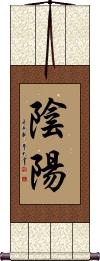
陰陽 literally means yin and yang in written form (versus the common yin-yang symbol). The first character has the element of the moon, while the second character has the element of the sun so that you can see, even in written form, they suggest the balance of opposites (of night and day). You could also translate this title as “sun and moon.”
Note: This title is often misspelled as Ying Yang instead of Yin Yang.
See Also: Taoism
Yako / Minami
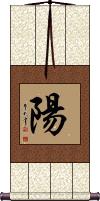
This can be the Japanese surname Yako or Minami.
陽 is actually the yang from yin and yang ☯.
The meaning includes positive, sun, male, the side on which the sun shines, the sun, heat, masculine, dynamic, etc.
Ba Gua
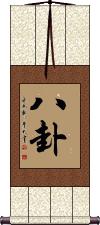
八卦 is the Chinese title for Bagua or Ba Gua.
Simply put, this represents the eight elements often seen around the yin-yang symbol.
Tai Chi Ball
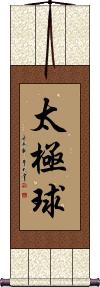
太極球 is the title “Tai Chi Ball.”
This may refer to any number of variations of exercise balls, some with yin-yang themes, others strictly for taichi/taiji or qigong exercises.
Not Only Can Water Float A Boat, It Can Sink It Also
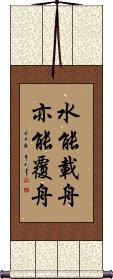
Many things have opposite properties. The water you drink can also drown you. Pork may nourish you and keep you alive but under-cook it and it could kill you. Potassium nitrate is often used as a fertilizer to grow the food that sustains us but it's also been used as an explosive to topple buildings and destroy us.
This concept is easily associated with “yin yang” where an element has two opposite properties that are as different as night and day.
This proverb's meaning can be summed up this way: “Anything that can lead you to success may also contain great risks.”
This phrase is known in literary circles by Korean people (scholars or literature). It is therefore also a valid proverb in Korean Hanja, though most Koreans would not be able to make sense of it.
Please note that there is an unwritten rule when the same character appears twice in the same phrase, the calligrapher will alter the appearance so that no two characters are exactly alike in the same piece. This calligraphy has two repeating characters that will be written differently than they appear here.
Daoism / Taoism
Literally: The Way or Road
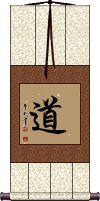
道 is the character “dao” which is sometimes written as “tao” but pronounced like “dow” in Mandarin.
道 is the base of what is known as “Taoism.” If you translate this literally, it can mean “the way” or “the path.”
Dao is believed to be that which flows through all things and keeps them in balance. It incorporates the ideas of yin and yang (e.g. there would be no love without hate, no light without dark, no male without female.)
The beginning of Taoism can be traced to a mystical man named
Lao Zi (604-531 BC), who followed, and added to the teachings of Confucius.
More about Taoism / Daoism here.
Note that this is pronounced “dou” and sometimes “michi” when written alone in Japanese but pronounced “do” in word compounds such as Karate-do and Bushido. It's also “do” in Korean.
Alternate translations and meanings: road, way, path; truth, principle province.
Important Japanese note: In Japanese, this will generally be read with the road, way, or path meaning. Taoism is not as popular or well-known in Japan so Daoist/Taoist philosophy is not the first thing a Japanese person will think of when they read this character.
See our Taoism Page
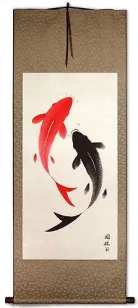
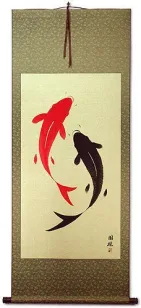
This in-stock artwork might be what you are looking for, and ships right away...
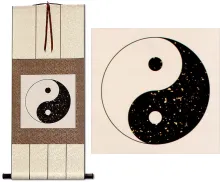
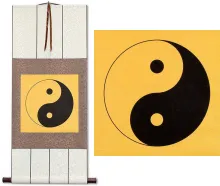
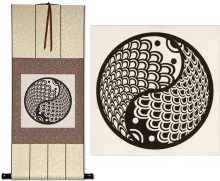


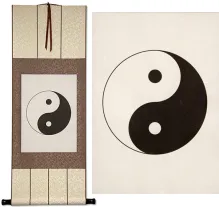

Gallery Price: $63.00
Your Price: $35.00


Not the results for yin-yang that you were looking for?
Below are some entries from our dictionary that may match your yin-yang search...
| Characters If shown, 2nd row is Simp. Chinese |
Pronunciation Romanization |
Simple Dictionary Definition |
六気 see styles |
rokki; rikki; rikuki ろっき; りっき; りくき |
(1) yin, yang, wind, rain, darkness, light; (2) cold, heat, dryness, dampness, wind, fire; (3) six emotions (joy, anger, sorrow, pleasure, love, hate) |
太陰 太阴 see styles |
tài yīn tai4 yin1 t`ai yin tai yin taiin / tain たいいん |
the Moon (esp. in Daoism) (1) (See 太陽) Moon; (2) (See 小陰) the greater yin (in yin-yang) |
小陰 see styles |
shouin / shoin しょういん |
the lesser yin (within yin-yang) |
氣化 气化 see styles |
qì huà qi4 hua4 ch`i hua chi hua |
to vaporize; evaporation; carburetion; 氣|气[qi4] transformation in TCM (i.e. transformation of yin yang vital breath); unvoicing of voiced consonant |
鄒衍 邹衍 see styles |
zōu yǎn zou1 yan3 tsou yen suuen / suen すうえん |
Zou Yan (305-240 BC), founder of the School of Yin-Yang of the Warring States Period (475-221 BC) (personal name) Suuen |
太極図 see styles |
taikyokuzu たいきょくず |
taijitu (chi:); cosmic dual forces symbol; yin-yang symbol |
太極圖 太极图 see styles |
tài jí tú tai4 ji2 tu2 t`ai chi t`u tai chi tu |
diagram of cosmological scheme; Yin-Yang symbol ☯ |
工巧明 see styles |
gōng qiǎo míng gong1 qiao3 ming2 kung ch`iao ming kung chiao ming kugyoumyou / kugyomyo くぎょうみょう |
(hist) (See 五明) silpasthanavidya (ancient Indian study of the arts, incl. mathematics and mechanics) Śilpasthana-vidyā. 巧業明 One of the five departments of knowledge dealing with the arts, e. g. the various crafts, mechanics, natural science (yin-yang), calculations (especially for the calendar and astrology), etc. |
陰陽家 阴阳家 see styles |
yīn yáng jiā yin1 yang2 jia1 yin yang chia inyouka; onyouke; onmyouke / inyoka; onyoke; onmyoke いんようか; おんようけ; おんみょうけ |
School of Yin-Yang of the Warring States Period (475-221 BC) founded by Zou Yan 鄒衍|邹衍[Zou1 Yan3] (1) (See 陰陽道) diviner (esp. of the Yin and Yang system); sorcerer; exorcist; medium; (2) (hist) School of Yin-yang (China); School of Naturalists |
三教九流 see styles |
sān jiào jiǔ liú san1 jiao4 jiu3 liu2 san chiao chiu liu |
the Three Religions (Daoism, Confucianism, Buddhism) and Nine Schools (Confucians, Daoists, Yin-Yang, Legalists, Logicians, Mohists, Political Strategists, Eclectics, Agriculturists); fig. people from all trades (often derog.) |
淫羊かく see styles |
inyoukaku / inyokaku いんようかく |
horny goat weed (Epimedium grandiflorum var. thunbergianum); rowdy lamb herb; barrenwort; bishop's hat; fairy wings; yin yang huo |
Variations: |
shouin / shoin しょういん |
the lesser yin (in yin-yang) |
Variations: |
shouyou / shoyo しょうよう |
the lesser yang (in yin-yang) |
インヨウカク see styles |
inyoukaku / inyokaku インヨウカク |
horny goat weed (Epimedium grandiflorum var. thunbergianum); rowdy lamb herb; barrenwort; bishop's hat; fairy wings; yin yang huo |
Variations: |
inyoukaku; inyoukaku / inyokaku; inyokaku いんようかく; インヨウカク |
(See 碇草) horny goat weed (Epimedium grandiflorum var. thunbergianum); rowdy lamb herb; barrenwort; bishop's hat; fairy wings; yin yang huo |
The following table may be helpful for those studying Chinese or Japanese...
| Title | Characters | Romaji (Romanized Japanese) | Various forms of Romanized Chinese | |
| Yin Yang | 陰陽 阴阳 | in you / inyou / in yo | yīn yáng / yin1 yang2 / yin yang / yinyang | |
| Yako Minami | 陽 阳 | you / yo | yáng / yang2 / yang | |
| Ba Gua | 八卦 | bā guà / ba1 gua4 / ba gua / bagua | pa kua / pakua | |
| Tai Chi Ball | 太極球 太极球 | tai kyoku kyuu taikyokukyuu tai kyoku kyu | tài jí qiú tai4 ji2 qiu2 tai ji qiu taijiqiu | t`ai chi ch`iu taichichiu tai chi chiu |
| Not Only Can Water Float A Boat, It Can Sink It Also | 水能載舟亦能覆舟 水能载舟亦能覆舟 | shuǐ néng zài zhōu yì néng fù zhōu shui3 neng2 zai4 zhou1 yi4 neng2 fu4 zhou1 shui neng zai zhou yi neng fu zhou | shui neng tsai chou i neng fu chou | |
| Daoism Taoism | 道 | michi / -do | dào / dao4 / dao | tao |
| In some entries above you will see that characters have different versions above and below a line. In these cases, the characters above the line are Traditional Chinese, while the ones below are Simplified Chinese. | ||||

Successful Chinese Character and Japanese Kanji calligraphy searches within the last few hours...



