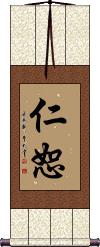
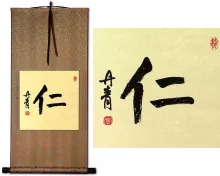
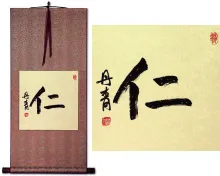
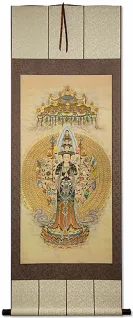
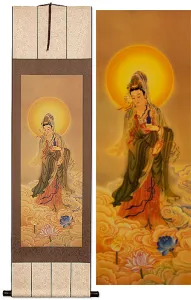
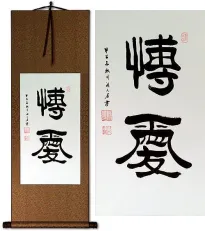
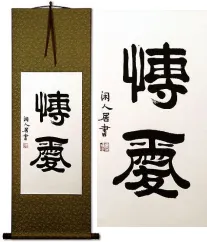
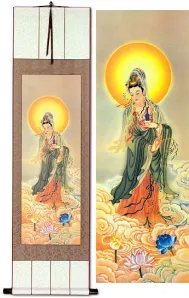
We have many options to create artwork with Compassion characters on a wall scroll or portrait.
If you want to create a cool Compassion Asian character tattoo, you can purchase that here:
Asian / Chinese / Japanese Tattoo Image Service
...and we'll give you many tattoo image templates of the ancient Asian symbols that express the idea of compassion.
Quick links to words on this page...
Triple Truth of Japanese Buddhism ningensei o saisei suruno wa kanyou na kokoro shinsetsu na kotoba houshi to omoiyari no seishin![]() ![]() ![]() ![]() ![]() ![]() ![]() ![]() ![]() ![]() ![]() ![]() ![]() ![]() ![]() ![]() ![]() ![]() ![]() ![]() ![]() ![]() ![]() ![]() ![]() ![]() ![]() ![]() ![]() Characters shown The Buddha ordered that all should know this triple truth... ![]() ![]() There are a few different words used to express charity in Chinese characters, Japanese Kanji and old Korean Hanja, but this is the most common. Some of the other words describe acts such as "giving alms" etc. See Also... Benevolence | Altruism ![]() ![]() Compassion is caring and understanding someone is hurt or troubled (even if you don't know them). It is wanting to help, even if all you can do is listen and say kind words. You forgive mistakes. You are a friend when someone needs a friend. ![]() This is the simplest way to express the idea of compassion. It can also mean love for your fellow humans, humanity, or living creatures. Sometimes this is extended to mean charity. See Also... Mercy | Benevolence | Forgiveness | Kindness ![]() ![]() This is the Buddhist deity known as the Goddess of Mercy or Bodhisattva of Compassion. In Chinese, the proper name of this being is Guan Yin. There is some debate as to whether Guan Yin is female. The argument comes from some scripture that suggests Buddhist deities take on male form. Others say that Guan Yin has no sex. And still others are okay with the female representation of Guan Yin. See Also... Buddhism | Goddess | Namo Amitabha | Bodhisattva Goddess of Mercy and CompassionThis is the long or more formal version of this title guān shì yīn 관세음![]() ![]() ![]() This is the longer, and perhaps more formal title for the Buddhist deity known as the Goddess of Mercy or Bodhisattva of Compassion. ![]() ![]() This is the specifically Japanese version of Bodhisattva of Compassion or Guan Yin. In Japanese this is pronounced Kannon, and occasionally spelled Kwannon. The Chinese version is a bit more commonly-seen in Asia, but in Japanese, there is a slight variation with the first character. Goddess of Compassion (Japanese)This is the long or more formal version of this title quān shì yīn kan ze on![]() ![]() ![]() This is the longer and more formal Japanese version of Bodhisattva of Compassion or Guan Yin. In Japanese this is pronounced Kanzeon. The Chinese version is a bit more common in Asia, but in Japanese they use a slight variation of the first character. Choose this version only if your intended audience is specifically Japanese. Impartial & Fair to the |
The scroll that I am holding in this picture is a "regular size"
4-character wall scroll.
As you can see, it is a great size to hang on your wall.
(We also offer custom wall scrolls in larger sizes)
Professional calligraphers are getting to be hard to find these days.
Instead of drawing characters by hand, the new generation in China merely type roman letters into their computer keyboards and pick the character that they want from a list that pops up.
There is some fear that true Chinese calligraphy may become a lost art in the coming years. Many art institutes in China are now promoting calligraphy programs in hopes of keeping this unique form
of art alive.
Even with the teachings of a top-ranked calligrapher in China, my calligraphy will never be good enough to sell. I will leave that to the experts.
The same calligrapher who gave me those lessons also attracted a crowd of thousands and a TV crew as he created characters over 6-feet high. He happens to be ranked as one of the top 100 calligraphers in all of China. He is also one of very few that would actually attempt such a feat.
The following table is only helpful for those studying Chinese (or Japanese), and perhaps helps search engines to find this page when someone enters Romanized Chinese or Japanese
| Title | Characters Simplified Traditional |
Japanese Romaji (Romanized Japanese) | Various forms of Hanyu-Pinyin (Romanized Chinese) | |||
| Triple Truth of Japanese Buddhism | 人間性を再生するのは寛容な心親切な言葉奉仕と思いやりの精神 人間性を再生するのは寛容な心親切な言葉奉仕と思いやりの精神 | ningensei o saisei suruno wa kanyou na kokoro shinsetsu na kotoba houshi to omoiyari no seishin ningenseiosaiseisurunowakanyounakokoroshinsetsunakotobahoushitoomoiyarinoseishin ningensei o saisei suruno wa kanyo na kokoro shinsetsu na kotoba hoshi to omoiyari no seishin | ||||
| Charity | 慈善 慈善 | jizen | cí shàn ci shan | ci2 shan4 cishan | ||
| Compassion | 同情 同情 | doujou dojo | tóng qíng tong qing | tong2 qing2 tongqing | ||
| Mercy / Compassion / Love | 慈 慈 | ji | cí ci | ci2 ci | ||
| Goddess of Mercy and Compassion | 观音 觀音 / 観音 | kan non kannon | guān yīn guan yin | guan1 yin1 guanyin | ||
| Goddess of Mercy and Compassion | 观世音 觀世音 | n/a | guān shì yīn guan shi yin | guan1 shi4 yin1 guanshiyin | ||
| Goddess of Compassion (Japanese) | 観音 観音 | kan non kannon | quān yīn quan yin | quan1 yin1 quanyin | ||
| Goddess of Compassion (Japanese) | 観世音 観世音 | kan ze on kanzeon | quān shì yīn quan shi yin | quan1 shi4 yin1 quanshiyin | ||
| Impartial & Fair to the Brotherhood & Sisterhood of the World | 一视同仁 一視同仁 | isshidoujin ishidojin | yí shì tóng rén yi shi tong ren | yi2 shi4 tong2 ren2 yishitongren | ||
| Kindness and Forgiving Nature | 仁恕 仁恕 | jinjo | rén shù ren shu | ren2 shu4 renshu | ||
| Loving Heart / Compassion | 爱心 愛心 | ai shin aishin | ài xīn ai xin | ai4 xin1 aixin | ||
| Mercy / Buddhist Compassion | 慈悲 慈悲 | jihi | cí bēi ci bei | ci2 bei1 cibei | ||
| If you have not set up your computer to display Chinese, the characters in this table probably look like empty boxes or random text garbage.
This is why we spent hundreds of hours making images so that you could view the characters in the "Compassion" listings above. If you want your Windows computer to be able to display Chinese characters you can either head to your Regional and Language options in your Win XP control panel, select the [Languages] tab and click on [Install files for East Asian Languages]. This task will ask for your Win XP CD to complete in most cases. If you don't have your Windows XP CD, or are running Windows 98, you can also download/run the simplified Chinese font package installer from Microsoft which works independently with Win 98, ME, 2000, and XP. It's a 2.5MB download, so if you are on dial up, start the download and go make a sandwich. | ||||||
All custom calligraphy items are made-to-order in our little Beijing artwork-mounting workshop.
Please note: Rush service can be as fast as two weeks, but regular service is over a month for delivery.
Copyright Oriental Outpost 2002-2010 - All Rights Reserved
Image Use Policy | Privacy Policy
Last modified: Oct 15 2008 11:47