Switched to secondary search mode due to lack of results using primary.
These secondary results may not be very accurate. Try a different but similar meaning word or phrase for better results. Or...
Look up in my Japanese Kanji & Chinese Character Dictionary(My dictionary is a different system then the calligraphy search you just tried)
If you want a special phrase, word, title, name, or proverb, feel free to contact me, and I will translate your custom calligraphy idea for you.
Faith Chinese / Japanese Calligraphy Wall Scrolls
See also: Faithful for additional words that are more related to loyalty and fidelity.
If you have strong faith, this is the place to find the perfect faith artwork in Asian symbols.
Start customizing your project by clicking on the button next to the faith-related title below...
3. Believe
8. Confidence / Faithful Heart
9. The Five Tenets of Confucius
10. Confucius: Golden Rule / Ethic of Reciprocity
11. Devotion / Dedication / Attentive / Focused
12. Devotion / Diligence / Vigorous / Energetic
13. Religious Devotion / Faith in God / Religious Faith
14. Dogen
15. Eishin-Ryu
16. Everything Happens for a Reason
17. Faith / Trusting in the Unseen
18. Faith is the bird that feels the light when the dawn is still dark
19. Faith Hope Love
20. Faith Love Peace
21. Faith
22. Fidelity / Personal Integrity / Honor
25. Good Intentions / Good Will / Good Faith
26. The Guts Theory
27. Hard Work
28. Faithful / Honorable / Trustworthy / Fidelity / Loyalty
29. Honesty
31. Hope
32. Integrity
33. John 3:16
34. Joshua 24:15
35. Karma
37. Firm Belief / Strong Faith
38. Listen to Your Heart / Follow Your Heart
40. Loyalty
41. Mercy / Compassion / Buddhist Loving Kindness
42. Morality of Mind
44. There is no god but Allah, and Muhammad is His Messenger
45. Patience / Perseverance / To Endure / Tolerant
46. Pure Land / Jodo
47. Sacrifice / Devotion / Dedication
48. Sangha
49. Self-Confidence
51. Faith Dojo
53. Soul Mates
54. Spiritual Peace / Enlightened Peace
55. Star
56. Daoism / Taoism
57. Tiger Rumor
59. Trust in God
60. Trust No One / Trust No Man
61. Trust in God / In God We Trust
62. Trust in God / Belief in God
63. Trust in God / Faith in God
64. Trust Your Heart
67. Monkey
Ten perfect Mahayana rules
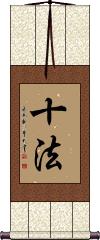
十法 is the title of the ten perfect or perfecting Mahāyāna rules.
The order of rules is as follows:
1. right belief.
2. right conduct.
3. right spirit.
4. the joy of the bodhi mind.
5. joy in the dharma.
6. joy in meditation.
7. pursuing the correct dharma.
8. obedience to, or accordance with dharma.
9. departing from pride, desire, etc.
10. comprehending the inner teaching of Buddha and taking no pleasure in attaining such knowledge or noting the ignorance of others.
This title is only used in the context of Buddhism. Japanese and Chinese people who are not familiar with Buddhism will not recognize this title.
Belief / Trust
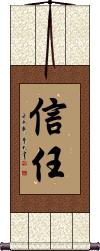
信任 means belief or trust in Chinese characters, old Korean Hanja, and Japanese Kanji.
It can also mean having confidence in or credence.
Believe
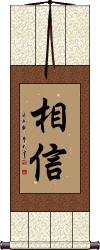
相信 is the Chinese way to say believe.
This specifically means to be convinced that something is true or to accept something as true or real.
This can also be translated as “convinced of,” “have trust in,” or “have faith in.”
Believe / Faith / Trust
śraddhā
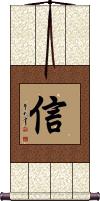
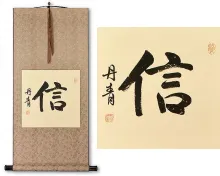
信 can mean to believe, truth, faith, fidelity, sincerity, trust, and confidence in Chinese, old Korean Hanja, and Japanese Kanji.
This single character is often part of other words with similar meanings.
It is one of the five basic tenets of Confucius.
In Chinese, it sometimes has the secondary meaning of a letter (as in the mail) depending on context but it will not be read that way when seen on a wall scroll.
In the Buddhist context, this is śraddhā (faith through hearing or being taught).
Believe in Yourself
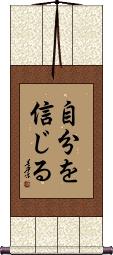
自分を信じる means “believe in yourself,” “have faith in yourself,” or “believe in myself” (can be myself or yourself depending on if you're saying it to yourself or someone else).
Note: Because this selection contains some special Japanese Hiragana characters, it should be written by a Japanese calligrapher.
Christian Friend
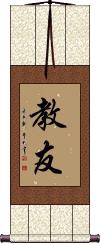
Depending on the context, 教友 can mean Christian or “friend of the same religion.”
While technically, it could be any religion, this is used mainly within the Christian faith. You can also translate this as “Christian friend” and, in some cases, “Church member.”
Christianity / Christian
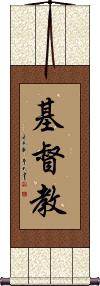
基督教 is the Chinese, Japanese and Korean word for “Christianity.”
Just as in English, this word is often used to mean “Protestant” but includes Catholics in the true definition.
It is the word used to refer to the whole “Christian religion” or “Christian Faith,” and therefore, it can be translated as “Christianity.” However, used as an adjective in regard to a person, it would translate as “Christian.” But more like saying, “His religion is Christianity,” rather than a noun form.
If you break it apart, the characters mean Base/Foundation Leading/Supervising Religion/Teaching. It makes more sense in Japanese, Chinese, and Korean. The first two characters together are translated as “Christ.” So you can also say this means “Christ's Religion” or “Christ's Teachings” when directly translated, or in reverse, “The Religion of Christ” or “The Teaching of Christ.”
Notes: The last character has a slight difference in one stroke - however, in calligraphic form, this will not be apparent. This entry can easily be read by any Korean person who knows Hanja characters (Chinese characters used in Korean).
See Also: Jesus Christ | God of Abraham
Confidence / Faithful Heart
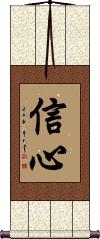
信心 is a Chinese, Japanese, and Korean word that means confidence, faith, or belief in somebody or something.
The first character means faith, and the second can mean heart or soul. Therefore, you could say this means “faithful heart” or “faithful soul.”
In Korean especially, this word has a religious connotation.
In the old Japanese Buddhist context, this was a word for citta-prasāda (clear or pure heart-mind).
In modern Japan (when read by non-Buddhists), this word is usually understood as “faith,” “belief,” or “devotion.”
See Also: Self-Confidence
The Five Tenets of Confucius
The Five Cardinal Rules / Virtues of Confucius
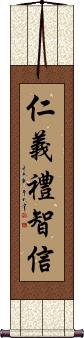
仁義禮智信 are the core of Confucius's philosophy.
Simply stated:
仁 = Benevolence / Charity
義 = Justice / Rectitude
禮 = Courtesy / Politeness / Tact
智 = Wisdom / Knowledge
信 = Fidelity / Trust / Sincerity
Many of these concepts can be found in various religious teachings. It should be clearly understood that Confucianism is not a religion but should instead be considered a moral code for a proper and civilized society.
This title is also labeled “5 Confucian virtues.”
 If you order this from the Japanese calligrapher, expect the middle Kanji to be written in a more simple form (as seen to the right). This can also be romanized as "jin gi rei satoshi shin" in Japanese. Not all Japanese will recognize this as Confucian tenets but they will know all the meanings of the characters.
See Also: Confucius Teachings | Ethics
Confucius: Golden Rule / Ethic of Reciprocity
Do not do to others what you do not want done to yourself
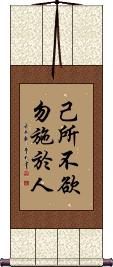
Some may think of this as a “Christian trait,” but actually, it transcends many religions.
This Chinese teaching dates back to about 2,500 years ago in China. Confucius had always taught the belief in being benevolent (ren), but this idea was hard to grasp for some of his students, as benevolence could be kind-heartedness or an essence of humanity itself.
When answering Zhong Gong's question as to what "ren" actually meant, Confucius said:
己所不欲勿施于人 or "When you go out, you should behave as if you were in the presence of a distinguished guest; when people do favors for you, act as if a great sacrifice was made for you. Whatever you wouldn't like done to you, do not do that thing to others. Don't complain at work or home.”
Hearing this, Zhong Gong said humbly, “Although I am not clever, I will do what you say.”
From this encounter, the Chinese version of the “Golden Rule” or “Ethic of Reciprocity” came to be.
The characters you see above express, “Do not do to others whatever you do not want to be done to yourself.”
See Also: Confucius Teachings | Benevolence
Devotion / Dedication / Attentive / Focused
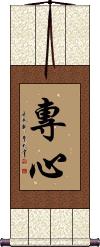
專心 makes a word that means “paying attention with your heart.”
It's often translated as “dedication,” as in “be absorbed in” or “concentrate one's efforts.” It's also used to mean “with the single mind,” “whole-heartedly,” “paying attention,” “undivided attention,” “concentration (-ed),” “engrossed,” “devotionally (listening/watching),” and/or “attentive.”
The first character means “for a particular person, occasion, or purpose,” “focused on one single thing,” “concentrated,” and sometimes, “special.”
The second character means “heart” or “mind” by itself.
My favorite translation, which comes from the Oxford Advanced Chinese/English Dictionary, is, “wholehearted devotion.”
If it seems like the meaning of this word is quite open, you are correct. The context in which the word is used matters a lot. It can mean different things depending on how you use it. This makes it kind of nice as you can decide what this means to you (within some limits). This is always positive in meaning, so even if a Chinese person reads it differently than you, it will still have a good meaning.
 In Japanese, they tend to use a variation of the second character which has one less stroke. If you want your calligraphy written this Japanese form, please click on the Kanji shown to the right instead of the button above. Note: Japanese and Chinese people will recognize either form.
See Also: Devotion
Devotion / Diligence / Vigorous / Energetic
vīrya
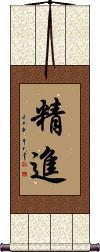
精進 is a wide-ranging word that is used in Chinese, Japanese, and Korean.
It can mean devotion, diligence, concentration, aggressive, enterprising, vigorous, energetic, purification, pushing, asceticism, assiduity, or virility. 精進 is deep, and these two characters can express ideas that take a full English phrase to describe, such as “concentration of mind,” “to forge ahead vigorously,” or “to dedicate oneself to progress.”
Used in the context of Buddhism, it means “making earnest efforts to cultivate virtue and get rid of evil” or “zeal in one's quest for enlightenment.”
Religious Devotion / Faith in God / Religious Faith
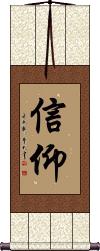
信仰 means firm belief, faith, persuasion, conviction, and sometimes religion or creed in Chinese, Japanese Kanji, and old Korean Hanja.
This clearly fits the religious connotation of the English word “devotion.”
This is often used to refer to a person of faith or a religious person.
This can be directly translated as “firm belief,” “creed,” “conviction,” or simply as “religious,” depending on context.
Some will also use this to mean “trust in God” in Japanese (though the term for God is not actually in this title).
It should be noted that this word is a little strange alone on a wall scroll.
While this can be pronounced in Japanese, it’s not a great selection for a wall scroll if your audience is Japanese.
See Also: Trust | Devotion | Trust | Trust in God
Dogen
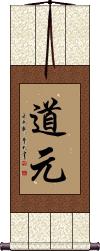
Usually, when people are looking for 道元 or “Dogen,” they are referring to the Japanese Zen monk by this name.
He lived from 1200-1253. This Dogen name or title literally means “The Way Origin” or “Beginning of the Path.” It is understood to mean “beginning of right doctrine or faith” in the context of his name and work to establish the Sōtō school of Zen in Japan.
To accomplish that task, this humble monk traveled from Japan and across China to find the more original or pure forms of Buddhism.
Eishin-Ryu
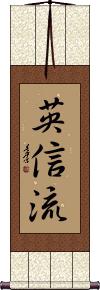
英信流 is the Japanese martial arts term, Eishin-ryu.
This can also be pronounced Hidenobu-ryu. The direct meaning is something like, hero faith school (or school of heroic faith).
Everything Happens for a Reason
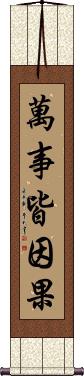
萬事皆因果 means “Everything happens for a reason” in Chinese.
The first two characters mean “all things” or “everything.”
The middle character kind of means “in all cases.”
The last two characters create a complex word that can be defined in many ways, such as “karma,” “cause and effect,” “fate,” and “every cause has its effect, as every effect arises from a cause.”
Keep in mind that Chinese grammar is a bit different than English, so trust me that this makes a natural-sounding proverb in Chinese.
Faith / Trusting in the Unseen
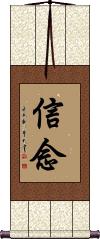
信念 expresses the idea of “having a belief” or “trusting in the unseen.”
信念 could also be translated as beliefs or convictions.
Note: Also considered to be one of the Seven Heavenly Virtues.
See Also: Devotion | Dedication | Trust
Faith is the bird that feels the light when the dawn is still dark
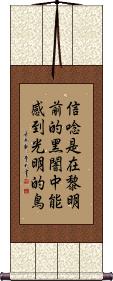
信唸是在黎明前的黑闇中能感到光明的鳥 is a philosophical poem/quote from Indian Poet and Philosopher, Rabindranath Tagore.
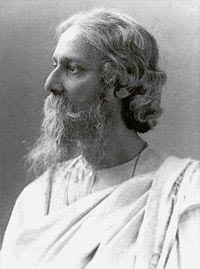
Rabindranath Tagore, 1915
This quote is not sourced, and therefore several variations exist in English. Some suggest the original was in the Bengali language.
This, of course, is the Chinese translation that has the meaning of, “Faith is the bird that feels the light and sings when the dawn is still dark.”
More about Rabindranath Tagore
Faith Hope Love
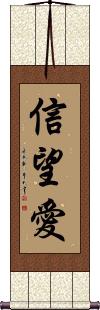
信望愛 is a Chinese list of words meaning faith, hope, and love.
This is not a typical phrase in Chinese but rather just random words strung together. There's no bad meaning, it's just not typical Chinese grammar.
Faith Hope Love
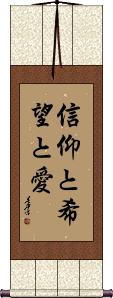
信仰と希望と愛 is a Japanese list of words (not really a phrase) meaning faith, hope, and love.
Some have associated this word list with Corinthians 13:13, though there are no specific religious connotations in this word list, and it's not directly from that Japanese Bible verse.
Note: Because this selection contains some special Japanese Hiragana characters, it should be written by a Japanese calligrapher.
Faith Love Peace
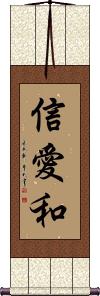
信愛和 is a word list that reads, “Faith Love Peace.”
This is not a natural phrase in Chinese or Japanese, as it lacks a subject, verb, or object. But if this is what you want, here it is.
Faith
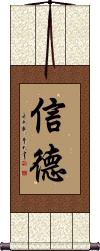
信德 is a term used often in Buddhism to express faith.
信德 is sometimes translated as the merit of the believing heart, faith of virtue, the power of faith, or virtuous faith.
In this context:
信 = Faith
德 = Virtue
Fidelity / Personal Integrity / Honor
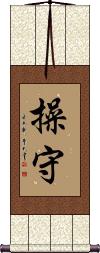
操守 is the Chinese and Japanese Kanji for personal integrity, constancy, fidelity, and honor/honour.
The original meaning of the first character is chastity, fidelity, honor, and/or faith.
The second character means to defend, guard, keep watch, and be observant.
So, this is about being observant of and guarding your integrity and honor.
Fragrant / Good Smell
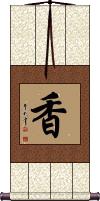
香 is the Chinese, Japanese Kanji, and old Korean Hanja that means: fragrant; sweet smelling; aromatic; savory; appetizing; perfume; incense; aroma; fragrance; scent; good smell.
Fragrance or incense is known to be one of the Buddha's messengers to stimulate faith and devotion.
Galatians 5:22-23

Here is Galatians 5:22 and a bit of 23 in Chinese.
The text with punctuation:
圣灵所结的果子,就是仁爱,喜乐,和平,忍耐,恩慈,良善,信实,温柔,节制。
Hand-painted calligraphy does not retain punctuation.
This translation is from the Chinese Union Bible.
You may know it from the KJV as:
5:22 But the fruit of the Spirit is love, joy, peace, longsuffering, gentleness, goodness, faith,
5:23 Meekness, temperance...
Good Intentions / Good Will / Good Faith
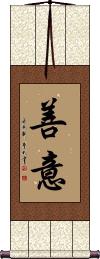
善意 is a word that means good intentions, goodwill, or to things done in good faith in Chinese, Japanese, and old Korean Hanja.
It's the reason you do good deeds or the desire you have inside yourself to do the right thing.
This can also be translated as benevolence, kindness, virtuous mind, positive mindset, or favorable sense.
善意 is also used in the legal context for things done in good faith (regardless of outcome).
In Japanese, this can be the personal name Yoshi or Yoshii.
The Guts Theory
The belief that where there's a will, there's a way.
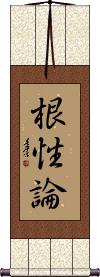
根性論 is a Japanese title that refers to the belief that where there's a will, there's a way.
Another way to translate this is “The Guts Theory” or “The Doctrine of Will-Power.” Maybe breaking down the meaning of the characters will help clarify this:
根性 = will-power; guts; temper; nature; spirit; nature and character; the nature of the powers of any sense.
論 = theory; doctrine; treatises on dogma, philosophy, discipline, etc.
Hard Work
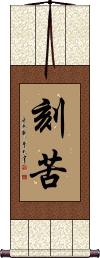
刻苦 is “hard work” in Chinese characters, Japanese Kanji, and old Korean Hanja.
If working hard is important to you, maybe this word will state your belief on your wall (this is not a common title to see on a wall scroll in Asia).
Faithful / Honorable / Trustworthy / Fidelity / Loyalty
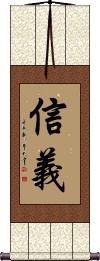
信義 is a word often used to describe a person with an honest and loyal reputation.
Simply put, this applies to somebody you can trust (with your life).
In Chinese, this is often defined as good faith, honor, trust, and justice.
In Korean, this word means fidelity, truthfulness, or faithfulness.
In Japanese: faith, fidelity, and loyalty. It's also a Japanese male given name when pronounced “Nobuyoshi.”
Honesty
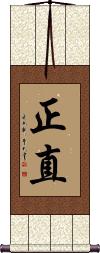
正直 or honesty is being truthful and sincere. It is important because it builds trust. When people are honest, they can be relied on not to lie, cheat or steal. Being honest means that you accept yourself as you are. When you are open and trustworthy, others can believe in you.
正直 is one of the 8 key concepts of Tang Soo Do.
Note: This entry is cross-listed as "integrity" because it also fits that definition.
 Please note that the second Kanji sometimes has an alternate form in Japanese. Let us know if you want the alternate form shown to the right.
Honesty
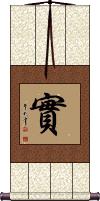
Honesty
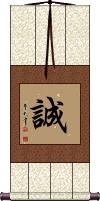
誠 means truth, faith, fidelity, sincerity, trust, and/or confidence.
As a single-character wall scroll, this suggests that you believe “honesty is the best policy,” as your personal philosophy.
This is also a virtue of the Samurai Warrior
See our page with just Code of the Samurai / Bushido here
Honesty / Fidelity
信 is another character that expresses the idea of honesty.
It can also mean truth, faith, belief in, fidelity, sincerity, trust, and/or confidence.
Some have included this in the list for the Bushido, although “makoto” is probably more common/popular.
Note: In some contexts, this character can mean a letter (mail), news, or envoy. However, alone, it will generally be read with the honesty-meaning.
See our page with just Code of the Samurai / Bushido here
See Also: Loyalty Trustworthiness Trustworthy
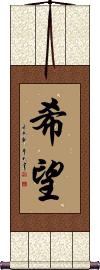
Hope
Integrity
Integrity is living by your highest values. It is being honest and sincere. Integrity helps you to listen to your conscience, do the right thing, and tell the truth. You act with integrity when your words and actions match. Integrity gives you self-respect and a peaceful heart.Please note that the second Kanji sometimes has an alternate form in Japanese. Let us know if you want the alternate form shown to the right.
Note: This entry is cross-listed as “honesty” because it also fits that definition.
Beyond Integrity, this word also means "upright" and "honest" in Chinese. Means "integrity," "honesty" or "frankness" in Japanese.
John 3:16

神愛世人甚至將他的獨生子賜給他們叫一切信他的不至滅亡反得永生 is the full translation of John 3:16 into Chinese.
This is from the Chinese Union Bible which comes from a revised version of the King James. This Chinese Bible was originally translated and printed in 1919 (several revisions since then).
Because of the origin being the KJV, I'll say that in English, this would be, “For God so loved the world, that he gave his only begotten Son, that whosoever believeth in him should not perish but have everlasting life.”
As with any translation, there are interesting cultural and linguistic issues. For instance, the word used for “world” in Chinese can also mean “common people.” So you could say that it means “For God so loved the common people...”
This does not take away from the text, as it will be understood with the same meaning and connotation.
There is no direct Greek-to-Chinese translation in print (that I know of), so this is the best available. Of course, you can ask any Greek person of faith, and they will claim that a bit is lost from the original Greek of the New Testament to any of the English versions of the Bible in print.
Joshua 24:15
This House Serves the LORD
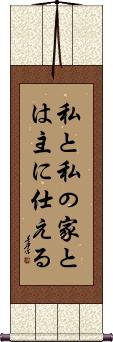
私と私の家とは、主に仕える is the last bit of Joshua 24:15 in Japanese.
Joshua 24:15 (KJV) ...as for me and my house, we will serve the LORD.
Joshua 24:15 (NIV) ...as for me and my household, we will serve the LORD.
This came from the Shinkaiyaku Japanese Bible. This is the most commonly-used Bible translation in Japan for both Protestants and Catholic Japanese folks.
I think it is a bit like having a secret code on your wall that quietly expresses to whom you are faithful.
This will be a nice gift for a friend or a wonderful expression of faith for your own home.
Note: Because this selection contains some special Japanese Hiragana characters, it should be written by a Japanese calligrapher.
Karma (of your past lives)
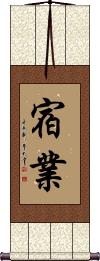
宿業 is the Buddhist concept of Past Karma. Simply put, it's the sum of all the good and bad from all previous lives (perhaps earlier in your current life). This term is not commonly used outside of the Buddhist faith (you'll have a tough time finding a non-Buddhist Asian person that knows this word).
Other ways to translate this are “The karma of previous existence,” “The karma remaining from prior existences,” or simply “Former karma.”
See Also: Buddhism
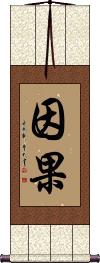
Karma - Cause and Effect
Firm Belief / Strong Faith
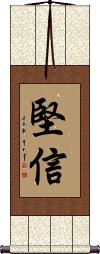
堅信 means to believe firmly, with firm faith, or without any doubt.
Japanese Christians sometimes use this term to mean the rite of confirmation.
This can also be the Japanese given name Kenshin.
Listen to Your Heart / Follow Your Heart
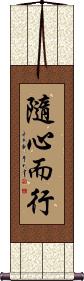
隨心而行 is the closest way to express this idea in Chinese. Literally translated, this phrase means “Allow your heart to dictate your behavior” or “Let your heart guide your conduct” in Chinese. You could also translate this as “follow your heart.” Or, with a bit of imagination, it could mean: “let your spirit be your guide.”
Note that in some cases, “heart” can mean “mind,” “soul” or even “spirit” in Chinese. In ancient China, it was thought that the big pumping organ in your chest was where your thoughts came from, or where your soul resides.
Ancient western thought followed a similar belief. Thus phrases like “I love you with all my heart” and “I give you my whole heart.”
Love Faith Strength
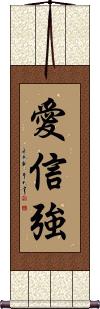
愛信強 is the shortest way to write the word list, “love faith strength.”
The first character is love, the second is faith or believe, and the third means strong or strength.
It should be noted that word lists like this are not as natural sounding in Chinese as word lists can be in English. it’s more common to have a full phrase (with subject, verb, and object) or single words on calligraphy wall scrolls in Asia.
Love Faith Strength
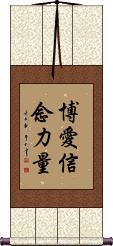
博愛信念力量 is the verbose way to write the word list, “love faith strength.”
It should be noted that word lists like this are not as natural sounding in Chinese as word lists can be in English. it’s more common to have a full phrase (with subject, verb, and object) or single words on calligraphy wall scrolls in Asia.
Loyalty
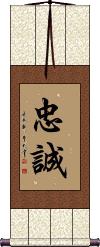
忠誠 is the written form of loyalty that is universal in Chinese, Japanese Kanji, and old Korean Hanja.
Loyalty is staying true to someone. It is standing up for something you believe in without wavering. It is being faithful to your family, country, school, friends, or ideals when the going gets tough and when things are good. With loyalty, you build relationships that last forever.
Notes:
1. There is also a Japanese version that is part of the Bushido Code which may be more desirable depending on whether your intended audience is Japanese or Chinese.
2. This version of loyalty is sometimes translated as devotion, sincerity, fidelity, or allegiance.
Mercy / Compassion / Buddhist Loving Kindness
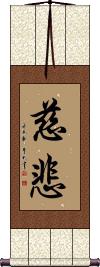
Besides the title above, 慈悲 can also be defined as clemency or lenience and sometimes the act of giving charity.
In the Buddhist context, it can be defined as “benevolence,” “loving-kindness and compassion,” or “mercy and compassion.”
This Buddhist virtue is perhaps the most important to employ in your life. All sentient beings that you encounter should be given your loving kindness. And trust me, however much you can give, it comes back. Make your life and the world a better place!
This Chinese/Japanese Buddhist term is the equivalent of Metta Karuna from Pali or Maitri Karuna from Sanskrit.
慈 can mean loving-kindness by itself.
悲 adds a component of sorrow, empathy, compassion, and sympathy for others.
See Also: Benevolence
Morality of Mind
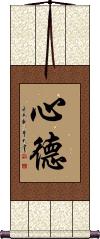
The idea of 心德 or “morality of mind” goes along with 行德 or “wu de” (martial morality or virtues of the warrior).
Here, the first character is a representation of your heart or mind.
The second character refers to morality or virtue.
This can also be translated as “morality of heart,” “virtue of heart,” or “virtue of the mind.”
Since ancient times in Asia, the idea of your mind (where your soul resides and your thought originates) has been associated with the heart. Just as in western culture, where we say “it comes from the heart” or “heartfelt emotions,” there is a belief that your heart and mind are one and the same (medical science now begs to differ).
See Also: Morality of Deed | Martial Morality
Namo Shakyamuni Buddha
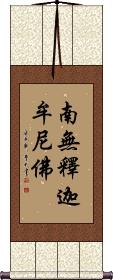
南無釋迦牟尼佛 is a Buddhist chant or prayer of respect to the Shakyamuni Buddha.
Some will translate this as the Buddhist vow.
The first two characters, 南無, are sometimes translated as “amen”; others will translate it as “belief in” or “homage to.”
To expand on this, 南無 can also mean “taking of refuge in” while representing devotion or conviction. 南無 as with most religious concepts or words, different people or denominations will have varying definitions.
There is no god but Allah, and Muhammad is His Messenger
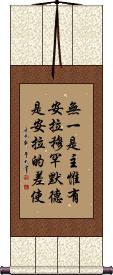
無一是主惟有安拉穆罕默德是安拉的差使 is one of the key creeds of Islam.
While perhaps more often seen in Arabic as
there are many native Chinese Muslims (especially the Hui ethnicity) that do not speak Arabic.
Instead, they use this Chinese phrase to express this idea or statement of faith.
Patience / Perseverance / To Endure / Tolerant
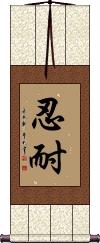
忍耐 is patience, the quiet hope, and trust that things will turn out right.
You wait without complaining. You are tolerant and accepting of difficulties and mistakes. You picture the end in the beginning and persevere to meet your goals.
忍耐 can also mean “to endure,” “restrain oneself,” or “forbearance,” and in some contexts, it can mean “perseverance” or “endurance.”
忍耐 is also used as a tenet of Taekwondo, Tang Soo Do, and other Korean martial arts where it's titled “Endurance” and romanized as “In Neh.”
 Note that when writing this as Kanji, Japanese will tend to write the first character in the form shown to the right. If you select our Japanese master calligrapher, please expect this Kanji form (yes,
it’s
just one stroke that is slightly different in location, crossing another stroke in the Japanese Kanji form).
Note that when writing this as Kanji, Japanese will tend to write the first character in the form shown to the right. If you select our Japanese master calligrapher, please expect this Kanji form (yes,
it’s
just one stroke that is slightly different in location, crossing another stroke in the Japanese Kanji form).
See Also: Peace | Harmony | Perseverance
Pure Land / Jodo
Also a sect of Buddhism
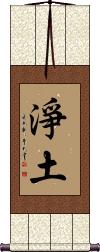
淨土 literally means “pure land” or “clean earth.”
淨土 is also the abbreviated title of a Buddhist sect that involves faith in the rebirth of Buddha Amitabha (Amitābha) in the Western Heaven. Sometimes this sect is translated as “Paradise of the West.” Other titles of this school of Buddhism include Amidism or Elysium.
See Also: Nirvana | Shin Buddhism
Sacrifice / Devotion / Dedication
(complete bodily devotion)
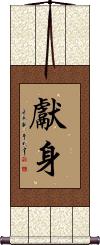
獻身 is used to describe being so devoted to something that you will make sacrifices for that goal/thing/person.
You can also translate this word as any of the following:
Sacrifice one's life for...
To dedicate oneself to...
Self-devotion
Dedication
Devote to...
Self-sacrifice
Giving your whole body to...
This can be a dedication to or for someone but is often used as a dedication or making sacrifices for your country, public service, or a cause. For instance, an Olympic athlete makes great sacrifices to train in his/her sport for their country and compatriots.

 While the form shown to the upper-left is considered an ancient Japanese version, in modern Japan, they use the simplified version of the first Kanji (shown to the right). Click on the Kanji at the right instead of the button above if you want this modern Japanese version.
If you are looking for a more religious meaning of devotion, see Faith.
See Also: Confidence | Dedication
Sangha
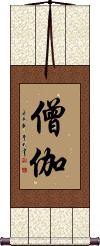
In Buddhism, 僧伽 refers to a community of monks and/or nuns (one of the “Three Jewels”). In general terms, it can simply mean “all followers of the Buddha.”
Notes: Though there are not vast numbers of Chinese Hindus, in the Hindu faith, this term means “community together.”
The original Sanskrit word is also Romanized as samgha.
The first character means “monk.” The second character means Buddha or Shakyamuni.
僧伽 is a transliteration of the original Sanskrit, but it uses two very profound Chinese characters related to Buddhism.
Some may pronounce this as “seng qie” or “seng jia” in Mandarin (two possible pronunciations for the second character). Note that “qie” sounds like “chee-ah” using typical English pronunciation. Chinese Romanization is not actually designed to match English sounds.

 Note that when writing this as Kanji, Japanese will tend to write the first character in the form shown to the right. If you select our Japanese master calligrapher, please expect this special Kanji form. However, it should also be noted that this is not a common term in Japanese (except by certain sects of Buddhism or perhaps devout Buddhists in Japan).
Self-Confidence
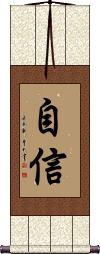
自信 is created by simply putting the character for “faith/believe/confidence” with the character for “oneself” in front of it.
The literal translation holds the same meaning in English, Chinese, and Japanese.
It's like a self-affirmation to say, “you can do it.”
Some may also use this to mean self-esteem or a sense of self-worth. 自信 is also how to say “believe in oneself.”
See Also: Confidence
Seven Heavenly Virtues
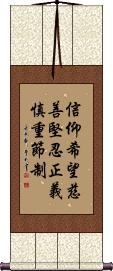
信仰希望慈善堅忍正義慎重節制 is a list in Chinese and Japanese Kanji of an interpretation of the Seven Heavenly Virtues.
1. Faith is belief in God, and the right virtues.
2. Hope is taking a positive future view that good will prevail.
3. Charity is a concern for, and active helping of, others.
4. Fortitude is never giving up.
5. Justice is being fair and equitable with others.
6. Prudence is care of and moderation with money.
7. Temperance is moderation of needed things and abstinence from things that are not needed.
The full list is here. 信仰希望慈善堅忍正義慎重節制 is a word list, not a common phrase. While all Chinese and Japanese people will recognize the words in the list, they may not understand what the list is about (unless they are familiar with the Seven Heavenly Virtues).
don’t get this as a tattoo or anything like that without first consulting a native translator in the target language. These are fine for a wall scroll but a long discussion is needed before you commit to this for a lifetime inking commitment.
Faith Dojo

Sincerity and Devotion
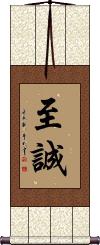
至誠 is the idea that you enter into something with the utmost sincerity and fidelity. Ideas such as devotion, honesty, and “one's true heart” are also contained in this word.
至誠 is a universal word as the Chinese, Japanese Kanji, and Korean Hanja are all identical.
Soul Mates
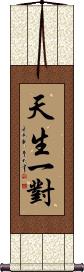
It was tough to find the best way to say “soul mates” in Chinese. We settled on 天生一對 as an old way to say, “A couple selected by heaven.”
The first two characters together mean “natural” or “innate.” Separated, they mean “heaven” and “born.” The last two characters mean “couple.” So this can be translated as “A couple that is together by nature,” or “A couple brought together by heaven's decree.” With a slight stretch, you could say, “A couple born together from heaven.”
It's a struggle to find the best way to describe this idea in English but trust me, it is pretty cool, and it is a great way to say “soulmates.”
If you're in a happy relationship or marriage and think you have found your soul mate, this would be a wonderful wall scroll to hang in your home.
Spiritual Peace / Enlightened Peace
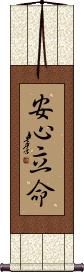
These Japanese Kanji, 安心立命, can be translated as “religious enlightenment” or “spiritual peace gained through faith.”
Other dictionaries define as “spiritual peace and enlightenment” or “keeping an unperturbed mind through faith.”
My Buddhist dictionary defines it as “spiritual peace and realization of enlightenment.”
In the Zen school, this is about settling one's body and life; attaining complete peace, and establishing one's course of life in accord with the ultimate reality.
Star
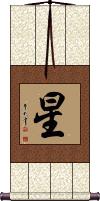
星 is how “star” is written in Chinese, Japanese, and old Korean.
Thousands of years ago, when this character was first developed, there was the belief that you could see remnants of stars in everything. In fact, some early Chinese men of science suggested that all living things came from “stardust” or cosmic debris. This could explain why the upper portion of this character means “sun” (a star itself) and the lower portion means “birth” or “life.”
Oddly enough, modern-day scientists suggest that we are all made up of cosmic dust. Seems they were getting it right in China at a time when the western world thought the Earth was flat and the Church was claiming that the sun and all cosmic bodies revolved around the Earth.
Daoism / Taoism
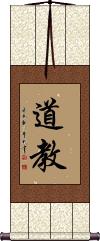
道教 is the title often used in both Chinese and Japanese to describe the beliefs or religion of Taoism / Daoism.
The first character is simply “dao” and the second character can be translated as “teachings,” “faith” or “doctrine.”
Tiger Rumor
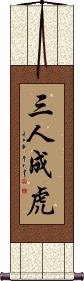
These four characters together relay the meaning that can be expressed in English as “When three people say there's a tiger running in the street, you believe it.”
Of course, there is an ancient story behind this idiom...
三人成虎 is actually a proverb that resulted from a conversation that occurred around 300 B.C.
The conversation was between the king of the Wei kingdom and one of the king's ministers named Pang Cong.
It was near the end of one of many wars, this time with the Zhao kingdom. Pang Cong was to be sent by the king to the Zhao kingdom with the king's son, who was to be held hostage. It was common at the time for a king to make his son a hostage to secure stable peace between warring kingdoms.
Before minister Pang Cong departed, he asked his king, “If one person told you a tiger was running in the street, would you believe it?.”
“No,” the king said.
The minister continued, “What if two people told you?”
The king replied, “Well, I would have my doubts but I might believe it.”
The minister continued, “So, what if three people told you that a tiger is running in the streets?”
The king replied, “Yes, I would believe it. It must be true if three people say it.”
The minister then reminded the king, “Your son and I are now traveling far away to live in the distant Zhao kingdom - much farther from your palace than the street. Rumors may fly about me in my absence, so I hope your majesty will weight such rumors appropriately.”
The king replied, “I have every trust in you, do not worry”
While the minister was gone, the king's enemies gossiped about minister Pang Cong on many occasions. At first, the king thought nothing of these comments and rumors. But slowly, as the rumors mounted, the king began to suspect ill of his minister.
Sometime later, when peace was well-established, the minister and prince were freed and returned to the kingdom of Wei. The king received his son BUT DID NOT EVEN SUMMON MINISTER PANG CONG TO THE PALACE!
Hopefully, this story will help you see how dangerous words can be when used to promote rumors or create ill will. And perhaps will inspire you not to believe everything you hear.
There is also a secondary suggestion in this idiom that gossip is as ferocious as a tiger. Some Chinese people who don't know the ancient story above may believe that this scroll means that rumors are as vicious as three tigers.
Note: This proverb appears in my Korean dictionary but is not well-known in Korea.
Trust / To Have Faith
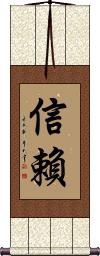
信賴 can also be translated as confidence, reliance, or dependence; thus, it can also mean “to rely on” or “to depend on.”
Trust is having faith in someone or something. It is a positive attitude about life. You are confident that the right thing will happen without trying to control or make it happen. Even when difficult things happen, trust helps us to find the gift or lesson in it.
 There is a slight deviation in the Japanese Kanji form of the second character. If you want the modern Japanese version, please click on the special Kanji shown to the right instead of the button above. Note that the traditional Chinese form is still readable and understood by Japanese people.
See Also: Confidence | Truth | Honor
Trust in God
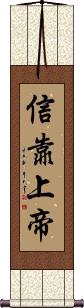
信靠上帝 means “Trust in God,” “Faith in God,” “Rely upon God” and/or “Believe in God.”
Trust No One / Trust No Man
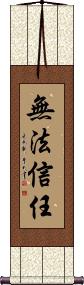
無法信任 is the kind of thing you expect to hear in a spy movie.
“Trust no one, 007!”
The first two characters express the idea of “no way” or “cannot.”
The last two characters mean “trust.”
The characters must go in this order due to Chinese grammar issues and in order to sound natural.
Note: This is not an ancient Chinese phrase by any means. It's just that we received a lot of requests for this phrase.
This is as close as you can get to the phrase “trust no man,” though technically, no gender is specified.
Trust No One / Trust No Man
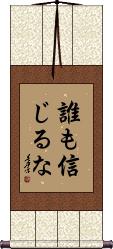
誰も信じるな is as close as you can get to the phrase “trust no man” in Japanese, though no gender is specified.
The first two characters mean everyone or anyone but change to “no one” with the addition of a negative verb.
The third through fifth characters express the idea of believing in, placing trust in, confiding in, or having faith in.
The last character makes the sentence negative (without the last character, this would mean “trust everyone,” with that last character, it's “trust no one”).
Note: Because this selection contains some special Japanese Hiragana characters, it should be written by a Japanese calligrapher.
Trust in God / In God We Trust
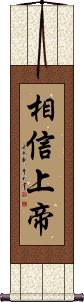
相信上帝 means exactly what the title suggests. The first two characters mean “trust” or “believe,” and the second two mean “God” (as in the God of Abraham and the God of Zion).
Thisis also how the American phrase “In God We Trust” as seen on U.S. Currency would be translated into Chinese. It would also be correct to say that this means “Believe in God,” though, in this arrangement/context, one would be more likely to interpret it as “trust.”
Trust in God / Belief in God

神の信仰 is the simplest way to express “Trust in God” in Japanese.
The first character means God, deity, divinity, or spirit (in this case, it will be read as God).
The second character is a particle that links the ideas.
The last two characters mean faith, belief, or creed in a religious context.
Trust in God / Faith in God

神を信ぜよ is a way to express “Trust in God” in Japanese.
The first character is “God.”
The second character is a particle that links the ideas here.
The last three characters are a word that means “to believe,” “to believe in,” “to place trust in,” “to confide in,” and “to have faith in.”
Basically, this is the Japanese phrase for “Have faith in God,” “Belief in God,” or “Trust in God.”
Note: Because this selection contains some special Japanese Hiragana characters, it should be written by a Japanese calligrapher.
Trust Your Heart
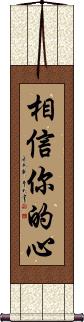
This means “Trust Your Heart” in Chinese.
In Wine there is Truth

酒后吐真言 / 酒後吐真言 is a nice Asian proverb if you know a vintner or wine seller - or wine lover - although the actual meaning might not be exactly what you think or hope.
The literal meaning is that someone drinking wine is more likely to let the truth slip out. It can also be translated as “People speak their true feelings after drinking alcohol.”
It's long believed in many parts of Asia that one can not consciously hold up a facade of lies when getting drunk, and therefore the truth will come out with a few drinks.
I've had the experience where a Korean man would not trust me until I got drunk with him (I was trying to gain access to the black market in North Korea which is tough to do as an untrusted outsider) - so I think this idea is still well-practiced in many Asian countries.
 VS
VS 
Please note that there are two common ways to write the second character of this phrase. The way it's written will be left up to the mood of the calligrapher, unless you let us know that you have a certain preference.
Xin Xin Ming / Shinjinmei
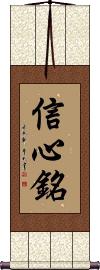
This is the title of a Buddhist poem known as Xin Xin Ming, Xinxinming, or Hsin Hsin Ming in Chinese and Shinjinmei in Japanese.
This title is typically translated as “Faith in Mind.”
The poem itself is quite long and steeped with meaning.
Download this document for more info: http://www.ln.edu.hk/econ/staff/Xin Xin Ming.doc
Monkey
Year of the Monkey / Zodiac Sign
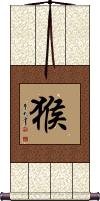
猴 is the monkey character in Chinese.
猴 means ape in Japanese due to an error made long ago as Japan absorbed Chinese characters.
If you were born in the year of the monkey, you . . .
Are smart, brave, active, and competitive.
Like new things.
Have a good memory.
Are quick to respond
Have an easy time winning people's trust.
Are, however, not very patient.
See also our Chinese Zodiac page.
Note: This character does have the meaning of monkey in Korean Hanja but is not used very often.
This in-stock artwork might be what you are looking for, and ships right away...
Gallery Price: $65.00
Your Price: $39.88
The following table may be helpful for those studying Chinese or Japanese...
| Title | Characters | Romaji (Romanized Japanese) | Various forms of Romanized Chinese | |
| Ten perfect Mahayana rules | 十法 | jippou / jipo | shí fǎ / shi2 fa3 / shi fa / shifa | shih fa / shihfa |
| Belief Trust | 信任 | shinnin | xìn rèn / xin4 ren4 / xin ren / xinren | hsin jen / hsinjen |
| Believe | 相信 | xiāng xìn xiang1 xin4 xiang xin xiangxin | hsiang hsin hsianghsin |
|
| Believe Faith Trust | 信 | shin | xìn / xin4 / xin | hsin |
| Believe in Yourself | 自分を信じる | jibun o shinjiru jibunoshinjiru | ||
| Christian Friend | 教友 | jiào yǒu / jiao4 you3 / jiao you / jiaoyou | chiao yu / chiaoyu | |
| Christianity Christian | 基督教 | kirisutokyou kirisutokyo | jī dū jiào ji1 du1 jiao4 ji du jiao jidujiao | chi tu chiao chituchiao |
| Confidence Faithful Heart | 信心 | shin jin / shinjin | xìn xīn / xin4 xin1 / xin xin / xinxin | hsin hsin / hsinhsin |
| The Five Tenets of Confucius | 仁義禮智信 仁义礼智信 | jin gi rei tomo nobu jingireitomonobu | rén yì lǐ zhì xìn ren2 yi4 li3 zhi4 xin4 ren yi li zhi xin renyilizhixin | jen i li chih hsin jenilichihhsin |
| Confucius: Golden Rule Ethic of Reciprocity | 己所不欲勿施於人 己所不欲勿施于人 | jǐ suǒ bú yù wù shī yú rén ji3 suo3 bu2 yu4, wu4 shi1 yu2 ren2 ji suo bu yu, wu shi yu ren jisuobuyu,wushiyuren | chi so pu yü, wu shih yü jen chisopuyü,wushihyüjen |
|
| Devotion Dedication Attentive Focused | 專心 / 専心 / 耑心 专心 | sen shin / senshin | zhuān xīn zhuan1 xin1 zhuan xin zhuanxin | chuan hsin chuanhsin |
| Devotion Diligence Vigorous Energetic | 精進 精进 | shoujin / shojin | jīng jìn / jing1 jin4 / jing jin / jingjin | ching chin / chingchin |
| Religious Devotion Faith in God Religious Faith | 信仰 | shin kou / shinkou / shin ko | xìn yǎng / xin4 yang3 / xin yang / xinyang | hsin yang / hsinyang |
| Dogen | 道元 | dou gen / dougen / do gen | dào yuán / dao4 yuan2 / dao yuan / daoyuan | tao yüan / taoyüan |
| Eishin-Ryu | 英信流 | ei shin ryuu eishinryuu ei shin ryu | ||
| Everything Happens for a Reason | 萬事皆因果 万事皆因果 | wàn shì jiē yīn guǒ wan4 shi4 jie1 yin1 guo3 wan shi jie yin guo wanshijieyinguo | wan shih chieh yin kuo wanshihchiehyinkuo |
|
| Faith Trusting in the Unseen | 信念 | shinnen | xìn niàn / xin4 nian4 / xin nian / xinnian | hsin nien / hsinnien |
| Faith is the bird that feels the light when the dawn is still dark | 信唸是在黎明前的黑闇中能感到光明的鳥 信念是在黎明前的黑暗中能感到光明的鸟 | xìn niǎn shì zài lí míng qián de hēi àn zhōng néng gǎn dào guāng míng de niǎo xin4 nian3 shi4 zai4 li2 ming2 qian2 de hei1 an4 zhong1 neng2 gan3 dao4 guang1 ming2 de niao3 xin nian shi zai li ming qian de hei an zhong neng gan dao guang ming de niao | hsin nien shih tsai li ming ch`ien te hei an chung neng kan tao kuang ming te niao hsin nien shih tsai li ming chien te hei an chung neng kan tao kuang ming te niao |
|
| Faith Hope Love | 信望愛 信望爱 | xìn wàng ài xin4 wang4 ai4 xin wang ai xinwangai | hsin wang ai hsinwangai |
|
| Faith Hope Love | 信仰と希望と愛 | shinkou to kibou to ai shinkoutokiboutoai shinko to kibo to ai | ||
| Faith Love Peace | 信愛和 信爱和 | shin ai wa shinaiwa | xìn ài hé xin4 ai4 he2 xin ai he xinaihe | hsin ai ho hsinaiho |
| Faith | 信德 | shin toku / shintoku | xìn dé / xin4 de2 / xin de / xinde | hsin te / hsinte |
| Fidelity Personal Integrity Honor | 操守 | soushu / soshu | cāo shǒu / cao1 shou3 / cao shou / caoshou | ts`ao shou / tsaoshou / tsao shou |
| Fragrant Good Smell | 香 | ka / kou / ka / ko | xiāng / xiang1 / xiang | hsiang |
| Galatians 5:22-23 | 聖靈所結的果子就是仁愛喜樂和平忍耐恩慈良善信實溫柔節制 圣灵所结的果子就是仁爱喜乐和平忍耐恩慈良善信实温柔节制 | shèng líng suǒ jié de guǒ zi jiù shì rén ài xǐ lè he píng rěn nài ēn cí liáng shàn xìn shí wēn róu jié zhì sheng4 ling2 suo3 jie2 de guo3 zi jiu4 shi4 ren2 ai4 xi3 le4 he ping2 ren3 nai4 en1 ci2 liang2 shan4 xin4 shi2 wen1 rou2 jie2 zhi4 sheng ling suo jie de guo zi jiu shi ren ai xi le he ping ren nai en ci liang shan xin shi wen rou jie zhi | sheng ling so chieh te kuo tzu chiu shih jen ai hsi le ho p`ing jen nai en tz`u liang shan hsin shih wen jou chieh chih sheng ling so chieh te kuo tzu chiu shih jen ai hsi le ho ping jen nai en tzu liang shan hsin shih wen jou chieh chih |
|
| Good Intentions Good Will Good Faith | 善意 | zen i / zeni | shàn yì / shan4 yi4 / shan yi / shanyi | shan i / shani |
| The Guts Theory | 根性論 | kon jou ron konjouron kon jo ron | ||
| Hard Work | 刻苦 | kokku / koku | kè kǔ / ke4 ku3 / ke ku / keku | k`o k`u / koku / ko ku |
| Faithful Honorable Trustworthy Fidelity Loyalty | 信義 信义 | shingi | xìn yì / xin4 yi4 / xin yi / xinyi | hsin i / hsini |
| Honesty | 正直 | shoujiki / shojiki | zhèng zhí zheng4 zhi2 zheng zhi zhengzhi | cheng chih chengchih |
| Honesty | 實 实 | shí / shi2 / shi | shih | |
| Honesty | 誠 诚 | makoto | chéng / cheng2 / cheng | ch`eng / cheng |
| Honesty Fidelity | 信 | shin | xìn / xin4 / xin | hsin |
| Hope | 希望 | ki bou / kibou / ki bo | xī wàng / xi1 wang4 / xi wang / xiwang | hsi wang / hsiwang |
| Integrity | 正直 | shoujiki / shojiki | zhèng zhí zheng4 zhi2 zheng zhi zhengzhi | cheng chih chengchih |
| John 3:16 | 神愛世人甚至將他的獨生子賜給他們叫一切信他的不至滅亡反得永生 神爱世人甚至将他的独生子赐给他们叫一切信他的不至灭亡反得永生 | shén ài shì rén shèn zhì jiāng tā de dú shēng zǐ cì gè tā mén jiào yí qiè xìn tā de bú zhì miè wáng fǎn dé yǒng shēng shen2 ai4 shi4 ren2 shen4 zhi4 jiang1 ta1 de du2 sheng1 zi3 ci4 gei3 ta1 men2 jiao4 yi2 qie4 xin4 ta1 de bu2 zhi4 mie4 wang2 fan3 de2 yong3 sheng1 shen ai shi ren shen zhi jiang ta de du sheng zi ci gei ta men jiao yi qie xin ta de bu zhi mie wang fan de yong sheng | shen ai shih jen shen chih chiang t`a te tu sheng tzu tz`u kei t`a men chiao i ch`ieh hsin t`a te pu chih mieh wang fan te yung sheng shen ai shih jen shen chih chiang ta te tu sheng tzu tzu kei ta men chiao i chieh hsin ta te pu chih mieh wang fan te yung sheng |
|
| Joshua 24:15 | 私と私の家とは主に仕える | Watashi to watashinoie to wa omo ni tsukaeru | ||
| Karma (of your past lives) | 宿業 宿业 | shukugou / shukugo | sù yè / su4 ye4 / su ye / suye | su yeh / suyeh |
| Karma - Cause and Effect | 因果 | inga | yīn guǒ / yin1 guo3 / yin guo / yinguo | yin kuo / yinkuo |
| Firm Belief Strong Faith | 堅信 坚信 | ken shin / kenshin | jiān xìn / jian1 xin4 / jian xin / jianxin | chien hsin / chienhsin |
| Listen to Your Heart Follow Your Heart | 隨心而行 随心而行 | suí xīn ér xíng sui2 xin1 er2 xing2 sui xin er xing suixinerxing | sui hsin erh hsing suihsinerhhsing |
|
| Love Faith Strength | 愛信強 爱信強 | ài xìn qiáng ai4 xin4 qiang2 ai xin qiang aixinqiang | ai hsin ch`iang aihsinchiang ai hsin chiang |
|
| Love Faith Strength | 博愛信念力量 博爱信念力量 | bó ài xìn niàn lì liàng bo2 ai4 xin4 nian4 li4 liang4 bo ai xin nian li liang boaixinnianliliang | po ai hsin nien li liang poaihsinnienliliang |
|
| Loyalty | 忠誠 忠诚 | chuu sei / chuusei / chu sei | zhōng chéng zhong1 cheng2 zhong cheng zhongcheng | chung ch`eng chungcheng chung cheng |
| Mercy Compassion Buddhist Loving Kindness | 慈悲 | ji hi / jihi | cí bēi / ci2 bei1 / ci bei / cibei | tz`u pei / tzupei / tzu pei |
| Morality of Mind | 心德 | xīn dé / xin1 de2 / xin de / xinde | hsin te / hsinte | |
| Namo Shakyamuni Buddha | 南無釋迦牟尼佛 南无释迦牟尼佛 | namu shakamuni butsu namushakamunibutsu | nán wú shì jiā móu ní fó nan2 wu2 shi4 jia1 mou2 ni2 fo2 nan wu shi jia mou ni fo nanwushijiamounifo | nan wu shih chia mou ni fo nanwushihchiamounifo |
| There is no god but Allah, and Muhammad is His Messenger | 無一是主惟有安拉穆罕默德是安拉的差使 无一是主惟有安拉穆罕默德是安拉的差使 | wú yī shì zhǔ wéi yǒu ān lā mù hǎn mò dé shì ān lā de chāi shǐ wu2 yi1 shi4 zhu3 wei2 you3 an1 la1 mu4 han3 mo4 de2 shi4 an1 la1 de chai1 shi3 wu yi shi zhu wei you an la mu han mo de shi an la de chai shi | wu i shih chu wei yu an la mu han mo te shih an la te ch`ai shih wu i shih chu wei yu an la mu han mo te shih an la te chai shih |
|
| Patience Perseverance To Endure Tolerant | 忍耐 | nin tai / nintai | rěn nài / ren3 nai4 / ren nai / rennai | jen nai / jennai |
| Pure Land Jodo | 淨土 净土 | jou do / joudo / jo do | jìng tǔ / jing4 tu3 / jing tu / jingtu | ching t`u / chingtu / ching tu |
| Sacrifice Devotion Dedication | 獻身 献身 | ken shin / kenshin | xiàn shēn xian4 shen1 xian shen xianshen | hsien shen hsienshen |
| Sangha | 僧伽 | sougya / sogya | sēng qié / seng1 qie2 / seng qie / sengqie | seng ch`ieh / sengchieh / seng chieh |
| Self-Confidence | 自信 | jishin | zì xìn / zi4 xin4 / zi xin / zixin | tzu hsin / tzuhsin |
| Seven Heavenly Virtues | 信仰希望慈善堅忍正義慎重節制 信仰希望慈善坚忍正义慎重节制 | shinkou kibou jizen kennin seigi shinchou sessei shinko kibo jizen kennin seigi shincho sesei | xìn yǎng xī wàng cí shàn jiān rěn zhèng yì shèn zhòng jié zhì xin4 yang3 xi1 wang4 ci2 shan4 jian1 ren3 zheng4 yi4 shen4 zhong4 jie2 zhi4 xin yang xi wang ci shan jian ren zheng yi shen zhong jie zhi | hsin yang hsi wang tz`u shan chien jen cheng i shen chung chieh chih hsin yang hsi wang tzu shan chien jen cheng i shen chung chieh chih |
| Faith Dojo | 信道場 | shin dō jō shindōjō | xìn dào chǎng xin4 dao4 chang3 xin dao chang xindaochang | hsin tao ch`ang hsintaochang hsin tao chang |
| Sincerity and Devotion | 至誠 至诚 | shisei | zhì chéng zhi4 cheng2 zhi cheng zhicheng | chih ch`eng chihcheng chih cheng |
| Soul Mates | 天生一對 天生一对 | tiān shēng yí duì tian1 sheng1 yi2 dui4 tian sheng yi dui tianshengyidui | t`ien sheng i tui tienshengitui tien sheng i tui |
|
| Spiritual Peace Enlightened Peace | 安心立命 | an jin ritsu myou anjinritsumyou an jin ritsu myo | ||
| Star | 星 | hoshi | xīng / xing1 / xing | hsing |
| Daoism Taoism | 道教 | doukyou / dokyo | dào jiào / dao4 jiao4 / dao jiao / daojiao | tao chiao / taochiao |
| Tiger Rumor | 三人成虎 | sān rén chéng hǔ san1 ren2 cheng2 hu3 san ren cheng hu sanrenchenghu | san jen ch`eng hu sanjenchenghu san jen cheng hu |
|
| Trust To Have Faith | 信賴 信赖 | shinrai | xìn lài / xin4 lai4 / xin lai / xinlai | hsin lai / hsinlai |
| Trust in God | 信靠上帝 | xìn kào shàng dì xin4 kao4 shang4 di4 xin kao shang di xinkaoshangdi | hsin k`ao shang ti hsinkaoshangti hsin kao shang ti |
|
| Trust No One Trust No Man | 無法信任 无法信任 | wú fǎ xìn rèn wu2 fa3 xin4 ren4 wu fa xin ren wufaxinren | wu fa hsin jen wufahsinjen |
|
| Trust No One Trust No Man | 誰も信じるな | dare mo shin ji ru na daremoshinjiruna | ||
| Trust in God In God We Trust | 相信上帝 | xiāng xìn shàng dì xiang1 xin4 shang4 di4 xiang xin shang di xiangxinshangdi | hsiang hsin shang ti hsianghsinshangti |
|
| Trust in God Belief in God | 神の信仰 | kami no shin kou kaminoshinkou kami no shin ko | ||
| Trust in God Faith in God | 神を信ぜよ | kami wo shin ze yo kamiwoshinzeyo | ||
| Trust Your Heart | 相信你的心 | xiàng xìn nǐ dì xīn xiang4 xin4 ni3 di4 xin1 xiang xin ni di xin xiangxinnidixin | hsiang hsin ni ti hsin hsianghsinnitihsin |
|
| In Wine there is Truth | 酒后吐真言 / 酒後吐真言 酒后吐真言 | jiǔ hòu tǔ zhēn yán jiu3 hou4 tu3 zhen1 yan2 jiu hou tu zhen yan jiuhoutuzhenyan | chiu hou t`u chen yen chiuhoutuchenyen chiu hou tu chen yen |
|
| Xin Xin Ming Shinjinmei | 信心銘 信心铭 | shin jin mei shinjinmei | xìn xīn míng xin4 xin1 ming2 xin xin ming xinxinming | hsin hsin ming hsinhsinming |
| Monkey | 猴 | hóu / hou2 / hou | ||
| In some entries above you will see that characters have different versions above and below a line. In these cases, the characters above the line are Traditional Chinese, while the ones below are Simplified Chinese. | ||||



