Didn't find what you want?
Try these methods:
1. Make your search more specific.
2. Use other similar-meaning words.
3. Use less words or just one word.
4. Post your request on our forum so that we can translate/create what you want.
We'll build you a handmade custom "Animals" calligraphy wall scroll if you wish!
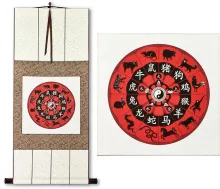
Because you are looking for "animals", you my want to see our Chinese Zodiac / Animal Years page.
Quick links to words on this page...
Check out all the Custom Calligraphy Options
Click on a![]()
to select your calligraphy and start customizing your artwork project...


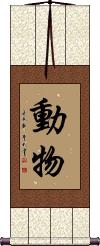
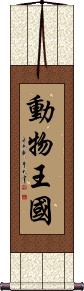
Like animals? These two characters are the way to write "animals" in Chinese characters, Japanese Kanji, and old Korean Hanja.
The first character means "moving" and the second means "things". So animals are "moving things" in these Asian languages.
Score: 100/100


This is literally what it says.
There is even a TV show in China that is similar to Wild Kingdom or what you would currently see on the Discovery Channel that has this same title.
For your information: In the Chinese way of thinking, the Tiger is the king of the animal kingdom (lions are not native to China, so the tiger took the role that we have given to the lion in our western way of thinking).
The Japanese version has a slight variation on the last character. Let me know if your audience is Japanese, and we will have it written in that form for you.
Score: 54/100

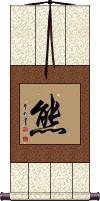
This is the way to write "bear" (as in the animal) in Chinese, Japanese Kanji, and old Korean Hanja. If you are a bear fanatic, this is the wall scroll for you.
This is not specific to species, such as panda bear, polar bear, brown bear, etc.
If you need a more specific title, just post a special Asian calligraphy title request on our forum.
See Also... Panda
Score: 29/100


Separately, the first character here does mean "danger" or "to endanger" and the second character can mean "opportunity".
However, I want to debunk a myth that was propagated by some westerners who did not have a clear understanding of Asian languages...
While often, Chinese/Japanese/Korean compound words (words of two or more characters) are the sum of their parts, this is not always the case. The compound is often understood with a completely different meaning than the two characters individually.
Many have said that the Chinese/Japanese/Korean word for Crisis is made up of the characters for "danger" and "opportunity". This is true when phrased this way.
However, it's not absolutely correct to say that "danger + opportunity = crisis" in Asian cultures.
English example:
If I tell you that...
Bovine creature + Guy behind the plate in baseball = Locomotive protection
...you would think I was mad. But consider that "cow + catcher = cowcatcher", which is the device that used to be found on steam engines to protect them if they hit an animal on the tracks. When we hear the word "cowcatcher" we don't separate the words into their individual meanings (necessarily).
The same is true with the word for crisis in Chinese/Japanese/Korean. While you can separate the characters, few Asian people would automatically do so in their minds.
The final answer:
It is a half-truth to say, "danger plus opportunity equals crisis" in Chinese/Japanese/Korean. Use this statement and concept with caution.
Also, the second character can mean "secret" or "machine" depending on context so I guess you have to say "a dangerous machine = crisis" or "danger + a secret = crisis". Both of these are only slightly more ridiculous than the first premise.
PS: This is probably not a great word for a scroll, unless you have a special use for it.
Score: 14/100


This phase often goes with "An eye for an eye", even in Chinese. Revenge seems to cross all languages, cultures, and even species (animals are known to take revenge too).
If a Chinese person uses just one phrase, it will be this "tooth for a tooth" one. Although, we are more likely to say "eye for an eye" alone in English.
Chinese people may also read this with a meaning of "Bite me and I will bite you back". However, it literally means "tooth for a tooth" or "you take my tooth, I take yours".
Score: 10/100

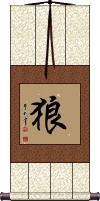
This is the character used to represent the elusive animal known as the wolf in both Chinese and Japanese.
If you are a fan of the wolf, or the wolf means something special to you, this could make a great addition to your wall.
Do keep in mind, that much like our preception of wolves in the history of western culture, eastern cultures do not have a very positive view of wolves (save the scientific community and animal lovers). The wolf is clearly an animal that is misunderstood or feared the world over.
This character is seldom used alone in Korean Hanja, and is used in a compound word that means utter failure (as in a wolf getting into your chicken pen - or an otherwise ferocious failure). Not a good choice if your audience is Korean.
Score: 6/100


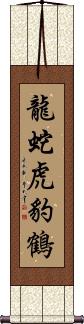
This is a list of the Chinese characters for the five animals of Shaolin Kung Fu in a comfortable order (meaning that they are in the proper order and will simply "feel right" to a Chinese person who views this arrangement).
Score: 10/100
Mandarin: lóng hǔ shé bào hè
Japanese: ryuu tora hebi hyou tsuru
Korean: 룡호사표학


This is a list of the Chinese characters for the five animals of Shaolin Kung Fu in a comfortable order (meaning that they are in the proper order and will simply "feel right" to a Chinese person who views this arrangement).
Score: 10/100


Being tolerant is accepting differences. You don't expect others to think, look, speak or act just like you. You are free of prejudice, knowing that all people have feelings, needs, hopes and dreams. Tolerance is also accepting things you wish were different with patience and flexibility.
These characters can also be translated as magnanimity, generosity, or leniency.
Note: There is a tiny deviation in the first character when written in Japanese. If you choose our Japanese master calligrapher, the little dot on the lower right of the first character will be omitted. With or without the dot, this can be read in Chinese, Japanese, and old Korean.
See Also... Patience
Score: 4/100


This is the title "Naruto" from the Japanese animation series. See Naruto Anime Series.
Because of the special Japanese character set used to write this title, it can only be written by the Japanese master calligrapher. Do not try to order it from one of our Chinese calligraphers.
Please note that while this is the correct title for this anime series, it can also mean the "@" sign or "at" in Japanese under different context (a Japanese person not familiar with the series may be confused by your wall scroll).
Score: 6/100


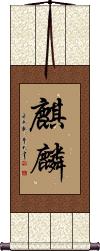
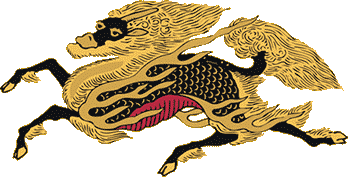
This word is the title of a mythical beast of Asia.
The animal is thought to be related to the giraffe, and in some ways, it is a giraffe. However, it is often depicted with the horns of a dragon or deer and sometimes with the body like a horse, but many variations exist.
In Japanese it is pronounced “Kirin” as in “Kirin Ichiban” beer.
Notes:
1. This is sometimes spelled as “kylin”.
2. In Japanese, this is the only Kanji word for giraffe. Therefore in Japan, this word needs context to know whether you are talking about the mythical creature or the long-necked giraffe of Africa.
3. Apparently, this was the first word used for regular giraffes in China (some were brought from Africa to China during the Ming Dynasty - probably around the year 1400). Though the mythical creature may have existed before, the name “qilin” was given to the “new giraffe”. This is because, more than 600 years ago, giraffes somewhat matched the mythical creature's description when Chinese people saw them for the first time. Later, to avoid such an ambiguous title, a three-character word was devised to mean a “giraffe of Africa”. The characters for “qilin” shown here are only for the mythological version in modern Chinese.
4. More information about the qilin / kirin from Wikipedia.
5. This creature is sometimes translated as the “Chinese Unicorn”, even though it is generally portrayed with two horns. I think this is done more for the fantasy aspect of the unicorn and because most westerners don't know what a qilin or kirin is (this avoids a long explanation by the translator).
6. In Korean, this can mean kirin or simply giraffe (usually the mythological creature is what they would think of when seeing these characters alone on a wall scroll).
Score: 4/100


This is the way to say mankind or humankind in Chinese. It's kind of the "animal title" for human. This is the word you would use if you said this phrase in Chinese, "Mammals include dolphins, monkeys, dogs, and humans among others".
This is a weird selection for a calligraphy wall scroll. But a customer begged me to add this word.
Score: 4/100


Generosity is giving and sharing. You share freely, not with the idea of receiving something in return. You find ways to give others happiness, and give just for the joy of giving. Generosity is one of the best ways to show love and friendship.
This word can also be translated as charitable, magnanimity, liberality or in some context broad-mindedness.
Note: There is a tiny deviation in the first character when written in Japanese. If you choose our Japanese master calligrapher, the little dot on the lower right of the first character will be omitted. With or without the dot, this can be read in Chinese, Japanese, and old Korean.
See Also... Benevolence | Altruism | Charity
Score: 4/100


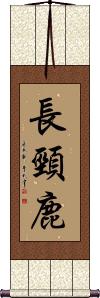
This is the Chinese word for Giraffe (the animal).
Not to be confused with the mythical “kirin” or “qilin” beast.
Score: 4/100


These two characters create a word in Chinese and Japanese that means something like benevolence with magnanimity or kindness with a forgiving nature.
If this describes you, then you are the type of person that I would like to call my friend.
This may not be the most common word in daily use, but it's old enough that it transcended cultures from China to Japan in the 5th century when Japan lacked a written language, and absorbed Chinese characters and words into their language.
Note: This is not commonly-used in Korean.
Score: 4/100


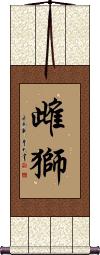
This is how to write "lioness" in Chinese.
Note: This is not a very common title for a wall scroll in China. Perhaps because lions are not indigenous to China. Though oddly enough, rarity of lions made them very prized - and lion dances are a popular festival attraction.
If you do see name of this species of animal written on a wall scroll, it's more likely to be the masculine form of "lion".
Score: 4/100
Samyag Ajiva / Samma Ajiva
Mandarin: zhèng mìng
Japanese: sei myou
Korean: 정명


This is one of the Noble Eightfold Paths of Buddhism. Right Living, along with Right Speech and Right Action constitute the path to Virtue.
Right Living means that a Buddhist should only take a job or pursue a career in a field that does no harm. Buddhists should not work in the arms trade, as pimps or in the field of prostitution, as a butcher or in a shop that kills or sells meat, in a laboratory that does animal research, or any other business that involves scheming or unethical behavior.
Another definition: Avoidance of professions that are harmful to sentient beings, such as slaugterer, hunter, dealer in weaponry or narcotics, etc.
This term is exclusively used by devout Buddhists. It is not a common term, and is remains an unknown concept to most Japanese and Chinese people.
See Also... Buddhism | Enlightenment
Score: 4/100

I will suppose you already know what a tiger is, so how about some trivia: If you look at the Japanese pronunciation, you might remember a movie called "Tora Tora Tora" which was the code word used to initiate the attack on Pearl Harbor. It simply means "Tiger Tiger Tiger".
In Chinese culture, the tiger is considered to be the king of all animals (in much the way we see the lion in western culture).
See Also... Flying Tiger
Score: 10/100


This two-character word of Chinese origin means forgive or forgiveness. This is a deep kind of forgiveness from the bottom of your heart.
In a religious context, this is the kind of forgiveness that you beg God for.
In Korean Hanja, this can also be defined as forbearance or leniency.
In Japanese Kanji, beyond forgiveness, this can also mean magnanimity or generosity.
While we don't actively recommend Asian tattoos, this would be the forgiveness title which is best for a tattoo in most cases.
Note: The first character can also be written in the form shown to the right (especially in Japanese). If you have a preference, please let us know in the "special instructions" when you place your order.
Score: 4/100
Wall scroll artwork shown on this page is priced as follows:
1 character $29.88 each
2-3 characters $39.88 each
4 characters $49.88 each
5-10 characters $59.88 each
After you select your calligraphy, our website will take you through the process of customizing your artwork.
Options for other mounting such as portraits are available for $13 less.
We also offer the services of a famous master calligrapher for a $40 fee on any scroll if you are looking for investment-quality calligraphy.
If you chose our famous master-calligrapher, you also get more choices for silk and paper colors and the option for larger artwork.
All of our calligraphy is completely done by hand in the ancient way.
When the calligrapher finishes creating your artwork, it is taken to our art mounting workshop in Beijing where a wall scroll is made by hand from a combination of silk, rice paper, and wood.
After we create your wall scroll, it takes at least two weeks for air mail delivery from Beijing to you.
Therefore, allow at least 3 weeks for delivery from the time you place your order.
When you select your calligraphy, you'll be taken to another page where you can choose various custom options.
The scroll that I am holding in this picture is a "regular size"
4-character wall scroll.
As you can see, it is a great size to hang on your wall.
(We also offer custom wall scrolls in larger sizes)
Professional calligraphers are getting to be hard to find these days.
Instead of drawing characters by hand, the new generation in China merely type roman letters into their computer keyboards and pick the character that they want from a list that pops up.
There is some fear that true Chinese calligraphy may become a lost art in the coming years. Many art institutes in China are now promoting calligraphy programs in hopes of keeping this unique form
of art alive.
Even with the teachings of a top-ranked calligrapher in China, my calligraphy will never be good enough to sell. I will leave that to the experts.
The same calligrapher who gave me those lessons also attracted a crowd of thousands and a TV crew as he created characters over 6-feet high. He happens to be ranked as one of the top 100 calligraphers in all of China. He is also one of very few that would actually attempt such a feat.
Successful Chinese and Japanese calligraphy searches within the last few hours...If your search is not successful, just post your request on our forum, and we'll be happy to do research or translation for any reasonable request. | ||||||
|
abbey angel anthony balance basil battle believe bliss budo cannot carlos carter cat chen come concentration | cool courage creative creativity danielle derek determination elizabeth enma family fei fight forest forever francisco free | freedom gerald girl glory guardian angel harmony hate heather hidden dragon holy hong honor impermanence in the beginning was the word jacob jennifer | johanna judo kai kevin king kurt learn little live live without regret love luck master matthew mercy mind | music natasha norah only god can judge me patrick philippines pillar renee respect sen sergio sexy sharon shin sister sisters | sky spirit strength tao taylor ting trust virtue wind year of the tiger | |
| With so many searches, we had to upgrade to our own Linux server. Of course, only one in 500 searches results in a purchase - Hey buy a wall scroll!!! | ||||||
The following table is only helpful for those studying Chinese (or Japanese), and perhaps helps search engines to find this page when someone enters Romanized Chinese or Japanese
| Title | Characters Simplified Traditional |
Japanese Romaji (Romanized Japanese) | Various forms of Hanyu-Pinyin (Romanized Chinese) | |||
| Animals | 动物 動物 | doubutsu dobutsu | dòng wù dong wu | dong4 wu4 dongwu | ||
| Animal Kingdom | 动物王国 動物王國 | doubutsu oukoku doubutsuoukoku dobutsu okoku | dòng wù wáng guó dong wu wang guo | dong4 wu4 wang2 guo2 dongwuwangguo | ||
| Bear | 熊 熊 | kuma | xióng xiong | xiong2 xiong | ||
| Crisis equals Danger plus Opportunity? | 危机 危機 | kiki | wēi jī wei ji | wei1 ji1 weiji | ||
| Tooth for a tooth | 以牙还牙 以牙還牙 | n/a | yǐ yá huán yá yi ya huan ya | yi3 ya2 huan2 ya2 yiyahuanya | ||
| Wolf | 狼 狼 | okami | láng lang | lang2 lang | ||
| Dragon Tiger Snake Leopard Crane | 龙虎蛇豹鹤 龍虎蛇豹鶴 | n/a | lóng hǔ shé bào hè long hu she bao he | long2 hu3 she2 bao4 he4 longhushebaohe | ||
| Dragon Tiger Snake Leopard Crane | 龙虎蛇豹鹤 龍虎蛇豹鶴 | ryuu tora hebi hyou tsuru ryuutorahebihyoutsuru ryu tora hebi hyo tsuru | lóng hǔ shé bào hè long hu she bao he | long2 hu3 she2 bao4 he4 longhushebaohe | ||
| Tolerance | 宽容 寬容 | kanyou kanyo | kuān róng kuan rong | kuan1 rong2 kuanrong | ||
| Naruto | ナルト ナルト | na ru to naruto | n/a | |||
| Kirin / Giraffe / Mythical Creature | 麒麟 麒麟 | kirin | qí lǐn qi lin | qi2 lin3 qilin | ||
| Human Race / Humanity / Mankind | 人类 人類 | jinrui | rén lèi ren lei | ren2 lei4 renlei | ||
| Generosity | 宽大 寬大 | kandai | kuān dà kuan da | kuan1 da4 kuanda | ||
| Giraffe | 长颈鹿 長頸鹿 | n/a | zhǎng jǐng lù zhang jing lu | zhang3 jing3 lu4 zhangjinglu | ||
| Kindness and Forgiving Nature | 仁恕 仁恕 | jinjo | rén shù ren shu | ren2 shu4 renshu | ||
| Lioness | 雌狮 雌獅 | n/a | cí shī ci shi | ci2 shi1 cishi | ||
| 5. Right Living / Right Livelihood / Perfect Livelihood | 正命 正命 | sei myou seimyou sei myo | zhèng mìng zheng ming | zheng4 ming4 zhengming | ||
| Tiger | 虎 虎 | tora | hǔ hu | hu3 hu | ||
| Forgive | 宽恕 寬恕 / 寛恕 | kan jo kanjo | kuān shù kuan shu | kuan1 shu4 kuanshu | ||
| If you have not set up your computer to display Chinese, the characters in this table probably look like empty boxes or random text garbage.
This is why we spent hundreds of hours making images so that you could view the characters in the "animals" listings above. If you want your Windows computer to be able to display Chinese characters you can either head to your Regional and Language options in your Win XP control panel, select the [Languages] tab and click on [Install files for East Asian Languages]. This task will ask for your Win XP CD to complete in most cases. If you don't have your Windows XP CD, or are running Windows 98, you can also download/run the simplified Chinese font package installer from Microsoft which works independently with Win 98, ME, 2000, and XP. It's a 2.5MB download, so if you are on dial up, start the download and go make a sandwich. | ||||||
Some people may refer to this entry as Animals Kanji, Animals Characters, Animals in Chinese Writing, Animals in Japanese Writing, Animals in Asian Writing, Animals Ideograms, Chinese Animals symbols, Animals Hieroglyphics, Animals Glyphs, Animals in Chinese Letters, Animals Hanzi, Animals in Japanese Kanji, Animals Pictograms, Animals in the Chinese Written-Language, or Animals in the Japanese Written-Language.
All custom calligraphy items are made-to-order in our little Beijing artwork-mounting workshop.
Normal delivery isjust over 3 weeksfor these handmade items.
Copyright Oriental Outpost 2002-2009 - All Rights Reserved
Image Use Policy | Privacy Policy
This page of animals Chinese calligraphy dictionary search results was generated in 0.625375032425seconds.