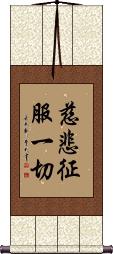
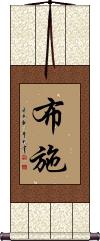
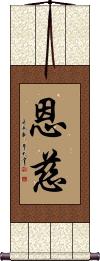
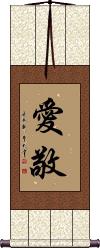
Didn't find what you want?
Try these methods:
1. Make your search more specific.
2. Use other similar-meaning words.
3. Use less words or just one word.
4. Post your request on our forum so that we can translate/create what you want.
We'll build you a handmade custom "Benevolence" calligraphy wall scroll if you wish!
Quick links to words on this page...
Check out all the Custom Calligraphy Options
Click on a![]()
to select your calligraphy and start customizing your artwork project...

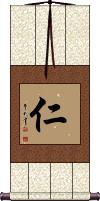
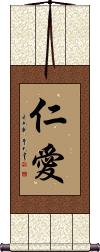
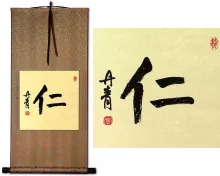
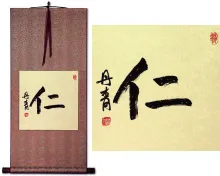
Beyond "benevolence" word can be also be defined as "charity" or "mercy" depending on context.
The meaning suggests that one should pay alms to the poor, care for those in trouble, and take care of his fellow man (or woman).
This is one of the five tenets of Confucius. In fact, it is a subject in which Confucius spent a great deal of time explaining to his disciples.
I have also seen this benevolent-related word translated as perfect virtue, selflessness, love for humanity, humaneness, goodness, good will, or simply "love" in the non-romantic form.
This word is so important to me that I named my second daughter with this character. Her name is "Renni" which means "Benevolent Girl".
-Gary.
This is also a virtue of the Samurai Warrior
See our page with just Code of the Samurai / Bushido here
See Also... Love | Altruism | Kindness | Charity | Brotherhood | Confucius
Score: 100/100


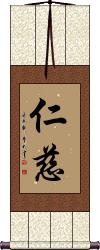
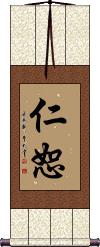
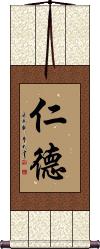
These two characters create a word that can be translated as love, kindheartedness, benevolence and humanity.
The first character means benevolence by itself.
The second character means virtue or morality.
Japanese note: The second Kanji of this word has been slightly simplified (one tiny horizontal stroke removed). It is still readable for Japanese, but if you select our Japanese calligrapher, expect that stroke to be missing on your wall scroll.
Score: 100/100
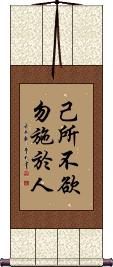
Do not do to others what you
do not want done to yourself
Mandarin: jǐ suǒ bú yù, wù shī yú rén
Korean: 기소불욕물시어인


Some may think of this as a "Christian trait" but actually it transcends many religions.
This Chinese teaching dates back to about 2,500 years ago in China. Confucius had always taught the belief in being benevolent (ren) but this idea was hard to grasp for some of his students, as benevolence could be kind-heartedness, or an essence of humanity itself.
When answering Zhong Gong's question as to what "ren" actually meant, Confucius said:
"When you go out, you should behave as if you were in the presents of a distinguished guest, when people do favors for you, act as if a great sacrifice was made for you. Whatever you wouldn't like done to you, do not do that thing to others. Don't complain at work or at home."
Hearing this, Zhong Gong said humbly, "Although I am not clever, I will do what you say."
From this encounter, the Chinese version of the Golden Rule came to be.
The characters you see above express, "Do not do to others whatever you do not want done to yourself."
See Also... Confucius Teachings
Score: 100/100


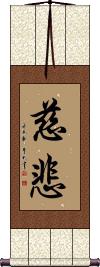
Can also be defined as clemency or lenience and sometimes the act of giving charity.
In Buddhist context, it can mean compassion or benevolence.
Score: 99/100


In Chinese and Korean, this means universal fraternity, brotherhood, or universal love.
In Japanese, this means charity, benevolence, philanthropy, or love for humanity.
Please note these subtle differences and take that into account depending on your intended audience (Chinese, Korean or Japanese).
Score: 92/100


There are a few different words used to express charity in Chinese characters, Japanese Kanji and old Korean Hanja, but this is the most common. Some of the other words describe acts such as "giving alms" etc.
Note: Also considered to be one of the Seven Heavenly Virtues.
If you need a different meaning, just post your request on our Asian calligraphy forum.
Note: Sometimes this is translated as benevolence or benevolent.
See Also... Altruism
Score: 92/100

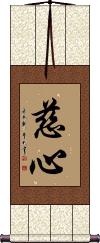
This is the simplest way to express the idea of compassion. It can also mean love for your fellow humans, humanity, or living creatures. Sometimes this is extended to mean charity.
This term is often used with Buddhist or Christian context. The concept was also spoken of by Laozi (Lao Tze) in the Dao De Jing (Tao Te Ching).
This Chinese character is understood in Japanese, but is usually used in compound words (not seen alone). Also used in Korean Hanja, so it's very universal.
See Also... Mercy | Forgiveness | Kindness
Score: 92/100
AKA: Universal Benevolence
Mandarin:
yí shì tóng rén
Japanese:
isshidoujin
Korean: 일시동인


This is how to write "universal benevolence". This is also how to express the idea that you see all people the same.
If you are kind and charitable to all people, this is the best way to state that virtue. It is the essence of being impartial to all mankind, regardless of social standing, background, race, sex, etc. You do not judge others, but rather you see them eye to eye on the same level with you.
See Also... Compassion | Equality | Justice | Right Decision | Selflessness | Work Unselfishly For The Common
Score: 82/100

This character means forgive, show mercy, absolve, or excuse in Chinese and Korean Hanja (though mostly used in compound words in Korean).
This character incorporates the pictogram of a heart at the bottom, and a woman and a mouth at the top. The heart portion has the most significance, as it is suggested that it is the heart's nature to forgive.
In Asian culture, as with most other cultures, forgiveness is an act of benevolence and altruism. In forgiving, you put yourself in someone else's shoes and show them the kindness that you would want them to show you. Confucius referred to this quality as "human-heartedness".
Score: 67/100


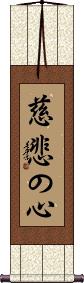
This means benevolent heart, compassionate heart, or merciful heart in Japanese. This is a Japanese only phrase, and should be ordered from our Japanese master calligrapher. This is because the third character is special Hiragana.
Chances are you are into Inuyasha and are seeking the title of chapter 471 which is often translated as "Merciful Heart".
Score: 65/100


This literally means "loving heart". It can also be translated as "compassion".
Specifically in Japanese, this can be defined as a loving heart, a mind full of desire, or a mind dominated by desire.
In Chinese, it carries more of a compassion meaning.
See Also... Compassion | Love
Score: 60/100


This is the specifically Japanese version of Bodhisattva of Compassion or Guan Yin. In Japanese this is pronounced Kannon, and occasionally spelled Kwannon. The Chinese version is a bit more commonly-seen in Asia, but in Japanese, there is a slight variation with the first character.
Some time ago, a camera company in Japan named their company after this Buddhist deity. That camera company is still known as Canon (they chose a "C" instead of a "K" when they Romanized this name).
Score: 60/100


This is the Buddhist deity known as the Goddess of Mercy or Bodhisattva of Compassion. In Chinese, the proper name of this being is Guan Yin. There is some debate as to whether Guan Yin is female. The argument comes from some scripture that suggests Buddhist deities take on male form. Others say that Guan Yin has no sex. And still others are okay with the female representation of Guan Yin.
This bodhisattva is also known or Romanized in the following ways:
Mandarin Chinese: Guan Yin, Kuan Yin, Kwan Yin.
Japanese: Kannon, Kwannon.
Sanskrit: Bodhisattva Avalokitesvara.
Korean: Gwan-eum.
Vietnamese: Quan Âm.
Thai: Kuan Eim.
English: Bodhisattva of Mercy and Salvation, Goddess of Compassion, Buddha of Mercy, et al.
Note: The first character has a slight variation in Japanese. If your audience is specifically Japanese, you may want to select that version.
See Also... Buddhism | Goddess | Namo Amitabha | Bodhisattva
Score: 60/100
This is the long or more formal version of this title
Mandarin: guān shì yīn
Korean: 관세음


This is the longer, and perhaps more formal title for the Buddhist deity known as the Goddess of Mercy or Bodhisattva of Compassion.
The longer title of this bodhisattva is Romanized in the following ways:
Mandarin Chinese: Guanshi Yin, Kuan-shih Yin.
Japanese: Kanzeon.
Sanskrit: Bodhisattva Avalokitesvara.
Korean: Gwan-se-eum.
Vietnamese: Quan Thế Âm.
Thai: Prah Mae Kuan Eim.
English: Bodhisattva of Mercy and Salvation, Goddess of Compassion, Buddha of Mercy, et al.
Please view our more common and shorter version "Guan Yin" before you make a decision. Also note that the first character has a slight variation in Japanese. If your audience is specifically Japanese, you may want to select that version.
See Also... Buddhism | Goddess
Score: 60/100
This is the long or more formal version of this title
Mandarin: quān shì yīn
Japanese: kan ze on


This is the longer and more formal Japanese version of Bodhisattva of Compassion or Guan Yin. In Japanese this is pronounced Kanzeon. The Chinese version is a bit more common in Asia, but in Japanese they use a slight variation of the first character. Choose this version only if your intended audience is specifically Japanese.
Score: 60/100
Also known as the Five Cardinal Rules of Confucius
Mandarin:
rén yì lǐ zhì xìn
Korean: 인의예지신


These are the core of Confucius philosophy. Simply stated they are:
benevolence / charity
justice / rectitude
politeness / tact
wisdom / knowledge
fidelity / trust
Many of these concepts can be found in various religious teachings. Though it should be clearly understood that Confucianism is not a religion, but should instead be considered a moral code for a proper and civilized society.
See Also... Confucius Teachings | Ethics
Score: 57/100


These two characters create a word in Chinese and Japanese that means something like benevolence with magnanimity or kindness with a forgiving nature.
If this describes you, then you are the type of person that I would like to call my friend.
This may not be the most common word in daily use, but it's old enough that it transcended cultures from China to Japan in the 5th century when Japan lacked a written language, and absorbed Chinese characters and words into their language.
Note: This is not commonly-used in Korean.
Score: 57/100

This is the simple way to express the ideas of having virtue, morals, kindness, benevolence, goodness etc. This character also happens to be the first character of the Chinese word for Germany.
There is a slight deviation in the Japanese Kanji form. If you want the modern Japanese version, please click on the special Kanji shown to the right instead of the button above. Note that the traditional Chinese form is still readable and understood by Japanese people.
See Also... Ethics | Chastity | Prudence | Morality
Score: 52/100


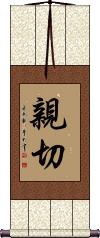
Kindness is showing you care, doing some good to make life better for others. Be thoughtful about people's needs. Show love and compassion to someone who is sad or needs your help. When you are tempted to be cruel, to criticize or tease, decide to be kind instead.
This Chinese / Japanese / Korean word can also mean affectionate, cordial, warmly, or close (emotionally).
Score: 45/100


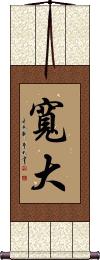
Generosity is giving and sharing. You share freely, not with the idea of receiving something in return. You find ways to give others happiness, and give just for the joy of giving. Generosity is one of the best ways to show love and friendship.
This word can also be translated as charitable, magnanimity, liberality or in some context broad-mindedness.
Note: There is a tiny deviation in the first character when written in Japanese. If you choose our Japanese master calligrapher, the little dot on the lower right of the first character will be omitted. With or without the dot, this can be read in Chinese, Japanese, and old Korean.
See Also... Altruism | Charity
Score: 45/100


Caring is giving love and attention to people and things that matter to you and anyone who is in need of help. When you care about people, you help them. You do a careful job, giving your very best effort. You treat people and things gently and respectfully. Caring makes the world a safer place.
This means caring in Chinese, and is also a word in Korean Hanja, but with more of a flavor or "taking an interest" and "concern".
Note, this is also a word in Korean Hanja, but in Korean, it means taking interest or concern. In Korean it's still a good word, but it doesn't quite have the "caring for a person" meaning that it does in Chinese.
Score: 45/100


This is the kind of forgiveness that a king might give to his subjects for crimes or wrong-doings. This is a rather high-level forgiveness. Meaning that it goes from a higher level to lower (not the reverse).
Alone, first character can mean "to bear", "to allow" and/or "to tolerate", and the second can mean "to forgive", "to pardon" and/or "to excuse".
Score: 45/100


Helpfulness is being of service to others, doing thoughtful things that make a difference in their lives. Offer your help without waiting to be asked. Ask for help when you need it. When we help each other, we get more done. We make our lives easier.
Score: 45/100

This is a very universal character. It means love in Chinese, Japanese Kanji, old Korean Hanja, and old Vietnamese.
This is one of the most recognized Asian symbols in the west, and is often seen on tee-shirts, coffee mugs, tattoos, and more.
This character can also be defined as affection, to be fond of, to like, or to be keen on. It often refers to romantic love, and is found in phrases like, "I love you". But in Chinese, one can say, "I love that movie" using this character as well.
It's very common for couples to say "I love you" in Chinese. However, in Japanese, "love" is not a term used very often. In fact, a person is more likely to say "I like you" rather than "I love you" in Japanese. So this word is well-known, but seldom spoken.
More about this character:
This may be hard to imagine as a westerner, but the strokes at the top of this love character symbolize family & marriage.
The symbol in the middle is a little easier to identify. It is the character for "heart" (it can also mean "mind" or "soul"). I guess you can say that no matter if you are from the East or the West, you must put your heart into your love.
The strokes at the bottom create a modified character that means "friend" or "friendship".
I suppose you could say that the full meaning of this love character is to love your family, spouse, and friends with all of your heart, since all three elements exist in this character.
See Also... I Love You | Caring | Friendliness | Double Happiness Happy Marriage Wall Scroll
Score: 45/100


This is the deepest way to say "Heaven's Grace" or "God's Grace" in Chinese characters and Japanese Kanji.
The first character means Heaven or sky (referring in this case to the domain of God).
The second character means grace, blessings, benevolence, favor / favour, acts of kindness, merits, or beneficial influence.
This title can also be defined as:
Blessings of Heaven, Favor of the Emperor, Divination's luckiest day, or blessings of nature. Note: When you see "Emperor" above, keep in mind that the Emperor, like the Pope is theoretically chosen by God, or seen as an emissary or conduit of God in ancient Asian culture. It would only be read that way in certain context such as, "The Emperor, in his mercy, bestowed upon him Heaven's Grace and the prisoner was set free".
Score: 35/100
-or- The crafty rabbit has three different entrances to its lair
Mandarin:
jiǎo tù sān kū


This speaks to the cunning character of a sly rabbit. Such a rabbit will not have just one hole, but rather a few entrances and exits from his liar.
About 2,250 years ago a very rich man told his assistant to go and buy something wonderful that he did not yet posses. He was a man that already had everything, so the assistant went to a local village that owed a great deal of money to the rich man. The assistant told the village elders that all debts were forgiven. All the villagers rejoiced and praised the rich man's name. The assistant returned to the rich man and told him he had purchased "benevolence" for him. The rich man was mildly amused, but perhaps a bit confused by the action.
Some time later, the rich man fell from the favor of the Emperor, and was wiped out without a penny to his name. One day he was walking aimlessly and stumbled into the village in which the debts had been forgiven. The villagers recognized the man and welcomed him with open arms, clothed, fed, and gave him a place to live.
Without trying, the man had become like the sly and cunning rabbit. When his exit was blocked, he had another hole to emerge from - and was reborn. This story and idiom comes from a book titled "The Amendment" - it's unclear whether this man actually existed or not. But the book did propel this idiom into common use in China.
Still today this idiom about the rabbit is used in China when suggesting "backup plans" alternate methods, and anyone with a good escape plan.
Score: 20/100
Mandarin: yī yuē cí èr yuē jiǎn sān yuē bù gǎn wéi tiān xià xiān


Characters shown
above are read
vertically, starting
from the right
This is an except from the 67th Chapter of Lao Tzu's (Lao Zi's) Te-Tao Ching (Dao De Jing). This is the part where the three treasures are discussed. In English, we'd say these three treasures are compassion, frugality, and humility. Some may translate these as love, moderation, and lack of arrogance. I have also seen them translated as benevolence, modesty, and "Not presuming to be at the forefront in the world". You can mix them up the way you want, as translation is not really a science but rather an art.
I should also explain that the first two treasures are single-character ideas, yet the third treasure was written out in six characters (there are also some auxiliary characters to number the treasures).
If Lao Tzu's words are important to you, then a wall scroll with this passage might make a great addition to your home.
Score: 20/100
Mandarin: dǎ pà de rén shì jiǎ de jìng pà de rén shì zhēn de


Characters shown
above are read
vertically, starting
from the right
This is a proverb that seems to be aimed at world leaders or others in power. Perhaps a suggestion to avoid the practice of "fear mongering" opting instead for a policy of benevolence and justice.
An example: When the Bush administration told Pakistan they could either join America in the "war on terror", or expect some bombs to be coming their way, Bush gained this kind of "less-than-genuine respect" from Pakistanis.
Leaders in places like North Korea and even Saudi Arabia reap the same bogus respect from their own citizens.
Note that calligraphers do not like to repeat the same characters in exactly the same way in the same piece of artwork. So expect the characters that are repeated to be written in different forms in the real artwork (unlike the way they are displayed to the left).
Score: 20/100

This word means goodness, virtue, good deed, charitable, benevolent, well-disposed, nice, pleasant, kind, or simply, "good".
This is the kind of good that applies to someone's good character, or a good person in general.
Referring to someone with this word means that they have a well-aimed moral compass, are charitable, giving, wise, and honest. Basically this is a blanket statement for every good trait a human can have, or all the things that makes someone good.
In other context, it can mean to improve or perfect something or refer to someone who is good at something.
Score: 14/100

This is often translated as "kind act from above", as in "The Grace of God". This doesn't necessarily have to come from God. It could be a favor paid to you, or help that you received (or gave). Of course, you can decide for yourself whether the grace or favor given to you by a friend is actually a gift from God.
Other possible translations of this character:
Favor / favour, acts of kindness, merits, beneficial Influence, kindness, indebtedness, obligation, and benevolent influence.
Score: 14/100
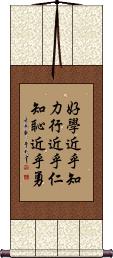
Qoute from Confucius
Mandarin: zhì yú dào jù yú dé yī yú rén yóu yú yì


Characters shown
above are read
vertically, starting
from the right
This quote from the Analects of Confucius translates as:
Resolve yourself in the Dao/Tao/Way.
Rely on Virtue.
Reside in benevolence.
Revel in the arts.
According to Confucius, these are the tenets of good and proper conduct.
This was written over 2500 years ago. The composition is in ancient Chinese grammar and phrasing. A modern Chinese person would need a background in Chinese literature to understand this without aid of a reference.
Score: 10/100
Mandarin: dào tiān dì jiàng fǎ
Japanese: dou ten chi shou hou
Korean: 도천지장법


The first chapter of Sun Tzu's Art of War lists five key points to analyzing your situation. Sun Tzu says that to sharpen your skills, you must plan. To plan well, you must know your situation. Therefore, you must consider and discuss the following:
1. Philosophy and Politics: Make sure your way or your policy is agreeable among all of your troops (and the citizens of your kingdom as well). For when your soldiers believe in you and your way, they will follow you to their deaths without hesitation, and will not question your orders.
2. Heaven/Sky: Consider climate / weather. This can also mean to consider whether God is smiling on you. In the modern military, this could be waiting for clear skies so that you can have air support for an amphibious landing.
3. Ground/Earth: Consider the terrain in which the battle will take place. This includes analyzing defensible positions, exit routes, and using varying elevation to your advantage. When you plan an ambush, you must know your terrain, and the best location from which to stage that ambush. This knowledge will also help you avoid being ambushed, as you will know where the likely places in which to expect an ambush from your enemy.
4. Leadership: This applies to you as the general, and also to your lieutenants. A leader should be smart and be able to develop good strategies. Leaders should keep their word, and if they break a promise, they should punish themselves as harshly as they would punish subordinates. Leaders should be benevolent to their troops, with almost a fatherly love for them. Leaders must have the ability to make brave and fast decisions. Leaders must have steadfast principles.
5. [Military] Methods: This can also mean laws, rules, principles, model, or system. You must have an efficient organization in place to manage both your troops and supplies. In the modern military, this would be a combination of how your unit is organized, and your SOP (Standard Operating Procedure).
Notes: This is a simplistic translation and explanation. Much more is suggested in the actual text of the Art of War (Bing Fa). It would take a lot of study to master all of these aspects. In fact, these five characters can be compared to the modern military acronyms such as BAMCIS or SMEAC.
CJK notes: I have included the Japanese and Korean pronunciations, but in Chinese, Korean and Japanese, this does not make a typical phrase (with subject, verb and object) it is a list that only someone familiar with Sun Tzu's writings would understand.
Score: 3/100
Wall scroll artwork shown on this page is priced as follows:
1 character $29.88 each
2-3 characters $39.88 each
4 characters $49.88 each
5-10 characters $59.88 each
11 or more characters $69.88 each
After you select your calligraphy, our website will take you through the process of customizing your artwork.
Options for other mounting such as portraits are available for $13 less.
We also offer the services of a famous master calligrapher for a $40 fee on any scroll if you are looking for investment-quality calligraphy.
If you chose our famous master-calligrapher, you also get more choices for silk and paper colors and the option for larger artwork.
All of our calligraphy is completely done by hand in the ancient way.
When the calligrapher finishes creating your artwork, it is taken to our art mounting workshop in Beijing where a wall scroll is made by hand from a combination of silk, rice paper, and wood.
After we create your wall scroll, it takes at least two weeks for air mail delivery from Beijing to you.
Therefore, allow at least 3 weeks for delivery from the time you place your order.
When you select your calligraphy, you'll be taken to another page where you can choose various custom options.
The scroll that I am holding in this picture is a "regular size"
4-character wall scroll.
As you can see, it is a great size to hang on your wall.
(We also offer custom wall scrolls in larger sizes)
Professional calligraphers are getting to be hard to find these days.
Instead of drawing characters by hand, the new generation in China merely type roman letters into their computer keyboards and pick the character that they want from a list that pops up.
There is some fear that true Chinese calligraphy may become a lost art in the coming years. Many art institutes in China are now promoting calligraphy programs in hopes of keeping this unique form
of art alive.
Even with the teachings of a top-ranked calligrapher in China, my calligraphy will never be good enough to sell. I will leave that to the experts.
The same calligrapher who gave me those lessons also attracted a crowd of thousands and a TV crew as he created characters over 6-feet high. He happens to be ranked as one of the top 100 calligraphers in all of China. He is also one of very few that would actually attempt such a feat.
Successful Chinese and Japanese calligraphy searches within the last few hours...If your search is not successful, just post your request on our forum, and we'll be happy to do research or translation for any reasonable request. | ||||||
|
abbey alison angel angelica anthony barry basil battle believe best bliss cannot carlos carter | cesar come cool courage creative creativity danielle diana enma family fight forest francisco free | freedom gerald glory grace guardian angel harmony hell hidden dragon holy honor impermanence in the beginning was the word jacob jason | jeff johanna john judo jujitsu learn leo life live love loyalty luck marion master | matthew mercy mind ninja norah only god can judge me peace philippines prosperity respect rose rosy sen sergio | sexy shin sister sisters strength success sun taylor unity virtue wind | |
| With so many searches, we had to upgrade to our own Linux server. Of course, only one in 500 searches results in a purchase - Hey buy a wall scroll!!! | ||||||
The following table is only helpful for those studying Chinese (or Japanese), and perhaps helps search engines to find this page when someone enters Romanized Chinese or Japanese
| Title | Characters Simplified Traditional |
Japanese Romaji (Romanized Japanese) | Various forms of Hanyu-Pinyin (Romanized Chinese) | |||
| Benevolence | 仁 仁 | jin | rén ren | ren2 ren | ||
| Kindheartedness / Benevolence / Humanity | 仁德 仁德 | jintoku | rén dé ren de | ren2 de2 rende | ||
| Confucius: Golden Rule | 己所不欲勿施于人 己所不欲勿施於人 | n/a | jǐ suǒ bú yù, wù shī yú rén ji suo bu yu, wu shi yu ren | ji3 suo3 bu2 yu4, wu4 shi1 yu2 ren2 jisuobuyu,wushiyuren | ||
| Mercy / Buddhist Compassion | 慈悲 慈悲 | jihi | cí bēi ci bei | ci2 bei1 cibei | ||
| Love for Humanity | 博爱 博愛 | hakuai | bó ài bo ai | bo2 ai4 boai | ||
| Charity | 慈善 慈善 | jizen | cí shàn ci shan | ci2 shan4 cishan | ||
| Mercy / Compassion / Love | 慈 慈 | ji | cí ci | ci2 ci | ||
| Impartial and Fair to the Brotherhood and Sisterhood of the World | 一视同仁 一視同仁 | isshidoujin ishidojin | yí shì tóng rén yi shi tong ren | yi2 shi4 tong2 ren2 yishitongren | ||
| Forgiveness | 恕 恕 | n/a | shù shu | shu4 shu | ||
| Benevolent Heart | 慈悲の心 慈悲の心 | ji hi no kokoro jihinokokoro | n/a | |||
| Loving Heart / Compassion | 爱心 愛心 | ai shin aishin | ài xīn ai xin | ai4 xin1 aixin | ||
| Goddess of Compassion (Japanese) | 観音 観音 | kan non kannon | quān yīn quan yin | quan1 yin1 quanyin | ||
| Goddess of Mercy and Compassion | 观音 觀音 / 観音 | kan non kannon | guān yīn guan yin | guan1 yin1 guanyin | ||
| Goddess of Mercy and Compassion | 观世音 觀世音 | n/a | guān shì yīn guan shi yin | guan1 shi4 yin1 guanshiyin | ||
| Goddess of Compassion (Japanese) | 観世音 観世音 | kan ze on kanzeon | quān shì yīn quan shi yin | quan1 shi4 yin1 quanshiyin | ||
| The Five Tenets of Confucius | 仁义礼智信 仁義禮智信 | n/a | rén yì lǐ zhì xìn ren yi li zhi xin | ren2 yi4 li3 zhi4 xin4 renyilizhixin | ||
| Kindness and Forgiving Nature | 仁恕 仁恕 | jinjo | rén shù ren shu | ren2 shu4 renshu | ||
| Moral and Virtuous | 徳 德 | toku | dé de | de2 de | ||
| Kindness | 亲切 親切 | shin setsu shinsetsu | qīn qiè qin qie | qin1 qie4 qinqie | ||
| Generosity | 宽大 寬大 | kandai | kuān dà kuan da | kuan1 da4 kuanda | ||
| Caring | 关心 關心 | n/a | guān xīn guan xin | guan1 xin1 guanxin | ||
| Forgiveness (from the top down) | 容赦 容赦 | you sha yousha yo sha | róng shè rong she | rong2 she4 rongshe | ||
| Helpfulness | 乐于助人 樂於助人 | n/a | lè yú zhù rén le yu zhu ren | le4 yu2 zhu4 ren2 leyuzhuren | ||
| Love | 爱 愛 | ai | ài ai | ai4 ai | ||
| Grace from Heaven / Grace from God | 天恩 天恩 | ten on tenon | tiān ēn tian en | tian1 en1 tianen | ||
| A sly rabbit has three openings to its den | 狡兔三窟 狡兔三窟 | n/a | jiǎo tù sān kū jiao tu san ku | jiao3 tu4 san1 ku1 jiaotusanku | ||
| Daodejing / Tao Te Ching - Except from Chapter 67 | 一曰慈二曰俭三曰不敢为天下先 一曰慈二曰儉三曰不敢為天下先 | n/a | yī yuē cí èr yuē jiǎn sān yuē bù gǎn wéi tiān xià xiān yi yue ci er yue jian san yue bu gan wei tian xia xian | yi1 yue1 ci2 er4 yue1 jian3 san1 yue1 bu4 gan3 wei2 tian1 xia4 xian1 | ||
| Respect out of fear is never genuine Reverence out of respect is never false | 打怕的人是假的敬怕的人是真的 打怕的人是假的敬怕的人是真的 | n/a | dǎ pà de rén shì jiǎ de jìng pà de rén shì zhēn de da pa de ren shi jia de jing pa de ren shi zhen de | da3 pa4 de ren2 shi4 jia3 de jing4 pa4 de ren2 shi4 zhen1 de | ||
| Goodness / Good Deed | 善 善 | zen | shàn shan | shan4 shan | ||
| Grace | 恩 恩 | on | ēn en | en1 en | ||
| The Foundation of Good Conduct | 志于道据于德依于仁游于艺 誌于道據于德依于仁遊于藝 | n/a | zhì yú dào jù yú dé yī yú rén yóu yú yì zhi yu dao ju yu de yi yu ren you yu yi | zhi4 yu2 dao4 ju4 yu2 de2 yi1 yu2 ren2 you2 yu2 yi4 | ||
| Art of War: 5 Points of Analysis | 道天地将法 道天地將法 | dou ten chi shou hou doutenchishouhou do ten chi sho ho | dào tiān dì jiàng fǎ dao tian di jiang fa | dao4 tian1 di4 jiang4 fa3 daotiandijiangfa | ||
| If you have not set up your computer to display Chinese, the characters in this table probably look like empty boxes or random text garbage.
This is why we spent hundreds of hours making images so that you could view the characters in the "benevolence" listings above. If you want your Windows computer to be able to display Chinese characters you can either head to your Regional and Language options in your Win XP control panel, select the [Languages] tab and click on [Install files for East Asian Languages]. This task will ask for your Win XP CD to complete in most cases. If you don't have your Windows XP CD, or are running Windows 98, you can also download/run the simplified Chinese font package installer from Microsoft which works independently with Win 98, ME, 2000, and XP. It's a 2.5MB download, so if you are on dial up, start the download and go make a sandwich. | ||||||
Some people may refer to this entry as Benevolence Kanji, Benevolence Characters, Benevolence in Chinese Writing, Benevolence in Japanese Writing, Benevolence in Asian Writing, Benevolence Ideograms, Chinese Benevolence symbols, Benevolence Hieroglyphics, Benevolence Glyphs, Benevolence in Chinese Letters, Benevolence Hanzi, Benevolence in Japanese Kanji, Benevolence Pictograms, Benevolence in the Chinese Written-Language, or Benevolence in the Japanese Written-Language.
All custom calligraphy items are made-to-order in our little Beijing artwork-mounting workshop.
Normal delivery isjust over 3 weeksfor these handmade items.
Copyright Oriental Outpost 2002-2009 - All Rights Reserved
Image Use Policy | Privacy Policy
This page of benevolence Chinese calligraphy dictionary search results was generated in 0.724221944809seconds.