Artwork
Search:

Exact
Phrase

Oriental Outpost LogoFlagTowerwatercolor
Chinese Calligraphy Search
ArtPaintingsAsian Art Gallery

Adventures in Asian Art

Didn't find what you want?
Try these methods:

1. Make your search more specific.
2. Use other similar-meaning words.
3. Use less words or just one word.
4. Post your request on our forum so that we can translate/create what you want.


Selections for Body in Chinese and/or Japanese...

We'll build you a handmade custom "Body" calligraphy wall scroll if you wish!


Quick links to words on this page...


Select

Body

Mandarin: shēn
Japanese: mi
Korean:

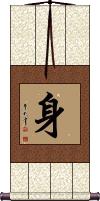
身

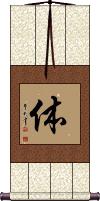
This is how to write "body" as in your human body, in Chinese, Japanese Kanji, and Korean Hanja. Depending on context and certain language issues, this character can also mean: main part, hull, oneself, somebody, person, I, me, sword, lifetime, one's station in life, etc.

While this written word is universal in three languages, it still makes a rather odd selection for a wall scroll.

Score: 100/100

Select

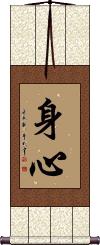
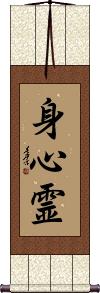
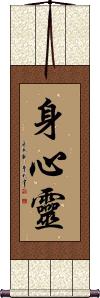
Mind, Body and Spirit

Mandarin: shēn xīn líng
Japanese: mi shin rei
Korean: 신심령

身
心
靈

This is probably the best way to express the idea of "Body, Mind and Spirit" in Chinese and old Korean Hanja. We are actually using the word for "heart" here because for thousands of years, the heart was thought to be the place where your thoughts, feelings and emotions came from. We do something similar in the west when we say "warm-hearted" or "I love you with all of my heart". In this context, heart = mind in Asian language and culture.

The very literal translation of these three characters is "body, heart & spirit" which could also be interpreted as "body mind & soul".

We have arranged these characters in this order because it simply "feels" like the proper order in the Chinese language. Word lists like this are not so common for calligraphy artwork, so we have to be careful to put them in the most natural order. It should be noted that this is not a common title in Asia, nor is it considered an actual phrase (as it lacks a clear subject, verb, and object).

In Japanese Kanji, they use an alternate form of the character for soul or spirit. If you want this using the Japanese alternate, please click on the Kanji shown to the right instead of the button above.

Japanese disclaimer: This title has been checked by our Chinese and Korean translators, but has not been reviewed by a Japanese translator. If you are the first to order this in Japanese, it will be reviewed and adjusted if necessary by the Japanese master calligrapher.

Score: 100/100

Select

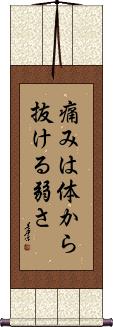
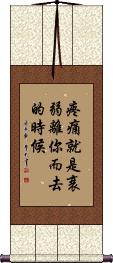
Pain is Weakness Leaving the Body

Mandarin: téng tòng jiù shì shuāi ruò lí nǐ ér qù de shí hòu

而
去
的
時
候
衰
弱
離
你
疼
痛
就
是


Characters shown
above are read
vertically, starting
from the right

I remember this being shouted a lot during U.S. Marine Corps boot camp. This is how to write that phrase in Chinese. At least, this is as close as we could compose/translate it, and hold the full original meaning and connotations.

The version shown here is really, "Pain is weakness leaving your body". Although, it's said in English both ways (the or your), it works better in Chinese with "your".

Score: 100/100

Select

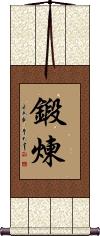
Exercise (for body or mind)

Mandarin: duàn liàn
Korean: 단련

鍛
煉

This means exercise in much the same way we use exercise in English. This can be exercising your body at the gym, or exercising your mind in studies. Most of the time, this refers to physical exercise.

This can also be translated as to temper, to toughen, to train, to drill, to forge, or simply discipline.

Score: 100/100

Select

Ocean

Japanese / Korean

Mandarin: dà yáng
Japanese: tai you
Korean: 대양

大
洋

This is the Japanese Kanji, and old Korean Hanja word for ocean. This also means ocean in Chinese, but it's not a commonly-used term.

The first character means "big" or "great".
The second means "ocean" or "body of water" (it can sometimes mean "foreign" but not in this case).
The first character designates that you are talking about a great or huge body of water (certainly a major ocean and not a smaller sea).

Score: 30/100

Select

Kempo Karate / Law of the Fist Empty Hand

Mandarin: quán fǎ kōng shǒu
Japanese: ken pou kara te

拳
法
空
手

The first two characters mean "fist law" which is Romanized from Japanese as "Kenpo" or "Kempo".

The last two express "karate" - technically they express "empty hand". That "empty hand" translation can be understood better when you grasp the idea that karate is a martial art without weapons (other than the weapons organic to your body, such as your foot, hand, fist, etc). When you practice karate, you do so with empty hands (no weapons).

Note: There is also an antiquated way to write karate. It has the same pronunciation but a different first character which means "Tang" as in the Tang Dynasty. Some dojos use that form - let us know if you need that alternate form, and we'll add it for you.

Score: 20/100

Select

Sacrifice

(complete bodily devotion)

Mandarin: xiàn shēn
Korean: 헌신

獻
身

This means sacrifice in Chinese. This kind of means that you are so devoted to something that you will make sacrifices for that goal/thing/person. Some will also translate this word as, "commit ones energy to", "devote to", or even, "giving your whole body to".

Score: 10/100

Back to the top of this page

Select

pain

ache / sorrow

Mandarin: tòng
Japanese: tsuu / ita
Korean:

痛

This word means pain in Chinese and old Korean Hanja. It also means pain/hurt/bruise in Japanese, but is seldom seen as a single Kanji (usually at least a Hiragana is added to make the word "itai" which is what a Japanese person will scream when they are in pain).

Depending on context, this word can mean hurt, ache, sorrow, or refer to damage to a human body. As a single character, the possible meanings are very open - so you can decide what it means to you, as long as the general meaning is still "painful".

See Also...  Hurt

Score: 10/100

Select

Namaste - Greeting

Mandarin: hé shí

合
十

The word namaste comes from Sanskrit and is a common greeting in the Hindi and Nepali languages exchanged by devout Hindu or Buddhist people in Southern Asia (especially India).

Here you can see the Chinese form of this word which is used describe a Buddhist (or Hindu) greeting with palms closed together in a prayerful manner, generally at chest level. However, this selection of characters describes the act, and is not a word spoken during the greeting. In fact, words or a greeting is seldom spoken when two Chinese Buddhists meet. The greeting is silent, and respectful, but composed completely of body language.

Note that the greeting namaste as well as the act of placing palms together are used both as a hello and goodbye (kind of like the word aloha in Hawaiian).

If you are looking for a welcoming hello and goodbye, you may want to consider gassho or a simple welcome.

Score: 10/100

Select

Karate

Mandarin: táng shǒu
Japanese: kara te

唐
手

This is a very seldom-used title for Karate. This title uses a character which represents the Tang Dynasty of China. Thus, this is often translated as the "Tang Hand" or incorrectly, "Tang Fist". I have also seen some call it "China Hand".

There is not a lot of information on this title, but some believe that a simplified form of Kung Fu that started in China, and ended up very popular in Japan used this title initially. It was later changed in Japan to a different Karate title which means "Empty Hand" (as in, without weapons).

I am sure that some will suggest a different history or argue a different origin. I think that nobody can be sure.

Note: Just like the more conventional Karate title, this one can have the "way" or "method" character added to the end, as in Karate-Do.

Score: 6/100

Back to the top of this page

Select

Brotherly and Sisterly Love

Mandarin: shǒu zú qíng

手
足
情

This is the love between siblings. When you love, protect, care for, and have a deep bond that only brothers or sisters can.

The actual translation is "Hand and Foot" but it is said the relationship between brothers or sisters is like that of hands and feet. They belong together, and complete the body. Even though this says "hand and foot", it will always be read with the brotherly and sisterly love meaning in Chinese.

Note: During the past 20 years, the "One child policy" in China is slowly making this term obsolete.

Score: 10/100

Select

Healthy Living

Mandarin: jiàn kāng shēng huó
Japanese: kenkou seikatsu
Korean: 건강생활

健
康
生
活

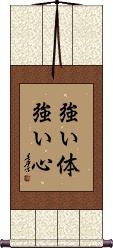
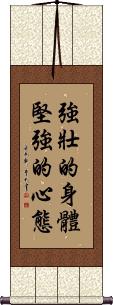
If you are into healthy living, this might be a great selection for a wall scroll to hang in your home. The first two characters speak of health, vitality, vigor and being of sound body. The second two mean living or life (daily existence).

See Also...  Strength | Vitality | Health

Score: 10/100

Select

Hello / How are you?

Mandarin: nǐ hǎo

你
好

This is the day to day way to say hello in Chinese. The characters literally mean, "You good?". It's sort of the equivalent of "What's up?" in English, where nobody expects an actual answer.

This explanation is here for educational purposes only. This is an oral word which is not appropriate for a scroll (not a bad meaning, just very odd for a wall scroll).

Score: 6/100

Back to the top of this page

Select

Fear No Man / Fear Nothing

Mandarin: wú suǒ wèi jù
Korean: 무소외구

無
所
畏
懼

This literally means "fear nothing", but it's the closest thing in Chinese to the phrase "fear no man" which many of you have requested. This would also be the way to say "fear nobody".

Score: 6/100

Select

Dance (Japanese only)

Japanese: buyou
Korean: 무용

舞
踊

This is the most proper term for dance or dancing in Japanese.

The first Kanji means "dance", and the second means to jump or leap. Together, they are just a strong way to say "dance" (the second Kanji just clarifies the first - nobody will translate this as "dance jumping").

Score: 6/100

Select

Example is Better than Precept

Mandarin:
shēn jiào shèng yú yán jiào

於
言
教
身
教
勝


Characters shown
above are read
vertically, starting
from the right

Tell somebody how to do something and they might get it.
Show them how to do it and they will master it in no time.

This can also be translated as "Behavior teaches more than words".

See Also...  Wisdom

Score: 6/100

Back to the top of this page

Select

Double Happiness

(Happy wedding and marriage)

Mandarin:

囍

This is a common gift for Chinese couples getting married or newly married couples, but it appropriate for anyone for whom you wish the greatest of happiness.

As we say in the west, "Two heads are better than one" Well, in the east, two "happinesses" are certainly better than one.

This is not really a character that is pronounced very often - it's almost exclusively used in written form. However, if pressed, most Chinese people will pronounce this "shuang xi" (double happy) although literally there are two "xi" characters combined in this calligraphy (but nobody will say "xi xi").

Double Happiness Portrait Red If you select this character, I strongly suggest the festive bright red paper for your calligraphy. Part of my suggestion comes from the fact that red is a good luck color in China, and this will add to the sentiment that you wish to convey with this scroll to the happy couple.
See our full Double Happiness web page here

Score: 6/100

Select

Honest and Loyal Reputation

Mandarin: xìn yì
Japanese: shingi
Korean: 신의

信
義

In Chinese, this is a word that is used to describe a person with an honest and loyal reputation. Or basically, somebody you can trust.

In Korean, this word means fidelity, truthfulness, or faithfulness.
In Japanese: faith, fidelity and loyalty.

Score: 6/100

Select

Katana

Japanese Samurai Sword

Mandarin: dāo
Japanese: katana
Korean:

刀

This is the Japanese Kanji for "sword". This refers to the style of sword carried by warriors, samurai, and shogun of ancient Japan.

With the pacification of Japan, such swords are now only used for ceremony and decoration. The true art of sword-smithing is all but lost in Japan with new sword production dedicated to making inexpensive replicas for the tourist and foreign market.

For those of you that want to ask whether I can get you a real antique sword. Let me tell you that most real Asian swords were melted down after WWII in Japan, and during the Great Leap Forward in China. Any remaining swords are family heirlooms that nobody will part with.

Please carefully note that the Japanese kanji character shown above is only for a Japanese audience. In China, this character means "knife". See our other entry for "sword" in Chinese.
Note: This can mean knife, sword, or blade in Korean, depending on context.

See Also...  Sword

Score: 6/100

Back to the top of this page

Select

Kung Fu / Gong Fu

Mandarin: gōng fu
Japanese: kanfu

功
夫

One of the most famous types of martial arts in the world - and not just because of Bruce Lee.

Some translate the meaning as "Accomplishment by Great Effort". I think this is partially true, but directly translated it literally means "Merit/Achievement/Accomplishment Man". The word "fu" can sometimes mean "husband" or "porter", but in this case, it can only mean "man". However, few in China will think "man" when they hear the word "Gong Fu" spoken.

This term is also used for things other than martial arts. In fact, it's used to refer to a person with excellent skills in crafts that require a great deal of effort such as cooking, tea ceremonies, and calligraphy.

What a lot of people don't know is that the spelling of "Kung Fu" was actually taken from the old Wade Giles form of Romanization. Using this method, the sounds of the English "G" and "K" were both written as "K" and an apostrophe after the "K" told you whether it was supposed to sound like a "G" or not. Nobody in the west knew this rule, so most people pronounce it with a "K-sound". And so Gong Fu will always be Kung Fu for most westerners.

Also, just to educate you a little more, the "O" in "Gong" has a sound like the English word "oh".

The popular Chinese dish "Kung Pao Chicken" suffers from the same problem. It should actually be "Gong Bao Chicken".

Historical note: Many will claim that Kung Fu was invented by the monks of the Shaolin monastery. This fact is argued in both directions by scholars of Chinese history. Perhaps it is more accurate to say that the Shaolin Monks brought the original fame to Kung Fu many generations ago.

Japanese note: While this does mean Jung Fu in Japanese, in most cases, Japanese will use Katakana to approximate the pronunciation of "Kung Fu". However, virtually any Japanese person who is into martial arts will recognize and understand these characters.

Score: 6/100

Select

Kirin / Giraffe / Mythical Creature

Mandarin: qí lǐn
Cantonese: keilun
Japanese: kirin
Korean: 기린

麒
麟

This word is the title of a mythical beast of Asia.

The animal is thought to be related to the giraffe, and in some ways, it is a giraffe. However, it is often depicted with the horns of a dragon or deer and sometimes with the body like a horse, but many variations exist.

In Japanese it is pronounced “Kirin” as in “Kirin Ichiban” beer.

Kirin - Mythical Beast and Great Japanese Beer!
Notes:

1. This is sometimes spelled as “kylin”.

2. In Japanese, this is the only Kanji word for giraffe. Therefore in Japan, this word needs context to know whether you are talking about the mythical creature or the long-necked giraffe of Africa.

3. Apparently, this was the first word used for regular giraffes in China (some were brought from Africa to China during the Ming Dynasty - probably around the year 1400). Though the mythical creature may have existed before, the name “qilin” was given to the “new giraffe”. This is because, more than 600 years ago, giraffes somewhat matched the mythical creature's description when Chinese people saw them for the first time. Later, to avoid such an ambiguous title, a three-character word was devised to mean a “giraffe of Africa”. The characters for “qilin” shown here are only for the mythological version in modern Chinese.

4. More information about the qilin / kirin from Wikipedia.

5. This creature is sometimes translated as the “Chinese Unicorn”, even though it is generally portrayed with two horns. I think this is done more for the fantasy aspect of the unicorn and because most westerners don't know what a qilin or kirin is (this avoids a long explanation by the translator).

6. In Korean, this can mean kirin or simply giraffe (usually the mythological creature is what they would think of when seeing these characters alone on a wall scroll).

Score: 10/100

Select

Homosexual / Gay (Chinese)

Mandarin: tóng xìng liàn

同
性
戀

A great way to tell your Chinese friends about your lifestyle, while keeping your Anglo friends in the dark.

Kind of a huge bold sign to say "I'm Gay" without anybody knowing.

These characters literally mean "same sex feeling" or "same sex affection" in Chinese.

Score: 6/100

Back to the top of this page

Select

Homosexual / Gay (Japanese)

Mandarin: tóng xìng ài
Japanese: douseiai
Korean: 동성애

同
性
愛

A great way to tell your Japanese friends about your lifestyle, while keeping your Anglo friends in the dark.

Kind of a huge bold sign to say "I'm Gay" without anybody knowing.

These Kanji characters literally mean "same sex love". This phrase would also be understood in Chinese but this combination would act to really emphasize the "love" component to a native Chinese person.

Score: 6/100

Select

Homosexual Male / Gay Male

Mandarin: nán tóng xìng liàn

男
同
性
戀

You just need the male character in front of the word for homosexual in Chinese to create this word.

It's a much nicer way to say "Gay Male" than English words like Fag, Fairy, Sissy, Puff, Poof, Poofster, Swish or Pansy. Although I suppose it could be used as a substitute for Nancy Boy or Queen (for which last time I checked, my gay friends said were OK in the right context).

For those of you who think China is a restrictive society - there are at least two gay discos in Beijing, the capital of China. It's at least somewhat socially acceptable to be a gay male in China. However, lesbians seem to be shunned a bit.

I think the Chinese government has realized that the 60% male population means not everybody is going to find a wife (every gay male couple that exists means two more women in the population are available for the straight guys), and the fact that it is biologically impossible for men to give birth, may be seen as helping to decrease the over-population in China.

Score: 6/100

Select

The Tao or Dao of Being Human / Humanity

Mandarin: rén dào
Japanese: jindou
Korean: 인도

人
道

This is literally the "The Way of Being Human", or "The Human Way". It can also be translated as "humanity".

This word has a secondary meaning of "sidewalk" as in "the way for people to walk" (in Japanese and Korean only). But as calligraphy artwork, nobody will read it with that translation.

Please note that there are two ways to Romanized Dao or Tao as in Daoism = Taoism. It's the same word in Chinese.

Score: 6/100

Back to the top of this page

Select

Zen / Chan / Meditation

...as in Zen Buddhism

Mandarin: chán
Japanese: zen
Korean:

禪

First let's correct something: The Japanese romanization for this character, "zen" has penetrated the English language. In English, it's almost always incorrectly used for phrases like "That's so zen". Nobody says "That's so meditation" - right? As the title of a sect, this would be like saying, "That's soooo Baptist!"

This character by itself just means "meditation". In that context, it should not be confined to use by any one religion or sect.

Regardless of the dictionary definition, more often than not, this character is associated with Buddhism. And here is one of the main reasons:
Zen is used as the title of a branch of Mahayana Buddhism which strongly emphasizes the practice of meditation.
However, it should be noted that Buddhism came from India, and "Chan Buddhism" evolved and developed in medieval China. The Chinese character "Chan" was eventually pronounced as "Zen" in Japanese. Chan Buddhists in China have a lot in common with Zen Buddhists in Japan.

More about the history of Zen Buddhism here.

Please also note that the Japanese Kanji character for zen has evolved a little in Japan, and the two boxes (kou) that you see at the top of the right side of the character have been replaced by three dots with tails.Japanese Zen Kanji The original character would still be generally understood and recognized in Japanese (it's considered an ancient version in Japan), but if you want the specifically modern Japanese version, please click on the zen Kanji to the right. Technically, there is no difference in Tensho and Reisho versions of zen since they are ancient character styles that existed long before Japan had a written language.

Chinese Zen/Chan CharacterThere is also an alternate/shorthand/simplified Chinese version which has two dots or tails above the right-side radical. This version is also popular for calligraphy in China. If you want this version, just click the character to the right.

Further notes: Zen is just one of seven sects of Buddhism practiced in Japan. The others are 律 Ritsu (or Risshū), 法相 Hossō, 論 Sanron 華嚴Kegon, 天台 Tendai, and 眞言 Shingon.

Score: 6/100


Wall scroll artwork shown on this page is priced as follows:

1 character $29.88 each

2-3 characters $39.88 each

4 characters $49.88 each

5-10 characters $59.88 each

11 or more characters $69.88 each


We dispatch any size order to any country worldwide for a flat rate US$9.80 P&P

After you select your calligraphy, our website will take you through the process of customizing your artwork.

Options for other mounting such as portraits are available for $13 less.

We also offer the services of a famous master calligrapher for a $40 fee on any scroll if you are looking for investment-quality calligraphy.

If you chose our famous master-calligrapher, you also get more choices for silk and paper colors and the option for larger artwork.


All of our calligraphy is completely done by hand in the ancient way.

When the calligrapher finishes creating your artwork, it is taken to our art mounting workshop in Beijing where a wall scroll is made by hand from a combination of silk, rice paper, and wood.

After we create your wall scroll, it takes at least two weeks for air mail delivery from Beijing to you.

Therefore, allow at least 3 weeks for delivery from the time you place your order.

When you select your calligraphy, you'll be taken to another page where you can choose various custom options.


A nice Chinese calligraphy wall scroll

The scroll that I am holding in this picture is a "regular size"
4-character wall scroll.
As you can see, it is a great size to hang on your wall.
(We also offer custom wall scrolls in larger sizes)

A professional Chinese Calligrapher

Professional calligraphers are getting to be hard to find these days.
Instead of drawing characters by hand, the new generation in China merely type roman letters into their computer keyboards and pick the character that they want from a list that pops up.

There is some fear that true Chinese calligraphy may become a lost art in the coming years. Many art institutes in China are now promoting calligraphy programs in hopes of keeping this unique form of art alive.

Trying to learn Chinese calligrapher - a futile effort

Even with the teachings of a top-ranked calligrapher in China, my calligraphy will never be good enough to sell. I will leave that to the experts.


A high-ranked Chinese master calligrapher that I met in Zhongwei

The same calligrapher who gave me those lessons also attracted a crowd of thousands and a TV crew as he created characters over 6-feet high. He happens to be ranked as one of the top 100 calligraphers in all of China. He is also one of very few that would actually attempt such a feat.


Successful Chinese and Japanese calligraphy searches within the last few hours...

If your search is not successful, just post your request on our forum, and we'll be happy to do research or translation for any reasonable request.

army
brother
brotherhood
christina
danny
dharma
family
five elements
friends
gassho
gen
george
georgi
god daughter
good luck
grandmother
happy
helena
ivana
jin
justin
liao
lindi
love
mandi
meditation
mom
naruto
ninjutsu
peace
powerful of soul
sister
sophia
soul
tiger
toni
wang
warrior
warrior spirit
wind
With so many searches, we had to upgrade to our own Linux server.
Of course, only one in 500 searches results in a purchase - Hey buy a wall scroll!!!


See: Our list of specifically Japanese Kanji Calligraphy Wall Scrolls. And, check out Our list of specifically old Korean Hanja Calligraphy Wall Scrolls.


The following table is only helpful for those studying Chinese (or Japanese), and perhaps helps search engines to find this page when someone enters Romanized Chinese or Japanese

Title
 
Characters
Simplified
Traditional
Japanese Romaji
(Romanized Japanese)
Various forms of Hanyu-Pinyin
(Romanized Chinese)
Body
mishēn
shen
shen1
shen
Mind, Body and Spirit身心灵
身心靈 / 身心霊
mi shin rei
mishinrei
shēn xīn líng
shen xin ling
shen1 xin1 ling2
shenxinling
Pain is Weakness Leaving the Body疼痛就是衰弱离你而去的时候
疼痛就是衰弱離你而去的時候
n/aténg tòng jiù shì shuāi ruò lí nǐ ér qù de shí hòu
teng tong jiu shi shuai ruo li ni er qu de shi hou
teng2 tong4 jiu4 shi4 shuai1 ruo4 li2 ni3 er2 qu4 de shi2 hou4
Exercise (for body or mind)锻炼
鍛煉 / 鍛鍊
n/aduàn liàn
duan lian
duan4 lian4
duanlian
Ocean大洋
大洋
tai you
taiyou
tai yo
dà yáng
da yang
da4 yang2
dayang
Kempo Karate / Law of the Fist Empty Hand拳法空手
拳法空手
ken pou kara te
kenpoukarate
ken po kara te
quán fǎ kōng shǒu
quan fa kong shou
quan2 fa3 kong1 shou3
quanfakongshou
Sacrifice献身
獻身
n/axiàn shēn
xian shen
xian4 shen1
xianshen
pain
tsuu / ita
tsuu/ita
tsu / ita
tòng
tong
tong4
tong
Namaste - Greeting合十
合十
n/ahé shí
he shi
he2 shi2
heshi
Karate唐手
唐手
kara te
karate
táng shǒu
tang shou
tang2 shou3
tangshou
Brotherly and Sisterly Love手足情
手足情
n/ashǒu zú qíng
shou zu qing
shou3 zu2 qing2
shouzuqing
Healthy Living健康生活
健康生活
kenkou seikatsu
kenkouseikatsu
kenko seikatsu
jiàn kāng shēng huó
jian kang sheng huo
jian4 kang1 sheng1 huo2
jiankangshenghuo
Hello / How are you?你好
你好
n/anǐ hǎo
ni hao
ni3 hao3
nihao
Fear No Man / Fear Nothing无所畏惧
無所畏懼
n/awú suǒ wèi jù
wu suo wei ju
wu2 suo3 wei4 ju4
wusuoweiju
Dance (Japanese only)舞踊
舞踴
buyou
buyo
n/a
Example is Better than Precept身教胜于言教
身教勝於言教
n/ashēn jiào shèng yú yán jiào
shen jiao sheng yu yan jiao
shen1 jiao4 sheng4 yu2 yan2 jiao1
shenjiaoshengyuyanjiao
Double Happiness喜喜
n/a
xi
xi3
xi
Honest and Loyal Reputation信义
信義
shingixìn yì
xin yi
xin4 yi4
xinyi
Katana
katanadāo
dao
dao1
dao
Kung Fu / Gong Fu功夫
功夫
kanfugōng fu
gong fu
gong1 fu
gongfu
Kirin / Giraffe / Mythical Creature麒麟
麒麟
kirinqí lǐn
qi lin
qi2 lin3
qilin
Homosexual / Gay (Chinese)同性恋
同性戀
n/atóng xìng liàn
tong xing lian
tong2 xing4 lian4
tongxinglian
Homosexual / Gay (Japanese)同性爱
同性愛
douseiai
doseiai
tóng xìng ài
tong xing ai
tong2 xing4 ai4
tongxingai
Homosexual Male / Gay Male男同性恋
男同性戀
n/anán tóng xìng liàn
nan tong xing lian
nan2 tong2 xing4 lian4
nantongxinglian
The Tao or Dao of Being Human / Humanity人道
人道
jindou
jindo
rén dào
ren dao
ren2 dao4
rendao
Zen / Chan / Meditation
zenchán
chan
chan2
chan
If you have not set up your computer to display Chinese, the characters in this table probably look like empty boxes or random text garbage.
This is why we spent hundreds of hours making images so that you could view the characters in the "body" listings above.
If you want your Windows computer to be able to display Chinese characters you can either head to your Regional and Language options in your Win XP control panel, select the [Languages] tab and click on [Install files for East Asian Languages]. This task will ask for your Win XP CD to complete in most cases. If you don't have your Windows XP CD, or are running Windows 98, you can also download/run the simplified Chinese font package installer from Microsoft which works independently with Win 98, ME, 2000, and XP. It's a 2.5MB download, so if you are on dial up, start the download and go make a sandwich.


Some people may refer to this entry as Body Kanji, Body Characters, Body in Chinese Writing, Body in Japanese Writing, Body in Asian Writing, Body Ideograms, Chinese Body symbols, Body Hieroglyphics, Body Glyphs, Body in Chinese Letters, Body Hanzi, Body in Japanese Kanji, Body Pictograms, Body in the Chinese Written-Language, or Body in the Japanese Written-Language.

All custom calligraphy items are made-to-order in our little Beijing artwork-mounting workshop.
Please note: Rush service can be as fast as two weeks, but regular service is over a month for delivery.


Key / Important Pages Information Pages "How To" Pages Search Engine & Tech Stuff
Home About Us Asian Art Questions & Answers How We Make Our Wall Scrolls Site Map
Asian Art Gallery About China How Chinese Paintings are Mounted How To Care For Wall Scrolls Asian Language Tools
New Asian Art Arrivals F.A.Q. Asian Art Adventures Framing Suggestions for Chinese Art Characters
Love in Chinese/Japanese Gary's Stories Japanese & Chinese Calligraphy Search How To Frame Asian Art Asian Art Index
Strength in Chinese/Japanese Contact Us Japanese Kakejiku   Chinese / Japanese Dictionary

Copyright Oriental Outpost 2002-2009   -   All Rights Reserved
Image Use Policy | Privacy Policy


This page of body Chinese calligraphy dictionary search results was generated in 0.573463201523seconds.