Many custom options...


And formats...



Gen in Chinese / Japanese...
Buy a Gen calligraphy wall scroll here!
Personalize your custom “Gen” project by clicking the button next to your favorite “Gen” title below...
Dogen
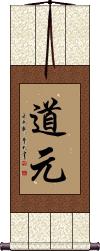
Usually, when people are looking for 道元 or “Dogen,” they are referring to the Japanese Zen monk by this name.
He lived from 1200-1253. This Dogen name or title literally means “The Way Origin” or “Beginning of the Path.” It is understood to mean “beginning of right doctrine or faith” in the context of his name and work to establish the Sōtō school of Zen in Japan.
To accomplish that task, this humble monk traveled from Japan and across China to find the more original or pure forms of Buddhism.
Infinity / Infinite / Unlimited / Unbounded
Japanese = Infinity / Chinese = No limits
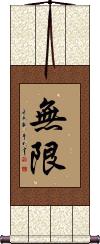
無限 is the Chinese and Japanese word meaning infinity, unlimited or unbounded.
無限 literally translates as “without limits” or “without [being] bound.”
The first character means “never” or “not,” like the prefix “un-.”
The second means “limited,” “restricted,” or “bound.”
Please note that the Japanese definition leans more toward “infinity” and the Chinese is more about being “boundless” or “without limits.”
In Korean, this means infinity, infinitude, or boundlessness. But in Korean, this term has many interpretations or contexts, so your intended meaning might be vague or ambiguous.
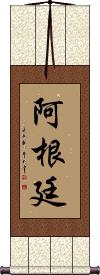
Argentina
Infinite Love
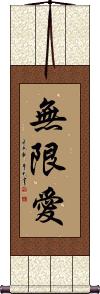
無限愛 is the Chinese and Japanese title meaning infinite love, unlimited love, or unbounded love.
The first character means never, not, or like the prefix “un-.”
The second means limited, restricted, or bound.
The third means love or affection.
Greatest Infinite Love
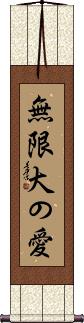
無限大の愛 is a Japanese title meaning infinite great love, unlimited great love, or eternal love.
無 means never, not, or like a prefix “un-.”
限 means limited, restricted, or bound.
大 means great or big.
の is a possessive article.
愛 means love or affection.
Not the results for gen that you were looking for?
Below are some entries from our dictionary that may match your gen search...
| Characters If shown, 2nd row is Simp. Chinese |
Pronunciation Romanization |
Simple Dictionary Definition |
摩根 see styles |
mó gēn mo2 gen1 mo ken |
More info & calligraphy: Morgan |
根特 see styles |
gēn tè gen1 te4 ken t`e ken te |
More info & calligraphy: Guenther |
雷根 see styles |
léi gēn lei2 gen1 lei ken |
More info & calligraphy: Ragan |
卑爾根 卑尔根 see styles |
bēi ěr gēn bei1 er3 gen1 pei erh ken |
More info & calligraphy: Bergen |
阿根廷 see styles |
ā gēn tíng a1 gen1 ting2 a ken t`ing a ken ting |
More info & calligraphy: Argentina |
亙 亘 see styles |
gèn gen4 ken wataru わたる |
extending all the way across; running all the way through (given name) Wataru cross over |
根 see styles |
gēn gen1 ken nemawari ねまわり |
root; basis; classifier for long slender objects, e.g. cigarettes, guitar strings; CL:條|条[tiao2]; radical (chemistry) (1) root (of a plant); (2) root (of a tooth, hair, etc.); center (of a pimple, etc.); (3) root (of all evil, etc.); source; origin; cause; basis; (4) one's true nature; (5) (fishing) reef; (personal name) Nemawari mūla, a root, basis, origin; but when meaning an organ of sense, indriyam, a 'power', 'faculty of sense, sense, organ of sense'. M.W. A root, or source; that which is capable of producing or growing, as the eye is able to produce knowledge, as faith is able to bring forth good works, as human nature is able to produce good or evil karma. v. 五根 and 二十二根. |
艮 see styles |
gèn gen4 ken gon ごん |
one of the Eight Trigrams 八卦[ba1 gua4], symbolizing mountain; ☶; ancient Chinese compass point: 45° (northeast) gen (one of the trigrams of the I Ching: mountain, northeast); (given name) Gon |
茛 see styles |
gèn gen4 ken |
ranunculus |
跟 see styles |
gēn gen1 ken kon |
heel; to follow closely; to go with; (of a woman) to marry sb; with; compared with; to; towards; and (joining two nouns) a heel |
三根 see styles |
sān gēn san1 gen1 san ken mine みね |
(place-name, surname) Mine The three (evil) 'roots'— desire, hate, stupidity, idem 三毒. Another group is the three grades of good roots, or abilities 上, 中, 下 superior, medium, and inferior. Another is the three grades of faultlessness 三無漏根. |
上根 see styles |
shàng gēn shang4 gen1 shang ken kamine かみね |
(place-name, surname) Kamine A man of superior character or capacity, e.g. with superior organs of sight, hearing, etc. |
下根 see styles |
xià gēn xia4 gen1 hsia ken shimone しもね |
(place-name, surname) Shimone Those (born) with base character, or of low capacity. |
中根 see styles |
zhōng gēn zhong1 gen1 chung ken nakane なかね |
(place-name, surname) Nakane Medium capacity, neither clever nor dull, of each of the six organs 六根; there are three powers of each organ 上根, 中根, and 下根. |
二根 see styles |
èr gēn er4 gen1 erh ken nikon |
The two "roots" or natural powers. (1) (a) 利根 keen, able (in the religion); (b) 鈍根 dull. (2) (a) 正根; 勝義根The power or ability which uses the sense organs to discern the truth; (b) 扶根; 扶 (or浮) 塵根the sense organs 五根 as aids. (3) The male and female sexual organs. |
五根 see styles |
wǔ gēn wu3 gen1 wu ken gokon |
pañcendriyāṇi. (1) The five roots, i. e. the five organs of the senses: eyes, ears, nose, tongue, and body as roots of knowing. (2) The five spiritual organs pr positive agents: 信 faith, 精進 energy, 念 memory, 定 visionary meditation, 慧 wisdom. The 五力 q. v. are regarded as negative agents. |
亙古 亘古 see styles |
gèn gǔ gen4 gu3 ken ku kouko / koko こうこ |
throughout time; from ancient times (up to the present) (archaism) (See 亘古) from long ago up until the present day |
依根 see styles |
yī gēn yi1 gen1 i ken ekon |
faculties |
信根 see styles |
xìn gēn xin4 gen1 hsin ken nobune のぶね |
(surname) Nobune śraddhendriya. Faith, one of the five roots or organs producing a sound moral life. |
側根 侧根 see styles |
cè gēn ce4 gen1 ts`e ken tse ken sokkon そっこん |
lateral root (botany) {bot} lateral root |
儒艮 see styles |
rú gèn ru2 gen4 ju ken jugon じゅごん |
dugong (ateji / phonetic) (kana only) dugong (Dugong dugon); sea pig |
內根 内根 see styles |
nèi gēn nei4 gen1 nei ken naikon |
internal realm |
六根 see styles |
liù gēn liu4 gen1 liu ken rokkon ろっこん |
{Buddh} six sense organs (eyes, ears, nose, tongue, body, and mind); (surname) Rokkon The six indriyas or sense-organs: eye, ear, nose, tongue, body, and mind. See also 六入, 六境, 六塵, and 六處. |
刨根 see styles |
páo gēn pao2 gen1 p`ao ken pao ken |
lit. to dig up the root; to get to the heart of (the matter) |
利根 see styles |
lì gēn li4 gen1 li ken rine りね |
(noun or adjectival noun) (ant: 鈍根) intelligence; cleverness; innate aptitude; (personal name) Rine Sharpness, cleverness, intelligence, natural powers, endowment; possessed of powers of the pañca-indryāni (faith, etc.) or the five sense-organs, v. 五根. |
去根 see styles |
qù gēn qu4 gen1 ch`ü ken chü ken |
to cure completely |
吐根 see styles |
tǔ gēn tu3 gen1 t`u ken tu ken tokon; tokon とこん; トコン |
ipecac (kana only) ipecac (species of shrub, Cephaelis ipecacuanha); ipecacuanha |
呆根 see styles |
dāi gēn dai1 gen1 tai ken |
(literary) idiot |
命根 see styles |
mìng gēn ming4 gen1 ming ken meikon / mekon めいこん |
lifeblood; the thing that one cherishes most in life; (coll.) family jewels (male genitals) life A root, or basis for life, or reincarnation, the nexus of Hīnayāna between two life-periods, accepted by Mahāyāna as nominal but not real. |
善根 see styles |
shàn gēn shan4 gen1 shan ken yoshine よしね |
good deeds; charity; (surname) Yoshine wholesome roots |
Click here for more gen results from our dictionary
The following table may be helpful for those studying Chinese or Japanese...
| Title | Characters | Romaji (Romanized Japanese) | Various forms of Romanized Chinese | |
| Dogen | 道元 | dou gen / dougen / do gen | dào yuán / dao4 yuan2 / dao yuan / daoyuan | tao yüan / taoyüan |
| Infinity Infinite Unlimited Unbounded | 無限 无限 | mu gen / mugen | wú xiàn / wu2 xian4 / wu xian / wuxian | wu hsien / wuhsien |
| Argentina | 阿根廷 | ā gēn tíng a1 gen1 ting2 a gen ting agenting | a ken t`ing akenting a ken ting |
|
| Infinite Love | 無限愛 无限爱 | mu gen ai / mugenai | wú xiàn ài wu2 xian4 ai4 wu xian ai wuxianai | wu hsien ai wuhsienai |
| Greatest Infinite Love | 無限大の愛 | bu gen dai no ai bugendainoai | ||
| In some entries above you will see that characters have different versions above and below a line. In these cases, the characters above the line are Traditional Chinese, while the ones below are Simplified Chinese. | ||||

Successful Chinese Character and Japanese Kanji calligraphy searches within the last few hours...



