Many custom options...


And formats...



Lose in Chinese / Japanese...
Buy a Lose calligraphy wall scroll here!
Personalize your custom “Lose” project by clicking the button next to your favorite “Lose” title below...
Know Your Enemy, Know Yourself, and You Cannot Lose
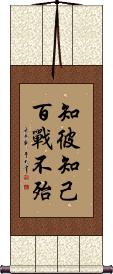
知彼知己百戰不殆 is from Sun Tzu's (Sunzi's) Art of War. It means that if you know and understand the enemy, you also know yourself, and thus with this complete understanding, you cannot lose.
This proverb is often somewhat directly translated as “Know the enemy and know yourself, and you can fight a hundred battles without defeat.”
It can also be translated as “If you know both yourself and your enemy, you can come out of hundreds of battles without danger,” or “Know your enemy, know yourself, and your victory will not be threatened.”
Never Give In / Never Succumb / Never Lose
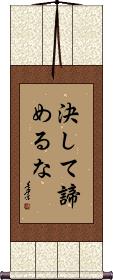
決して諦めるな is a Japanese term that informally means “never give up.”
It's also a Japanese way to say “never surrender.”
Note: Because this selection contains some special Japanese Hiragana characters, it should be written by a Japanese calligrapher.
See Also: Tenacity | Perseverance | Hope
Never Forget Your First Resolution
Never Lose Your Beginner's Spirit
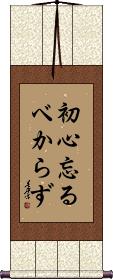
初心忘るべからず is an old Japanese proverb that suggests you try to never forget the enthusiasm you had as a child when you try new things (or even face the day-to-day). Basically, avoid having the mundane attitude that many people get with age.
You'll find this Japanese proverb translated in a few different ways. Here are some of them:
Don't forget your first resolution.
Never forget your childlike enthusiasm.
Forget not the beginner's mind.
Try never to lose your initial enthusiasm (freshness of attitude).
Note: This is sometimes written as 初心忘る可からず. The one shown above is used about 10x more often. There’s only one character difference between the two versions.
Note: Because this selection contains some special Japanese Hiragana characters, it should be written by a Japanese calligrapher.
These search terms might be related to Lose:
Not the results for lose that you were looking for?
Below are some entries from our dictionary that may match your lose search...
| Characters If shown, 2nd row is Simp. Chinese |
Pronunciation Romanization |
Simple Dictionary Definition |
失戀 失恋 see styles |
shī liàn shi1 lian4 shih lien |
More info & calligraphy: Broken HeartedSee: 失恋 |
現世 现世 see styles |
xiàn shì xian4 shi4 hsien shih ariyo ありよ |
More info & calligraphy: Live In The Moment / Live In The Now(1) {Buddh} (usu. げんせ) this world; this life; (2) (げんせい only) (See 完新世) current epoch (i.e. the Holocene epoch); (female given name) Ariyo The present world. |
ロース see styles |
roozu ローズ |
rose; (place-name) Rhodes (South Africa); (female given name) Ro-zu; Lawes; Laws; Lose; Lowes; Rhoads; Roz |
カサック see styles |
kasakku カサック |
(v5k,vi) (See カサカサ・1) to dry up; to grow dry; to lose moisture; (personal name) Kassak |
驕兵必敗 骄兵必败 see styles |
jiāo bīng bì bài jiao1 bing1 bi4 bai4 chiao ping pi pai kyouheihippai / kyohehippai きょうへいひっぱい |
More info & calligraphy: Pride Goes Before a Fall(expression) (yoji) defeat is inevitable for an overconfident army; being arrogant and overconfident inevitably leads to defeat; pride comes before a fall |
丟 丢 see styles |
diū diu1 tiu |
to lose; to put aside; to throw |
亡 see styles |
wáng wang2 wang suemaru すえまる |
to die; to lose; to be gone; to flee; deceased (n,n-suf) (1) (usu. after dates) (See 没・ぼつ・1) death; (prefix) (2) (usu. before names) (See 故・こ) the late; the deceased; (personal name) Suemaru Gone, lost, dead, ruined; not. |
厥 see styles |
jué jue2 chüeh ketsu |
to faint; to lose consciousness; his; her; its; their Third personal pronoun; demonstrative pronoun; also used instead of 倶. |
喪 丧 see styles |
sàng sang4 sang mo(p); sou / mo(p); so も(P); そう |
to lose something abstract but important (courage, authority, one's life etc); to be bereaved of (one's spouse etc); to die; disappointed; discouraged (noun - becomes adjective with の) (1) mourning; (2) (も only) (archaism) calamity; misfortune Mourning. To lose; destroy. |
失 see styles |
shī shi1 shih shitsu しつ |
to lose; to miss; to fail (1) loss (of something); disadvantage; (2) mistake; error; failure; (3) flaw; defect; (4) (abbreviation) {baseb} (See 失策・2) error To lose, opp. of 得; to err. |
奪 夺 see styles |
duó duo2 to datsu |
to seize; to take away forcibly; to wrest control of; to compete or strive for; to force one's way through; to leave out; to lose Snatch, carry off, take by force; decide. |
慌 see styles |
huāng huang1 huang |
to get panicky; to lose one's head; (coll.) (after 得[de2]) unbearably; terribly |
掉 see styles |
diào diao4 tiao jō |
to fall; to drop; to lag behind; to lose; to go missing; to reduce; fall (in prices); to lose (value, weight etc); to wag; to swing; to turn; to change; to exchange; to swap; to show off; to shed (hair); (used after certain verbs to express completion, fulfillment, removal etc) To shake, change, arrange; to fall. |
損 损 see styles |
sǔn sun3 sun takuji たくじ |
to decrease; to lose; to damage; to harm; (coll.) to ridicule; to deride; (coll.) caustic; sarcastic; nasty; mean; one of the 64 hexagrams of the Book of Changes: ䷨ (n,adj-na,vs,vi) (1) loss; damage; harm; unprofitable; (noun or adjectival noun) (2) disadvantage; handicap; drawback; unfavorable; (personal name) Takuji To spoil, hurt, damage. |
敗 败 see styles |
bài bai4 pai hai はい |
to defeat; to damage; to lose (to an opponent); to fail; to wither (1) loss; defeat; (suf,ctr) (2) (ant: 勝・しょう・3) counter for losses Subvert, defeat, ruin, spoil, destroy. |
昏 see styles |
hūn hun1 hun kon |
muddle-headed; twilight; to faint; to lose consciousness Dusk, dull, confused. |
瘦 see styles |
shòu shou4 shou |
thin; to lose weight; (of clothing) tight; (of meat) lean; (of land) unproductive |
虧 亏 see styles |
kuī kui1 k`uei kuei |
to lose (money); to have a deficit; to be deficient; to treat unfairly; luckily; fortunately; thanks to; (used to introduce an ironic remark about sb who has fallen short of expectations) |
輸 输 see styles |
shū shu1 shu yu |
to lose; to be beaten; (bound form) to transport; (literary) to donate; to contribute; (coll.) to enter (a password) To pay one's dues, to lose, be beaten, ruined: translit. su, śu; cf. 首; 室; 蘇. |
不失 see styles |
bù shī bu4 shi1 pu shih fushitsu |
still possesses; yet retains (some positive attribute that contrasts with another of its attributes) does not lose |
丟丑 丢丑 see styles |
diū chǒu diu1 chou3 tiu ch`ou tiu chou |
to lose face |
丟人 丢人 see styles |
diū rén diu1 ren2 tiu jen |
to lose face |
丟包 丢包 see styles |
diū bāo diu1 bao1 tiu pao |
(computing) packet loss; to lose a packet |
丟失 丢失 see styles |
diū shī diu1 shi1 tiu shih |
to lose; to misplace |
丟官 丢官 see styles |
diū guān diu1 guan1 tiu kuan |
(of an official) to lose one's job |
丟掉 丢掉 see styles |
diū diào diu1 diao4 tiu tiao |
to lose; to throw away; to discard; to cast away |
丟臉 丢脸 see styles |
diū liǎn diu1 lian3 tiu lien |
to lose face; humiliation |
倒嗓 see styles |
dǎo sǎng dao3 sang3 tao sang |
(of a singer) to lose one's voice; (male opera singer's) voice change (at puberty) |
倒貼 倒贴 see styles |
dào tiē dao4 tie1 tao t`ieh tao tieh |
to lose money instead of being paid (i.e. sb should pay me, but is actually taking my money) |
倦く see styles |
aku あく |
(v5k,vi) (1) (archaism) to tire of; to lose interest in; (2) to be satisfied; to enjoy; (3) to do adequately |
Click here for more lose results from our dictionary
The following table may be helpful for those studying Chinese or Japanese...
| Title | Characters | Romaji (Romanized Japanese) | Various forms of Romanized Chinese | |
| Know Your Enemy, Know Yourself, and You Cannot Lose | 知彼知己百戰不殆 知彼知己百战不殆 | zhí bǐ zhí jī bǎi zhàn bú dài zhi2 bi3 zhi2 ji1 bai3 zhan4 bu2 dai4 zhi bi zhi ji bai zhan bu dai zhibizhijibaizhanbudai | chih pi chih chi pai chan pu tai | |
| Never Give In Never Succumb Never Lose | 決して諦めるな | kesshite akirameruna kesshiteakirameruna keshite akirameruna | ||
| Never Forget Your First Resolution | 初心忘るべからず / 初心忘る可からず 初心忘るべからず | sho shin wasu ru be ka ra zu shoshinwasurubekarazu | ||
| In some entries above you will see that characters have different versions above and below a line. In these cases, the characters above the line are Traditional Chinese, while the ones below are Simplified Chinese. | ||||

Successful Chinese Character and Japanese Kanji calligraphy searches within the last few hours...



