Many custom options...


And formats...



San in Chinese / Japanese...
Buy a San calligraphy wall scroll here!
Personalize your custom “San” project by clicking the button next to your favorite “San” title below...
1. San-Dan
5. San Marino
6. San Pedro
7. San Diego
8. San Marino
9. Mt. Fuji
10. Sanbo
11. Samadhi
12. Zhang / Cheung
13. Five Families / Tsoi Li Hoi Fut Hung
14. The Saint
15. Month of March
17. Samadhi
18. Sammu
19. Sanchin
20. Sandi
21. Sanje
22. Three Kingdoms
23. Three Souls
24. Three Treasures of Buddhism
25. The Three Truths
26. Asanka
27. Ashanti
28. Auxanne
29. Betelgeuse
30. Sandaiyu
31. Three
32. Alexane
33. Romance of the Three Kingdoms
35. Samudaya
36. A sly rabbit has three openings to its den
37. Take Refuge in the Three Treasures
38. The Holy Trinity
39. Tiger Rumor
40. Ebtisam
41. When Three People Gather, One Becomes a Teacher
42. Great Lotus Wisdom - Samadhi Wisdom
43. You May Learn from Victory, You Will Learn from Failure
San-Dan
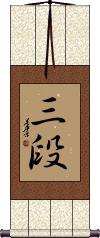
三段 is a Japanese Kanji word that literally means “third degree.”
三段 is the third black belt rank in Japanese martial arts.
The first Kanji means three or third in Japanese.
The second Kanji means step, grade, rank, or level.
Kung Fu San Soo / San Shou
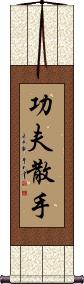
功夫散手 is a martial arts title.
Oddly, there are multiple ways two spell/romanize this in English, but in Chinese, it's written exactly the same.
Technically, the Mandarin romanizes as “gong fu san shou,” for which you'll sometimes see it written “kung fu san shou” (k'ung is an old romanization for a word that sounds like gong with a vowel sound like “oh”).
There is another martial arts style that spells this “Kung Fu San Soo.” I guess this was supposed to approximate Cantonese pronunciation for which the scholarly romanization is generally agreed to be “gung fu saan sau.”
San Soo / San Shou
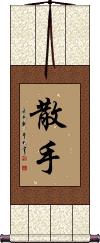
散手 is a martial arts title sometimes spelled in English as “San Soo” or “San Shou.”
The Mandarin version romanizes as “San Shou.” Mandarin Chinese is the most common dialect in China (literally 99% of Chinese people speak standard Mandarin along with their local dialect).
There is another martial arts style that spells this “San Soo.” I guess this was supposed to approximate Cantonese pronunciation for which the scholarly romanization is generally agreed to be “Saan Sau.”
San Soo Kung Fu
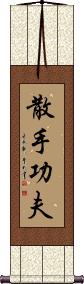
散手功夫 is San Soo Kung Fu.
Sometimes you will see this in the order 功夫散手 (Kung Fu San Soo). Either version is OK.
It's like “Kung Fu of San Soo” vs. “San Soo Kung Fu” if you put it in English terms. San Soo is the adjective either way in Chinese.
San Marino
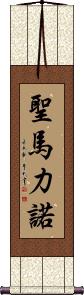
San Pedro

聖佩德羅 is the name San Pedro in Chinese (Mandarin).
San Pedro

サンペドロ is the name San Pedro in Japanese Katakana.
Note: Because this title is entirely Japanese Katakana, it should be written by a Japanese calligrapher.
San Diego
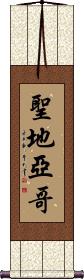
聖地亞哥 is how to write San Diego in Mandarin Chinese.
San Marino
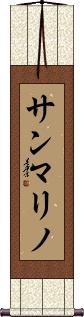
サンマリノ is the small country of San Marino in Japanese Katakana.
Note: Because this title is entirely Japanese Katakana, it should be written by a Japanese calligrapher.
Mt. Fuji
Fujiyama
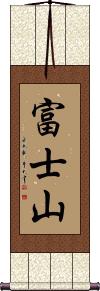
富士山 is the Chinese and Japanese Kanji title for Mount Fuji in Japan.
富士山 is also known as Fujiyama or Fuji-san.
Sanbo
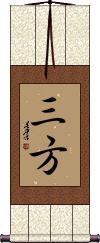
三方 is San Bo or Sanbo which literally means three sides but in Japanese, refers to a small offering stand.
It can also be the Japanese surname Mitsukata.
Samadhi

In Buddhism, “三摩提” is the transliteration of the Sanskrit word Samādhi, which means equanimity, concentration, and determination.
It is one of the Buddhist practices aimed at eliminating all distractions and calming the mind.
Sometimes written in a shorter form of 三昧 (san mei).
Zhang / Cheung
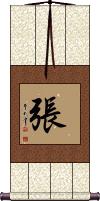
This is a Chinese surname that romanizes as Zhang, but in Taiwan or old romanization can be Cheung.
This can also be the Japanese surnames Harisaki, Hari, Hara, Tsuan, Chou, Cho, Chiyan, Chiyau, Chan, Chian, Sun, Jin, Jiyon, Jiyan, Zan, San, or Kin.
The meaning of this character can be: to open up; to spread; sheet of paper; classifier for flat objects; sheet; classifier for votes.
Five Families / Tsoi Li Hoi Fut Hung
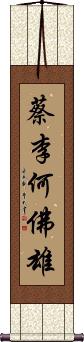
蔡李何佛雄 is the five families associated with San Soo Kung Fu.
The characters are always the same, but there are several ways these are romanized from Cantonese, Mandarin, and other dialects. Some common ones include Tsoi Li Hoi Fut Hung and Choi Li Ho Fut Hung.
If you are using a different romanization, that does not mean it's wrong. It might just be that your school is using a different dialect or romanization scheme.
The Saint
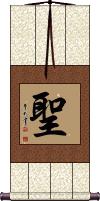
聖 is the simple, single-character religious form of “saint” in Chinese (also holds the same meaning in Japanese and Korean, though rarely used alone like this).
This can also mean holy, sage, master, or priest.
Note: 聖 is often used in compound words (words of more than one character) to create further meanings. In compounds, it can mean holy, sacred, or divine.
聖 is also used as the first word for Spanish and English place names such as “San Diego” and “St. Louis” in Chinese (not Japanese).
In the Buddhist context, this can represent ārya or sādhu. And mean a sage; wise and good; upright, or correct in all his character; sacred, holy, or saintly.
Month of March
Third Month of the Year
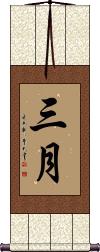
三月 is the Chinese, Japanese, and Chinese way to write the month of March.
This literally reads as “third month” or “third moon.”
Mixed Martial Arts / MMA
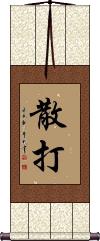
散打 is Sanda, a Chinese word for “Mixed Martial Arts” or “MMA.”
Samadhi
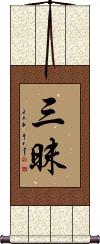
三昧 is the Chinese, Japanese Kanji, and old Korean Hanja way to write Samādhi.
Samadhi is the state of intense concentration achieved through meditation.
Some will define Samādhi as putting together, composing the mind, intent contemplation, perfect absorption, or union of the meditator with the object of meditation.
Sammu
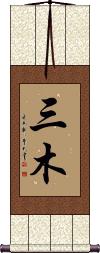
三木 is the name Sammu in Chinese (Mandarin).
Sanchin
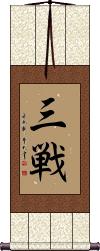
三戦 is a title that literally means “three battles/conflicts/wars.”
三戦 is often figuratively used to relay the idea of a battle to unify the mind, body, and spirit.
Original usage likely comes from Fujian province in Southern China (just across from Taiwan).
This title is used in various schools such as Okinawan Karate, Uechi-Ryū, Gōjū-Ryū, Fujian White Crane, and Five Ancestors among others.
Sandi
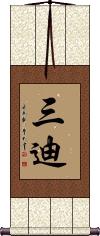
三迪 is the name Sandi in Chinese (Mandarin).
Sanje
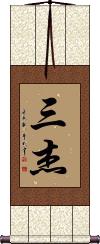
三杰 is the name Sanje in Chinese (Mandarin).
Three Kingdoms
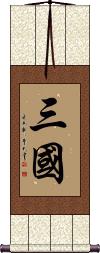
三國 is the title for the Three Kingdoms period (220-280 A.D.) in Chinese history.
In Korean Hanja, this can also refer to one of several Three Kingdoms periods in Korean history.
In Japanese, this could refer to the Chinese Three Kingdoms period or be the surname Mitsukuni.
Three Souls
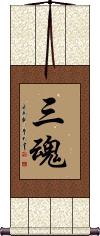
三魂 is a Daoist / Taoist term, “three immortal souls.”
Three Treasures of Buddhism
The Triple Gem
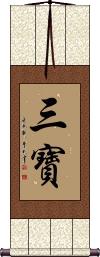
三寶 is the title for “Three Precious Treasures of Buddhism” or “The Triple Gem.”
These three treasures are the Buddha 佛, the Dharma 法 (teachings or the law of the Buddha), and the Sangha 僧 (the community of monks or followers).
This term is used by most (perhaps not all) Buddhists in China, Japan, and South Korea (written the same in the original form but pronounced differently in each language). Non-Buddhists may just read this as “Three Treasures” without the religious context. For instance, there is also a “Three Treasures of Chinese Medicine” that is sometimes titled the same way.
In modern Japanese and Simplified Chinese, this is written 三宝 instead of 三寶.
The Three Truths
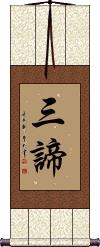
三諦 is a Buddhist term that means “threefold truth” or “three dogmas.”
The three truths are:
1. All things are void (卽空).
2. All things are temporary (卽假).
3. All things are in the middle state between these two (卽中).
Asanka
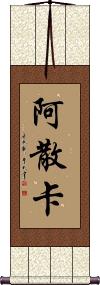
阿散卡 is the name Asanka in Chinese (Mandarin).
Ashanti
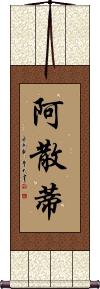
阿散蒂 is the name Ashanti in Chinese (Mandarin).
Auxanne
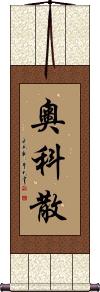
This is a common Mandarin Chinese transliteration for the female French name Auxanne.
Betelgeuse
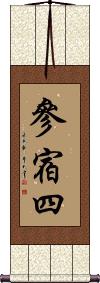
參宿四 is the title for Betelgeuse (star in the constellation Orion) in Chinese.
Also known as “α Orionis” (Alpha Orionis), Alpha Ori, or in Japan the Heike-boshi or Heike-star.
Note: 参宿 (Shēn Xiù) is the name given by ancient Chinese astronomers for a constellation of three stars (the three naked-eye visible belt stars of Orion). Therefore, 參宿四 means the Fourth Star of the constellation of Three Stars (which sounds like a joke). As telescopes got better, it should be noted that there are actually 10 stars in the constellation.
Sandaiyu
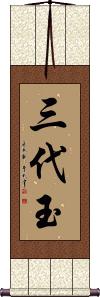
三代玉 is the name Sandaiyu in Chinese (Mandarin).
This is also the title for “three-generation jade.”
Three
The number three
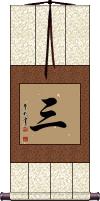
三 is the number three in Chinese, Japanese Kanji, and old Korean Hanja.
This is a strange selection for a wall scroll, so it's here mostly for reference. I guess it's OK if the number three is important to you.

 Because this character is rather simple (just three lines), there is an anti-fraud way to write three on bank documents. These variants are shown to the right.
Alexane
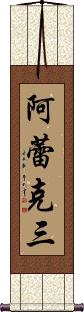
This is a common Mandarin Chinese transliteration for the female French name Alexane.
Romance of the Three Kingdoms
Novel Title

三國演義 is the Chinese title for The Romance of the Three Kingdoms by Luo Guanzhong.
This is one of the most famous novels of Chinese literature.
Profound / Powerful Words
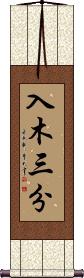
入木三分 is a four-character Chinese proverb that translates in English to a strong form of “profound” or “written with a forceful hand.”
But there is much more to the story...
The deep meaning behind this proverb comes from a man named Wan Xizhi, who lived in the third century.
He was a great writer and calligrapher whose writing style influenced generations of other writers and calligraphers.
He once wrote words on a piece of wood to be taken to an engraver.
When the engraver began to carve the characters into the wood, he found that Wang Xizhi's writing had penetrated the wood about 3/8 of an inch.
Thus people believed that his words were so powerful and profound that they caused the ink from his brush to penetrate the wood deeply.
The proverb literally means “penetrated wood three fen” (A fen is an ancient Chinese measurement of a little over 1/8 of an inch or almost 4mm).
Samudaya
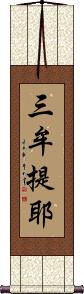
This is the Chinese way to write Samudaya, the second of the Four Noble Truths.
In the Buddhist context, this is the aggregation of suffering.
A sly rabbit has three openings to its den
-or- The crafty rabbit has three different entrances to its lair
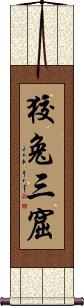
狡兔三窟 speaks to the cunning character of a sly rabbit. Such a rabbit will not have just one hole but rather a few entrances and exits from his liar.
About 2,250 years ago, a rich man told his assistant to go and buy something wonderful that he did not yet possess. He was a man that already had everything, so the assistant went to a local village that owed a great deal of money to the rich man. The assistant told the village elders that all debts were forgiven. All the villagers rejoiced and praised the rich man's name. The assistant returned to the rich man and told him he had purchased “benevolence” for him. The rich man was mildly amused but perhaps slightly confused by the action.
Sometime later, the rich man fell from the favor of the Emperor and was wiped out without a penny to his name. One day he was walking aimlessly and stumbled into the village where the debts had been forgiven. The villagers recognized the man and welcomed him with open arms, clothed, fed him, and gave him a place to live.
Without trying, the man had become like the sly and cunning rabbit. When his exit was blocked, he had another hole to emerge from - and was reborn. This story and idiom come from a book titled “The Amendment” - it's unclear whether this man actually existed or not. But the book did propel this idiom into common use in China.
Still today, this idiom about the rabbit is used in China when suggesting “backup plans,” alternate methods, and anyone with a good escape plan.
Take Refuge in the Three Treasures
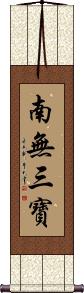
南無三寶 means to take refuge in the three treasures (of Buddhism).
This starts with the phonetic “南無” or “Namo/Namu” trying to sound like the original Pali or Sanskrit, followed by “三寶” being more literally the three treasures.
Take Refuge in the Three Treasures
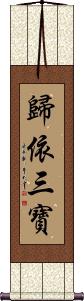
歸依三寶 means to take refuge in the three treasures (of Buddhism).
This is the literal (there is also a partially-phonetic version) way to express taking refuge in the three treasures by the actual meaning of the characters.
The Holy Trinity
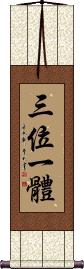
三位一體 is the Chinese and old Korean way to write Holy Trinity.
This would be understood in Japanese as well, but they tend to write it with the last character simplified like 三位一体 in modern Japan.
This can be translated literally as “Three Thrones, One Body.”
Asian Christians will understand this as the Trinity, God the Father, the Son, and the Holy Spirit.
Tiger Rumor
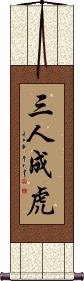
These four characters together relay the meaning that can be expressed in English as “When three people say there's a tiger running in the street, you believe it.”
Of course, there is an ancient story behind this idiom...
三人成虎 is actually a proverb that resulted from a conversation that occurred around 300 B.C.
The conversation was between the king of the Wei kingdom and one of the king's ministers named Pang Cong.
It was near the end of one of many wars, this time with the Zhao kingdom. Pang Cong was to be sent by the king to the Zhao kingdom with the king's son, who was to be held hostage. It was common at the time for a king to make his son a hostage to secure stable peace between warring kingdoms.
Before minister Pang Cong departed, he asked his king, “If one person told you a tiger was running in the street, would you believe it?.”
“No,” the king said.
The minister continued, “What if two people told you?”
The king replied, “Well, I would have my doubts but I might believe it.”
The minister continued, “So, what if three people told you that a tiger is running in the streets?”
The king replied, “Yes, I would believe it. It must be true if three people say it.”
The minister then reminded the king, “Your son and I are now traveling far away to live in the distant Zhao kingdom - much farther from your palace than the street. Rumors may fly about me in my absence, so I hope your majesty will weight such rumors appropriately.”
The king replied, “I have every trust in you, do not worry”
While the minister was gone, the king's enemies gossiped about minister Pang Cong on many occasions. At first, the king thought nothing of these comments and rumors. But slowly, as the rumors mounted, the king began to suspect ill of his minister.
Sometime later, when peace was well-established, the minister and prince were freed and returned to the kingdom of Wei. The king received his son BUT DID NOT EVEN SUMMON MINISTER PANG CONG TO THE PALACE!
Hopefully, this story will help you see how dangerous words can be when used to promote rumors or create ill will. And perhaps will inspire you not to believe everything you hear.
There is also a secondary suggestion in this idiom that gossip is as ferocious as a tiger. Some Chinese people who don't know the ancient story above may believe that this scroll means that rumors are as vicious as three tigers.
Note: This proverb appears in my Korean dictionary but is not well-known in Korea.
Ebtisam
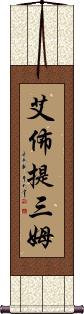
This is the Arabic name Ebtisam transliterated into Mandarin Chinese.
When Three People Gather, One Becomes a Teacher
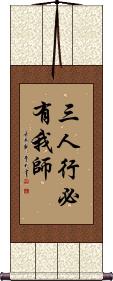
三人行必有我师 means “when three people meet, one becomes the teacher.”
This famous Chinese philosophy suggests that when people come together, they can always learn from each other.
One person must be the teacher and others learn. And in turn, the others become the teachers of the knowledge they possess.
It is important to remember that we all have something to teach, and we all have something to learn as well.
Great Lotus Wisdom - Samadhi Wisdom
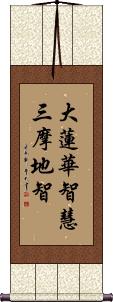
大蓮華智慧三摩地智 is the title for “The wisdom of the great lotus, samādhi-wisdom.”
This is also the penetrating wisdom of Amitābha.
You May Learn from Victory, You Will Learn from Failure
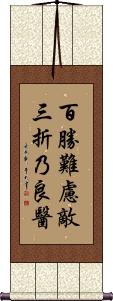
百胜难虑敌三折乃良医 is a Chinese proverb that literally translates as: [Even a general who has won a] hundred victories [may be] hard put to see through the enemy's [strategy], [but one who has] broken [his] arm three [times] [will] be a good doctor.
Figuratively, this means: One cannot always depend on past successes to guarantee future success but one can always learn from lessons drawn from failure.
See Also: Failure - Mother of Success | Experience - Mother of Success | Fall Down 7 Times Get Up 8 | Hard Knocks
Daodejing / Tao Te Ching - Excerpt
Excerpt from Chapter 67
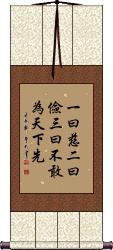
一曰慈二曰儉三曰不敢為天下先 is an excerpt from the 67th Chapter of Lao Tzu's (Lao Zi's) Te-Tao Ching (Dao De Jing).
This is the part where the three treasures are discussed. In English, we'd say these three treasures are compassion, frugality, and humility. Some may translate these as love, moderation, and lack of arrogance. I have also seen them translated as benevolence, modesty, and “Not presuming to be at the forefront in the world.” You can mix them up the way you want, as translation is not really a science but rather an art.
I should also explain that the first two treasures are single-character ideas, yet the third treasure was written out in six characters (there are also some auxiliary characters to number the treasures).
If Lao Tzu's words are important to you, then a wall scroll with this passage might make a great addition to your home.
Mind Your Own Business
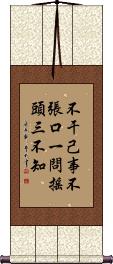
不干己事不张口一问摇头三不知 literally translates as [About] matters [that] don't concern [you], do not open [your] mouth, [and] when questioned, always shake [your] head “No.”
Figuratively, this means: It is best to remain reticent about other people's affairs and to refuse to make any comment on matters that don't concern you.
Return to Dwell in Gardens and Fields Poem

This is Tao Yuanming's poem, “Returning to Dwell in Gardens and Fields.”
少無適俗韻 性本愛丘山。
誤落塵網中 一去三十年。
羈鳥戀舊林 池魚思故淵。
開荒南野際 抱拙歸園田。
方宅十餘畝 草屋八九間。
榆柳蔭後簷 桃李羅堂前。
暖暖遠人村 依依墟裡煙。
狗吠深巷中 雞鳴桑樹顛。
戶庭無塵雜 虛室有餘閒。
久在樊籠裡 復得返自然。
Not the results for san that you were looking for?
Below are some entries from our dictionary that may match your san search...
| Characters If shown, 2nd row is Simp. Chinese |
Pronunciation Romanization |
Simple Dictionary Definition |
三國 三国 see styles |
sān guó san1 guo2 san kuo mitsukuni みつくに |
More info & calligraphy: Three Kingdoms(surname) Mitsukuni |
三寶 三宝 see styles |
sān bǎo san1 bao3 san pao sanbou / sanbo さんぼう |
More info & calligraphy: Three Treasures of Buddhism(surname) Sanbou three treasures |
三昧 see styles |
sān mèi san1 mei4 san mei sanmai さんまい |
More info & calligraphy: Samadhi(1) (さんまい only) {Buddh} samadhi (state of intense concentration achieved through meditation) (san:); (suffix noun) (2) (usu. ざんまい) being immersed in; being absorbed in; indulging in; doing to one's heart's content; (suffix noun) (3) (usu. ざんまい) prone to; apt to; (given name) Sanmai (三昧地) Samādhi, "putting together, composing the mind, intent contemplation, perfect absorption, union of the meditator with the object of meditation." (M. W.) Also 三摩地 (三摩提, 三摩帝, 三摩底). Interpreted by 定 or 正定, the mind fixed and undisturbed; by 正受 correct sensation of the object contemplated; by 調直定 ordering and fixing the mind; by 正心行處 the condition when the motions of the mind are steadied and harmonized with the object; by 息慮凝心 the cessation of distraction and the fixation of the mind; by 等持 the mind held in equilibrium; by 奢摩他, i.e. 止息 to stay the breathing. It is described as concentration of the mind (upon an object). The aim is 解脫, mukti, deliverance from all the trammels of life, the bondage of the passions and reincarnations. It may pass from abstraction to ecstasy, or rapture, or trance. Dhyāna 定 represents a simpler form of contemplation; samāpatti 三摩鉢底 a stage further advanced; and samādhi the highest stage of the Buddhist equivalent for Yoga, though Yoga is considered by some as a Buddhist development differing from samādhi. The 翻譯名義 says: 思專 when the mind has been concentrated, then 志一不分 the will is undivided; when 想寂 active thought has been put to rest, then 氣虛神朗 the material becomes etherealized and the spirit liberated, on which 智 knowledge, or the power to know, has free course, and there is no mystery into which it cannot probe. Cf. 智度論 5, 20, 23, 28; 止觀 2; 大乘義章 2, 9, 1 3, 20, etc. There are numerous kinds and degrees of samādhi. |
三月 see styles |
sān yuè san1 yue4 san yüeh yayoi やよい |
More info & calligraphy: Month of Marchthree months; (female given name) Yayoi |
三段 see styles |
sān duàn san1 duan4 san tuan sandan さんだん |
More info & calligraphy: San-Danthree levels |
三諦 三谛 see styles |
sān dì san1 di4 san ti santai; sandai さんたい; さんだい |
More info & calligraphy: The Three TruthsThe three dogmas. The "middle" school of Tiantai says 卽空, 卽假. 卽中 i.e. 就是空, 假, 中; (a) by 空śūnya is meant that things causally produced are intheir essential nature unreal (or immaterial) 實空無; (b) 假, though thingsare unreal in their essential nature their derived forms are real; (c) 中;but both are one, being of the one 如 reality. These three dogmas arefounded on a verse of Nāgārjuna's— 因緣所生法, 我說卽是空 亦爲是假名, 亦是中道義 "All causally produced phenomena, I say, areunreal, Are but a passing name, and indicate the 'mean'." There are otherexplanations— the 圓教 interprets the 空 and 假 as 中; the 別教 makes 中 independent. 空 is the all, i.e. the totality of all things, and is spokenof as the 眞 or 實 true, or real; 假 is the differentiation of all thingsand is spoken of as 俗 common, i.e. things as commonly named; 中 is theconnecting idea which makes a unity of both, e.g. "all are but parts of onestupendous whole." The 中 makes all and the all into one whole, unifying thewhole and its parts. 空 may be taken as the immaterial, the undifferentiatedall, the sum of existences, by some as the tathāgatagarbha 如來藏; 假as theunreal, or impermanent, the material or transient form, the temporal thatcan be named, the relative or discrete; 中 as the unifier, which places eachin the other and all in all. The "shallower" 山外 school associated 空 and 中 with the noumenal universe as opposed to the phenomenal and illusoryexistence represented by 假. The "profounder" 山内 school teaches that allthree are aspects of the same. |
三魂 see styles |
sān hún san1 hun2 san hun |
More info & calligraphy: Three Souls |
散打 see styles |
sǎn dǎ san3 da3 san ta sanda; sanda サンダ; さんだ |
More info & calligraphy: Mixed Martial Arts / MMAsanda (chi:); sanshou; Chinese boxing; Chinese kickboxing |
三摩提 see styles |
sān mó tí san1 mo2 ti2 san mo t`i san mo ti sanmaji |
More info & calligraphy: Samadhi |
〣 see styles |
sān san1 san |
numeral 3 in the Suzhou numeral system 蘇州碼子|苏州码子[Su1 zhou1 ma3 zi5] |
三 see styles |
sān san1 san miyoshi みよし |
three; 3 (numeric) three (chi: sān); (personal name) Miyoshi Tri, trayas; three. |
傘 伞 see styles |
sǎn san3 san san さん |
umbrella; parasol; CL:把[ba3] (1) umbrella; parasol; (2) (See 笠・2) something shaped like an umbrella or a conical hat; shade (of a lamp); mushroom cap; pileus; (surname) San |
叁 see styles |
sān san1 san |
variant of 參|叁[san1] |
叄 see styles |
sān san1 san |
variant of 參|叁[san1] |
弎 see styles |
sān san1 san |
archaic variant of 參|叁, banker's anti-fraud numeral three |
散 see styles |
sàn san4 san bara; bara ばら; バラ |
to scatter; to break up (a meeting etc); to disperse; to disseminate; to dispel; (coll.) to sack (noun - becomes adjective with の) (1) (kana only) loose articles (not packaged with other things); bulk items; individual items; (2) (abbreviation) (kana only) (See ばら銭) coins; small change viprakrī. Scatter, disperse, dismiss; scattered; broken, powder; translit. saṃ, san. |
毿 毵 see styles |
sān san1 san |
long-haired; shaggy |
潵 see styles |
sàn san4 san |
to disperse water |
糝 糁 see styles |
sǎn san3 san |
to mix (of powders) |
繖 伞 see styles |
sǎn san3 san kinugasa きぬがさ |
damask silk; variant of 傘|伞[san3] (surname) Kinugasa |
鏾 see styles |
sǎn san3 san |
the trigger of a crossbow; crossbow |
饊 馓 see styles |
sǎn san3 san |
used in 饊子|馓子[san3 zi5] |
鬖 see styles |
sān san1 san |
wild hair |
㪚 散 see styles |
sàn san4 san |
variant of 散[san4] See: 散 |
3C see styles |
sān c san1 c san c |
computers, communications, and consumer electronics; China Compulsory Certificate (CCC) |
3P see styles |
sān p san1 p san p sanpii / sanpi さんピー |
(slang) threesome (colloquialism) threesome (sexual activity) |
3Q see styles |
sān q san1 q san q |
(Internet slang) thank you (loanword) |
三C see styles |
sān c san1 c san c |
see 3C[san1 C] |
三P see styles |
sān p san1 p san p |
(slang) threesome |
三一 see styles |
sān yī san1 yi1 san i mitsukazu みつかず |
(1) (abbreviation) (derogatory term) (See 三一侍) low-ranking samurai; (2) (orig. meaning) rolling three and one (in a dice game); (given name) Mitsukazu Trinity; also 31. |
Click here for more san results from our dictionary
The following table may be helpful for those studying Chinese or Japanese...
| Title | Characters | Romaji (Romanized Japanese) | Various forms of Romanized Chinese | |
| San-Dan | 三段 | san dan / sandan | ||
| Kung Fu San Soo San Shou | 功夫散手 | gōng fu sǎn shǒu gong1 fu san3 shou3 gong fu san shou gongfusanshou | kung fu san shou kungfusanshou |
|
| San Soo San Shou | 散手 | sǎn shǒu / san3 shou3 / san shou / sanshou | ||
| San Soo Kung Fu | 散手功夫 | sǎn shǒu gōng fu san3 shou3 gong1 fu san shou gong fu sanshougongfu | san shou kung fu sanshoukungfu |
|
| San Marino | 聖馬力諾 圣马力诺 | shèng mǎ lì nuò sheng4 ma3 li4 nuo4 sheng ma li nuo shengmalinuo | sheng ma li no shengmalino |
|
| San Pedro | 聖佩德羅 圣佩德罗 | shèng pèi dé luó sheng4 pei4 de2 luo2 sheng pei de luo shengpeideluo | sheng p`ei te lo shengpeitelo sheng pei te lo |
|
| San Pedro | サンペドロ | sanpedoro | ||
| San Diego | 聖地亞哥 圣地亚哥 | shèng dì yà gē sheng4 di4 y4 ge1 sheng di y ge shengdiyge | sheng ti ko shengtiko |
|
| San Marino | サンマリノ | sanmarino | ||
| Mt. Fuji | 富士山 | fujiyama / fujisan | fù shì shān fu4 shi4 shan1 fu shi shan fushishan | fu shih shan fushihshan |
| Sanbo | 三方 | sanbou / sanpou / mitsukata sanbo / sanpo / mitsukata | ||
| Samadhi | 三摩提 | sanmaji | sān mó tí san1 mo2 ti2 san mo ti sanmoti | san mo t`i sanmoti san mo ti |
| Zhang Cheung | 張 张 | chou / cho | zhāng / zhang1 / zhang | chang |
| Five Families Tsoi Li Hoi Fut Hung | 蔡李何佛雄 | cài lǐ hé fú xióng cai4 li3 he2 fu2 xiong2 cai li he fu xiong cailihefuxiong | ts`ai li ho fu hsiung tsailihofuhsiung tsai li ho fu hsiung |
|
| The Saint | 聖 圣 | sei | shèng / sheng4 / sheng | |
| Month of March | 三月 | mitsuki / sangatsu | sān yuè / san1 yue4 / san yue / sanyue | san yüeh / sanyüeh |
| Mixed Martial Arts MMA | 散打 | sàn dǎ / san4 da3 / san da / sanda | san ta / santa | |
| Samadhi | 三昧 | san mai / sanmai | sān mèi / san1 mei4 / san mei / sanmei | |
| Sammu | 三木 | sān mù / san1 mu4 / san mu / sanmu | ||
| Sanchin | 三戦 | san sen / sansen | sān zhàn / san1 zhan4 / san zhan / sanzhan | san chan / sanchan |
| Sandi | 三迪 | sān dí / san1 di2 / san di / sandi | san ti / santi | |
| Sanje | 三杰 | sān jié / san1 jie2 / san jie / sanjie | san chieh / sanchieh | |
| Three Kingdoms | 三國 三国 | mitsu kuni / mitsukuni | sān guó / san1 guo2 / san guo / sanguo | san kuo / sankuo |
| Three Souls | 三魂 | san tamashi santamashi | sān hún / san1 hun2 / san hun / sanhun | |
| Three Treasures of Buddhism | 三寶 三宝 | san bou / sanbou / san bo | sān bǎo / san1 bao3 / san bao / sanbao | san pao / sanpao |
| The Three Truths | 三諦 三谛 | san dai / san tai sandai / santai | sān dì / san1 di4 / san di / sandi | san ti / santi |
| Asanka | 阿散卡 | ā sàn kǎ a1 san4 ka3 a san ka asanka | a san k`a asanka a san ka |
|
| Ashanti | 阿散蒂 | ā sàn dì a1 san4 di4 a san di asandi | a san ti asanti |
|
| Auxanne | 奧科散 奥科散 | ào kē sàn ao4 ke1 san4 ao ke san aokesan | ao k`o san aokosan ao ko san |
|
| Betelgeuse | 參宿四 | sān sù sì san1 su4 si4 san su si sansusi | san su ssu sansussu |
|
| Sandaiyu | 三代玉 | sān dài yù san1 dai4 yu4 san dai yu sandaiyu | san tai yü santaiyü |
|
| Three | 三 / 參 三 / 参 | san | sān / san1 / san | |
| Alexane | 阿蕾克三 | ā lěi kè sān a1 lei3 ke4 san1 a lei ke san aleikesan | a lei k`o san aleikosan a lei ko san |
|
| Romance of the Three Kingdoms | 三國演義 三国演义 | sān guó yǎn yì san1 guo2 yan3 yi4 san guo yan yi sanguoyanyi | san kuo yen i sankuoyeni |
|
| Profound Powerful Words | 入木三分 | rù mù sān fēn ru4 mu4 san1 fen1 ru mu san fen rumusanfen | ju mu san fen jumusanfen |
|
| Samudaya | 三牟提耶 | sanmudaiya | sān móu tí yé san1 mou2 ti2 ye2 san mou ti ye sanmoutiye | san mou t`i yeh sanmoutiyeh san mou ti yeh |
| A sly rabbit has three openings to its den | 狡兔三窟 | jiǎo tù sān kū jiao3 tu4 san1 ku1 jiao tu san ku jiaotusanku | chiao t`u san k`u chiaotusanku chiao tu san ku |
|
| Take Refuge in the Three Treasures | 南無三寶 南无三宝 | na mu san bou namusanbou na mu san bo | nán mo sān bǎo nan2 mo san1 bao3 nan mo san bao nanmosanbao | nan mo san pao nanmosanpao |
| Take Refuge in the Three Treasures | 歸依三寶 归依三宝 | ki e san bou kiesanbou ki e san bo | guī yī sān bǎo gui1 yi1 san1 bao3 gui yi san bao guiyisanbao | kuei i san pao kueiisanpao |
| The Holy Trinity | 三位一體 三位一体 | sān wèi yì tǐ san1 wei4 yi4 ti3 san wei yi ti sanweiyiti | san wei i t`i sanweiiti san wei i ti |
|
| Tiger Rumor | 三人成虎 | sān rén chéng hǔ san1 ren2 cheng2 hu3 san ren cheng hu sanrenchenghu | san jen ch`eng hu sanjenchenghu san jen cheng hu |
|
| Ebtisam | 艾佈提三姆 艾布提三姆 | ài bù tí sān mǔ ai4 bu4 ti2 san1 mu3 ai bu ti san mu aibutisanmu | ai pu t`i san mu aiputisanmu ai pu ti san mu |
|
| When Three People Gather, One Becomes a Teacher | 三人行必有我師 三人行必有我师 | sān rén xíng bì yǒu wǒ shī san1 ren2 xing2 bi4 you3 wo3 shi1 san ren xing bi you wo shi sanrenxingbiyouwoshi | san jen hsing pi yu wo shih sanjenhsingpiyuwoshih |
|
| Great Lotus Wisdom - Samadhi Wisdom | 大蓮華智慧三摩地智 大莲华智慧三摩地智 | dai renge chie sanmajichi dairengechiesanmajichi | dà lián huá zhì huì sān mó dì zhì da4 lian2 hua2 zhi4 hui4 san1 mo2 di4 zhi4 da lian hua zhi hui san mo di zhi | ta lien hua chih hui san mo ti chih |
| You May Learn from Victory, You Will Learn from Failure | 百勝難慮敵三折乃良醫 百胜难虑敌三折乃良医 | bǎi shèng nán lǜ dí sān zhé nǎi liáng yī bai3 sheng4 nan2 lv4 di2 san1 zhe2 nai3 liang2 yi1 bai sheng nan lv di san zhe nai liang yi | pai sheng nan lü ti san che nai liang i | |
| Daodejing Tao Te Ching - Excerpt | 一曰慈二曰儉三曰不敢為天下先 一曰慈二曰俭三曰不敢为天下先 | yī yuē cí èr yuē jiǎn sān yuē bù gǎn wéi tiān xià xiān yi1 yue1 ci2 er4 yue1 jian3 san1 yue1 bu4 gan3 wei2 tian1 xia4 xian1 yi yue ci er yue jian san yue bu gan wei tian xia xian | i yüeh tz`u erh yüeh chien san yüeh pu kan wei t`ien hsia hsien i yüeh tzu erh yüeh chien san yüeh pu kan wei tien hsia hsien |
|
| Mind Your Own Business | 不干己事不張口一問搖頭三不知 不干己事不张口一问摇头三不知 | bù gān jǐ shì bù zhāng kǒu yī wèn yáo tóu sān bù zhī bu4 gan1 ji3 shi4 bu4 zhang1 kou3 yi1 wen4 yao2 tou2 san1 bu4 zhi1 bu gan ji shi bu zhang kou yi wen yao tou san bu zhi | pu kan chi shih pu chang k`ou i wen yao t`ou san pu chih pu kan chi shih pu chang kou i wen yao tou san pu chih |
|
| Return to Dwell in Gardens and Fields Poem | 少無適俗韻性本愛丘山誤落塵網中一去三十年羈鳥戀舊林池魚思故淵開荒南野際抱拙歸園田方宅十余畝草屋八九間榆柳蔭后檐桃李羅堂前暖暖遠人村依依墟里煙狗吠深巷中雞鳴桑樹顛戶庭無塵雜虛室有余閑久在樊籠里復得返自然 少无适俗韵性本爱丘山误落尘网中一去三十年羁鸟恋旧林池鱼思故渊开荒南野际抱拙归园田方宅十余亩草屋八九间榆柳荫后檐桃李罗堂前暖暖远人村依依墟里烟狗吠深巷中鸡鸣桑树颠户庭无尘杂虚室有余闲久在樊笼里复得返自然 | shào wú shì sú yùn xìng běn ài qiū shān wù luò chén wǎng zhōng yī qù sān shí nián jī niǎo liàn jiù lín chí yú sī gù yuān kāi huāng nán yě jì bào zhuō guī yuán tián fāng zhái shí yú mǔ cǎo wū bā jiǔ jiān yú liǔ yīn hòu yán táo lǐ luó táng qián nuǎn nuǎn yuǎn rén cūn yī yī xū lǐ yān gǒu fèi shēn xiàng zhōng jī míng sāng shù diān hù tíng wú chén zá xū shì yǒu yú xián jiǔ zài fán lóng lǐ fù dé fǎn zì rán shao4 wu2 shi4 su2 yun4 xing4 ben3 ai4 qiu1 shan1 wu4 luo4 chen2 wang3 zhong1 yi1 qu4 san1 shi2 nian2 ji1 niao3 lian4 jiu4 lin2 chi2 yu2 si1 gu4 yuan1 kai1 huang1 nan2 ye3 ji4 bao4 zhuo1 gui1 yuan2 tian2 fang1 zhai2 shi2 yu2 mu3 cao3 wu1 ba1 jiu3 jian1 yu2 liu3 yin1 hou4 yan2 tao2 li3 luo2 tang2 qian2 nuan3 nuan3 yuan3 ren2 cun1 yi1 yi1 xu1 li3 yan1 gou3 fei4 shen1 xiang4 zhong1 ji1 ming2 sang1 shu4 dian1 hu4 ting2 wu2 chen2 za2 xu1 shi4 you3 yu2 xian2 jiu3 zai4 fan2 long2 li3 fu4 de2 fan3 zi4 ran2 shao wu shi su yun xing ben ai qiu shan wu luo chen wang zhong yi qu san shi nian ji niao lian jiu lin chi yu si gu yuan kai huang nan ye ji bao zhuo gui yuan tian fang zhai shi yu mu cao wu ba jiu jian yu liu yin hou yan tao li luo tang qian nuan nuan yuan ren cun yi yi xu li yan gou fei shen xiang zhong ji ming sang shu dian hu ting wu chen za xu shi you yu xian jiu zai fan long li fu de fan zi ran | shao wu shih su yün hsing pen ai ch`iu shan wu lo ch`en wang chung i ch`ü san shih nien chi niao lien chiu lin ch`ih yü ssu ku yüan k`ai huang nan yeh chi pao cho kuei yüan t`ien fang chai shih yü mu ts`ao wu pa chiu chien yü liu yin hou yen t`ao li lo t`ang ch`ien nuan nuan yüan jen ts`un i i hsü li yen kou fei shen hsiang chung chi ming sang shu tien hu t`ing wu ch`en tsa hsü shih yu yü hsien chiu tsai fan lung li fu te fan tzu jan shao wu shih su yün hsing pen ai chiu shan wu lo chen wang chung i chü san shih nien chi niao lien chiu lin chih yü ssu ku yüan kai huang nan yeh chi pao cho kuei yüan tien fang chai shih yü mu tsao wu pa chiu chien yü liu yin hou yen tao li lo tang chien nuan nuan yüan jen tsun i i hsü li yen kou fei shen hsiang chung chi ming sang shu tien hu ting wu chen tsa hsü shih yu yü hsien chiu tsai fan lung li fu te fan tzu jan |
|
| In some entries above you will see that characters have different versions above and below a line. In these cases, the characters above the line are Traditional Chinese, while the ones below are Simplified Chinese. | ||||

Successful Chinese Character and Japanese Kanji calligraphy searches within the last few hours...



