Many custom options...


And formats...



Swords in Chinese / Japanese...
Buy a Swords calligraphy wall scroll here!
Personalize your custom “Swords” project by clicking the button next to your favorite “Swords” title below...
Katana
Japanese Samurai Sword
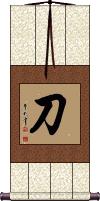
刀 is the Japanese Kanji for “sword.” This refers to the style of sword carried by warriors, samurai, and shogun of ancient Japan.
With the pacification of Japan, such swords are now only used for ceremony and decoration. The true art of sword-smithing is all but lost in Japan with new sword production dedicated to making inexpensive replicas for the tourist and foreign market.
For those of you that want to ask whether I can get you a real antique sword. Let me tell you that most real Asian swords were melted down after WWII in Japan, and during the Great Leap Forward in China. Any remaining swords are family heirlooms that nobody will part with.
Please carefully note that the Japanese kanji character shown above is only for a Japanese audience. In China, this character means “knife.” See our other entry for “sword” in Chinese.
Note: 刀 can mean knife, sword, or blade in Korean, depending on context.
See Also: Sword
Sword
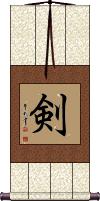
剱 is the modern Japanese way to write sword.
This Kanji character comes from original Chinese. This form would also be understood in Chinese (there are often several ways to write the same character) but I suggest this one only if your audience is Japanese (because they've settled on a slightly different form as the standard in China).
In Japanese, this character also means saber/sabre, blade, bayonet, stinger, and clock hand (clock hands are the “swords” of the clock).
See Also: Katana
Kenjutsu / Kenjitsu
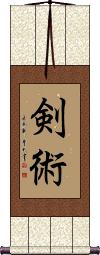
In Japanese, the modern definition, using simple terms, 剣術 is “A martial art involving swords” or “The art of the sword.”
However, in Chinese, this is the word for fencing (as in the Olympic sport).
I will suppose that you want this for the Japanese definition, which comes from skills and techniques developed in the 15th century. At that time, Kenjutsu (or swordsmanship) was a strictly military art taught to Samurai and Bushi (soldiers). The fact that swords are rarely used in military battles anymore, and with the pacification of Japan after WWII, Kenjutsu is strictly a ceremonial practice often studied as a form of martial art (more for the discipline aspect rather than practical purpose).
Language note: The Korean definition is close to the Japanese version described above. However, it should be noted that this can mean “fencing” depending on the context in Japanese, Chinese, and Korean.

 Character variation notes: There are slight variations possible with the second character. Either way is correct and understood by both Japanese and Chinese folks.
Since there are about 5 common ways to write the sword character, if you are particular about which version you want, please note that in the “special instructions” when you place your order.
Romanization note: This term is often Romanized as Kenjitsu; however, following the rules of Japanese Romaji, it should be Kenjutsu.
Kendo / The Way of the Sword
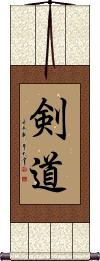
Often associated with Kenjutsu, 剱道/劍道 means “The way of the sword” in Japanese (and Korean with an alternate form of the first character).
This is also the term used for swordsmanship and even fencing in Japanese and Korean, depending on context.
Note: These same characters are also used separately in Chinese, but this exact combination yields a common title in Japanese only (perhaps someone who is really into swords would use this in China).
Note: There is more than one way to write the “sword” character (shown above is the Japanese version - if you want the Korean version, please let me know when you place your order).
Bloodless Victory
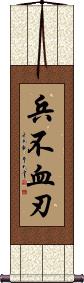
Perhaps a pacifist view or perhaps the best kind of victory; 兵不血刃 reflect this idea:
The edges of the swords not being stained with blood.
You could also translate it as: Win victory without firing a shot.
The first character means army or force. The second character means without or none. The last two characters mean bloodstained knives. So it represents a returning victorious army without bloodstained knives. 兵不血刃 is the very literal sense of this Chinese proverb. The title definition is more accurate to the way this proverb is understood.
Asking yourself why the direct or literal translation is different?
...Think of compound words in English such as “nevertheless” if we break it apart to “never the less,” we will have trouble getting the real definition of “in spite of that.” Similar things happen when multiple characters create a compounded word in Chinese.
Musashi
The most famous Samurai
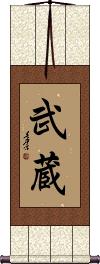
Miyamoto Musashi is probably the most famous Samurai in all of Japanese history.
武蔵 is the short title for a man long in legend. While coming from a lower class, his new sword and fighting techniques put him on par with the best that feudal Japan had to offer. His long career started with his first duel at age 13!
He is credited with using two swords at once and never losing a single battle in his career. After becoming a Buddhist, and getting older, like many old warriors, he took up a peaceful and solitary life until his death around 1645 A.D.
Note: Technically, Musashi is his given name, and Miyamoto is his surname. However, it's suggested that he assumed both of these names and had a few other names in childhood, as well as being given a Buddhist name. It's hard to know what to call him, as with most Kanji, there are multiple pronunciations. The characters for Musashi can also be pronounced Takezō. But everyone in modern times seems to know him by the name Musashi.
Sword
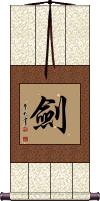
劍 is pronounced “jian” in Chinese. When you say it, imagine that you are making the sound of a sword as it clashes with a metal shield. This might get you closer to the correct pronunciation in Chinese.
I actually wonder if this word came from the metallic ringing sounds of a sword in battle - but such knowledge is lost in history.
The sword is a symbol of a warrior. The one thing that a soldier in ancient China lived and died by. A warrior with his skills and sword proves himself of great value. A warrior who losses his sword instantly becomes worthless.
劍 is an excellent scroll for someone in the military (especially officers of all services - as well as enlisted NCO Marines since they still carry swords even if mainly for ceremonial purposes). Or perhaps someone who practices variations of kung fu or tai chi that involve weapons.
Please note that while this character is understood with the sword meaning in Japanese, you might be looking for the word “katana” which also means sword in Japanese but means “knife” in Chinese.
There are other ways to write sword, and here are a few...


If you are particular about the version you receive, please let me know when you place your order (Note: Special styles are only available from one of our master calligraphers).
Not the results for swords that you were looking for?
Below are some entries from our dictionary that may match your swords search...
| Characters If shown, 2nd row is Simp. Chinese |
Pronunciation Romanization |
Simple Dictionary Definition |
丁丁 see styles |
zhēng zhēng zheng1 zheng1 cheng cheng toutou / toto とうとう chouchou / chocho ちょうちょう |
More info & calligraphy: Tintin(adv,n) clashing of swords; felling of trees; ringing of an ax |
剣道 see styles |
kendou / kendo けんどう |
More info & calligraphy: Kendo / The Way of the Sword |
兵不血刃 see styles |
bīng bù xuè rèn bing1 bu4 xue4 ren4 ping pu hsüeh jen |
More info & calligraphy: Bloodless Victory |
真剣勝負 see styles |
shinkenshoubu / shinkenshobu しんけんしょうぶ |
More info & calligraphy: Shinken Shobu |
佩 see styles |
pèi pei4 p`ei pei hai はい |
to respect; to wear (belt etc) (1) ancient oriental belt decoration; (suf,ctr) (2) counter for swords to wear; put on; wrap around |
円 see styles |
yuán yuan2 yüan meguru めぐる |
yen (Japanese currency); Japanese variant of 圓|圆 (1) circle; (n,n-pref) (2) entirety; whole; full; complete; (3) (slang) money; dough; moola; (4) enclosure inside a castle's walls; (5) (ksb:) soft-shelled turtle; (suffix) (6) suffix for ship names; suffix for names of people (esp. infants); suffix for names of swords, armour, musical instruments, etc.; suffix for names of dogs, horses, etc.; (1) yen; Japanese monetary unit; (2) circle; (female given name) Meguru |
口 see styles |
kǒu kou3 k`ou kou hamanoguchi はまのぐち |
mouth; classifier for things with mouths (people, domestic animals, cannons, wells etc); classifier for bites or mouthfuls (1) mouth; (2) opening; hole; gap; orifice; (3) mouth (of a bottle); spout; nozzle; mouthpiece; (4) gate; door; entrance; exit; (5) (See 口を利く・1) speaking; speech; talk (i.e. gossip); (6) (See 口に合う) taste; palate; (7) mouth (to feed); (8) (See 働き口) opening (i.e. vacancy); available position; (9) (See 口がかかる・1) invitation; summons; (10) kind; sort; type; (11) opening (i.e. beginning); (suf,ctr) (12) counter for mouthfuls, shares (of money) and stove burners; (suf,ctr) (13) (often read ふり in museum, etc. contexts) (See 振り・ふり・8) counter for swords, blades, etc.; (surname) Hamanoguchi mukha, the mouth, especially as the organ of speech. 身, 口, 意 are the three media of corruption, body or deed , mouth or word, and mind or thought. |
枝 see styles |
zhī zhi1 chih shige しげ |
branch; classifier for sticks, rods, pencils etc (counter) counter for long, thin things (i.e. swords); (surname) Shige A branch. |
いず see styles |
isu イス |
{cards} swords (suit) (por: es(padas)); (place-name) Is |
丁々 see styles |
toutou / toto とうとう chouchou / chocho ちょうちょう |
(adv,n) clashing of swords; felling of trees; ringing of an ax |
三塗 三涂 see styles |
sān tú san1 tu2 san t`u san tu sanzu |
The 塗 mire is interpreted by 途 a road, i.e. the three unhappy gati or ways; (a) 火塗 to the fires of hell; (b) 血塗 to the hell of blood, where as animals they devour each other; (c) 刀塗 the asipattra hell of swords, where the leaves and grasses are sharp-edged swords. Cf. 三惡趣. |
両刀 see styles |
ryoutou / ryoto りょうとう |
(1) two swords; (2) (abbreviation) (See 両刀使い・りょうとうづかい・2) being skilled in two fields; (an) expert in two fields; (3) (abbreviation) (See 両刀使い・りょうとうづかい・3) liking both alcohol and sweets; person who likes alcohol and sweets equally well; (4) (abbreviation) (See 両刀使い・りょうとうづかい・4) bisexual (person) |
五刀 see styles |
wǔ dāo wu3 dao1 wu tao gotou / goto ごとう |
(surname) Gotou The 'five swords' or slayers who were sent in pursuit of a man who fled from his king, e. g. the five skandhas 五蘊. |
交鋒 交锋 see styles |
jiāo fēng jiao1 feng1 chiao feng |
to cross swords; to have a confrontation (with sb) |
六劍 六剑 see styles |
liù jiàn liu4 jian4 liu chien rokken |
六箭 The six swords (or arrows), i. e. the six senses, v. 六塵, which are defined as the qualities of sight, sound, smell, taste, touch, and mind. |
兵戈 see styles |
bīng gē bing1 ge1 ping ko heika / heka へいか |
weapons; arms; fighting; war swords; arms; warfare weapons |
刀山 see styles |
dāo shān dao1 shan1 tao shan katanayama かたなやま |
(surname) Katanayama The hill of swords in one of the hells. |
刀杖 see styles |
dāo zhàng dao1 zhang4 tao chang tōjō |
swords and staves |
刀術 see styles |
toujutsu / tojutsu とうじゅつ |
{MA} fencing; art of wielding swords |
剣戟 see styles |
kengeki けんげき |
(1) weapons; arms; (2) fighting with swords; sword fight |
劍山 剑山 see styles |
jiàn shān jian4 shan1 chien shan kensan |
劍樹地獄 Asipattra. The hill of swords, or sword-leaf trees hell, one of the sixteen hells; also called 刀刃路. |
和鋼 see styles |
wakou / wako わこう |
traditional Japanese steel (e.g. used in swords) |
大小 see styles |
dà xiǎo da4 xiao3 ta hsiao daishou / daisho だいしょう |
large and small; size; adults and children; consideration of seniority; at any rate (1) size; (noun - becomes adjective with の) (2) large and small (sizes); various sizes; (3) daishō (matched pair of long and short swords); (4) large and small drums; (5) long months and short months; (6) sic bo (Macao dice game); tai sai; dai siu; big and small; (place-name) Daishou large and small |
玉鋼 see styles |
tamahagane たまはがね |
traditional Japanese steel made from iron sand (esp. for use in swords) |
赤札 see styles |
akafuda あかふだ |
(1) red tag (esp. one attached to sold goods or discounted products); red label; (2) {cards} swords (playing card suit in traditional Japanese gambling decks) |
金打 see styles |
kanauchi かなうち |
(1) solemn promise; (n,vs,vi) (2) (hist) promise sealed by striking metal objects together (e.g. swords for samurai, mirrors for women); (surname) Kanauchi |
鉄火 see styles |
tekka てっか |
(1) red-hot iron; (2) swords and guns; (3) gunfire; (n,adj-no,adj-na) (4) (See 鉄火肌) termagancy; violent temper; (5) (abbreviation) (See 鉄火打ち) gambler; (6) (See 鉄火丼,鉄火巻き) red flesh of lean tuna; (personal name) Tekka |
銃剣 see styles |
juuken / juken じゅうけん |
(1) bayonet; (2) guns and swords |
ギンッ see styles |
gin ギンッ |
(adverb taking the "to" particle) (1) (onomatopoeic or mimetic word) sharply (glare, stare, etc.); piercingly; stinging; (adverb taking the "to" particle) (2) (onomatopoeic or mimetic word) clashing (of swords, etc.) |
三刀流 see styles |
santouryuu / santoryu さんとうりゅう |
(1) (manga slang) wielding three swords; (2) {baseb} (See 二刀流・3) player who can play as pitcher, fielder and batter |
Click here for more swords results from our dictionary
The following table may be helpful for those studying Chinese or Japanese...
| Title | Characters | Romaji (Romanized Japanese) | Various forms of Romanized Chinese | |
| Katana | 刀 | katana | dāo / dao1 / dao | tao |
| Sword | 剱 剣 | ken | jiàn / jian4 / jian | chien |
| Kenjutsu Kenjitsu | 剣術 剑术 | kenjutsu | jiàn shù / jian4 shu4 / jian shu / jianshu | chien shu / chienshu |
| Kendo The Way of the Sword | 剱道 / 劍道 剣道 | kendou / kendo | jiàn dào / jian4 dao4 / jian dao / jiandao | chien tao / chientao |
| Bloodless Victory | 兵不血刃 | bīng bù xuè rèn bing1 bu4 xue4 ren4 bing bu xue ren bingbuxueren | ping pu hsüeh jen pingpuhsüehjen |
|
| Musashi | 武蔵 | mu sashi / musashi | ||
| Sword | 劍 剑 | ken / tsurugi | jiàn / jian4 / jian | chien |
| In some entries above you will see that characters have different versions above and below a line. In these cases, the characters above the line are Traditional Chinese, while the ones below are Simplified Chinese. | ||||

Successful Chinese Character and Japanese Kanji calligraphy searches within the last few hours...



