Custom Trust Chinese & Japanese Calligraphy Wall Scroll
We have many options to create artwork with Trust characters on a wall scroll or portrait.
4. Faith / Trusting in the Unseen
5. Faithful / Honorable / Trustworthy / Fidelity / Loyalty
6. Trust in God
7. Trust No One / Trust No Man
8. Trust in God / In God We Trust
9. Trust in God / Belief in God
10. Trust in God / Faith in God
11. Trust Your Heart
12. Honesty
15. Religious Devotion / Faith in God / Religious Faith
16. Faith is the bird that feels the light when the dawn is still dark
17. Faith Hope Love
18. Faith Love Peace
19. Good Intentions / Good Will / Good Faith
20. Integrity: Sincere Honest and Faithful
21. Firm Belief / Strong Faith
23. Loyalty / Faithful / Devoted
24. Semper Fidelis / Always Faithful
25. Sincerity and Faithfulness
26. Faith
28. Loyalty
31. Ultimate Loyalty to Your Country
33. Appreciation of Truth by Meditation
34. Believe
35. Triple Truth of Japanese Buddhism
36. Comparison Leads to Truth and Enlightenment
37. The Five Tenets of Confucius
38. Dependable
39. Devotion / Dedication / Attentive / Focused
40. Devotion / Diligence / Vigorous / Energetic
42. Hope
43. Integrity
44. Justice / Rectitude / Right Decision
45. Hoes Before Bros
47. Sacrifice / Devotion / Dedication
48. Seeking Truth
49. Most Sincere Friend / Honest Friend / Real Friend / Best Friend
52. Tathata / Ultimate Nature of All Things
53. Thirst for Truth
54. The Three Truths
56. True Religion / Buddha Truth
57. Truth Flashed Through The Mind
59. Truth
61. Walk in the Way
62. Ultimate Truth
63. Knowledge of Ultimate Truth
Trust / To Have Faith
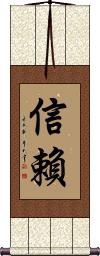
信賴 can also be translated as confidence, reliance, or dependence; thus, it can also mean “to rely on” or “to depend on.”
Trust is having faith in someone or something. It is a positive attitude about life. You are confident that the right thing will happen without trying to control or make it happen. Even when difficult things happen, trust helps us to find the gift or lesson in it.
 There is a slight deviation in the Japanese Kanji form of the second character. If you want the modern Japanese version, please click on the special Kanji shown to the right instead of the button above. Note that the traditional Chinese form is still readable and understood by Japanese people.
See Also: Confidence | Truth | Honor
Believe / Faith / Trust
śraddhā
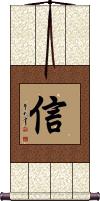
信 can mean to believe, truth, faith, fidelity, sincerity, trust, and confidence in Chinese, old Korean Hanja, and Japanese Kanji.
This single character is often part of other words with similar meanings.
It is one of the five basic tenets of Confucius.
In Chinese, it sometimes has the secondary meaning of a letter (as in the mail) depending on context but it will not be read that way when seen on a wall scroll.
In the Buddhist context, this is śraddhā (faith through hearing or being taught).
Belief / Trust
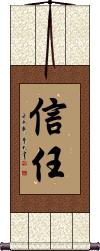
信任 means belief or trust in Chinese characters, old Korean Hanja, and Japanese Kanji.
It can also mean having confidence in or credence.
Faith / Trusting in the Unseen
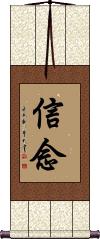
信念 expresses the idea of “having a belief” or “trusting in the unseen.”
信念 could also be translated as beliefs or convictions.
Note: Also considered to be one of the Seven Heavenly Virtues.
See Also: Devotion | Dedication
Faithful / Honorable / Trustworthy / Fidelity / Loyalty
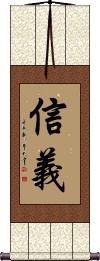
信義 is a word often used to describe a person with an honest and loyal reputation.
Simply put, this applies to somebody you can trust (with your life).
In Chinese, this is often defined as good faith, honor, trust, and justice.
In Korean, this word means fidelity, truthfulness, or faithfulness.
In Japanese: faith, fidelity, and loyalty. It's also a Japanese male given name when pronounced “Nobuyoshi.”
Trust in God
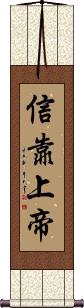
信靠上帝 means “Trust in God,” “Faith in God,” “Rely upon God” and/or “Believe in God.”
Trust No One / Trust No Man
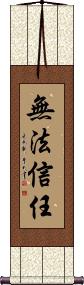
無法信任 is the kind of thing you expect to hear in a spy movie.
“Trust no one, 007!”
The first two characters express the idea of “no way” or “cannot.”
The last two characters mean “trust.”
The characters must go in this order due to Chinese grammar issues and in order to sound natural.
Note: This is not an ancient Chinese phrase by any means. It's just that we received a lot of requests for this phrase.
This is as close as you can get to the phrase “trust no man,” though technically, no gender is specified.
Trust No One / Trust No Man
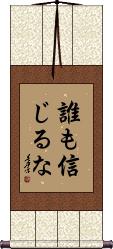
誰も信じるな is as close as you can get to the phrase “trust no man” in Japanese, though no gender is specified.
The first two characters mean everyone or anyone but change to “no one” with the addition of a negative verb.
The third through fifth characters express the idea of believing in, placing trust in, confiding in, or having faith in.
The last character makes the sentence negative (without the last character, this would mean “trust everyone,” with that last character, it's “trust no one”).
Note: Because this selection contains some special Japanese Hiragana characters, it should be written by a Japanese calligrapher.
Trust in God / In God We Trust
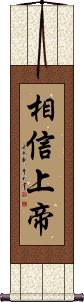
相信上帝 means exactly what the title suggests. The first two characters mean “trust” or “believe,” and the second two mean “God” (as in the God of Abraham and the God of Zion).
Thisis also how the American phrase “In God We Trust” as seen on U.S. Currency would be translated into Chinese. It would also be correct to say that this means “Believe in God,” though, in this arrangement/context, one would be more likely to interpret it as “trust.”
Trust in God / Belief in God
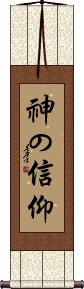
神の信仰 is the simplest way to express “Trust in God” in Japanese.
The first character means God, deity, divinity, or spirit (in this case, it will be read as God).
The second character is a particle that links the ideas.
The last two characters mean faith, belief, or creed in a religious context.
Trust in God / Faith in God
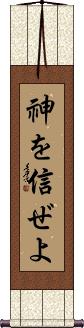
神を信ぜよ is a way to express “Trust in God” in Japanese.
The first character is “God.”
The second character is a particle that links the ideas here.
The last three characters are a word that means “to believe,” “to believe in,” “to place trust in,” “to confide in,” and “to have faith in.”
Basically, this is the Japanese phrase for “Have faith in God,” “Belief in God,” or “Trust in God.”
Note: Because this selection contains some special Japanese Hiragana characters, it should be written by a Japanese calligrapher.
Trust Your Heart
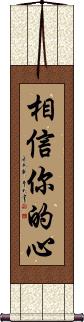
This means “Trust Your Heart” in Chinese.
Honesty
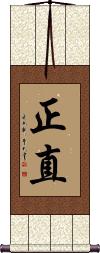
正直 or honesty is being truthful and sincere. It is important because it builds trust. When people are honest, they can be relied on not to lie, cheat or steal. Being honest means that you accept yourself as you are. When you are open and trustworthy, others can believe in you.
正直 is one of the 8 key concepts of Tang Soo Do.
Note: This entry is cross-listed as "integrity" because it also fits that definition.
 Please note that the second Kanji sometimes has an alternate form in Japanese. Let us know if you want the alternate form shown to the right.
Honesty
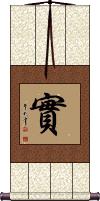
Honesty
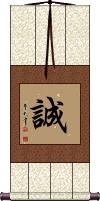
誠 means truth, faith, fidelity, sincerity, trust, and/or confidence.
As a single-character wall scroll, this suggests that you believe “honesty is the best policy,” as your personal philosophy.
This is also a virtue of the Samurai Warrior
See our page with just Code of the Samurai / Bushido here
Honesty / Fidelity
信 is another character that expresses the idea of honesty.
It can also mean truth, faith, belief in, fidelity, sincerity, trust, and/or confidence.
Some have included this in the list for the Bushido, although “makoto” is probably more common/popular.
Note: In some contexts, this character can mean a letter (mail), news, or envoy. However, alone, it will generally be read with the honesty-meaning.
See our page with just Code of the Samurai / Bushido here
See Also: Loyalty Trustworthiness Trustworthy
Integrity / Honesty
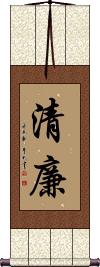
清廉 means honest, uncorrupted, honesty, integrity, purity, and unselfishness.
In Japanese, this can also be the given name Kiyoyuki.
Religious Devotion / Faith in God / Religious Faith
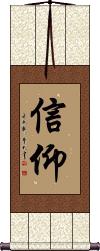
信仰 means firm belief, faith, persuasion, conviction, and sometimes religion or creed in Chinese, Japanese Kanji, and old Korean Hanja.
This clearly fits the religious connotation of the English word “devotion.”
This is often used to refer to a person of faith or a religious person.
This can be directly translated as “firm belief,” “creed,” “conviction,” or simply as “religious,” depending on context.
Some will also use this to mean “trust in God” in Japanese (though the term for God is not actually in this title).
It should be noted that this word is a little strange alone on a wall scroll.
While this can be pronounced in Japanese, it’s not a great selection for a wall scroll if your audience is Japanese.
See Also: Faith | Devotion | Trust in God
Faith is the bird that feels the light when the dawn is still dark
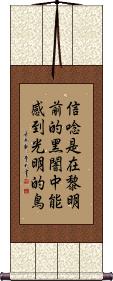
信唸是在黎明前的黑闇中能感到光明的鳥 is a philosophical poem/quote from Indian Poet and Philosopher, Rabindranath Tagore.
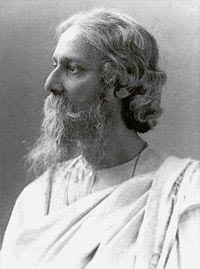
Rabindranath Tagore, 1915
This quote is not sourced, and therefore several variations exist in English. Some suggest the original was in the Bengali language.
This, of course, is the Chinese translation that has the meaning of, “Faith is the bird that feels the light and sings when the dawn is still dark.”
More about Rabindranath Tagore
Faith Hope Love
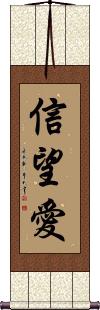
信望愛 is a Chinese list of words meaning faith, hope, and love.
This is not a typical phrase in Chinese but rather just random words strung together. There's no bad meaning, it's just not typical Chinese grammar.
Faith Hope Love
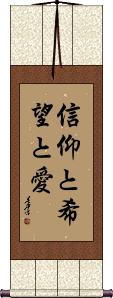
信仰と希望と愛 is a Japanese list of words (not really a phrase) meaning faith, hope, and love.
Some have associated this word list with Corinthians 13:13, though there are no specific religious connotations in this word list, and it's not directly from that Japanese Bible verse.
Note: Because this selection contains some special Japanese Hiragana characters, it should be written by a Japanese calligrapher.
Faith Love Peace
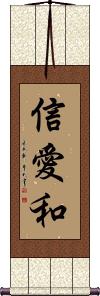
信愛和 is a word list that reads, “Faith Love Peace.”
This is not a natural phrase in Chinese or Japanese, as it lacks a subject, verb, or object. But if this is what you want, here it is.
Good Intentions / Good Will / Good Faith
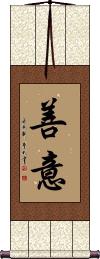
善意 is a word that means good intentions, goodwill, or to things done in good faith in Chinese, Japanese, and old Korean Hanja.
It's the reason you do good deeds or the desire you have inside yourself to do the right thing.
This can also be translated as benevolence, kindness, virtuous mind, positive mindset, or favorable sense.
善意 is also used in the legal context for things done in good faith (regardless of outcome).
In Japanese, this can be the personal name Yoshi or Yoshii.
Integrity: Sincere Honest and Faithful
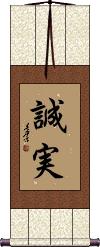
誠実 is the Japanese version of integrity which can also be defined as a combination of “sincere, honest, and faithful.”
Some may also define this as “loyal” or “loyalty.” In some contexts, it can mean “genuine.” Yes, all of this meaning in just one Japanese word!
Firm Belief / Strong Faith
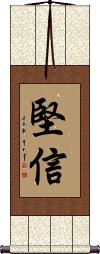
堅信 means to believe firmly, with firm faith, or without any doubt.
Japanese Christians sometimes use this term to mean the rite of confirmation.
This can also be the Japanese given name Kenshin.
Love Faith Strength
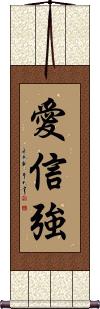
愛信強 is the shortest way to write the word list, “love faith strength.”
The first character is love, the second is faith or believe, and the third means strong or strength.
It should be noted that word lists like this are not as natural sounding in Chinese as word lists can be in English. it’s more common to have a full phrase (with subject, verb, and object) or single words on calligraphy wall scrolls in Asia.
Love Faith Strength
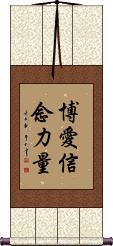
博愛信念力量 is the verbose way to write the word list, “love faith strength.”
It should be noted that word lists like this are not as natural sounding in Chinese as word lists can be in English. it’s more common to have a full phrase (with subject, verb, and object) or single words on calligraphy wall scrolls in Asia.
Loyalty / Faithful / Devoted
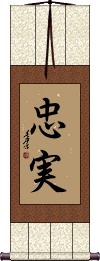
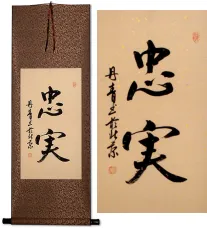
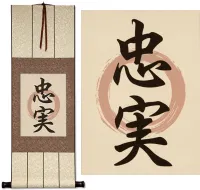
忠実 is a Japanese way to write “Loyalty” - it also contains the ideas of being faithful, devoted, true, and obedient.
The second character is a modified form only used in the Japanese lexicon; however, Chinese speakers can easily guess the meaning.
This is also a virtue of the Samurai Warrior
See our page with just Code of the Samurai / Bushido here
Semper Fidelis / Always Faithful
U.S. Marines Slogan
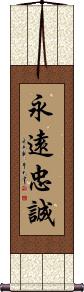
永遠忠誠 is the clearest and most natural way to translate “Semper Fidelis” or “Always Faithful” into Mandarin Chinese. 永遠忠誠 is meant explicitly for U.S. Marines who often use the shortened term “Semper Fi.”
The first two characters are a word that always means, forever, and/or eternally.
The last two characters are a word that means fidelity, loyal, and/or devotion.
I spent 10 years in the Marines, so it was a no-brainer to add this to our calligraphy database.
Semper Fidelis / Always Faithful
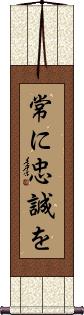
常に忠誠を is “Semper Fidelis” or “Always Faithful” in Japanese. This is specifically meant for U.S. Marines who often use the shortened term “Semper Fi.”
The first two Kanji mean “always” or “constantly.” The last three Kanji mean “faithful,” “loyal,” “devoted,” and/or “diligent.” It's most often read as “faithful.”
Note: Because this selection contains some special Japanese Hiragana characters, it should be written by a Japanese calligrapher.
Semper Fidelis / Always Faithful
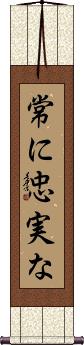
常に忠実な is an alternate way to write “Semper Fidelis” or “Always Faithful” in Japanese.
Note: Because this selection contains some special Japanese Hiragana characters, it should be written by a Japanese calligrapher.
Sincerity and Faithfulness
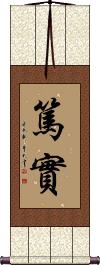
Faith
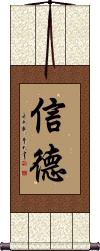
信德 is a term used often in Buddhism to express faith.
信德 is sometimes translated as the merit of the believing heart, faith of virtue, the power of faith, or virtuous faith.
In this context:
信 = Faith
德 = Virtue
Loyalty to Duty or Master
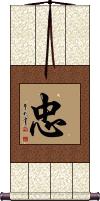
忠 is the simplest way to write the word loyalty in Chinese and Japanese.
A single character like this leaves the meaning open. But alone, a Chinese or Japanese person would think of loyalty to duty or loyalty to one's master (in ancient times). I suppose that it could be loyalty to your boss or company in this day in age.
忠 can also mean fidelity or faithfulness.
This can also be romanized as “chung.”
Loyalty
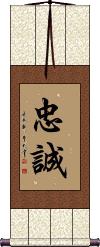
忠誠 is the written form of loyalty that is universal in Chinese, Japanese Kanji, and old Korean Hanja.
Loyalty is staying true to someone. It is standing up for something you believe in without wavering. It is being faithful to your family, country, school, friends, or ideals when the going gets tough and when things are good. With loyalty, you build relationships that last forever.
Notes:
1. There is also a Japanese version that is part of the Bushido Code which may be more desirable depending on whether your intended audience is Japanese or Chinese.
2. This version of loyalty is sometimes translated as devotion, sincerity, fidelity, or allegiance.
Loyalty / Devotion
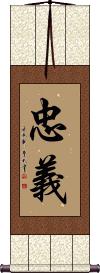
忠義 is another form of loyalty or devotion.
In Chinese, this is more specifically about being loyal and devoted to your friends.
In Japanese, this is more often used to mean loyalty to your country or nation.
Except for the slight difference noted above between Japanese and Chinese, this word is understood universally in Chinese, Japanese Kanji, and old Korean Hanja. It can also be used to describe devotion or fidelity.
It should be noted that this Kanji combination is being used less and less in modern Japan (this is a better choice if your audience is Chinese, though any Japanese person will clearly understand it).
Respect and Loyalty
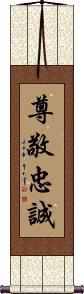
尊敬忠誠 means respect and loyalty in Chinese.
This is a word list (not a normal Chinese or Japanese phrase).
Word lists like this are not very common or natural in Chinese, so try to look for a better phrase to match your idea before you settle on this.
Ultimate Loyalty to Your Country
The most famous tattoo in Chinese history
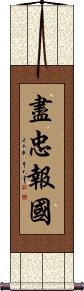
盡忠報國 is a proverb that is the tattoo worn on the back of Yue Fei, a famous Chinese warrior who lived until 1142 A.D.
The tattoo can be translated as “Serve the country with the utmost loyalty.” More literally, it means “[The] Ultimate Loyalty [is too] Duty [of] Country.”
Legend has it that this tattoo once saved his life when he was accused of treason.
The first two characters have come to create a word that means “serve the country faithfully” or “die for the country.” Note: It's more a willingness to die for one's country than the actual act of dying.
The last two characters have come to mean “Dedicate oneself to the service of one's country.”
Both of these words are probably only in the Chinese lexicon because of this famous tattoo.
If you break it down, character-by-character, here is what you get:
1. To the utmost, to the limit of something, the ultimate.
2. Loyalty or duty (a sense of duty to one's master, lord, country, or job).
3. Report, recompense, give back to (in this case, you are giving yourself to your country as payback).
4. Country, state, nation, kingdom.
Love Loyalty Respect
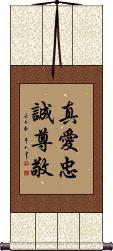
真愛忠誠尊敬 is a Chinese word list that means love, loyalty, and respect.
Love Loyalty Respect
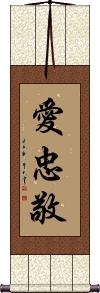
愛忠敬 is a Chinese word list that means love, loyalty, and respect.
愛忠敬 is the shortest way to express these words/ideas. Word lists are not as natural in Chinese as they are in English - phrases or proverbs are more common.
Appreciation of Truth by Meditation
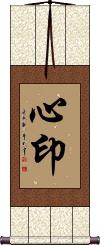
心印 is a Buddhist concept that simply stated is “appreciation of truth by meditation.”
It's a deep subject, but my understanding is that you can find truth through meditation, and once you've found the truth, you can learn to appreciate it more through further meditation. This title is not commonly used outside of the Buddhist community (your Asian friends may or may not understand it). The literal translation would be something like “the mind seal,” I've seen this term translated this way from Japanese Buddhist poetry. But apparently, the seal that is stamped deep in your mind is the truth. You just have to meditate to find it.
Soothill defines it this way: Mental impression, intuitive certainty; the mind is the Buddha-mind in all, which can seal or assure the truth; the term indicates the intuitive method of the Chan (Zen) school, which was independent of the spoken or written word.
Reference: Soothill-Hodous Dictionary of Chinese Buddhism
See Also: Zen
Believe
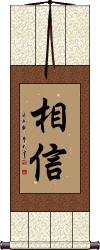
相信 is the Chinese way to say believe.
This specifically means to be convinced that something is true or to accept something as true or real.
This can also be translated as “convinced of,” “have trust in,” or “have faith in.”
Triple Truth of Japanese Buddhism
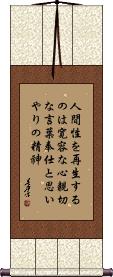
人間性を再生するのは寛容な心親切な言葉奉仕と思いやりの精神 is known as the Triple Truth of Buddhism in Japanese.
The Buddha ordered that all should know this triple truth...
A generous heart, kind speech, and a life of service and compassion are the things that renew humanity.
That is the English translation most commonly used for this Japanese Buddhist phrase. You might have seen this on a coffee cup or tee shirt.
Note: Because this selection contains some special Japanese Hiragana characters, it should be written by a Japanese calligrapher.
Comparison Leads to Truth and Enlightenment
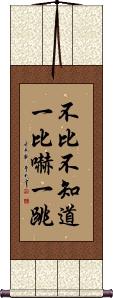
不比不知道一比吓一跳 is a Chinese proverb that literally means: [If one not does] not make comparisons, [one will] not know [the truth] when [one] compares, [one will be] greatly surprised.
This goes to the idea that if you do not know bad times, you cannot know what good times are.
...And...
You can not know light without experiencing darkness.
Another way to translate this would be: If you wish to be enlightened, you need to make comparisons and analyze every aspect (of a situation, issue, or problem).
The Five Tenets of Confucius
The Five Cardinal Rules / Virtues of Confucius
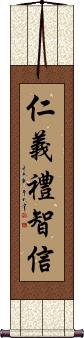
仁義禮智信 are the core of Confucius's philosophy.
Simply stated:
仁 = Benevolence / Charity
義 = Justice / Rectitude
禮 = Courtesy / Politeness / Tact
智 = Wisdom / Knowledge
信 = Fidelity / Trust / Sincerity
Many of these concepts can be found in various religious teachings. It should be clearly understood that Confucianism is not a religion but should instead be considered a moral code for a proper and civilized society.
This title is also labeled “5 Confucian virtues.”
 If you order this from the Japanese calligrapher, expect the middle Kanji to be written in a more simple form (as seen to the right). This can also be romanized as "jin gi rei satoshi shin" in Japanese. Not all Japanese will recognize this as Confucian tenets but they will know all the meanings of the characters.
See Also: Confucius Teachings | Ethics
Dependable
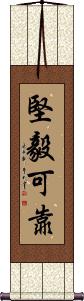
The first two characters mean resolute with firm determination.
The second two characters mean reliable.
Together, this creates a 4-character expression that means dependable.
Devotion / Dedication / Attentive / Focused
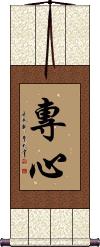
專心 makes a word that means “paying attention with your heart.”
It's often translated as “dedication,” as in “be absorbed in” or “concentrate one's efforts.” It's also used to mean “with the single mind,” “whole-heartedly,” “paying attention,” “undivided attention,” “concentration (-ed),” “engrossed,” “devotionally (listening/watching),” and/or “attentive.”
The first character means “for a particular person, occasion, or purpose,” “focused on one single thing,” “concentrated,” and sometimes, “special.”
The second character means “heart” or “mind” by itself.
My favorite translation, which comes from the Oxford Advanced Chinese/English Dictionary, is, “wholehearted devotion.”
If it seems like the meaning of this word is quite open, you are correct. The context in which the word is used matters a lot. It can mean different things depending on how you use it. This makes it kind of nice as you can decide what this means to you (within some limits). This is always positive in meaning, so even if a Chinese person reads it differently than you, it will still have a good meaning.
 In Japanese, they tend to use a variation of the second character which has one less stroke. If you want your calligraphy written this Japanese form, please click on the Kanji shown to the right instead of the button above. Note: Japanese and Chinese people will recognize either form.
Devotion / Diligence / Vigorous / Energetic
vīrya
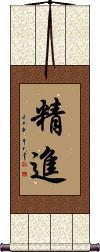
精進 is a wide-ranging word that is used in Chinese, Japanese, and Korean.
It can mean devotion, diligence, concentration, aggressive, enterprising, vigorous, energetic, purification, pushing, asceticism, assiduity, or virility. 精進 is deep, and these two characters can express ideas that take a full English phrase to describe, such as “concentration of mind,” “to forge ahead vigorously,” or “to dedicate oneself to progress.”
Used in the context of Buddhism, it means “making earnest efforts to cultivate virtue and get rid of evil” or “zeal in one's quest for enlightenment.”
Fidelity Honor Courage
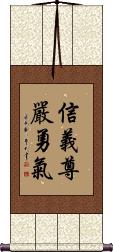
信義尊嚴勇氣 means fidelity, honor, and courage in Chinese.
This is a word list that was requested by a customer. Word lists are not common in Chinese, but we've put this one in the best order/context to make it as natural as possible.
We used the “honor” that leans toward the definition of “dignity” since that seemed the best match for the other two words.
Please note: These are three two-character words. You should choose the single-column format when you get to the options when you order this selection. The two-column option would split one word or be arranged with four characters on one side and two on the other.
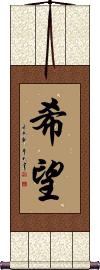
Hope
Integrity
Integrity is living by your highest values. It is being honest and sincere. Integrity helps you to listen to your conscience, do the right thing, and tell the truth. You act with integrity when your words and actions match. Integrity gives you self-respect and a peaceful heart.Please note that the second Kanji sometimes has an alternate form in Japanese. Let us know if you want the alternate form shown to the right.
Note: This entry is cross-listed as “honesty” because it also fits that definition.
Beyond Integrity, this word also means "upright" and "honest" in Chinese. Means "integrity," "honesty" or "frankness" in Japanese.
Justice / Rectitude / Right Decision
Also means: honor loyalty morality righteousness
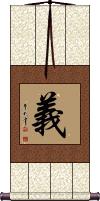
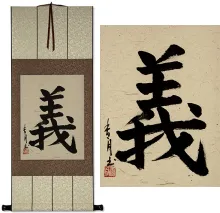
義 is about doing the right thing or making the right decision, not because it's easy but because it's ethically and morally correct.
No matter the outcome or result, one does not lose face if tempering proper justice.
義 can also be defined as righteousness, justice, morality, honor, or “right conduct.” In a more expanded definition, it can mean loyalty to friends, loyalty to the public good, or patriotism. This idea of loyalty and friendship comes from the fact that you will treat those you are loyal to with morality and justice.
義 is also one of the five tenets of Confucius's doctrine.
 There's also an alternate version of this character sometimes seen in Bushido or Korean Taekwondo tenets. It's just the addition of a radical on the left side of the character. If you want this version, click on the image to the right instead of the button above.
This is also a virtue of the Samurai Warrior
See our page with just Code of the Samurai / Bushido here
See Also: Judgment | Impartial | Confucius Tenets
Hoes Before Bros
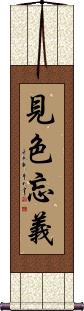
見色忘義 is a modern Chinese idiom that means to put love before loyalty or to forget loyalty when in love.
This would be roughly equivalent to the English, “Hoes before bros.”
Respect, Honor, Truth
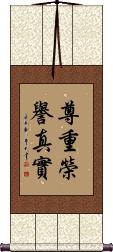
尊重, 榮譽, 真實 means “Respect, Honor, Truth” in Chinese.
This is a word list, which is not the most natural kind of composition in Chinese (usually there is a subject, object, and verb - or a single word).
Respect, Honor, Truth
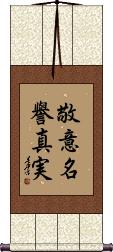
This means “Respect, Honor, Truth” in Japanese.
This is a word list, which is not the most natural kind of composition in Japanese (usually there is a subject, object, and verb - or a single word).
Sacrifice / Devotion / Dedication
(complete bodily devotion)
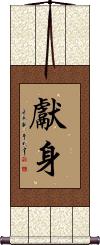
獻身 is used to describe being so devoted to something that you will make sacrifices for that goal/thing/person.
You can also translate this word as any of the following:
Sacrifice one's life for...
To dedicate oneself to...
Self-devotion
Dedication
Devote to...
Self-sacrifice
Giving your whole body to...
This can be a dedication to or for someone but is often used as a dedication or making sacrifices for your country, public service, or a cause. For instance, an Olympic athlete makes great sacrifices to train in his/her sport for their country and compatriots.

 While the form shown to the upper-left is considered an ancient Japanese version, in modern Japan, they use the simplified version of the first Kanji (shown to the right). Click on the Kanji at the right instead of the button above if you want this modern Japanese version.
If you are looking for a more religious meaning of devotion, see Faith.
See Also: Confidence | Dedication
Seeking Truth
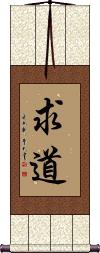
求道 means seeking for truth, or to seek (practice for, strive for) enlightenment.
求道 is used mostly in a Buddhist context, so some non-Buddhists may not recognize it.
Most Sincere Friend / Honest Friend / Real Friend / Best Friend
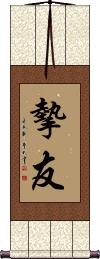
摯友 is one way to say best friend in Chinese.
The first character can mean “honest” or “most sincere.” The second character means “friend” or “friends” (plural forms work differently in Chinese).
See Also: Friendship | Soulmates
Sincerity and Devotion
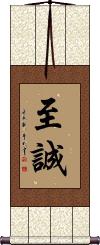
至誠 is the idea that you enter into something with the utmost sincerity and fidelity. Ideas such as devotion, honesty, and “one's true heart” are also contained in this word.
至誠 is a universal word as the Chinese, Japanese Kanji, and Korean Hanja are all identical.
Honest / Straightforward
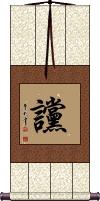
Tathata / Ultimate Nature of All Things
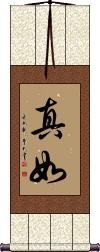
真如 comes from the Sanskrit and Pali word often romanized as “tathata” or “tathatā.” Originally written, “तथता.”
It's a Buddhist term often translated as “thusness” or “suchness,” but this does not explain it.
A better explanation may be “the ultimate nature of all things” or “ultimate truth.” However, this gives it too strong of a feeling. This concept is sometimes described as being in awe of the simple nature of something - like a blade of grass blowing in the wind or ripples on water. It is what it is supposed to be, these things follow their nature. Amazing in their mundane simplicity.
Every sect of Buddhism will have a slightly different flavor or explanation, so don't get fixated on one definition.
Notes: Sometimes Buddhists use the word dharmatā, a synonym to tathatā.
In Japan, this can also be the female given name Mayuki, or the surname Majo.
Thirst for Truth
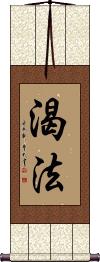
渴法 means to thirst for the truth or the Buddha-way.
渴法 is the internal need to seek the way of the truth in Buddhism.
The Three Truths
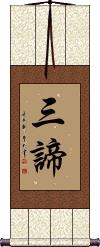
三諦 is a Buddhist term that means “threefold truth” or “three dogmas.”
The three truths are:
1. All things are void (卽空).
2. All things are temporary (卽假).
3. All things are in the middle state between these two (卽中).
True / Real / Genuine
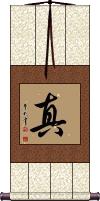
真 is a simple way to express the idea that something is real, true, truth, or genuine.
Occasionally, this character refers to a Buddhist sect that originated in the 13th century.
真 is commonly used as a compound with other characters to create ideas like “true love.” It's also used similarly to the English words “really” or “truly” to say “really good” or “He is really knowledgeable.” Those phrases start with “他真的是... (note the second character is 真).
There are two ways to write this character, shown here is the most common way in China; however, a slight stroke variation is used in Korean Hanja. If you want that version, just let us know when you place your order.
See Also: Honesty
True Religion / Buddha Truth
The way of the truth
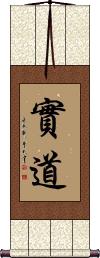
實道 is a Buddhist title that means “The true way,” “The true religion,” “The way of the truth,” or “The absolute Buddha-truth.”
Truth Flashed Through The Mind
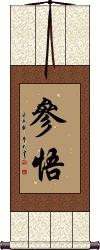
參悟 is a Chan / Zen Buddhism concept that means “to understand (mystery) from meditation” or “to see truth flash through the mind.”
參悟 is a pretty deep idea; therefore, your study and contemplation may be required before fully appreciating it.
Truth Goodness and Beauty
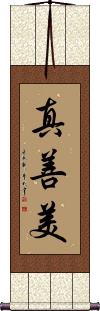
真善美 means truth, goodness, and beauty in Chinese and Japanese.
These can also be read as “the true, the good, and the beautiful.”
In Japanese, this can be the female given name Mazemi or the personal name Shinzenbi.
Truth
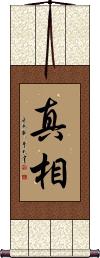
Truth
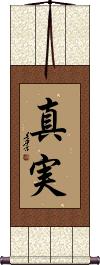
真実 means “truth,” “actual,” or “reality” in Japanese.
The second character is modified or no longer used in Chinese vocabulary - so this is Japanese only.
In Wine there is Truth

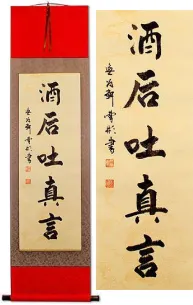
酒后吐真言 / 酒後吐真言 is a nice Asian proverb if you know a vintner or wine seller - or wine lover - although the actual meaning might not be exactly what you think or hope.
The literal meaning is that someone drinking wine is more likely to let the truth slip out. It can also be translated as “People speak their true feelings after drinking alcohol.”
It's long believed in many parts of Asia that one can not consciously hold up a facade of lies when getting drunk, and therefore the truth will come out with a few drinks.
I've had the experience where a Korean man would not trust me until I got drunk with him (I was trying to gain access to the black market in North Korea which is tough to do as an untrusted outsider) - so I think this idea is still well-practiced in many Asian countries.
 VS
VS 
Please note that there are two common ways to write the second character of this phrase. The way it's written will be left up to the mood of the calligrapher, unless you let us know that you have a certain preference.
Walk in the Way
The Way of Buddha Truth
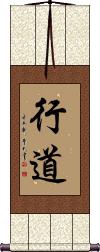
In Taoist and Buddhist contexts, 行道 means to “Walk in the Way.” In Buddhism, that further means to follow the Buddha truth. In some Buddhist sects, this can mean making a procession around a statue of the Buddha (always with the right shoulder towards the Buddha).
Outside of that context, this can mean route (when going somewhere), the way to get somewhere, etc.
In Japanese, this can be the surname or given name Yukimichi.
Ultimate Truth
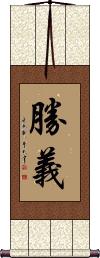
勝義 is a Buddhist term that can mean ultimate truth, beyond description, that which surpasses mere earthly ideas, superlative, or inscrutable.
In Japan, this can also be a given name romanized as Yoshitomo.
Knowledge of Ultimate Truth
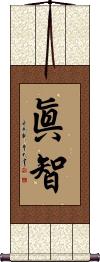
眞智 can mean the wisdom or knowledge of ultimate truth.
眞智 is also the absolute knowledge of the non-thing or that which is immaterial. This makes more sense when you consider that true wisdom includes the knowledge of both the real and unreal, or what is material and immaterial.
In Japan, 眞智 (Masatoshi) can also be a given name.
Enlightened Truth
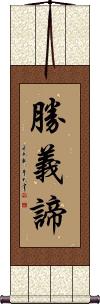
This Buddhist term means the superior truth or enlightened truth.
勝義諦 is a realm of understanding that is far beyond worldly truth.
Some will also define this as the ultimate truth.
The Supreme Mahayana Truth
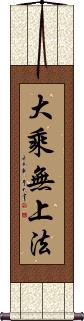
大乘無上法 means the supreme Mahāyāna truth.
This refers to the ultimate reality in contrast with the temporary and apparent. Other translations include “the reliance on the power of the vow of the bodhisattva” or “the peerless great vehicle teaching.”
Note: This may suggest that Mahayana Buddhism, as practiced in China, Japan, Korea, Vietnam, and other regions is superior (with subtle arrogance) to the original Theravada (or old school) Buddhism. Mahayana and Theravada Buddhists generally get along better than Catholics and Protestants, but there have been schisms.
Kyojitsu: Falsehood and Truth
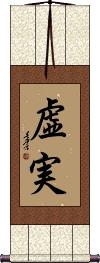
虚実 is a Japanese word that means “falsehood [and] truth” or “fiction [and] fact.”
This concept is used in warfare, gameplay, and martial arts strategies. 虚実 can be a strategy of real and/or deceptive moves. This gets to some Sun Tzu Art of War stuff where in warfare a strategic move is either a real and serious move or it is a deceptive blow.
Let's explore each character in more depth:
虚 was originally written 虛 (there is a very subtle difference in the strokes at the bottom of the character) and means unpreparedness, falsehood, emptiness, void, abstract theory, empty or unoccupied, diffident or timid, false, humble or modest, virtual, or in vain.
In the Buddhist context, 虛 represents the Pali/Sanskrit word “śūnya,” meaning empty, vacant, unreal, unsubstantial, untrue, space, humble, or in vain.
In ancient Eastern/Chinese astronomy, 虛 represents the “Emptiness” constellation (one of the 28 mansions in the sky).
実 was originally 實 in Chinese (they currently write it as 实 in Simplified Chinese) with the meaning, truth, reality, sincerity, honesty, fidelity, and substance.
The Buddhist context is similar, adding real, true, honest, really, solid, definitely, sincere, solid, fixed, full, to fill, fruit, kernel, verily, in fact, the supreme fact, or ultimate reality to the definition.
This in-stock artwork might be what you are looking for, and ships right away...
Gallery Price: $168.00
Your Price: $92.88
Gallery Price: $90.00
Your Price: $49.88
Gallery Price: $200.00
Your Price: $88.88
Gallery Price: $200.00
Your Price: $88.88
Gallery Price: $200.00
Your Price: $88.88
Gallery Price: $200.00
Your Price: $109.88
Gallery Price: $65.00
Your Price: $39.88

Gallery Price: $36.00
Starting at: $20.00
The following table may be helpful for those studying Chinese or Japanese...
| Title | Characters | Romaji (Romanized Japanese) | Various forms of Romanized Chinese | |
| Trust To Have Faith | 信賴 信赖 | shinrai | xìn lài / xin4 lai4 / xin lai / xinlai | hsin lai / hsinlai |
| Believe Faith Trust | 信 | shin | xìn / xin4 / xin | hsin |
| Belief Trust | 信任 | shinnin | xìn rèn / xin4 ren4 / xin ren / xinren | hsin jen / hsinjen |
| Faith Trusting in the Unseen | 信念 | shinnen | xìn niàn / xin4 nian4 / xin nian / xinnian | hsin nien / hsinnien |
| Faithful Honorable Trustworthy Fidelity Loyalty | 信義 信义 | shingi | xìn yì / xin4 yi4 / xin yi / xinyi | hsin i / hsini |
| Trust in God | 信靠上帝 | xìn kào shàng dì xin4 kao4 shang4 di4 xin kao shang di xinkaoshangdi | hsin k`ao shang ti hsinkaoshangti hsin kao shang ti |
|
| Trust No One Trust No Man | 無法信任 无法信任 | wú fǎ xìn rèn wu2 fa3 xin4 ren4 wu fa xin ren wufaxinren | wu fa hsin jen wufahsinjen |
|
| Trust No One Trust No Man | 誰も信じるな | dare mo shin ji ru na daremoshinjiruna | ||
| Trust in God In God We Trust | 相信上帝 | xiāng xìn shàng dì xiang1 xin4 shang4 di4 xiang xin shang di xiangxinshangdi | hsiang hsin shang ti hsianghsinshangti |
|
| Trust in God Belief in God | 神の信仰 | kami no shin kou kaminoshinkou kami no shin ko | ||
| Trust in God Faith in God | 神を信ぜよ | kami wo shin ze yo kamiwoshinzeyo | ||
| Trust Your Heart | 相信你的心 | xiàng xìn nǐ dì xīn xiang4 xin4 ni3 di4 xin1 xiang xin ni di xin xiangxinnidixin | hsiang hsin ni ti hsin hsianghsinnitihsin |
|
| Honesty | 正直 | shoujiki / shojiki | zhèng zhí zheng4 zhi2 zheng zhi zhengzhi | cheng chih chengchih |
| Honesty | 實 实 | shí / shi2 / shi | shih | |
| Honesty | 誠 诚 | makoto | chéng / cheng2 / cheng | ch`eng / cheng |
| Honesty Fidelity | 信 | shin | xìn / xin4 / xin | hsin |
| Integrity Honesty | 清廉 | sei ren / seiren | qīng lián qing1 lian2 qing lian qinglian | ch`ing lien chinglien ching lien |
| Religious Devotion Faith in God Religious Faith | 信仰 | shin kou / shinkou / shin ko | xìn yǎng / xin4 yang3 / xin yang / xinyang | hsin yang / hsinyang |
| Faith is the bird that feels the light when the dawn is still dark | 信唸是在黎明前的黑闇中能感到光明的鳥 信念是在黎明前的黑暗中能感到光明的鸟 | xìn niǎn shì zài lí míng qián de hēi àn zhōng néng gǎn dào guāng míng de niǎo xin4 nian3 shi4 zai4 li2 ming2 qian2 de hei1 an4 zhong1 neng2 gan3 dao4 guang1 ming2 de niao3 xin nian shi zai li ming qian de hei an zhong neng gan dao guang ming de niao | hsin nien shih tsai li ming ch`ien te hei an chung neng kan tao kuang ming te niao hsin nien shih tsai li ming chien te hei an chung neng kan tao kuang ming te niao |
|
| Faith Hope Love | 信望愛 信望爱 | xìn wàng ài xin4 wang4 ai4 xin wang ai xinwangai | hsin wang ai hsinwangai |
|
| Faith Hope Love | 信仰と希望と愛 | shinkou to kibou to ai shinkoutokiboutoai shinko to kibo to ai | ||
| Faith Love Peace | 信愛和 信爱和 | shin ai wa shinaiwa | xìn ài hé xin4 ai4 he2 xin ai he xinaihe | hsin ai ho hsinaiho |
| Good Intentions Good Will Good Faith | 善意 | zen i / zeni | shàn yì / shan4 yi4 / shan yi / shanyi | shan i / shani |
| Integrity: Sincere Honest and Faithful | 誠實 誠実 | sei jitsu / seijitsu | ||
| Firm Belief Strong Faith | 堅信 坚信 | ken shin / kenshin | jiān xìn / jian1 xin4 / jian xin / jianxin | chien hsin / chienhsin |
| Love Faith Strength | 愛信強 爱信強 | ài xìn qiáng ai4 xin4 qiang2 ai xin qiang aixinqiang | ai hsin ch`iang aihsinchiang ai hsin chiang |
|
| Love Faith Strength | 博愛信念力量 博爱信念力量 | bó ài xìn niàn lì liàng bo2 ai4 xin4 nian4 li4 liang4 bo ai xin nian li liang boaixinnianliliang | po ai hsin nien li liang poaihsinnienliliang |
|
| Loyalty Faithful Devoted | 忠實 忠実 | chuujitsu / chuugi chujitsu / chugi | ||
| Semper Fidelis Always Faithful | 永遠忠誠 永远忠诚 | yǒng yuǎn zhōng chéng yong3 yuan3 zhong1 cheng2 yong yuan zhong cheng yongyuanzhongcheng | yung yüan chung ch`eng yungyüanchungcheng yung yüan chung cheng |
|
| Semper Fidelis Always Faithful | 常に忠誠を | tsune ni chuu sei wo tsunenichuuseiwo tsune ni chu sei wo | ||
| Semper Fidelis Always Faithful | 常に忠実な | tsune ni chuu jitsu na tsunenichuujitsuna tsune ni chu jitsu na | ||
| Sincerity and Faithfulness | 篤實 笃实 | dǔ shí / du3 shi2 / du shi / dushi | tu shih / tushih | |
| Faith | 信德 | shin toku / shintoku | xìn dé / xin4 de2 / xin de / xinde | hsin te / hsinte |
| Loyalty to Duty or Master | 忠 | chuu / chu | zhōng / zhong1 / zhong | chung |
| Loyalty | 忠誠 忠诚 | chuu sei / chuusei / chu sei | zhōng chéng zhong1 cheng2 zhong cheng zhongcheng | chung ch`eng chungcheng chung cheng |
| Loyalty Devotion | 忠義 忠义 | chuu gi / chuugi / chu gi | zhōng yì / zhong1 yi4 / zhong yi / zhongyi | chung i / chungi |
| Respect and Loyalty | 尊敬忠誠 尊敬忠诚 | son kei chu sei sonkeichusei | zūn jìng zhōng chéng zun1 jing4 zhong1 cheng2 zun jing zhong cheng zunjingzhongcheng | tsun ching chung ch`eng tsunchingchungcheng tsun ching chung cheng |
| Ultimate Loyalty to Your Country | 盡忠報國 尽忠报国 | jìn zhōng bào guó jin4 zhong1 bao4 guo2 jin zhong bao guo jinzhongbaoguo | chin chung pao kuo chinchungpaokuo |
|
| Love Loyalty Respect | 真愛忠誠尊敬 | zhēn ài zhōng chéng zū jìng zhen1 ai4 zhong1 cheng2 zu1 jing4 zhen ai zhong cheng zu jing zhenaizhongchengzujing | chen ai chung ch`eng tsu ching chenaichungchengtsuching chen ai chung cheng tsu ching |
|
| Love Loyalty Respect | 愛忠敬 | ài zhōng jìng ai4 zhong1 jing4 ai zhong jing aizhongjing | ai chung ching aichungching |
|
| Appreciation of Truth by Meditation | 心印 | shin nin / shinnin | xīn yìn / xin1 yin4 / xin yin / xinyin | hsin yin / hsinyin |
| Believe | 相信 | xiāng xìn xiang1 xin4 xiang xin xiangxin | hsiang hsin hsianghsin |
|
| Triple Truth of Japanese Buddhism | 人間性を再生するのは寛容な心親切な言葉奉仕と思いやりの精神 | ningensei o saisei suruno wa kanyou na kokoro shinsetsu na kotoba houshi to omoi yari no seishin ningensei o saisei suruno wa kanyo na kokoro shinsetsu na kotoba hoshi to omoi yari no seishin | ||
| Comparison Leads to Truth and Enlightenment | 不比不知道一比嚇一跳 不比不知道一比吓一跳 | bù bǐ bù zhī dào yī bǐ xià yì tiào bu4 bi3 bu4 zhi1 dao4 yi1 bi3 xia4 yi4 tiao4 bu bi bu zhi dao yi bi xia yi tiao | pu pi pu chih tao i pi hsia i t`iao pu pi pu chih tao i pi hsia i tiao |
|
| The Five Tenets of Confucius | 仁義禮智信 仁义礼智信 | jin gi rei tomo nobu jingireitomonobu | rén yì lǐ zhì xìn ren2 yi4 li3 zhi4 xin4 ren yi li zhi xin renyilizhixin | jen i li chih hsin jenilichihhsin |
| Dependable | 堅毅可靠 坚毅可靠 | jiān yì kě kào jian1 yi4 ke3 kao4 jian yi ke kao jianyikekao | chien i k`o k`ao chienikokao chien i ko kao |
|
| Devotion Dedication Attentive Focused | 專心 / 専心 / 耑心 专心 | sen shin / senshin | zhuān xīn zhuan1 xin1 zhuan xin zhuanxin | chuan hsin chuanhsin |
| Devotion Diligence Vigorous Energetic | 精進 精进 | shoujin / shojin | jīng jìn / jing1 jin4 / jing jin / jingjin | ching chin / chingchin |
| Fidelity Honor Courage | 信義尊嚴勇氣 信义尊严勇气 | xìn yì zūn yán yǒng qì xin4 yi4 zun1 yan2 yong3 qi4 xin yi zun yan yong qi xinyizunyanyongqi | hsin i tsun yen yung ch`i hsinitsunyenyungchi hsin i tsun yen yung chi |
|
| Hope | 希望 | ki bou / kibou / ki bo | xī wàng / xi1 wang4 / xi wang / xiwang | hsi wang / hsiwang |
| Integrity | 正直 | shoujiki / shojiki | zhèng zhí zheng4 zhi2 zheng zhi zhengzhi | cheng chih chengchih |
| Justice Rectitude Right Decision | 義 义 | gi | yì / yi4 / yi | i |
| Hoes Before Bros | 見色忘義 见色忘义 | jiàn sè wàng yì jian4 se4 wang4 yi4 jian se wang yi jiansewangyi | chien se wang i chiensewangi |
|
| Respect, Honor, Truth | 尊重, 榮譽, 真實 尊重, 荣誉, 真实 | zūn zhòng róng yù zhēn shí zun1 zhong4 rong2 yu4 zhen1 shi2 zun zhong rong yu zhen shi zunzhongrongyuzhenshi | tsun chung jung yü chen shih tsunchungjungyüchenshih |
|
| Respect, Honor, Truth | 敬意, 名譽, 真実 敬意, 名誉, 真実 | keii meiyo shinjitsu keiimeiyoshinjitsu kei meiyo shinjitsu | ||
| Sacrifice Devotion Dedication | 獻身 献身 | ken shin / kenshin | xiàn shēn xian4 shen1 xian shen xianshen | hsien shen hsienshen |
| Seeking Truth | 求道 | gu dou / gudou / gu do | qiú dào / qiu2 dao4 / qiu dao / qiudao | ch`iu tao / chiutao / chiu tao |
| Most Sincere Friend Honest Friend Real Friend Best Friend | 摯友 挚友 | zhì yǒu / zhi4 you3 / zhi you / zhiyou | chih yu / chihyu | |
| Sincerity and Devotion | 至誠 至诚 | shisei | zhì chéng zhi4 cheng2 zhi cheng zhicheng | chih ch`eng chihcheng chih cheng |
| Honest Straightforward | 讜 谠 | dǎng / dang3 / dang | tang | |
| Tathata Ultimate Nature of All Things | 真如 | shinnyo | zhēn rú / zhen1 ru2 / zhen ru / zhenru | chen ju / chenju |
| Thirst for Truth | 渴法 | katsuhō | kě fǎ / ke3 fa3 / ke fa / kefa | k`o fa / kofa / ko fa |
| The Three Truths | 三諦 三谛 | san dai / san tai sandai / santai | sān dì / san1 di4 / san di / sandi | san ti / santi |
| True Real Genuine | 真 or 眞 真 | shin / makoto | zhēn / zhen1 / zhen | chen |
| True Religion Buddha Truth | 實道 实道 | jitsu dou / jitsudou / jitsu do | shí dào / shi2 dao4 / shi dao / shidao | shih tao / shihtao |
| Truth Flashed Through The Mind | 參悟 参悟 | cān wù / can1 wu4 / can wu / canwu | ts`an wu / tsanwu / tsan wu | |
| Truth Goodness and Beauty | 真善美 | shin zen bi shinzenbi | zhēn shàn měi zhen1 shan4 mei3 zhen shan mei zhenshanmei | chen shan mei chenshanmei |
| Truth | 真相 | shin sou / shinsou / shin so | zhēn xiàng zhen1 xiang4 zhen xiang zhenxiang | chen hsiang chenhsiang |
| Truth | 真實 真実 | shinjitsu / sana | ||
| In Wine there is Truth | 酒后吐真言 / 酒後吐真言 酒后吐真言 | jiǔ hòu tǔ zhēn yán jiu3 hou4 tu3 zhen1 yan2 jiu hou tu zhen yan jiuhoutuzhenyan | chiu hou t`u chen yen chiuhoutuchenyen chiu hou tu chen yen |
|
| Walk in the Way | 行道 | yukimichi | xíng dào / xing2 dao4 / xing dao / xingdao | hsing tao / hsingtao |
| Ultimate Truth | 勝義 胜义 | shougi / shogi | shèng yì / sheng4 yi4 / sheng yi / shengyi | sheng i / shengi |
| Knowledge of Ultimate Truth | 眞智 | masatoshi | zhēn zhì / zhen1 zhi4 / zhen zhi / zhenzhi | chen chih / chenchih |
| Enlightened Truth | 勝義諦 胜义谛 | shou gi tai shougitai sho gi tai | shèng yì dì sheng4 yi4 di4 sheng yi di shengyidi | sheng i ti shengiti |
| The Supreme Mahayana Truth | 大乘無上法 大乘无上法 | dai jou mu jou hou daijoumujouhou dai jo mu jo ho | dà shèng wú shàng fǎ da4 sheng4 wu2 shang4 fa3 da sheng wu shang fa dashengwushangfa | ta sheng wu shang fa tashengwushangfa |
| Kyojitsu: Falsehood and Truth | 虚実 | kyo jitsu / kyojitsu | ||
| In some entries above you will see that characters have different versions above and below a line. In these cases, the characters above the line are Traditional Chinese, while the ones below are Simplified Chinese. | ||||




