Artwork
Search:

Exact
Phrase

Oriental Outpost LogoFlagTowerwatercolor
Chinese Calligraphy Search
ArtPaintingsAsian Art Gallery

Adventures in Asian Art

Didn't find what you want?
Try these methods:

1. Make your search more specific.
2. Use other similar-meaning words.
3. Use less words or just one word.
4. Post your request on our forum so that we can translate/create what you want.


Selections for Emperor in Chinese and/or Japanese...

We'll build you a handmade custom "Emperor" calligraphy wall scroll if you wish!


Quick links to words on this page...


Select

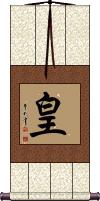
Emperor

Mandarin: huáng
Japanese: kou
Korean:

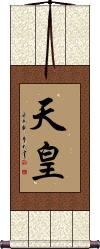
皇

This is the simple, single-character way to write emperor in Chinese and Japanese.

See Also...  Empress | King | Queen | Dragon

Score: 100/100

Select

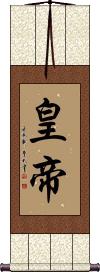
Emperor

Mandarin: huáng dì
Japanese: koutei
Korean: 황제

皇
帝

From times of old, the emperors of Asia ruled under the authority of God himself. In fact, one definition of an emperor is a ruler put in power by God. This definition separates emperors from the various kings in Chinese history (although defining who is a king versus an emperor gets vague sometimes).

Occasionally, the emperor's wife was widowed, and she took the role of empress until her death (see our entry for empress if that is what you are looking for).

See Also...  Empress | King | Queen | Dragon

Score: 100/100

Select

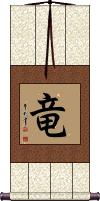
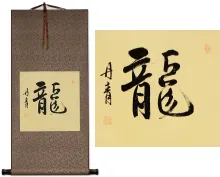
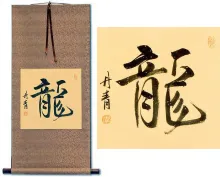
Dragon / Emperor Symbol

Mandarin: lóng
Japanese: ryuu / tatsu
Korean:

竜

This is an alternate form of dragon. Still pronounced the same in Chinese, Japanese, and Korean (this version is more popular in the Japanese language, but generally recognized by most Chinese people - recognized in Korean until 100 years ago).

This particular Kanji is often associated as an imperial symbol as well as representing the mythical Asian dragon. You may have seen it on the chest or flag of the emperor in old Japanese and Chinese movies.

Note: I would rate this as a non-universal alternate form. The other dragon character is by far more common, and universally understood.

Special Japanese note: This is the shinjitai (new character form). Shinjitai Kanji are the result a simplification effort in Japan after WWII. Theoretically, this is the only official way to write "dragon" in modern Japanese. However, virtually all Japanese people recognize the traditional and ancient form.

See Also...  Phoenix | King

Score: 100/100

Select

Empress

Mandarin: huáng hòu
Japanese: kou gou
Korean: 황후

皇
后

This is the title of empress or emperess, the female form of emperor. This is used in Chinese, Japanese Kanji, and old Korean Hanja.

While the emperor's reign was for life, if he died, his wife would hold his power. In this case, a woman was the ultimate ruler of the greater part of East Asia (what is now China) until her death and the succession of the emperor's first born son to lead the empire. Numerous times in various Chinese dynasties, an empress took power in this way.

The first character means emperor by itself.

The second character alone can mean "wife of an emperor or king" (the first character clarifies that we are talking about an empress, and not a queen). It can also mean sovereign or last offspring, depending on context.

Note: In some books, this word is translated as queen. While only incorrect if you get technical (because an empress is theoretically a higher level than a queen), the meaning is very similar.

This is sometimes used for the title of queen, but more technically, this is the wife of the emperor (a higher level than a queen).

See Also...  King | Queen | Phoenix

Score: 83/100

Select

Queen / Empress

Wife of the King

Mandarin: wáng hòu
Japanese: ou kou
Korean: 왕후

王
后

This is another way to write queen in Chinese, Japanese Kanji, and old Korean Hanja.

This is sometimes used for the title of empress.

The first character means "king" and the second means "wife", or a short form to say "wife of the king / emperor". So this is literally, "king's wife" or "emperor's wife". Some will translate this as "queen consort".

See Also...  Queen | Goddess | King

Score: 43/100

Select

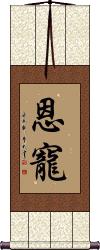
Grace from Heaven / Grace from God

Mandarin: tiān ēn
Japanese: ten on

天
恩

This is the deepest way to say "Heaven's Grace" or "God's Grace" in Chinese characters and Japanese Kanji.

The first character means Heaven or sky (referring in this case to the domain of God).
The second character means grace, blessings, benevolence, favor / favour, acts of kindness, merits, or beneficial influence.

This title can also be defined as:
Blessings of Heaven, Favor of the Emperor, Divination's luckiest day, or blessings of nature. Note: When you see "Emperor" above, keep in mind that the Emperor, like the Pope is theoretically chosen by God, or seen as an emissary or conduit of God in ancient Asian culture. It would only be read that way in certain context such as, "The Emperor, in his mercy, bestowed upon him Heaven's Grace and the prisoner was set free".

Score: 37/100

Select

Undaunted After Repeated Setbacks

Persistence to overcome all challenges

Mandarin:
bǎi zhé bù náo

Japanese:
hyaku setsu su tou

Korean: 백절불요

百
折
不
撓

This phrase means "Be undaunted in the face of repeated setbacks".

It comes from a long, and occasionally tragic story of a man that lived sometime around 25-220 AD. His name was Qiao Xuan and he never stooped to flattery, but remained an upright person at all times. He fought to expose corruption of higher-level government officials at great risk to himself.

Then when he was at a higher level in the Imperial Court, bandits were regularly capturing hostages and demanding ransoms. But when his own son was captured, he was so focused on his duty to the Emperor and common good that he sent a platoon of soldiers to raid the bandits' hideout, and stop them once and for all even at the risk of his own son's life. While all of the bandits were arrested in the raid, they killed Qiao Xuan's son at first sight of the raiding soldiers.

Near the end of his career a new Emperor came to power, and Qiao Xuan reported to him that one of his ministers was bullying the people and extorting money from them. The new Emperor refused to listen to Qiao Xuan and even promoted the corrupt Minister. Qiao Xuan was so disgusted that in protest he resigned his post as minister (something almost never done) and left for his home village.

His tombstone reads "Bai Zhe Bu Nao" which is now a phrase used in Chinese culture to describe a person of strong will who puts up stubborn resistance against great odds.

My Chinese-English dictionary defines these 4 characters as, "keep on fighting in spite of all setbacks", "be undaunted by repeated setbacks" and "be indomitable".

Our translator says it can mean, "never give up" in modern Chinese.

Although the first two characters are translated correctly as "repeated setbacks", the literal meaning is "100 setbacks" or "a rope that breaks 100 times". The last two characters can mean "do not yield" or "do not give up".
Most Chinese, Japanese, and Korean people will not take this absolutely literal meaning, but will instead understand it as the title suggests above.

See Also...  Tenacity | Fortitude | Strength | Perseverance

Score: 28/100

Back to the top of this page

Select

Work Unselfishly for the Common Good

Mandarin:
kè jǐ fèng gōng

Korean: 극기봉공

克
己
奉
公

This can also mean: "Place Strict Standards on Oneself in Public Service".
This Chinese phrase is often used to express how one should act as a government official. Most of us wish our public officials would hold themselves to higher standards. I wish I could send this scroll, along with the meaning to every member of Congress, and the President (or if I was from the UK, all the members of Parliament, and the PM)

The story behind this ancient Chinese idiom:
A man named Cai Zun was born in China a little over 2000 years ago. In 24 AD, he joined an uprising led by Liu Xiu who later became the emperor of the Eastern Han Dynasty.

Later, the new emperor put Cai Zun in charge of the military court. Cai Zun exercised his power in strict accordance with military law, regardless of the offender's rank or background. He even ordered the execution of one of the emperor's close servants after the servant committed a serious crime.

Cai Zun led a simple life, but put great demands on himself to do all things in an honorable way. The emperor rewarded him for his honest character and honorable nature by promoting him to the rank of General and granting him the title of Marquis.

Whenever Cai Zun would receive an award, he would give credit to his men and share the reward with them.
Cai Zun was always praised by historians who found many examples of his selfless acts that served the public interest.
Sometime, long ago in history, people began to refer to Cai Zun as "ke ji feng gong".

See Also...  Unselfish | Selflessness | Altruism

Score: 27/100

Select

Queen

Mandarin: nǚ wáng
Japanese: jo ou
Korean: 여왕

女
王

This is one way to write queen in Chinese, Japanese Kanji, and old Korean Hanja.

This is not the same thing as an empress.

The first character means "woman" or "female", and the second means "king". So this is literally, "woman king".

See Also...  Empress | Goddess | King

Score: 25/100

Select

Banzai / Wansui

Old Japanese / Traditional Chinese & Korean

Mandarin: wàn suì
Japanese: banzai / manzai
Korean: 만세

萬
歲

We've made two almost identical entries for this word. This is the traditional Chinese, Korean Hanja, and ancient Japanese way to write banzai. In modern times, the first character was simplified in Japan and China. So you might want to select the other entry for more universal readability.

While it has become a popular if not an odd thing to scream as you jump out of an airplane (preferably with a parachute attached), banzai is actually a very old Asian way to say "hooray". The Japanese word "banzai" comes from the Chinese word "wan sui" which means "The age of 10,000 years". It is actually a wish that the Emperor or the Empire live that long.

Imagine long ago as the Emperor made a rare public appearance. This is what all of the people would yell to their leader in respect.

So if you like is as a hooray, or you want to wish someone that they live for 10,000 years, this is the calligraphy for you.

Other translations include: Cheers! (not the drinking kind), hurrah!, long live [name]!, congratulations!

To other things with banzai in their names; I am still waiting for the promised sequel to Buckaroo Banzai.

Notes: Sometimes people confuse banzai with bonsai. A bonsai is a miniature tree. They have nothing to do with each other. Further, bonzai is not a word at all - although it would make a great name for a calcium supplement for older people.

Score: 21/100

Back to the top of this page

Select

Banzai (Modern Japanese Version)

Mandarin: wàn suì
Japanese: banzai
Korean: 만세

万
歲

We've made two almost identical entries for this word. This is the modern Japanese way to write banzai. In the last century, the first character was simplified in Japan and China. The new generation will expect it to be written this way, but the old generation can still read the more traditional form. You must make your own determination as to what version is best for you. If your audience is mostly Japanese, I suggest this form.

While it has become a popular if not an odd thing to scream as you jump out of an airplane (preferably with a parachute attached), banzai is actually a very old Asian way to say "hooray". The Japanese word "banzai" comes from the Chinese word "wan sui" which means "The age of 10,000 years". It is actually a wish that the Emperor or the Empire live that long.

Imagine long ago as the Emperor made a rare public appearance. This is what all of the people would yell to their leader in respect.

So if you like is as a hooray, or you want to wish someone that they live for 10,000 years, this is the calligraphy for you.

To other things with banzai in their names; I am still waiting for the promised sequel to Buckaroo Banzai.

Other translations: hurrah, long life, congratulations, cheers, live long.

Notes: Sometimes people confuse banzai with bonsai. A bonsai is a miniature tree. They have nothing to do with each other. Further, bonzai is not a word at all - although it would make a great name for a calcium supplement for older people.

Score: 21/100

Select

Listen to Both Sides and be Enlightened,
Listen to One Side and be in the Dark

Mandarin: jiān tīng zé míng, piān tīng zé àn
Korean: 겸청칙명편청칙암

兼
聽
則
明
偏
聽
則
暗

A man named Wei Zheng lived between 580-643 AD. He was a noble and wise historian and minister in the court of the early Tang Dynasty.

The emperor once asked him, "What should an emperor do to understand the real-world situation and what makes an emperor out-of-touch with reality?"

Wei Zheng replied, "Listen to both sides and you will be enlightened; listen to only one side and you will be left in the dark."

Then Wei Zheng went on to site examples of leaders in history that were victorious after heeding both sides of the story, and other leaders that met their doom because they believed one-sided stories which often came from flattering lips.

Please note that there is an unwritten rule when the same character appears twice in the same phrase, the calligrapher will alter the appearance so that no two characters are exactly alike in the same piece. This calligraphy has two repeating characters that will be written differently than they appear here.


Score: 18/100

Select

Master / Sifu / Shi Fu / Shifu

Martial Arts Teacher

Mandarin: shī fu
Cantonese: si fu
Korean: 사부

師
傅

This means master in Chinese (occasionally used in Korean Hanja as well). In the context of Martial Arts, this is the master and teacher who instructs students.

In other contexts, this can simply mean "skilled worker".

Historically, this term has been used for a lot of things, such as, "The tutor of a king or emperor". But now it's more commonly used to mean, master worker, or qualified worker.

Currently, within the field of skilled labor, a master (shifu) is higher than a journeyman, and is considered to be one worthy to teach others.

Note: In the 1970's and 1980's this term was used as a common form of polite address between people. You might say, "master, do you know were Tian'anmen Square is?" to just a person on the street at that time. This usage has almost passed, however, for some reason, people still often refer to taxi cab drivers as "master" in China (though I think/hope this is fading).

Language notes: I've often seen this romanized as "sifu", this is actually the Cantonese romanization. In Mandarin Chinese, it's "shifu". The pronunciation in Mandarin is actually like "sure foo" (using typical English pronunciation). There's an "R-sound" in there, which is not obvious from the romanization. Many martial arts studios incorrectly pronounce this like "she foo". In Cantonese, it sounds like "Sea foo" (almost like "sea food", minus the "d" on the end).

This is kind of a weird selection for a calligraphy wall scroll, this entry is more for educational purposes. But you are welcome to buy it if you feel it's appropriate for your circumstances.

Score: 16/100

Back to the top of this page

Select

Destiny / Fate

(single character)

Mandarin: mìng yùn
Japanese: inochi / mei
Korean:

命

This character is often translated as "destiny". Sometimes this character is simply translated as "life", but more in terms of one's lot in life. In certain context, this can mean command or decree (generally from a king or emperor). Of course, such a decree are part of fate and lead you to fulfill your destiny.

In Chinese this word leans toward the fate or destiny definition.
In Korean, it is usually read simply as "life".
In Japanese, it can mean all definitions shown above, depending on context.

See Also...  Good Fortune | Good Luck

Score: 16/100

Select

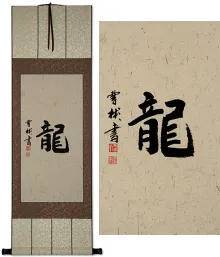
Dragon

Mandarin: lóng
Japanese: ryuu / tatsu
Korean: 룡 or 용

龍

This is pretty self-explanatory. This is the creature of myth and legend that dominates Chinese, Japanese, and even European folklore. In China, the dragon is the symbol of the Emperor, strength and power, and the Chinese dragon is known as the god of water.

See: More Chinese & Japanese Dragon calligraphy & Dragon information.

Score: 16/100

Select

A sly rabbit has three openings to its den

-or- The crafty rabbit has three different entrances to its lair

Mandarin:
jiǎo tù sān kū

狡
兔
三
窟

This speaks to the cunning character of a sly rabbit. Such a rabbit will not have just one hole, but rather a few entrances and exits from his liar.

About 2,250 years ago a very rich man told his assistant to go and buy something wonderful that he did not yet posses. He was a man that already had everything, so the assistant went to a local village that owed a great deal of money to the rich man. The assistant told the village elders that all debts were forgiven. All the villagers rejoiced and praised the rich man's name. The assistant returned to the rich man and told him he had purchased "benevolence" for him. The rich man was mildly amused, but perhaps a bit confused by the action.

Some time later, the rich man fell from the favor of the Emperor, and was wiped out without a penny to his name. One day he was walking aimlessly and stumbled into the village in which the debts had been forgiven. The villagers recognized the man and welcomed him with open arms, clothed, fed, and gave him a place to live.

Without trying, the man had become like the sly and cunning rabbit. When his exit was blocked, he had another hole to emerge from - and was reborn. This story and idiom comes from a book titled "The Amendment" - it's unclear whether this man actually existed or not. But the book did propel this idiom into common use in China.

Still today this idiom about the rabbit is used in China when suggesting "backup plans" alternate methods, and anyone with a good escape plan.

Score: 16/100

Back to the top of this page

Select

Confucius

Mandarin: kǒng zǐ
Japanese: koushi
Korean: 공자

孔
子

This is how to write the name of the great sage, known in the west as Confucius. His real name is Kongzi (The name Confucius is a westernized version of his name - his family name is Kong, and "zi" was added as a title of distinction). He lived some 2500 years ago in Qufu, a town in modern day Shandong Province of Northern China (about 6 hours south of Beijing by bus). He was a consort to Emperors, and after his death, the impact of his philosophies still served to advise emperors, officials, and common people for generations. Also during these thousands of years, the Kong family remained powerful in China, and the Kong estate was much like the Vatican in Rome. The Kong estate existed as if on sovereign ground with its own small garrison of guards and privileges of a kingdom within an empire.

This was true up until the time the Kong family had to flee to Taiwan in 1949 when the Red Army took victory over the Nationalists during the Revolution. The home of Confucius was later razed and all statues defaced or stolen during the Cultural Revolution. Finally, after years of smearing his name and image, it is once again okay to celebrate the teachings of Confucius in mainland China.

Score: 11/100

Select

King

Mandarin: wáng
Cantonese: wong
Japanese: ou
Korean:

王

This is wang which means king. It is not pronounced the way you think in Chinese. It is more like English-speakers would want to pronounce wong. It has roughly the same vowel sound as tong, song, or long in English.

Note that this means king only, not emperor. An emperor is higher than a king, and theoretically is chosen by God, according to ancient Chinese culture. However, the definition is often blurred at various points in Asian history.

This word can also be defined as ruler, sovereign, monarch or magnate. It is also can refer to a game piece in the chess-like Japanese strategic game of shoji.

Note: This can also be a family name in Chinese, Korean and Vietnamese (in Vietnamese it's Vương).

See Also...  Queen

Score: 11/100

Select

Shaolin

Mandarin: shǎo lín
Japanese: sho rin
Korean: 소림

少
林

The Shaolin monks of China have been practicing the art of Kung Fu for thousands of years. While there are many schools of Kung Fu in China, Shaolin are one of the more religiously devout and disciplined.

The title of Shaolin actually refers to a specific Buddhist monastery. It should be noted that the Shaolin were famous in China long before the Kung Fu TV show. Their fame in China is due to the monks' heroic and swift rescue an emperor during the Tang Dynasty. Most Chinese people are not keenly aware of the Kung Fu TV show, and have no idea who David Carradine is or anything about his character, Kwai Chang Caine.

Note: The literal meaning of these two characters is "little forest".

The fame of the Shaolin has spread all over Asia, as even though this is a Chinese title, the same characters are used in Japanese with the same meaning.

Score: 6/100

Back to the top of this page

Select

Phoenix (female)

Mandarin: huáng
Japanese: ou
Korean:

凰

This is another simple way to write "Phoenix" in Chinese. This is the specifically female element of phoenix, so this is how you write "female phoenix". This character is sometimes used to represent the female empress (many times in history, China was ruled by a woman, in much the same way queens came to power in Europe).

Note that the emperor is always represented as a dragon (not the male version of phoenix).

If you see yourself as a strong woman, this might be scroll for you to express "woman power" or "powerful woman" in a cool way.

Score: 6/100

Select

Destiny Determined by Heaven

Mandarin: tiān yì
Japanese: teni
Korean: 천의

天
意

This is a way to express destiny in a slightly religious way. Literally this means "Heaven's Wish" or "Heaven's Desire" with the idea of fate and destiny being derived as well. It suggests that your destiny comes from God / Heaven and that your path has already been chosen by a higher power.

My Japanese dictionary defines this word as "divine will" or "providence" but it also holds the meaning of "the will of the emperor". Therefore I don't suggest this phrase if your audience is Japanese - it feels a little strange in Japanese anyway.

Score: 6/100

Select

Mountain Travels Poem by Dumu


Mandarin: yuǎn shàng hán shān shí jìng xiá bái yún shēng chù yǒu rén jiā tíng chē zuò ài fēng lín wǎn shuàng yè hóng yú èr yuè huā

遠
上
寒
山
石
徑
斜
白
雲
生
處
有
人
家
停
車
坐
愛
楓
林
晚
霜
葉
紅
於
二
月
花

This poem was written almost 1200 years ago during the Tang dynasty. It depicts traveling up a place known as Cold Mountain, where some hearty people have built their homes. The traveler is overwhelmed by the beauty of the turning leaves of the maple forest that surrounds him just as night overtakes the day, and darkness prevails. His heart implores him to stop, and take in all of the beauty around him.

First before you get to the full translation, I must tell you that Chinese poetry is a lot different than what we have in the west. Chinese words simply don't rhyme in the same way that English, or other western languages do. Chinese poetry depends on rhythm and a certain beat of repeated numbers of characters.

I have done my best to translate this poem keeping a certain feel of the original poet. But some of the original beauty of the poem in it's original Chinese will be lost in translation.

Far away on Cold Mountain, a stone path leads upwards.
Among white clouds peoples homes reside.
Stopping my carriage I must, as to admire the maple forest at nights fall.
In awe of autumn leaves showing more red than even flowers of early spring.

Hopefully, this poem will remind you to stop, and "take it all in" as you travel through life.
The poet's name is "Du Mu" in Chinese that is: 杜牧.
The title of the poem, "Mountain Travels" is: 山行
You can have the title, poet's name, and even Tang Dynasty written as an inscription on your custom wall scroll if you like.

More about the poet:

Dumu lived from 803-852 AD and was a leading Chinese poet during the later part of the Tang dynasty.
He was born in Chang'an, a city of central China and former capital of the ancient Chinese empire in 221-206 BC. In present day China, his birthplace is currently known as Xi'an, the home of the Terracotta Soldiers.

He was awarded his Jinshi degree (an exam administered by the emperor's court which leads to becoming an official of the court) at the age of 25, and went on to hold many official positions over the years. However, he never achieved a high rank, apparently because of some disputes between various factions, and his family's criticism of the government. His last post in the court was his appointment to the office of Secretariat Drafter.

During his life, he wrote scores of narrative poems, as well as a commentary on the Art of War and many letters of advice to high officials.

His poems were often very realistic, and often depicted every day life. He wrote poems about everything, from drinking beer in a tavern to weepy poems about lost love.

The thing that strikes you most is the fact even after 1200 years, not much has changed about the beauty of nature, toils and troubles of love and beer drinking.

Score: 6/100

Back to the top of this page

Select

Samurai

Mandarin: shì
Japanese: samurai
Korean:

侍

In Japanese, this character represents the warriors that attempted to hold peace when there was no Emperor in Japan. Be cautious though, as it is an old way to express "servant" or "waiter" in Chinese and Korean. Of course, if you are a samurai, you are a servant to your Shogun-ate, Lord, or the people (which is the root meaning).

See Also...  Warrior

Score: 6/100

Select

Five Ancestors Fist

Mandarin: wǔ zǔ quán

五
祖
拳

This is a martial arts concept (some would say "school") known as Five Ancestors' Fist.

The first character means five.
The second means ancestor, forefather, or grandparents.
The third means fist.


The ancestors referred to by this title and whose attributes contribute to this style are as follows:
1. Grace of the White Crane.
2. Agility of the Monkey.
3. Precision and skill of Emperor Taizu (mythical great ancestor).
4. Power of Luohan (Buddist arhat).
5. Breath of Damo (founder of Buddhism, or the first Buddha).

Score: 6/100


Wall scroll artwork shown on this page is priced as follows:

1 character $29.88 each

2-3 characters $39.88 each

4 characters $49.88 each

5-10 characters $59.88 each

11 or more characters $69.88 each


We dispatch any size order to any country worldwide for a flat rate US$9.80 P&P

After you select your calligraphy, our website will take you through the process of customizing your artwork.

Options for other mounting such as portraits are available for $13 less.

We also offer the services of a famous master calligrapher for a $40 fee on any scroll if you are looking for investment-quality calligraphy.

If you chose our famous master-calligrapher, you also get more choices for silk and paper colors and the option for larger artwork.


All of our calligraphy is completely done by hand in the ancient way.

When the calligrapher finishes creating your artwork, it is taken to our art mounting workshop in Beijing where a wall scroll is made by hand from a combination of silk, rice paper, and wood.

After we create your wall scroll, it takes at least two weeks for air mail delivery from Beijing to you.

Therefore, allow at least 3 weeks for delivery from the time you place your order.

When you select your calligraphy, you'll be taken to another page where you can choose various custom options.

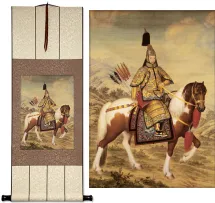
We also have these ready-to-ship pieces of artwork that may match your search:

More EMPEROR Asian artwork can be found here.


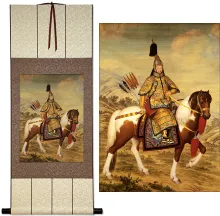
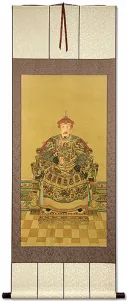
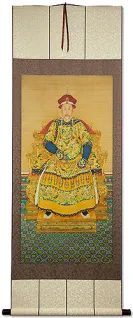
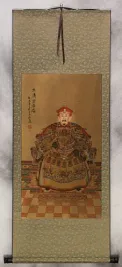
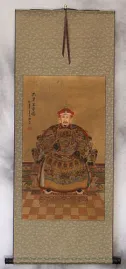
Emperor Ancestor - Partial-Print Wall Scroll

Emperor Ancestor
Partial-Print Wall Scroll

This kind of artwork is often called an "ancestor painting". Though it's only your ancestor if you are a descendant of the Emperor.

Typical Gallery Price: $200.00

Our Price:
US$68.88U.S. Dollars

GBP £41.80British Pounds
Euro €46.49Euro
Canadian $73.81Canadian Dollars
Australian $75.78Australian Dollars


A nice Chinese calligraphy wall scroll

The scroll that I am holding in this picture is a "regular size"
4-character wall scroll.
As you can see, it is a great size to hang on your wall.
(We also offer custom wall scrolls in larger sizes)

A professional Chinese Calligrapher

Professional calligraphers are getting to be hard to find these days.
Instead of drawing characters by hand, the new generation in China merely type roman letters into their computer keyboards and pick the character that they want from a list that pops up.

There is some fear that true Chinese calligraphy may become a lost art in the coming years. Many art institutes in China are now promoting calligraphy programs in hopes of keeping this unique form of art alive.

Trying to learn Chinese calligrapher - a futile effort

Even with the teachings of a top-ranked calligrapher in China, my calligraphy will never be good enough to sell. I will leave that to the experts.


A high-ranked Chinese master calligrapher that I met in Zhongwei

The same calligrapher who gave me those lessons also attracted a crowd of thousands and a TV crew as he created characters over 6-feet high. He happens to be ranked as one of the top 100 calligraphers in all of China. He is also one of very few that would actually attempt such a feat.


Successful Chinese and Japanese calligraphy searches within the last few hours...

If your search is not successful, just post your request on our forum, and we'll be happy to do research or translation for any reasonable request.

alison
andrew
barry
believe
bravery
catherine
christina
courage
daisy
derek
dharma
diana
federica
fighter
gassho
heart
honesty
jason
jefferson
jin
john
justin
leo
luca
marisa
pride
rice
sing
song
warrior spirit
With so many searches, we had to upgrade to our own Linux server.
Of course, only one in 500 searches results in a purchase - Hey buy a wall scroll!!!


See: Our list of specifically Japanese Kanji Calligraphy Wall Scrolls. And, check out Our list of specifically old Korean Hanja Calligraphy Wall Scrolls.


The following table is only helpful for those studying Chinese (or Japanese), and perhaps helps search engines to find this page when someone enters Romanized Chinese or Japanese

Title
 
Characters
Simplified
Traditional
Japanese Romaji
(Romanized Japanese)
Various forms of Hanyu-Pinyin
(Romanized Chinese)
Emperor
kou
ko
huáng
huang
huang2
huang
Emperor皇帝
皇帝
koutei
kotei
huáng dì
huang di
huang2 di4
huangdi
Dragon / Emperor Symbol
ryuu / tatsu
ryuu/tatsu
ryu / tatsu
lóng
long
long2
long
Empress皇后
皇后
kou gou
kougou
ko go
huáng hòu
huang hou
huang2 hou4
huanghou
Queen / Empress王后
王后
ou kou
oukou
o ko
wáng hòu
wang hou
wang2 hou4
wanghou
Grace from Heaven / Grace from God天恩
天恩
ten on
tenon
tiān ēn
tian en
tian1 en1
tianen
Undaunted After Repeated Setbacks百折不挠
百折不撓

hyaku setsu su tou

hyakusetsusutou

hyaku setsu su to
bǎi zhé bù náo
bai zhe bu nao
bai3 zhe2 bu4 nao2
baizhebunao
Work Unselfishly for the Common Good克己奉公
克己奉公
n/akè jǐ fèng gōng
ke ji feng gong
ke4 ji3 feng4 gong1
kejifenggong
Queen女王
女王
jo ou
joou
jo o
nǚ wáng
nv wang
nv3 wang2
nvwang
Banzai / Wansui万岁
萬歲
banzai / manzai
banzai/manzai
wàn suì
wan sui
wan4 sui4
wansui
Banzai (Modern Japanese Version)万岁
萬歲
banzaiwàn suì
wan sui
wan4 sui4
wansui
Listen to Both Sides and be Enlightened, Listen to One Side and be in the Dark兼听则明偏听则暗
兼聽則明偏聽則暗
n/ajiān tīng zé míng, piān tīng zé àn
jian ting ze ming, pian ting ze an
jian1 ting1 ze2 ming2, pian1 ting1 ze2 an4
Master / Sifu / Shi Fu / Shifu师傅
師傅
n/ashī fu
shi fu
shi1 fu
shifu
Destiny / Fate
inochi / mei
inochi/mei
mìng yùn
ming
ming4
ming
Dragon
ryuu / tatsu
ryuu/tatsu
ryu / tatsu
lóng
long
long2
long
A sly rabbit has three openings to its den狡兔三窟
狡兔三窟
n/ajiǎo tù sān kū
jiao tu san ku
jiao3 tu4 san1 ku1
jiaotusanku
Confucius孔子
孔子
koushi
koshi
kǒng zǐ
kong zi
kong3 zi3
kongzi
King
ou
o
wáng
wang
wang2
wang
Shaolin少林
少林
sho rin
shorin
shǎo lín
shao lin
shao3 lin2
shaolin
Phoenix (female)
ou
o
huáng
huang
huang2
huang
Destiny Determined by Heaven天意
天意
tenitiān yì
tian yi
tian1 yi4
tianyi
Mountain Travels Poem by Dumu远上寒山石径斜白云生处有人家停车坐爱枫林晚霜叶红于二月花
遠上寒山石徑斜白雲生處有人家停車坐愛楓林晚霜葉紅於二月花
n/ayuǎn shàng hán shān shí jìng xiá bái yún shēng chù yǒu rén jiā tíng chē zuò ài fēng lín wǎn shuàng yè hóng yú èr yuè huā
yuan shang han shan shi jing xia bai yun sheng chu you ren jia ting che zuo ai feng lin wan shuang ye hong yu er yue hua
yuan3 shang4 han2 shan1 shi2 jing4 xia2 bai2 yun2 sheng1 chu4 you3 ren2 jia1 ting2 che1 zuo4 ai4 feng1 lin2 wan3 shuang4 ye4 hong2 yu2 er4 yue4 hua1
Samurai
samuraishì
shi
shi4
shi
Five Ancestors Fist五祖拳
五祖拳
n/awǔ zǔ quán
wu zu quan
wu3 zu3 quan2
wuzuquan
If you have not set up your computer to display Chinese, the characters in this table probably look like empty boxes or random text garbage.
This is why we spent hundreds of hours making images so that you could view the characters in the "emperor" listings above.
If you want your Windows computer to be able to display Chinese characters you can either head to your Regional and Language options in your Win XP control panel, select the [Languages] tab and click on [Install files for East Asian Languages]. This task will ask for your Win XP CD to complete in most cases. If you don't have your Windows XP CD, or are running Windows 98, you can also download/run the simplified Chinese font package installer from Microsoft which works independently with Win 98, ME, 2000, and XP. It's a 2.5MB download, so if you are on dial up, start the download and go make a sandwich.


Some people may refer to this entry as Emperor Kanji, Emperor Characters, Emperor in Chinese Writing, Emperor in Japanese Writing, Emperor in Asian Writing, Emperor Ideograms, Chinese Emperor symbols, Emperor Hieroglyphics, Emperor Glyphs, Emperor in Chinese Letters, Emperor Hanzi, Emperor in Japanese Kanji, Emperor Pictograms, Emperor in the Chinese Written-Language, or Emperor in the Japanese Written-Language.

All custom calligraphy items are made-to-order in our little Beijing artwork-mounting workshop.
Please note: Rush service can be as fast as two weeks, but regular service is over a month for delivery.


Key / Important Pages Information Pages "How To" Pages Search Engine & Tech Stuff
Home About Us Asian Art Questions & Answers How We Make Our Wall Scrolls Site Map
Asian Art Gallery About China How Chinese Paintings are Mounted How To Care For Wall Scrolls Asian Language Tools
New Asian Art Arrivals F.A.Q. Asian Art Adventures Framing Suggestions for Chinese Art Characters
Love in Chinese/Japanese Gary's Stories Japanese & Chinese Calligraphy Search How To Frame Asian Art Asian Art Index
Strength in Chinese/Japanese Contact Us Japanese Kakejiku   Chinese / Japanese Dictionary

Copyright Oriental Outpost 2002-2009   -   All Rights Reserved
Image Use Policy | Privacy Policy


This page of emperor Chinese calligraphy dictionary search results was generated in 0.535732984543seconds.