Many custom options...


And formats...



Love in Chinese / Japanese...
Buy a Love calligraphy wall scroll here!
Personalize your custom “Love” project by clicking the button next to your favorite “Love” title below...
1. Love
2. Eternal Love / Love Eternally
3. Eternal Love
4. Passionate Love / Ardent Love and Devotion
5. Forever Love
6. Eternal Love
7. Love Forever / Love Eternal
8. True Love
9. Love the House and Its Crow
10. True Love
11. Infinite Love
12. I Love You
13. Universal Love
15. Adoring Love
17. A Mother’s Love / Motherly Love
20. Greatest Love
21. Divine Love
23. Pure Love
24. I love you to the moon and back
30. Benevolent Love
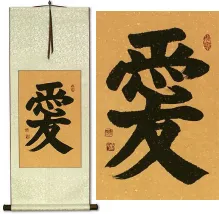
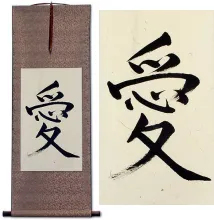
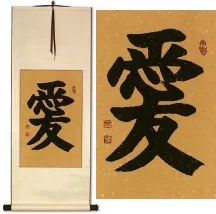
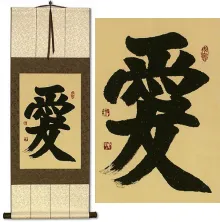
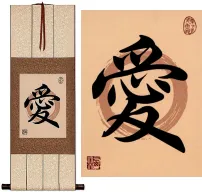
Love
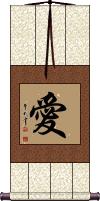
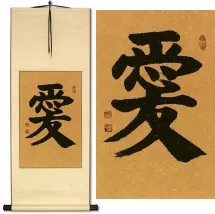
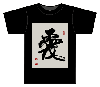
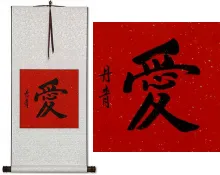
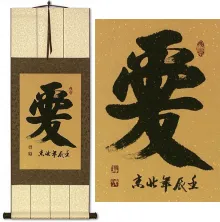
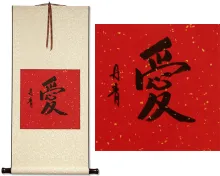
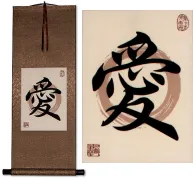
愛 universally means love in Chinese, Japanese Kanji, old Korean Hanja, and old Vietnamese.
愛 is one of the most recognized Asian symbols in the West and is often seen on tee shirts, coffee mugs, tattoos, and more.
愛 can also be defined as affection, to be fond of, to like, or to be keen on. It often refers to romantic love, and is found in phrases like, “I love you.” But in Chinese, one can say, “I love that movie” using this character as well.
This can also be a pet name or part of a pet name in the way we say “dear” or “honey” in English.
This can be a girl’s name “Ai” in both Chinese and Japanese.
More about this character:
This may be hard to imagine as a westerner but the strokes at the top of this love character symbolize family & marriage.
 The symbol in the middle is a little easier to identify. It is the character for "heart" (it can also mean "mind" or "soul"). I guess you can say that no matter if you are from the East or the West, you must put your heart into your love.
 The strokes at the bottom create a modified character that means "friend" or "friendship."
I suppose you could say that the full meaning of this love character is to love your family, spouse, and friends with all of your heart, since all three elements exist in this character.
See Also: I Love You | Caring | Benevolence | Friendliness | Double Happiness Happy Marriage Wall Scroll
Eternal Love / Love Eternally
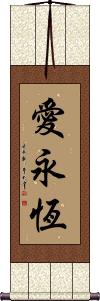
愛永恆 is the shortest way to express the idea of “love eternally” in Chinese.
The first character here means “love”
The last two mean eternal, eternally, everlasting, and/or perpetual.
See Also: Love Forever
Eternal Love
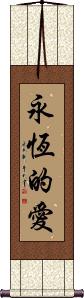
永恆的愛 is the best way to write “Eternal Love” in Chinese.
The first two characters mean eternal, eternally, everlasting, and/or perpetual.
The third character is a possessive article which sort of makes this selection mean “Love of the eternal kind.”
The last character is “love.”
This version is best if your audience is Chinese. We also have a Japanese version of eternal love.
See Also: Forever Love | Eternal Love (Japanese)
Passionate Love / Ardent Love and Devotion
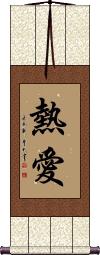
熱愛 means love passionately, ardent love, devotion, adoration.
The literal meaning is “hot love,” as the first character means heat, fervent, hot, and warm. Sometimes it can mean fever, restlessness, or zeal. The second character is, of course, love. If you adore and are devoted to someone with all your love, this is the title for you.
Forever Love
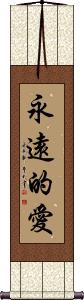
永遠的愛 refers to love that will last forever.
The first two characters mean forever, eternal, eternity, perpetuity, immortality, and/or permanence.
The third character is a possessive article which sort of makes this selection mean “The forever kind of love.”
The last character is “love.”
See Also: Eternal Love Always
Eternal Love
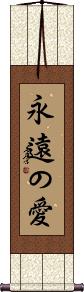
永遠の愛 is a great way to write “Eternal Love” in Japanese.
The first two characters mean eternal, eternity, perpetuity, forever, immortality, and permanence.
The third character is a possessive article which sort of makes this selection mean “Love, of the eternal kind.”
The last character is “love.”
Cultural note: Most of the time, it is taboo to use the word “love” in Japanese. For instance, a Japanese man will say, “I like you,” rather than, “I love you,” to his spouse/girlfriend. However, this entry for eternal love is acceptable because of the way it is composed.
This entry is only appropriate if your audience is Japanese. We also have a Chinese version of this eternal love.
Love Forever / Love Eternal
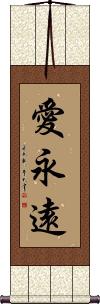
The first character here means “love.”
The last two mean forever, eternity, eternal, perpetuity, immortality, and/or permanence.
愛永遠 is the shortest and most universal way to express this idea in Chinese and Japanese.
Japanese note: This sound more like a title than a phrase in Japanese (if that makes any sense). 愛永遠 is a great title for a romantic book, the title of a movie, the name of a perfume, or even a name for a store.
See Also: Eternal Love | Forever Love
True Love
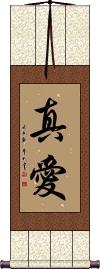
真愛 is literally “True Love” in Chinese.
The first character means “real,” “true,” and “genuine.” The second character means “love” and “affection.”
During the customization of your calligraphy wall scroll, there is a place to add an inscription. You might want that inscription to be your names in Chinese down the side of your wall scroll or perhaps just below these two main characters (just $9 extra). A nice gift to celebrate an anniversary or marriage!
Love the House and Its Crow
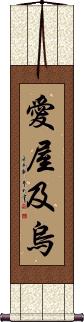
愛屋及烏 is the Chinese idiom, “Love the house and its crow.”
It speaks to the fact that if you are involved in a relationship with somebody, you are also in a relationship with everyone connected to that person. In English, we say, “Love me, love my dog.”
True Love
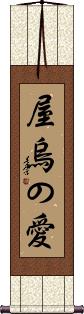
屋烏の愛 is a Japanese way to express true love or deep love.
The phrase literally suggests that this is a love for someone so strong that it can reach a crow perched on that person's roof.
Infinite Love
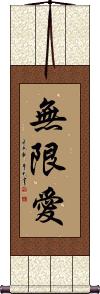
無限愛 is the Chinese and Japanese title meaning infinite love, unlimited love, or unbounded love.
The first character means never, not, or like the prefix “un-.”
The second means limited, restricted, or bound.
The third means love or affection.
I Love You
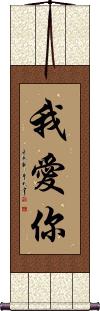
我愛你 directly translates as “I love you” from English to Chinese characters.
This “I love you” phrase is very commonly used between lovers in China.
Universal Love
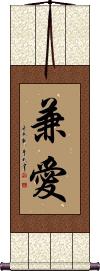
兼愛 is a Chinese word that means “universal love,” a principle advocated by philosopher Mozi (墨子), stressing that people should care for everyone equally.
Greatest Infinite Love
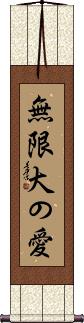
無限大の愛 is a Japanese title meaning infinite great love, unlimited great love, or eternal love.
無 means never, not, or like a prefix “un-.”
限 means limited, restricted, or bound.
大 means great or big.
の is a possessive article.
愛 means love or affection.
Adoring Love
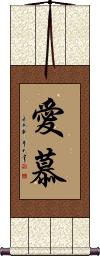
愛慕 means “adoring love” in Chinese, Japanese, and Korean.
I suppose this is the best kind of love to have. 愛慕 has the common character for love. But the second character modifies and reinforces the meaning to become adore, adoring love, or to love and adore.
Ancient Chinese warning:
Adoring someone is fine until you are in the shoes of the Prince of the Kingdom of Wu. This Prince adored a certain beautiful woman (Xi Shi) so much that he neglected his duties and soon let the kingdom fall into ruins.
Love and Affection
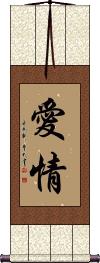
愛情 is a universal word in Japanese, Korean, and Chinese which means love and affection.
Some may translate this as “love between a man and a woman.”
Depending on the context, it can mean utter devotion or favorite.
A Mother’s Love / Motherly Love
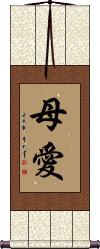
母愛 is a way to write a mother's love or motherly love in Chinese.
Breaking down the characters:
母 means mother.
愛 means love.
Love Myself First
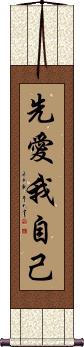
This directly translates as, “First, love myself.”
While you might be looking for “Love yourself first,” there's the problem with yourself versus myself. If this is on your wall or tattooed on your arm, should it not say “myself” since it's directed at you, and not others?
See Also: Love Yourself First
Love Yourself First
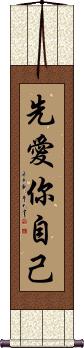
This directly translates as, “First, love yourself.”
Because this uses “yourself” instead of “myself,” this is a direction for those reading it. It could be the owner of the art or those who view it.
This would be weird as a tattoo, so please avoid it since for whom the tattoo is directed would be confusing.
See Also: Love Myself First
Greatest Love
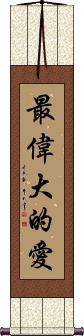
最偉大的愛 means “the greatest love” in Chinese.
Keeping in mind that Chinese is different than English, the first character is like “-est” or adding “the most” as a modifier to the next word.
The 2nd and 3rd characters mean great, mighty, and/or large.
The 4th is a possessive article.
The last is the character for love.
When you put it all together, you get a phrase that means the greatest love, enormous love, or the mightiest love.
Divine Love
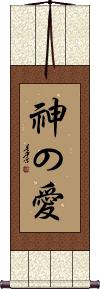
神の愛 is “divine love” in Japanese.
You could also translate it as “God's Love.”
Love and Devotion
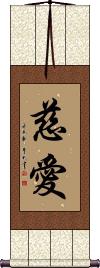
慈愛 refers to the kind of love and devotion you might have to your children or any loved one.
This especially applied to your children but could also be any member of your family - spouse, etc.
This can also be translated as affection, kindness, love, to love affectionately.
慈愛 is also used in a Buddhist context with the same meaning.
In Japanese, this can also be a female given name romanized as Yasue.
Pure Love
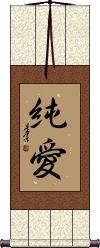
純愛 means pure love.
純 means pure, simple, unmixed, genuine, innocent, chaste, and/or naive.
愛 means love.
純愛 is also a variety of given names in Japan with these romanizations: Pyua, Hiroe, Sumie, Junai, Ayame, Ayane, or Yasushi.
I love you to the moon and back

我愛你到地老天荒 is a Chinese version of “I love you to the moon and back.”
The literal meaning of this phrase is, “I love you from the end of the Earth to the reaches of Heaven” or more simply translated as, “I love you until the end of time.”
Together Forever in Love
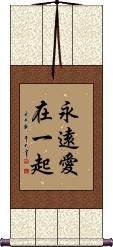
永遠愛在一起 is “together forever in love” in Chinese.
It's a nice phrase if you're a couple who plans to stay together and make your love last as long as you live.
Love Without Reason
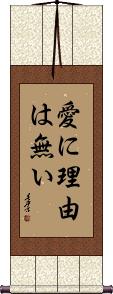
愛に理由は無い is a Japanese phrase that means “love without reason,” or “love doesn't need a reason.” It's a pretty cool phrase in Japanese
Note: Because this selection contains some special Japanese Hiragana characters, it should be written by a Japanese calligrapher.
Unconditional Love
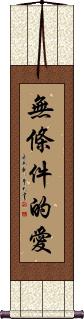
無條件的愛 is a common way to write “unconditional love” in Chinese.
Unconditional Love
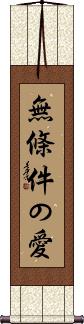
無條件の愛 is a common way to write “unconditional love” in Japanese.
Pledge of Lifelong Love
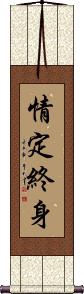
情定終身 is a pledge of eternal love in Chinese.
This can also be a colloquial way to refer to the act of exchanging marriage vows.
If you and your mate want to express how committed you are to your life-long love, this will be a great piece of calligraphy for your wall. Also, a nice phrase to celebrate an anniversary.
I Love You / Aishiteru
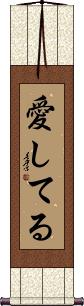
It's very uncommon (some will say taboo) to say “I love you” in Japanese culture. It's especially awkward for a man to tell a woman this in Japanese. Everyone is more likely to say “Watashi wa anata ga suki desu” or “I like you” (literally, “I regarding you, have like.”
If you have to say “I love you” in Japanese, 愛してる is a selection of Kanji and Hiragana that provide a way.
Note: Because this selection contains some special Japanese Hiragana characters, it should be written by a Japanese calligrapher.
Benevolent Love
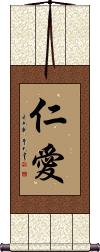
仁愛 is a word that means benevolence, charity, compassion, and/or love.
This can also be a Japanese female name that romanizes as Megumi.
Love Loyalty Respect
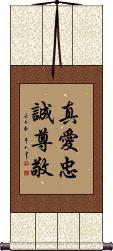
真愛忠誠尊敬 is a Chinese word list that means love, loyalty, and respect.
Love Without Reason
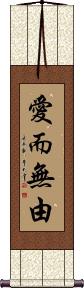
愛而無由 is how to write “love without reason” in Mandarin Chinese (using proper grammar, etc).
This is not a commonly used or ancient phrase in Chinese.
Love Loyalty Respect
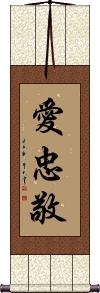
愛忠敬 is a Chinese word list that means love, loyalty, and respect.
愛忠敬 is the shortest way to express these words/ideas. Word lists are not as natural in Chinese as they are in English - phrases or proverbs are more common.
Mercy / Compassion / Love
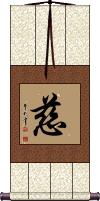
慈 is the simplest way to express the idea of compassion.
This can also mean love for your fellow humans, humanity, or living creatures. Sometimes this is extended to mean charity.
This term is often used in a Buddhist or Christian context. The concept was also spoken of by Laozi (Lao Tzu) in the Dao De Jing (Tao Te Ching).
慈 is considered the direct translation of the Sanskrit word मैत्री (maitrī) Pali word मेत्ता (mettā). In this context, it means benevolence, loving kindness, and goodwill.
This Chinese character is understood in Japanese but is usually used in compound words (not seen alone). Also used in old Korean Hanja, so it's very universal.
See Also: Mercy | Benevolence | Forgiveness | Kindness
Love and Respect / Kindness and Respect
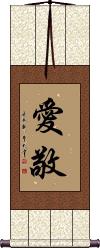
愛敬 is a Chinese, Japanese Kanji, and old Korean Hanja title that can mean “love and respect,” “kindness and respect,” “to love with reverence,” “charm,” “amiability,” “winsomeness,” “courtesy,” or “ingratiating behavior.”
Note: The wide-ranging definitions show that this word is a bit ambiguous without the context of being used in a sentence.
This in-stock artwork might be what you are looking for, and ships right away...
Gallery Price: $87.50
Your Price: $39.00


Gallery Price: $65.00
Your Price: $39.88
Gallery Price: $65.00
Your Price: $39.88

Gallery Price: $200.00
Your Price: $122.88
Gallery Price: $200.00
Your Price: $69.88
These search terms might be related to Love:
A Journey of 1000 Miles Feels Like One
Be Like Water
Dear Grandfather
Dear Grandmother
Devotion / Dedication / Attentive / Focused
Devotion / Diligence / Vigorous / Energetic
Devotion / Enthusiasm
Devotion to Your Profession / Career
Enthusiasm / Passion for a Cause
Eternal Friendship / Friends Forever
Fancy
Fancy Nails
Feeling of Bliss
Friend / Friendship
Friendship
Friendship Dojo
Honey
Honey / Nectar
I Adore You
If You Have Not Been a Monk, How Can You Know What It is Like to Be a Vegetarian?
Love and Affection
Love and Devotion
Lover / Spouse / Sweetheart
Lover / Sweetheart
Loyalty / Devotion
Lust / Desire / Passion
Mind Like Water
No Place Like Home
One Day Seems Like 1000 Years
Passion for a Cause
Passionate Love / Ardent Love and Devotion
Pleasant Feeling
Religious Devotion / Faith in God / Religious Faith
Romantic Passion
Sacrifice / Devotion / Dedication
Sincerity and Devotion
Sorrow / Feeling Sorry
There’s No Place Like Home
Tsuki No Kokoro / Mind Like the Moon
The following table may be helpful for those studying Chinese or Japanese...
| Title | Characters | Romaji (Romanized Japanese) | Various forms of Romanized Chinese | |
| Love | 愛 爱 | ai | ài / ai4 / ai | |
| Eternal Love Love Eternally | 愛永恆 爱永恒 | ài yǒng héng ai4 yong3 heng2 ai yong heng aiyongheng | ai yung heng aiyungheng |
|
| Eternal Love | 永恆的愛 永恒的爱 | yǒng héng de ài yong3 heng2 de ai4 yong heng de ai yonghengdeai | yung heng te ai yunghengteai |
|
| Passionate Love Ardent Love and Devotion | 熱愛 热爱 | netsu ai / netsuai | rè ài / re4 ai4 / re ai / reai | je ai / jeai |
| Forever Love | 永遠的愛 永远的爱 | yǒng yuǎn de ài yong3 yuan3 de ai4 yong yuan de ai yongyuandeai | yung yüan te ai yungyüanteai |
|
| Eternal Love | 永遠の愛 | ei en no ai eiennoai | ||
| Love Forever Love Eternal | 愛永遠 爱永远 | ai ei en / aieien | ài yǒng yuǎn ai4 yong3 yuan3 ai yong yuan aiyongyuan | ai yung yüan aiyungyüan |
| True Love | 真愛 真爱 | shinai | zhēn ài / zhen1 ai4 / zhen ai / zhenai | chen ai / chenai |
| Love the House and Its Crow | 愛屋及烏 爱屋及乌 | ài wū jí wū ai4 wu1 ji2 wu1 ai wu ji wu aiwujiwu | ai wu chi wu aiwuchiwu |
|
| True Love | 屋烏の愛 | okuunoai / okunoai | ||
| Infinite Love | 無限愛 无限爱 | mu gen ai / mugenai | wú xiàn ài wu2 xian4 ai4 wu xian ai wuxianai | wu hsien ai wuhsienai |
| I Love You | 我愛你 我爱你 | wǒ ài nǐ wo3 ai4 ni3 wo ai ni woaini | ||
| Universal Love | 兼愛 兼爱 | jiān ài / jian1 ai4 / jian ai / jianai | chien ai / chienai | |
| Greatest Infinite Love | 無限大の愛 | bu gen dai no ai bugendainoai | ||
| Adoring Love | 愛慕 爱慕 | ai bou / aibou / ai bo | ài mù / ai4 mu4 / ai mu / aimu | |
| Love and Affection | 愛情 爱情 | aijou / aijo | ài qíng / ai4 qing2 / ai qing / aiqing | ai ch`ing / aiching / ai ching |
| A Mother’s Love Motherly Love | 母愛 母爱 | mǔ ài / mu3 ai4 / mu ai / muai | ||
| Love Myself First | 先愛我自己 先爱我自己 | xiān ài wǒ zì jǐ xian1 ai4 wo3 zi4 ji3 xian ai wo zi ji xianaiwoziji | hsien ai wo tzu chi hsienaiwotzuchi |
|
| Love Yourself First | 先愛你自己 先爱你自己 | xiān ài nǐ zì jǐ xian1 ai4 ni3 zi4 ji3 xian ai ni zi ji xianainiziji | hsien ai ni tzu chi hsienainitzuchi |
|
| Greatest Love | 最偉大的愛 最伟大的爱 | zuì wěi dà de ài zui4 wei3 da4 de ai4 zui wei da de ai zuiweidadeai | tsui wei ta te ai tsuiweitateai |
|
| Divine Love | 神の愛 | kami no ai / kaminoai | ||
| Love and Devotion | 慈愛 慈爱 | jiai | cí ài / ci2 ai4 / ci ai / ciai | tz`u ai / tzuai / tzu ai |
| Pure Love | 純愛 | jun ai / junai | ||
| I love you to the moon and back | 我愛你到地老天荒 我爱你到地老天荒 | wǒ ài nǐ dào dì lǎo tiān huāng wo3 ai4 ni3 dao4 di4 lao3 tian1 huang1 wo ai ni dao di lao tian huang woainidaodilaotianhuang | wo ai ni tao ti lao t`ien huang woainitaotilaotienhuang wo ai ni tao ti lao tien huang |
|
| Together Forever in Love | 永遠愛在一起 永远爱在一起 | yǒng yuǎn ài zài yī qǐ yong3 yuan3 ai4 zai4 yi1 qi3 yong yuan ai zai yi qi yongyuanaizaiyiqi | yung yüan ai tsai i ch`i yungyüanaitsaiichi yung yüan ai tsai i chi |
|
| Love Without Reason | 愛に理由は無い | ai ni ri yuu wa na i ainiriyuuwanai ai ni ri yu wa na i | ||
| Unconditional Love | 無條件的愛 无条件的爱 | wú tiáo jiàn de ài wu2 tiao2 jian4 de ai4 wu tiao jian de ai wutiaojiandeai | wu t`iao chien te ai wutiaochienteai wu tiao chien te ai |
|
| Unconditional Love | 無條件の愛 無条件の愛 | mu jou ken no ai mujoukennoai mu jo ken no ai | ||
| Pledge of Lifelong Love | 情定終身 情定终身 | qíng dìng zhōng shēn qing2 ding4 zhong1 shen1 qing ding zhong shen qingdingzhongshen | ch`ing ting chung shen chingtingchungshen ching ting chung shen |
|
| I Love You Aishiteru | 愛してる | ai shi te ru aishiteru | ||
| Benevolent Love | 仁愛 仁爱 | jinai | rén ài / ren2 ai4 / ren ai / renai | jen ai / jenai |
| Love Loyalty Respect | 真愛忠誠尊敬 | zhēn ài zhōng chéng zū jìng zhen1 ai4 zhong1 cheng2 zu1 jing4 zhen ai zhong cheng zu jing zhenaizhongchengzujing | chen ai chung ch`eng tsu ching chenaichungchengtsuching chen ai chung cheng tsu ching |
|
| Love Without Reason | 愛而無由 爱而无由 | ài ér wú yóu ai4 er2 wu2 you2 ai er wu you aierwuyou | ai erh wu yu aierhwuyu |
|
| Love Loyalty Respect | 愛忠敬 | ài zhōng jìng ai4 zhong1 jing4 ai zhong jing aizhongjing | ai chung ching aichungching |
|
| Mercy Compassion Love | 慈 | ji | cí / ci2 / ci | tz`u / tzu |
| Love and Respect Kindness and Respect | 愛敬 爱敬 | aikei / aikyou aikei / aikyo | ài jìng / ai4 jing4 / ai jing / aijing | ai ching / aiching |
| In some entries above you will see that characters have different versions above and below a line. In these cases, the characters above the line are Traditional Chinese, while the ones below are Simplified Chinese. | ||||

Successful Chinese Character and Japanese Kanji calligraphy searches within the last few hours...



