Many custom options...


And formats...



Behave in Chinese / Japanese...
Buy a Behave calligraphy wall scroll here!
Personalize your custom “Behave” project by clicking the button next to your favorite “Behave” title below...
1 Corinthians 13:5
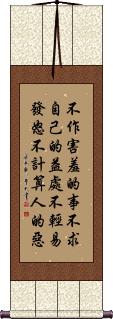
Here is 1 Corinthians 13:5 in Chinese.
The text with punctuation:
不作害羞的事。不求自己的益处。不轻易发怒。不计算人的恶。
Hand-painted calligraphy does not retain punctuation.
This translation is from the Chinese Union Bible.
You may know it from the KJV as:
Doth not behave itself unseemly, seeketh not her own, is not easily provoked, thinketh no evil.
Five Codes of Tang Soo Do
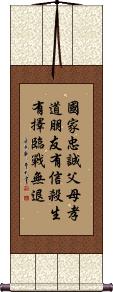
国家忠诚父母孝道朋友有信杀生有择临战无退 are the five codes of Tang Soo Do.
I suggest you have this arranged in five columns when you get to the options page for your custom calligraphy wall scroll.
Here are my translations of each of the five codes:
國家忠誠 Be loyal to your country.
父母孝道 In regards to parents, behave in a filial way.
朋友有信 Be faithful in friendship.
殺生有擇 When fighting for life and death, make noble choices.
臨戰無退 No retreat in battle.
Note: “Tang Soo Do” is a romanization of 唐手道. It's 당수도 in Korean Hangul. It can also be romanized as “Tangsudo” or “Dangsudo.”
Confucius: Golden Rule / Ethic of Reciprocity
Do not do to others what you do not want done to yourself
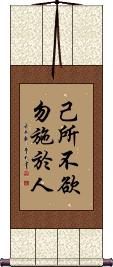
Some may think of this as a “Christian trait,” but actually, it transcends many religions.
This Chinese teaching dates back to about 2,500 years ago in China. Confucius had always taught the belief in being benevolent (ren), but this idea was hard to grasp for some of his students, as benevolence could be kind-heartedness or an essence of humanity itself.
When answering Zhong Gong's question as to what "ren" actually meant, Confucius said:
己所不欲勿施于人 or "When you go out, you should behave as if you were in the presence of a distinguished guest; when people do favors for you, act as if a great sacrifice was made for you. Whatever you wouldn't like done to you, do not do that thing to others. Don't complain at work or home.”
Hearing this, Zhong Gong said humbly, “Although I am not clever, I will do what you say.”
From this encounter, the Chinese version of the “Golden Rule” or “Ethic of Reciprocity” came to be.
The characters you see above express, “Do not do to others whatever you do not want to be done to yourself.”
See Also: Confucius Teachings | Benevolence
These search terms might be related to Behave:
Hard Work
Heaven Rewards Hard Work
Use Hard Work to Overcome Adversity
Work Together With One Heart
Work Together With One Mind
Work Unselfishly for the Common Good
Not the results for behave that you were looking for?
Below are some entries from our dictionary that may match your behave search...
| Characters If shown, 2nd row is Simp. Chinese |
Pronunciation Romanization |
Simple Dictionary Definition |
待 see styles |
dài dai4 tai dai |
to wait; to treat; to deal with; to need; going to (do something); about to; intending to To wait, treat, behave to. |
作假 see styles |
zuò jiǎ zuo4 jia3 tso chia |
to counterfeit; to falsify; to cheat; to defraud; fraudulent; to behave affectedly |
做人 see styles |
zuò rén zuo4 ren2 tso jen |
to conduct oneself; to behave with integrity |
出づ see styles |
izu いづ |
(v2d-s,vi) (1) (archaism) to leave; to exit; to go out; to come out; to get out; (2) (archaism) to leave (on a journey); to depart; to start out; to set out; (3) (archaism) to move forward; (4) (archaism) to come to; to get to; to lead to; to reach; (5) (archaism) to appear; to come out; to emerge; to surface; to come forth; to turn up; to be found; to be detected; to be discovered; to be exposed; to show; to be exhibited; to be on display; (6) (archaism) to appear (in print); to be published; to be announced; to be issued; to be listed; to come out; (7) (archaism) to attend; to participate; to take part; to enter (an event); to play in; to perform; (8) (archaism) to be stated; to be expressed; to come up; to be brought up; to be raised; (9) (archaism) to sell; (10) (archaism) to exceed; to go over; (11) (archaism) to stick out; to protrude; (12) (archaism) to break out; to occur; to start; to originate; (13) (archaism) to be produced; (14) (archaism) to come from; to be derived from; (15) (archaism) to be given; to get; to receive; to be offered; to be provided; to be presented; to be submitted; to be handed in; to be turned in; to be paid; (16) (archaism) to answer (phone, door, etc.); to get; (17) (archaism) to assume (an attitude); to act; to behave; (18) (archaism) to pick up (speed, etc.); to gain; (19) (archaism) to flow (e.g. tears); to run; to bleed; (20) (archaism) to graduate |
出る see styles |
izuru いずる |
(v1,vi) (1) (ant: 入る・はいる・1) to leave; to exit; to go out; to come out; to get out; (v1,vi) (2) to leave (on a journey); to depart; to start out; to set out; (v1,vi) (3) to move forward; (v1,vi) (4) to come to; to get to; to lead to; to reach; (v1,vi) (5) to appear; to come out; to emerge; to surface; to come forth; to turn up; to be found; to be detected; to be discovered; to be exposed; to show; to be exhibited; to be on display; (v1,vi) (6) to appear (in print); to be published; to be announced; to be issued; to be listed; to come out; (v1,vi) (7) to attend; to participate; to take part; to enter (an event); to play in; to perform; (v1,vi) (8) to be stated; to be expressed; to come up; to be brought up; to be raised; (v1,vi) (9) to sell; (v1,vi) (10) to exceed; to go over; (v1,vi) (11) to stick out; to protrude; (v1,vi) (12) to break out; to occur; to start; to originate; (v1,vi) (13) to be produced; (v1,vi) (14) to come from; to be derived from; (v1,vi) (15) to be given; to get; to receive; to be offered; to be provided; to be presented; to be submitted; to be handed in; to be turned in; to be paid; (v1,vi) (16) to answer (phone, door, etc.); to get; (v1,vi) (17) to assume (an attitude); to act; to behave; (v1,vi) (18) to pick up (speed, etc.); to gain; (v1,vi) (19) to flow (e.g. tears); to run; to bleed; (v1,vi) (20) to graduate; (v1,vi) (21) (vulgar) to ejaculate; to cum; (place-name) Izuru |
喝茶 see styles |
hē chá he1 cha2 ho ch`a ho cha |
to drink tea; to get engaged; to have a serious conversation; (fig.) to have a meeting with state security agents (to be warned to behave "responsibly") |
抗禮 抗礼 see styles |
kàng lǐ kang4 li3 k`ang li kang li |
to behave informally as equals; not to stand on ceremony |
振る see styles |
buru ぶる |
(suf,v5r) (1) (kana only) (after a noun, adjectival noun or adjective stem) to assume an air of ...; to act ...; to affect ...; to pose as ...; to behave like ...; to pretend to be ...; (v5r,vi) (2) (colloquialism) (kana only) to put on airs; to be self-important |
撒野 see styles |
sā yě sa1 ye3 sa yeh |
to display shockingly bad behavior; to behave atrociously |
滑る see styles |
numeru; nameru ぬめる; なめる |
(v5r,vi) (1) (kana only) to be slippery; to be slimy; (v5r,vi) (2) (ぬめる only) (kana only) to behave charmingly; to walk merrily |
瞎鬧 瞎闹 see styles |
xiā nào xia1 nao4 hsia nao |
to make a scene; to fool around; to behave foolishly |
篤行 笃行 see styles |
dǔ xíng du3 xing2 tu hsing tokuyuki とくゆき |
to carry out (obligation) conscientiously; to behave sincerely virtuous conduct; virtue; goodness; (personal name) Tokuyuki |
はくる see styles |
hakuru ハクル |
(v5r,vi) (colloquialism) to behave buggily (of software); to act up; to behave strangely; (place-name) Haql |
亂彈琴 乱弹琴 see styles |
luàn tán qín luan4 tan2 qin2 luan t`an ch`in luan tan chin |
to talk nonsense; to behave like a fool |
出歯る see styles |
debaru でばる |
(v5r,vi) (rare) (See 出歯亀) to behave perversely; to (sexually) assault a woman |
吹かす see styles |
fukasu ふかす |
(transitive verb) (1) to smoke (a cigarette, pipe, etc.); to puff on; to puff out (smoke); (transitive verb) (2) (See エンジンを吹かす) to rev (an engine); to race; (transitive verb) (3) (as ...風を〜) (See 先輩風を吹かす) to put on (an air of); to act in a ... way; to behave as; to play (the role of); (transitive verb) (4) (kana only) {sports} (See シュートをふかす) to shoot (a ball) too high; to blast over the bar |
守規矩 守规矩 see styles |
shǒu guī ju shou3 gui1 ju5 shou kuei chü |
to behave oneself; to abide by the rules |
徒めく see styles |
adameku あだめく |
(Godan verb with "ku" ending) (kana only) to be bewitching; to look coquettish; to behave in an alluring manner; to behave in a seductive manner |
振舞う see styles |
furumau ふるまう |
(transitive verb) (1) to behave; to conduct oneself; (2) to entertain; to treat someone (to a drink); to make tea for someone (tea ceremony) |
甘える see styles |
amaeru あまえる |
(v1,vi) (1) to behave like a spoiled child; to fawn on; (v1,vi) (2) to take advantage of; to presume upon (e.g. another's benevolence); to depend on |
耍無賴 耍无赖 see styles |
shuǎ wú lài shua3 wu2 lai4 shua wu lai |
to act shamelessly; to behave in a way that leaves others tut-tutting and shaking their heads in disapproval |
荒びる see styles |
arabiru あらびる |
(v1,vi) (archaism) (See 荒ぶ・1) to behave roughly; to get wild |
荒ぶる see styles |
araburu あらぶる |
(pre-noun adjective) (1) (See 荒ぶる神,荒びる) savage; wild; unruly; fierce; rough; (v5r,vi) (2) (colloquialism) to behave roughly; to get wild |
あいだる see styles |
aidaru あいだる |
(v2r-s,vi) (archaism) (See 甘える・1) to behave like a spoilt child |
うぇい系 see styles |
weikei / weke うぇいけい |
young people who behave in a rowdy fashion (e.g. in a pub); young people who cheer and drink loudly |
うざがる see styles |
uzagaru うざがる |
(exp,v5r) (from うざい and がる) to behave annoyed; to feel annoyed |
きょどる see styles |
kyodoru きょどる |
(v5r,vi) (1) (slang) to act suspiciously; to behave in a strange way; (expression) (2) (obscure) How are you today? |
公而忘私 see styles |
gōng ér wàng sī gong1 er2 wang4 si1 kung erh wang ssu |
for the common good and forgetting personal interests (idiom); to behave altruistically; selfless |
凈心修身 净心修身 see styles |
jìng xīn xiū shēn jing4 xin1 xiu1 shen1 ching hsin hsiu shen |
to have an untroubled heart and behave morally (idiom) |
反面教師 see styles |
hanmenkyoushi / hanmenkyoshi はんめんきょうし |
(yoji) bad example from which one can learn; good example of what not to do (esp. how not to behave); negative example |
Click here for more behave results from our dictionary
The following table may be helpful for those studying Chinese or Japanese...
| Title | Characters | Romaji (Romanized Japanese) | Various forms of Romanized Chinese | |
| 1 Corinthians 13:5 | 不作害羞的事不求自己的益處不輕易發怒不計算人的惡 不作害羞的事不求自己的益处不轻易发怒不计算人的恶 | bù zuò hài xiū de shì bù qiú zì jǐ de yì chu bù qīng yì fā nù bù jì suàn rén de è bu4 zuo4 hai4 xiu1 de shi4 bu4 qiu2 zi4 ji3 de yi4 chu bu4 qing1 yi4 fa1 nu4 bu4 ji4 suan4 ren2 de e4 bu zuo hai xiu de shi bu qiu zi ji de yi chu bu qing yi fa nu bu ji suan ren de e | pu tso hai hsiu te shih pu ch`iu tzu chi te i ch`u pu ch`ing i fa nu pu chi suan jen te o pu tso hai hsiu te shih pu chiu tzu chi te i chu pu ching i fa nu pu chi suan jen te o |
|
| Five Codes of Tang Soo Do | 國家忠誠父母孝道朋友有信殺生有擇臨戰無退 国家忠诚父母孝道朋友有信杀生有择临战无退 | guó jiā zhōng chéng fù mǔ xiào dào péng yǒu yǒu xìn shā shēng yǒu zé lín zhàn wú tuì guo2 jia1 zhong1 cheng2 fu4 mu3 xiao4 dao4 peng2 you3 you3 xin4 sha1 sheng1 you3 ze2 lin2 zhan4 wu2 tui4 guo jia zhong cheng fu mu xiao dao peng you you xin sha sheng you ze lin zhan wu tui | kuo chia chung ch`eng fu mu hsiao tao p`eng yu yu hsin sha sheng yu tse lin chan wu t`ui kuo chia chung cheng fu mu hsiao tao peng yu yu hsin sha sheng yu tse lin chan wu tui |
|
| Confucius: Golden Rule Ethic of Reciprocity | 己所不欲勿施於人 己所不欲勿施于人 | jǐ suǒ bú yù wù shī yú rén ji3 suo3 bu2 yu4, wu4 shi1 yu2 ren2 ji suo bu yu, wu shi yu ren jisuobuyu,wushiyuren | chi so pu yü, wu shih yü jen chisopuyü,wushihyüjen |
|
| In some entries above you will see that characters have different versions above and below a line. In these cases, the characters above the line are Traditional Chinese, while the ones below are Simplified Chinese. | ||||

Successful Chinese Character and Japanese Kanji calligraphy searches within the last few hours...



