Many custom options...


And formats...



Combat-Do in Chinese / Japanese...
Buy a Combat-Do calligraphy wall scroll here!
Personalize your custom “Combat-Do” project by clicking the button next to your favorite “Combat-Do” title below...
2. Maintain An Army For 1000 Days, Use It For An Hour
3. Let Us Try
4. Neijing
7. Self-Discipline and Martial Virtue
8. Boxing
9. Fighter
10. Boxing
11. Wing Chun
13. Taekwondo
Fighting Spirit
The Will to Fight
dòu zhì
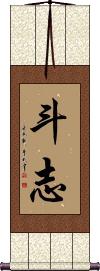
斗志 literally means fighting spirit in Chinese.
As in the spirit that a warrior, soldier, athlete, or fighter must possess.
 Note: There is more than one way to write the first character of this word. It is sometimes written like the version shown to the right (yes, it's completely different but has the same meaning & pronunciation). If you have a preference, please let us know in the special instructions about your order.
Fighting Spirit
tou shi
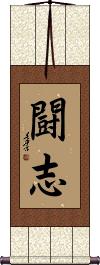
This literally means “fighting spirit” or “the will to fight.”
As in the spirit that a warrior, soldier, athlete, or fighter must possess.
Fighting Spirit
Alternate Japanese version
tou kon
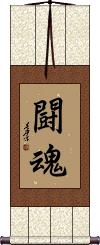
闘魂 is an alternate title with the meaning “fighting spirit” or “the will to fight.”
Fighting Spirit
tou ki
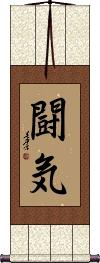
闘気 is an alternate Japanese title for “fighting spirit.”
This one is more like “fighting energy.” The second character is “ki,” the same “ki” in Aikido. This “ki” is the spiritual energy that all martial arts practitioners must master and focus on.
yǎng bīng qiān rì, yàng bīng yì shí
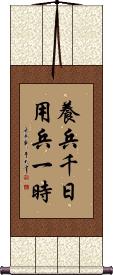
Nothing could be more true. When I was in the Marine Corps, we trained for years for combat that often lasts only hours.
養兵千日用兵一時 is a Chinese proverb that, also reminds me of a common phrase used in the military to describe combat: “Weeks of total boredom, punctuated with five minutes of sheer terror.”
This may have some roots in Sun Tzu's The Art of War. Though I can not find this passage in his writings.
On the subject of the Art of War, if you have a favorite passage, we can create a custom calligraphy scroll with that phrase.
Let Us Try
Essayons
cháng shì
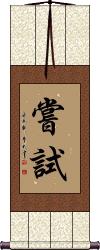
嘗試 is a close match for the English phrase “let us try” or the French word “Essayons.”
 Essayons the motto of Combat Engineers in the U.S. Army.
This word can also be translated as “to try” or “to attempt.”
Even if you're not a Combat Engineer, this word should inspire you to attempt to accomplish difficult things. If you don't try, you are certain to fail; if you do try, at least there is a chance of success.
The worst thing is not failure, the worst thing is not trying at all.
Neijing
nèi jìng
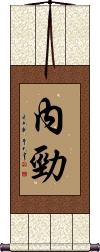
內勁 is Neijing or Nei Jing, the Kung Fu technique of using the conscious control of the practitioner's “qi” or “life energy” to gain advantages in combat.
Kakuto Karate
kaku tou kara te
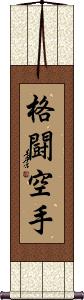
格闘空手 is Kakutō Karate and means Fighting Karate and/or Combat Karate.
Jissen Kobudo
jissen ko bu dou
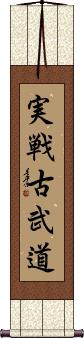
実戦古武道 is the title Jissen Kobudo in Japanese Kanji.
Jissen or 実戦 means combat, battle, or fighting.
Kobudo or 古武道 is the title used for Okinawan martial arts. The literal translation would be something like “Old Martial Way.”
Self-Discipline and Martial Virtue

克己武術 can be translated as “Self-Discipline Martial Arts Techniques,” or “Self-Discipline and Martial Virtue.”
克己 = Self-mastery, or overcome the self.
武術 = Martial techniques/arts, or practical combat methods.
Self-mastery; overcome the self. Martial techniques/arts; practical combat methods.
Boxing
quán jī
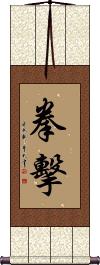
拳擊 is the term used in Chinese to refer to the original Olympic sport of combat and fighting.
If you like to strap on your boxing gloves and go a few rounds or are just a fan of boxing, this could make a nice wall scroll for you.
Note that Japanese use the same first character (which means fist) but a different Kanji for the second. Please see our Japanese boxing entry for that version.
Fighter
Warrior / Soldier
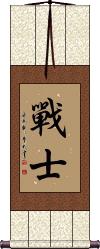
戰士 is how to write “fighter” in Chinese, ancient Japanese Kanji, and old Korean Hanja.
The first character means war, warfare, or battle.
The second character means soldier, officer, man, or pawn.
戰士 can also mean soldier or warrior. Usually this will be read as “fighter” or “one who fights.” 戰士 is an odd selection for a wall scroll unless you are a boxer, ultimate fighter, or otherwise participate in combat sports.
Other translations include combatant or champion.
 Note that after WWII, the first Kanji was reformed/simplified. This modern Japanese version is shown to the right. If you want this version, click on the Kanji to the right, instead of the button above.
Boxing
ken tou
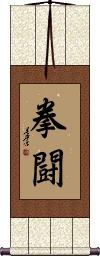
拳闘 is the term used in Japanese Kanji to refer to the original Olympic sport of combat and fighting.
This can also be translated as prizefighting.
The first Kanji means fist. The second means fight. So when literally translated, this means “fistfight” (though understood in Japanese as a more refined sport, versus street fighting).
Note: A completely different second character is used in the Chinese word for boxing but a Chinese person would still be able to guess the meaning of these Kanji.
Wing Chun
yǒng chūn
wing2 cheun1
ei haru
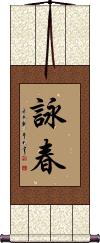
詠春 is a martial arts technique that has an oral history (versus a written one) so very little can be said for sure about its origins.
Wing Chun (or Wing Cheun) is a Chinese martial art that emphasizes short combat strokes.
The characters 詠春 literally mean “Singing Spring” (as in springtime).
If you are wondering, the spelling and pronunciation of this martial arts style in English come from the Cantonese pronunciation of these characters. The second character sounds similar in both Mandarin and Cantonese, but the first is quite different.
Note: This title can be pronounced in Japanese, but only a Japanese practitioner of Wing Chun would recognize or understand this title. It is not considered a Japanese word or martial art at all.
Ninjutsu / Ninjitsu
rěn shù
ninjutsu
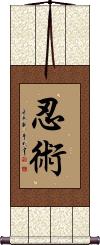
忍術 is the “art of the ninja” in Japanese. Most Japanese people associate ninjas with romance and reverence for Japan's ancient past. But most will accept that the ninja is an idea or way of life whose time has passed. However, this has not stopped floods of movies about ninjas and dojos offering Ninjutsu training from keeping the idea of the ninja alive in modern times.
My modern Japanese dictionary defines this as “assassination, stealth, and combat techniques” or “fighting art of the ninja.”
 Note that when writing this as Kanji, Japanese tend to write the first character in the form shown to the right. Because this is specifically a Japanese title, we only suggest a Japanese calligrapher for this selection - and you will get the form shown to the right if you do that (please ignore the fact that some of the images you see during the following pages in the options process will be the Chinese/alternate form).
Taekwondo
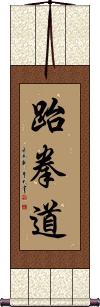
跆拳道 is one of the most widespread types of martial arts in the world as well as being an Olympic sport. Taekwondo was born in Korea with influences of Chinese and Japanese styles combined with traditional Korean combat skills. Some will define it as the “Korean art of empty-handed self-defense.”
In the simplest translation, the first character means “kick,” the second character can mean either “fist” or “punching,” and the third means “way” or “method.” Altogether, you could say this is the “Kick Punch Method.” When heard or read in various Asian languages, all will automatically think of this famous Korean martial art. It is written the same in Japanese Kanji, Chinese, and Korean Hanja characters - so the appearance of the characters is universal. However, you should note that there is another way to write this in modern Korean Hangul characters, which looks like the image to the right. 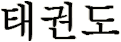
We suggest the original Korean Hanja (Chinese characters) for a wall scroll, but if you need the Hangul version, you must use master calligrapher Cao Bin: Order Taekwondo in Korean Hangul
Note: Taekwondo is sometimes Romanized as Tae-Kwondo, Tae Kwon Do, Taekwon-do, Taegwondo, Tae Gweon Do, Tai Kwon Do, Taikwondo, Taekwando, Tae Kwan Do and in Chinese Taiquandao, Tai Quan Dao, Taichuando, or Tai Chuan Tao.
The following table may be helpful for those studying Chinese or Japanese...
| Title | Characters | Romaji (Romanized Japanese) | Various forms of Romanized Chinese | |
| Fighting Spirit | 斗志 | dòu zhì / dou4 zhi4 / dou zhi / douzhi | tou chih / touchih | |
| Fighting Spirit | 闘誌 闘志 | tou shi / toushi / to shi | ||
| Fighting Spirit | 闘魂 | tou kon / toukon / to kon | ||
| Fighting Spirit | 闘氣 闘気气 | tou ki / touki / to ki | ||
| Maintain An Army For 1000 Days, Use It For An Hour | 養兵千日用兵一時 养兵千日用兵一时 | yǎng bīng qiān rì, yàng bīng yì shí yang3 bing1 qian1 ri4 yang4 bing1 yi4 shi2 yang bing qian ri yang bing yi shi | yang ping ch`ien jih yang ping i shih yang ping chien jih yang ping i shih |
|
| Let Us Try | 嘗試 尝试 | cháng shì chang2 shi4 chang shi changshi | ch`ang shih changshih chang shih |
|
| Neijing | 內勁 内劲 | nèi jìng / nei4 jing4 / nei jing / neijing | nei ching / neiching | |
| Kakuto Karate | 格闘空手 | kaku tou kara te kakutoukarate kaku to kara te | ||
| Jissen Kobudo | 実戦古武道 | jissen ko bu dou jissenkobudou jisen ko bu do | ||
| Self-Discipline and Martial Virtue | 克己武術 | kokki bu jutsu kokkibujutsu koki bu jutsu | kè jǐ wǔ shù ke4 ji3 wu3 shu4 ke ji wu shu kejiwushu | k`o chi wu shu kochiwushu ko chi wu shu |
| Boxing | 拳擊 拳击 | quán jī / quan2 ji1 / quan ji / quanji | ch`üan chi / chüanchi / chüan chi | |
| Fighter | 戰士 战士 / 戦士 | sen shi / senshi | zhàn shì / zhan4 shi4 / zhan shi / zhanshi | chan shih / chanshih |
| Boxing | 拳闘 拳斗 | ken tou / kentou / ken to | ||
| Wing Chun | 詠春 咏春 | ei haru / eiharu | yǒng chūn yong3 chun1 yong chun yongchun | yung ch`un yungchun yung chun |
| Ninjutsu Ninjitsu | 忍術 忍术 | ninjutsu | rěn shù / ren3 shu4 / ren shu / renshu | jen shu / jenshu |
| Taekwondo | 跆拳道 | te kon do / tekondo | tái quán dào tai2 quan2 dao4 tai quan dao taiquandao | t`ai ch`üan tao taichüantao tai chüan tao |
| In some entries above you will see that characters have different versions above and below a line. In these cases, the characters above the line are Traditional Chinese, while the ones below are Simplified Chinese. | ||||

Successful Chinese Character and Japanese Kanji calligraphy searches within the last few hours...
AadhyaAadilahAaliyahAarishAasiaAbadAbbeyAbbyAbdallahAbdulAbdulazizAbimaelAbsalomAbsalonAdaraAdeyAdrianAfnanAgataAguilarAileenAimanAishaAjaiAkiraAkivaAlaiaAlanaAlbericAlbertoAleishaAlejandraAlekaAlessiaAlexAlexanAlexandraAlfredoAlinAlinaAlirezaAlizaAlizeeAlkiAllionsAlmaAlondraAltheaAlunAlways and ForeverAlyaAlyssaAmadeoAmaroAmerAmereAmimaAminaAminahAmirAmmaAnamikaAnastasiaAndreasAndreiAndriAndyAngelaAngelicaAngelinaAngieAnikAnikaAniketAnishAnn-MarieAntheaAnthonyAntoineAntonAntoniAntoniaAntonioAquariusAriaAriadnaAriannaArletteArmanArnoldArturoArzooAshaAsherAshleeAshokAspenAssaAssafAtulAubreyAuraAureliaAustinAvanelAveryAvonAyanAylaAylinAyushAyyanAzizBakiBalanceBambooBarryBe Like WaterBeatrizBeckBeckyBelief TrustBelieve in YourselfBellaBeniBennieBenoitBermudoBernaBertrandBiangBibleBjornBless This HomeBless This HouseBloodless VictoryBody and Earth in UnityBonnyBraedenBrahmavihara - the Four ImmeasurablesBrayanBreannaBrendaBriaBrianBriellaBrielleBrittBrittneyBryanBubuBujutsuBurtButchCadeCaedmonCaesarCailinCaineCaitlynCallumCalmCalm HeartCambellCamiloCandyCarmenCarolineCarpe DiemCarrettiCassandraCassiusCaydenCeciCecilyCedricCelesteChandraChantalChantellCharlineCheriseChop Wood Carry WaterChrishiCindyClaraClarissaClarkeClaudiaClaudiuClementineCocoCodieCohenColeColsonCompassionCooperationCoreyCorine



