Many custom options...


And formats...



One Chan in Chinese / Japanese...
Buy an One Chan calligraphy wall scroll here!
Personalize your custom “One Chan” project by clicking the button next to your favorite “One Chan” title below...
Zen / Chan / Meditation
...as in Zen Buddhism
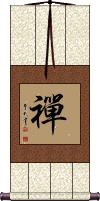
First, let's correct something: The Japanese romanization for this character, “Zen” has penetrated the English language. In English, it's almost always incorrectly used for phrases like “That's so zen.” Nobody says, “That's so meditation” - right? As the title of a sect, this would be like saying, “That's so Baptist!"
禪 by itself just means “meditation.” In that context, it should not be confined to use by any one religion or sect.
Regardless of the dictionary definition, more often than not, this character is associated with Buddhism. And here is one of the main reasons:
Zen is used as the title of a branch of Mahayana Buddhism, which strongly emphasizes meditation practice.
However, it should be noted that Buddhism came from India, and “Chan Buddhism” evolved and developed in medieval China. The Chinese character “Chan” was eventually pronounced as “Zen” in Japanese. Chan Buddhists in China have much in common with Zen Buddhists in Japan.
More about the history of Zen Buddhism here.
Please also note that the Japanese Kanji character for Zen has evolved a little in Japan, and the two boxes (kou) that you see at the top of the right side of the character have been replaced by three dots with tails.
 The original character would still be generally understood and recognized in Japanese (it's considered an ancient version in Japan) but if you want the specifically modern Japanese version, please click on the zen Kanji to the right. Technically, there is no difference between the Tensho and Reisho versions of Zen since they are ancient character styles that existed long before Japan had a written language.
 There is also an alternate/shorthand/simplified Chinese version, which has two dots or tails above the right-side radical. This version is also popular for calligraphy in China. If you want this version, just click the character to the right.
Further notes: Zen is just one of seven sects of Buddhism practiced in Japan. The others are 律 Ritsu (or Risshū), 法相 Hossō, 論 Sanron 華嚴 Kegon, 天台 Tendai, and 眞言 Shingon.
Seeing one’s Nature and becoming a Buddha
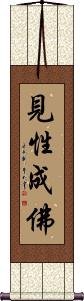
見性成佛 is a universal phrase that suggests that one may see one's nature and accomplish Buddhahood.
見性 suggests penetrating deep inside oneself to see one's “Original finally
Mind.”
成佛 refers to a sentient being who dispenses with illusions and delusions
through ascetic practice, is enlightened to the truth, and becomes a Buddha.
This is used by Mahayana, Chan, and Zen Buddhists in China, Korea, and Japan.
You will also see this with the last character written as 仏 in Japanese. In the religious context, 佛 is commonly used to mean Buddha. If you want the other version, see Kenshō Jōbutsu 見性成仏
Meditation
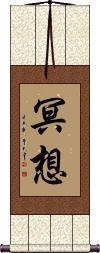
This encompasses the idea of meditation.
It's also a term used to describe a deep form of daydreaming, exploring one's imagination, the act of contemplating, or the idea of contemplation. 冥想 is often associated with Buddhism; however, the word “Zen” in Japanese (or “Chan” in Chinese) is probably more commonly used (or better known in the west).
See Also: Zen
Zen Buddhism
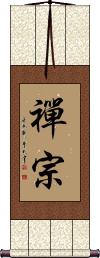
禪宗 is one way to title “Zen Buddhism.” Because the original pronunciation of Zen in Chinese is Chan, you'll also see this expressed as Chan Buddhism.
From the Buddhist Dictionary:
The Chan, meditative or intuitional, sect is usually said to have been established in China by Bodhidharma, the twenty-eighth patriarch, who brought the tradition of the Buddha-mind from India. This sect, believing in direct enlightenment, disregarded ritual and sūtras and depended upon the inner light and personal influence for the propagation of its tenets, founding itself on the esoteric tradition supposed to have been imparted to Kāśyapa by the Buddha, who indicated his meaning by plucking a flower without further explanation. Kāśyapa smiled in apprehension and is supposed to have passed on this mystic method to the patriarchs. The successor of Bodhidharma was 慧可 Huike, and he was succeeded by 僧璨 Sengcan, 道信 Daoxin, 弘忍 Hongren, 慧能 Huineng, and 神秀 Shenxiu, the sect dividing under the two latter into the southern and northern schools: the southern school became prominent, producing 南嶽 Nanyue and 靑原 Qingyuan, the former succeeded by 馬祖 Mazu, the latter by 石頭 Shitou. From Mazu's school arose the five later schools.
No Mind / Mushin
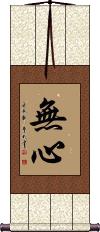
In Japanese, 無心 means innocent or without knowledge of good and evil. It literally means “without mind.”
無心 is one of the five spirits of the warrior (budo) and is often used as a Japanese martial arts tenet. Under that context, places such as the Budo Dojo define it this way: “No mind, a mind without ego. A mind like a mirror which reflects and dos not judge.” The original term was “mushin no shin,” meaning “mind of no mind.” It is a state of mind without fear, anger, or anxiety. Mushin is often described by the phrase “Mizu no Kokoro,” which means “mind like water.” The phrase is a metaphor describing the pond that clearly reflects its surroundings when calm but whose images are obscured once a pebble is dropped into its waters.
This has a good meaning in conjunction with Chan / Zen Buddhism in Japan. However, out of that context, it means mindlessness or absent-mindedness. To non-Buddhists in China, this is associated with doing something without thinking.
In Korean, this usually means indifference.
Use caution and know your audience before ordering this selection.
More info: Wikipedia: Mushin
Unmoved by the Eight Winds

八風吹不動 is an ancient Buddhist phrase from about 1000 years ago.
Literal meaning: “The Eight Winds cannot move [me].”
The original famous anecdote is from Song Dynasty China, involving the poet-official 蘇東坡 (Su Dongpo / Su Shi, 1037–1101) and Zen master 佛印 (Foyin).
Su Dongpo wrote 八風吹不動,一屁打過江
“The Eight Winds cannot move me; Yet one fart blows me across the river.”
Foyin’s irreverent reply exposed Su Dongpo’s ego, which is kind of a classic Zen/Chan teaching story.
利 gain
衰 loss
毀 disgrace
譽 praise
稱 honor
譏 ridicule
苦 suffering
樂 pleasure
“The Eight Winds cannot move [him / the mind].”
“Unmoved by the Eight Winds.”
“The Eight Winds do not move me.”
“Not moved by the Eight Winds.”
“Unshaken by the Eight Winds.”
“Unaffected by the Eight Winds.”
“Unmoved by worldly forces.”
“Steadfast against the Eight Winds.”
“Remaining unmoved amid the Eight Winds.”
There is a shorter Japanese Zen version, 八風不動, which drops the middle character. Often romanized as happū fudō. The romanization of 八風吹不動 is arguably happū fukedomo ugokazu or happū sui fudō.
This in-stock artwork might be what you are looking for, and ships right away...

Gallery Price: $72.00
Your Price: $39.88

Gallery Price: $31.00
Your Price: $16.88
Gallery Price: $232.00
Your Price: $128.88
Gallery Price: $268.00
Your Price: $148.77

Gallery Price: $61.00
Your Price: $33.88

Gallery Price: $61.00
Your Price: $33.88

Gallery Price: $61.00
Your Price: $33.88

Gallery Price: $60.00
Your Price: $36.88
Gallery Price: $144.00
Your Price: $79.88
Not the results for one chan that you were looking for?
Below are some entries from our dictionary that may match your one chan search...
| Characters If shown, 2nd row is Simp. Chinese |
Pronunciation Romanization |
Simple Dictionary Definition |
見性 见性 see styles |
jiàn xìng jian4 xing4 chien hsing kenshou / kensho けんしょう |
More info & calligraphy: Kensho - Initial EnlightenmentTo behold the Buddha-nature within oneself, a common saying of the Chan (Zen) or Intuitive School. |
辿 see styles |
chān chan1 ch`an chan tadoru たどる |
used in names, e.g. 龍王辿|龙王辿[Long2 wang2 Chan1] Longwang Chan, a place in Shaanxi Province; (literary) (of one's walking pace) slow (surname, given name) Tadoru |
一拶 see styles |
yī zā yi1 za1 i tsa issatsu |
A sudden remark, or question, by a monk or master to test a disciple, a Chan (Zen) method. |
三句 see styles |
sān jù san1 ju4 san chü sanku |
Three cryptic questions of 雲門 Yunmen, founder of the Yunmen Chan School. They are: (1) 截斷衆流 What is it that stops all flow (of reincarnation) ? The reply from the 起信論 is 一心, i. e. the realization of the oneness of mind, or that all is mind. (2) 函蓋乾坤 What contains and includes the universe? The 眞如. (3) 隨波逐浪 One wave following another— what is this? Birth and death 生死, or transmigration, phenomenal existence. |
引座 see styles |
yǐn zuò yin3 zuo4 yin tso in zo |
A phrase used by one who ushers a preacher into the 'pulpit' to expound the Law. |
法眼 see styles |
fǎ yǎn fa3 yan3 fa yen hougen / hogen ほうげん |
discerning eye (1) {Buddh} (See 五眼) the dharma eye; (2) (abbreviation) second highest priestly rank in Buddhism; (3) (archaism) title bestowed upon doctors, etc.; (surname) Hougen The (bodhisattva) dharma-eye able to penetrate all things. Name of the founder of the法眼宗 Fayan sect, one of the five Chan (Zen) schools. |
一味禪 一味禅 see styles |
yī mèi chán yi1 mei4 chan2 i mei ch`an i mei chan ichimi zen |
one taste Chan |
一字禪 一字禅 see styles |
yī zì chán yi1 zi4 chan2 i tzu ch`an i tzu chan ichiji zen |
A cryptic single-word reply to a question, requiring meditation for its apprehension; it is a Chan or Zen method. |
蝦蟆禪 虾蟆禅 see styles |
xiā má chán xia1 ma2 chan2 hsia ma ch`an hsia ma chan gama zen |
Frog samādhi, which causes one to leap with joy at half-truths. |
一指頭禪 一指头禅 see styles |
yī zhǐ tóu chán yi1 zhi3 tou2 chan2 i chih t`ou ch`an i chih tou chan ichishi zu zen |
The one finger-tip contemplation used by a certain monk to bring to another a conception of the universe. Also a parable in the 楞伽經 Laṅkāvatāra-sūtra. The Chan or Zen sect 禪宗 regard the sūtras merely as indicators, i.e. pointing fingers, their real object being only attained through personal mediation. |
淸淨眞如 淸净眞如 see styles |
qīng jìng zhēn rú qing1 jing4 zhen1 ru2 ch`ing ching chen ju ching ching chen ju shōjō shinnyo |
One of the seven Chan-ju, q. v. |
茶禪一味 茶禅一味 see styles |
chá chán yī mèi cha2 chan2 yi1 mei4 ch`a ch`an i mei cha chan i mei chazen ichimi |
tea and Chan; Seon are of one and the same taste |
茶禪一體 茶禅一体 see styles |
chá chán yī tǐ cha2 chan2 yi1 ti3 ch`a ch`an i t`i cha chan i ti chazen ittai |
tea and Chan; Seon meditation are one |
The following table may be helpful for those studying Chinese or Japanese...
| Title | Characters | Romaji (Romanized Japanese) | Various forms of Romanized Chinese | |
| Zen Chan Meditation | 禪 禅 | zen | chán / chan2 / chan | ch`an / chan |
| Seeing one’s Nature and becoming a Buddha | 見性成佛 见性成佛 | ken shou jou butsu kenshoujoubutsu ken sho jo butsu | jiàn xìng chéng fó jian4 xing4 cheng2 fo2 jian xing cheng fo jianxingchengfo | chien hsing ch`eng fo chienhsingchengfo chien hsing cheng fo |
| Meditation | 冥想 | mei sou / meisou / mei so | míng xiǎng ming2 xiang3 ming xiang mingxiang | ming hsiang minghsiang |
| Zen Buddhism | 禪宗 禅宗 | zen shuu / zenshuu / zen shu | chán zōng chan2 zong1 chan zong chanzong | ch`an tsung chantsung chan tsung |
| No Mind Mushin | 無心 无心 | mu shin / mushin | wú xīn / wu2 xin1 / wu xin / wuxin | wu hsin / wuhsin |
| Unmoved by the Eight Winds | 八風吹不動 八风吹不动 | happuu sui fudou happuusuifudou hapu sui fudo | bā fēng chuī bù dòng ba1 feng1 chui1 bu4 dong4 ba feng chui bu dong bafengchuibudong | pa feng ch`ui pu tung pafengchuiputung pa feng chui pu tung |
| In some entries above you will see that characters have different versions above and below a line. In these cases, the characters above the line are Traditional Chinese, while the ones below are Simplified Chinese. | ||||

Successful Chinese Character and Japanese Kanji calligraphy searches within the last few hours...



