Many custom options...


And formats...



Not what you want?
Try other similar-meaning words, fewer words, or just one word.
Feel free to email me with your request. If it's easy, I'll translate it for free and add it to this database of calligraphy for you.
Bodhisattva Vows in Chinese / Japanese...
Buy a Bodhisattva Vows calligraphy wall scroll here!
Namu Dai Bosa
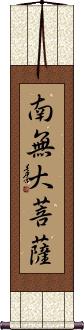
南無大菩薩 means to submit to or pay homage to the great Bodhisattva.
The last three characters, 大菩薩, can mean bodhisattva-mahāsattva, refer to one who has reached enlightenment but vows to save all beings before becoming a buddha or a high and noble monk.
This in-stock artwork might be what you are looking for, and ships right away...
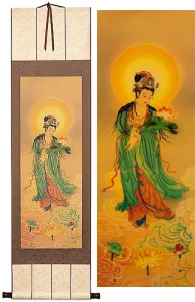
Gallery Price: $200.00
Your Price: $69.88
Not the results for bodhisattva vows that you were looking for?
Below are some entries from our dictionary that may match your bodhisattva vows search...
| Characters If shown, 2nd row is Simp. Chinese |
Pronunciation Romanization |
Simple Dictionary Definition |
菩薩 菩萨 see styles |
pú sà pu2 sa4 p`u sa pu sa mizoro みぞろ |
More info & calligraphy: Bodhisattva(n,n-suf) (1) {Buddh} bodhisattva; one who has reached enlightenment but vows to save all beings before becoming a buddha; (n,n-suf) (2) High Monk (title bestowed by the imperial court); (n,n-suf) (3) (See 本地垂迹説) title bestowed to Shinto kami in manifestation theory; (surname) Mizoro bodhisattva, cf. 菩提薩埵. While the idea is not foreign to Hīnayāna, its extension of meaning is one of the chief marks of Mahāyāna. 'The Bodhisattva is indeed the characteristic feature of the Mahāyāna.' Keith. According to Mahāyāna the Hinayanists, i.e. the śrāvaka and pratyekabuddha, seek their own salvation, while the bodhisattva's aim is the salvation of others and of all. The earlier intp. of bodhisattva was 大道心衆生 all beings with mind for the truth; later it became 大覺有情 conscious beings of or for the great intelligence, or enlightenment. It is also intp. in terms of leadership, heroism, etc. In general it is a Mahayanist seeking Buddhahood, but seeking it altruistically; whether monk or layman, he seeks enlightenment to enlighten others, and he will sacrifice himself to save others; he is devoid of egoism and devoted to helping others. All conscious beings having the Buddha-nature are natural bodhisattvas, but require to undergo development. The mahāsattva is sufficiently advanced to become a Buddha and enter nirvāṇa, but according to his vow he remains in the realm of incarnation to save all conscious beings. A monk should enter on the arduous course of discipline which leads to Bodhisattvahood and Buddhahood. |
下化 see styles |
xià huà xia4 hua4 hsia hua geke |
(下化衆生) Below, to transform all beings, one of the great vows of a bodhisattva. 上求菩提 above, to seek bodhi. Also 下濟衆生. |
咒願 咒愿 see styles |
zhòu yuàn zhou4 yuan4 chou yüan jugan |
Vows, prayers, or formulas uttered in behalf of donors, or of the dead; especially at the All Souls Day's offerings to the seven generations of ancestors. Every word and deed of a bodhisattva should be a dhāraṇī. |
地藏 see styles |
dì zàng di4 zang4 ti tsang jizou / jizo じぞう |
Kṣitigarbha, the Bodhisattva of the Great Vow (to save all souls before accepting Bodhi); also translated Earth Treasury, Earth Womb, or Earth Store Bodhisattva (surname) Jizou Ti-tsang, J. Jizō, Kṣitigarbha, 乞叉底蘗沙; Earth-store, Earth-treasury, or Earthwomb. One of the group of eight Dhvani- Bodhisattvas. With hints of a feminine origin, he is now the guardian of the earth. Though associated with Yama as overlord, and with the dead and the hells, his role is that of saviour. Depicted with the alarum staff with its six rings, he is accredited with power over the hells and is devoted to the saving of all creatures between the nirvana of Śākyamuni and the advent of Maitreya the fifth century he has been especially considered as the deliverer from the hells. His central place in China is at Chiu-hua-shan, forty li south-west of Ch'ing-yang in Anhui. In Japan he is also the protector of travellers by land and his image accordingly appears on the roads; bereaved parents put stones by his images to seek his aid in relieving the labours of their dead in the task of piling stones on the banks of the Buddhist Styx; he also helps women in labour. He is described as holding a place between the gods and men on the one hand and the hells on the other for saving all in distress; some say he is an incarnation of Yama. At dawn he sits immobile on the earth 地 and meditates on the myriads of its beings 藏. When represented as a monk, it may be through the influence of a Korean monk who is considered to be his incarnation, and who came to China in 653 and died in 728 at the age of 99 after residing at Chiu-hua-shan for seventy-five years: his body, not decaying, is said to have been gilded over and became an object of worship. Many have confused 眞羅 part of Korea with 暹羅 Siam. There are other developments of Ti-tsang, such as the 六地藏 Six Ti-tsang, i. e. severally converting or transforming those in the hells, pretas, animals, asuras, men, and the devas; these six Ti-tsang have different images and symbols. Ti-tsang has also six messengers 六使者: Yama for transforming those in hell; the pearl-holder for pretas; the strong one or animals; the devīof mercy for asuras; the devī of the treasure for human beings; one who has charge of the heavens for the devas. There is also the 延命地藏 Yanming Ti-tsang, who controls length of days and who is approached, as also may be P'u-hsien, for that Purpose; his two assistants are the Supervisors of good and evil 掌善 and 掌惡. Under another form, as 勝軍地藏 Ti-tsang is chiefly associated with the esoteric cult. The benefits derived from his worship are many, some say ten, others say twenty-eight. His vows are contained in the 地藏菩薩本願經. There is also the 大乘大集地藏十電經 tr. by Xuanzang in 10 juan in the seventh century, which probably influenced the spread of the Ti-tsang cult. |
大乘 see styles |
dà shèng da4 sheng4 ta sheng oonori おおのり |
Mahayana, the Great Vehicle; Buddhism based on the Mayahana sutras, as spread to Central Asia, China and beyond; also pr. [Da4 cheng2] (surname) Oonori Mahāyāna; also called 上乘; 妙乘; 勝乘; 無上乘; 無上上乘; 不惡乘; 無等乘, 無等等乘; 摩訶衍 The great yāna, wain, or conveyance, or the greater vehicle in comparison with the 小乘 Hīnayāna. It indicates universalism, or Salvation for all, for all are Buddha and will attain bodhi. It is the form of Buddhism prevalent in Tibet, Mongolia, China, Korea, Japan, and in other places in the Far East. It is also called Northern Buddhism. It is interpreted as 大教 the greater teaching as compared with 小教 the smaller, or inferior. Hīnayāna, which is undoubtedly nearer to the original teaching of the Buddha, is unfairly described as an endeavour to seek nirvana through an ash-covered body, an extinguished intellect, and solitariness; its followers are sravakas and pratyekabuddhas (i.e. those who are striving for their own deliverance through ascetic works). Mahāyāna, on the other hand, is described as seeking to find and extend all knowledge, and, in certain schools, to lead all to Buddhahood. It has a conception of an Eternal Buddha, or Buddhahood as Eternal (Adi-Buddha), but its especial doctrines are, inter alia, (a) the bodhisattvas 菩薩 , i.e. beings who deny themselves final Nirvana until, according to their vows, they have first saved all the living; (b) salvation by faith in, or invocation of the Buddhas or bodhisattvas; (c) Paradise as a nirvana of bliss in the company of Buddhas, bodhisattvas, saints, and believers. Hīnayāna is sometimes described as 自利 self-benefiting, and Mahāyāna as 自利利他 self-benefit for the benefit of others, unlimited altruism and pity being the theory of Mahāyāna. There is a further division into one-yana and three-yanas: the trīyāna may be śrāvaka, pratyeka-buddha, and bodhisattva, represented by a goat, deer, or bullock cart; the one-yāna is that represented by the Lotus School as the one doctrine of the Buddha, which had been variously taught by him according to the capacity of his hearers, v. 方便. Though Mahāyāna tendencies are seen in later forms of the older Buddhism, the foundation of Mahāyāna has been attributed to Nāgārjuna 龍樹. "The characteristics of this system are an excess of transcendental speculation tending to abstract nihilism, and the substitution of fanciful degrees of meditation and contemplation (v. Samādhi and Dhyāna) in place of the practical asceticism of the Hīnayāna school."[Eitel 68-9.] Two of its foundation books are the 起信論and the 妙法蓮華經 but a larnge numberof Mahāyāna sutras are ascribed to the Buddha。. |
弘誓 see styles |
hóng shì hong2 shi4 hung shih kousei / kose こうせい |
Buddha's great vows; (personal name) Kōsei 弘誓願 vast or universal vows of a Buddha, or Bodhisattva, especially Amitābha's forty-eight vows. |
普賢 普贤 see styles |
pǔ xián pu3 xian2 p`u hsien pu hsien fugen ふげん |
Samantabhadra, the Buddhist Lord of Truth Samantabhadra (bodhisattva); Universal Compassion; (place-name) Fugen Samantabhadra, Viśvabhadra; cf. 三曼 Universal sagacity, or favour; lord of the 理 or fundamental law, the dhyāna, and the practice of all Buddhas. He and Mañjuśrī are the right- and left-hand assistants of Buddha, representing 理 and 智 respectively. He rides on a white elephant, is the patron of the Lotus Sūtra and its devotees, and has close connection with the Huayan Sūtra. His region is in the east. The esoteric school has its own special representation of him, with emphasis on the sword indicative of 理 as the basis of 智. He has ten vows. |
本願 本愿 see styles |
běn yuàn ben3 yuan4 pen yüan hongan ほんがん |
Amida Buddha's original vow; long-cherished desire; (surname) Hongan pūrvapraṇidhāna. The original vow, or vows, of a Buddha or bodhisattva, e. g. the forty-eight of Amitābha, the twelve of 藥師, etc. |
三昧耶 see styles |
sān mèi yé san1 mei4 ye2 san mei yeh sanmaiya さんまや |
(1) (Buddhist term) time (san: samaya); (2) (Buddhist term) meeting; coming together; (3) (Buddhist term) equality, warning, or riddance of hindrances (esp. in esoteric Buddhism as vows of the buddhas and bodhisattvas) samaya is variously defined as 會 coming together, meeting, convention; 時 timely; 宗 in agreement, of the same class; 平等 equal, equalized; 驚覺 aroused, warned; 除垢障 riddance of unclean hindrances. Especially it is used as indicating the vows made by Buddhas and bodhisattvas, hence as a tally, symbol, or emblem of the spiritual quality of a Buddha or bodhisattva. |
十金剛心 十金刚心 see styles |
shí jīn gāng xīn shi2 jin1 gang1 xin1 shih chin kang hsin jū kongō shin |
Ten characteristics of the "diamond heart" as developed by bodhisattva: (1) complete insight into all truth; (2) saving of all creatures; (3) the glorifying of all Buddha-worlds; (4) supererogation of his good deeds; (5) service of all Buddhas; (6) realization of the truth of all Buddha-laws; (7) manifestation of all patience and endurance; (8) unflagging devotion to his vocation; (9) perfection of his work; (10) aiding all to fulfill their vows and accomplish their spiritual ends. 華嚴經 55. |
四弘誓願 四弘誓愿 see styles |
sì hóng shì yuàn si4 hong2 shi4 yuan4 ssu hung shih yüan shi ku seigan |
The four universal vows of a Buddha or bodhisattva: 衆生無邊誓願度 to save all living beings without limit; 煩惱無數誓願斷 to put an end to all passions and delusions however numerous; 法門無盡誓願學 to study and learn all methods and means without end; 佛道無上誓願成 to become perfect in the supreme Buddha-law. The four vows are considered as arising one by one out of the 四諦 Four Noble Truths. |
菩薩行願 菩萨行愿 see styles |
pú sà xíng yuàn pu2 sa4 xing2 yuan4 p`u sa hsing yüan pu sa hsing yüan bosatsu gyōgan |
vows of the bodhisattva |
地藏本願經 地藏本愿经 see styles |
dì zàng běn yuàn jīng di4 zang4 ben3 yuan4 jing1 ti tsang pen yüan ching Jizō hongan kyō |
Sūtra of the Original Vows of Kṣitigarbha Bodhisattva |
地蔵菩薩本願経 see styles |
jizoubosatsuhongankyou / jizobosatsuhongankyo じぞうぼさつほんがんきょう |
(work) Sutra of the Original Vows of Ksitigarbha Bodhisattva; (wk) Sutra of the Original Vows of Ksitigarbha Bodhisattva |
地藏菩薩本願經 地藏菩萨本愿经 see styles |
dì zàng pú sà běn yuàn jīng di4 zang4 pu2 sa4 ben3 yuan4 jing1 ti tsang p`u sa pen yüan ching ti tsang pu sa pen yüan ching Jizō bosatsu hongan kyō |
Sūtra on the Past Vows of Kṣitigarbha Bodhisattva |
The following table may be helpful for those studying Chinese or Japanese...
| Title | Characters | Romaji (Romanized Japanese) |
| Namu Dai Bosa | 南無大菩薩 南无大菩萨 | namu dai bosa namudaibosa |
| In some entries above you will see that characters have different versions above and below a line. In these cases, the characters above the line are Traditional Chinese, while the ones below are Simplified Chinese. | ||

Successful Chinese Character and Japanese Kanji calligraphy searches within the last few hours...



