Many custom options...


And formats...



Drums in Chinese / Japanese...
Buy a Drums calligraphy wall scroll here!
The one who retreats 50 paces mocks the one to retreats 100
The pot calls the kettle black
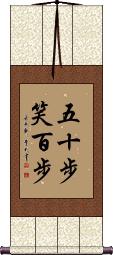
五十步笑百步 is a Chinese proverb that means the one who retreats 50 paces mocks the one who retreats 100 paces.
During the Warring States Period of what is now China (475 - 221 B.C.), the King of Wei was in love with war. He often fought with other kingdoms just for spite or fun.
One day, the King of Wei asked the philosopher Mencius, “I love my people, and all say I do the best for them. I move the people from famine-stricken areas to places of plenty and transport grains from rich areas to the poor. Nobody goes hungry in my kingdom, and I treat my people far better than other kings. But why does the population of my kingdom not increase, and why does the population of other kingdoms not decrease?”
Mencius answered, “Since you love war, I will make this example: When going to war, and the drums beat to start the attack, some soldiers flee for their lives in fear. Some run 100 paces in retreat, and others run 50 steps. Then the ones who retreated 50 paces laugh and taunt those who retreated 100 paces, calling them cowards mortally afraid of death. Do you think this is reasonable?
The King of Wei answered, “Of course not! Those who run 50 paces are just as timid as those who run 100 paces.”
Mencius then said, “You are a king who treats his subjects better than other kings treat their people, but you are so fond of war that your people suffer from great losses in battle. Therefore, your population does not grow. While other kings allow their people to starve to death, you send your people to die in war. Is there any difference?”
This famous conversation led to the six-character proverb shown here. It serves as a warning to avoid hypocrisy. It goes hand-in-hand with the western phrase, “The pot calls the kettle black,” or the Biblical phrase, “Before trying to remove a splinter from your neighbor's eye, first remove the plank from your own eye.”
Not the results for drums that you were looking for?
Below are some entries from our dictionary that may match your drums search...
| Characters If shown, 2nd row is Simp. Chinese |
Pronunciation Romanization |
Simple Dictionary Definition |
ドラム see styles |
doramu ドラム |
More info & calligraphy: Drumm |
撥 拨 see styles |
bō bo1 po hatsu ばち |
to push aside with the hand, foot, a stick etc; to dial; to allocate; to set aside (money); to poke (the fire); to pluck (a string instrument); to turn round; classifier: group, batch (1) plectrum; pick; (2) drumstick for Japanese drums (e.g. taiko) To spread, open out, scatter, disseminate, detach, uproot. |
枹 see styles |
fū fu1 fu bachi ばち nara なら |
Quercus glandulifera (1) plectrum; pick; (2) drumstick for Japanese drums (e.g. taiko); (kana only) oak (esp. Quercus serrata) |
桴 see styles |
fú fu2 fu bachi ばち ikada いかだ |
beam; rafter (1) plectrum; pick; (2) drumstick for Japanese drums (e.g. taiko); (1) (kana only) raft; (2) forearm protector; (3) skewered baby-eel kabayaki |
鍠 锽 see styles |
huáng huang2 huang |
sound of drums and bells; trident |
鏜 镗 see styles |
tāng tang1 t`ang tang |
noise of drums |
面 see styles |
miàn mian4 mien hootsuki ほおつき |
face; side; surface; aspect; top; classifier for objects with flat surfaces such as drums, mirrors, flags etc (1) face; (2) mask; face guard; (3) {MA} striking the head (in kendo); (4) surface (esp. a geometrical surface); (5) page; (n,suf) (6) aspect; facet; side; (n,suf) (7) chamfer; (counter) (8) counter for broad, flat objects, levels or stages, e.g. in a video game; (personal name) Hootsuki Face. |
駴 see styles |
xiè xie4 hsieh |
thunderous beating of drums |
三鼓 see styles |
mitsuzumi みつづみ |
(1) (rare) the three types of gagaku drums; (2) (archaism) third division of the night (approx. 11pm to 1am); (surname) Mitsuzumi |
大小 see styles |
dà xiǎo da4 xiao3 ta hsiao daishou / daisho だいしょう |
large and small; size; adults and children; consideration of seniority; at any rate (1) size; (noun - becomes adjective with の) (2) large and small (sizes); various sizes; (3) daishō (matched pair of long and short swords); (4) large and small drums; (5) long months and short months; (6) sic bo (Macao dice game); tai sai; dai siu; big and small; (place-name) Daishou large and small |
敲く see styles |
tataku たたく |
(out-dated kanji) (transitive verb) (1) to strike; to clap; to knock; to beat; to tap; to pat; (2) to play drums; (3) to abuse; to flame (e.g. on the Internet); to insult; (4) to consult; to sound out; (5) to brag; to talk big; (6) (computer terminology) to call; to invoke (e.g. a function) |
旗鼓 see styles |
kiko きこ |
banner and drums; army |
泥々 see styles |
dorodoro どろどろ |
(adj-na,adv,n,adj-no) (1) (onomatopoeic or mimetic word) (kana only) syrupy; muddled; (can be adjective with の) (2) (kana only) muddy; (noun or participle which takes the aux. verb suru) (3) (kana only) sordid; (adverb taking the "to" particle) (4) (onomatopoeic or mimetic word) (kana only) rumble (e.g. of drums, of thunder); peal; boom |
泥泥 see styles |
dorodoro どろどろ |
(adj-na,adv,n,adj-no) (1) (onomatopoeic or mimetic word) (kana only) syrupy; muddled; (can be adjective with の) (2) (kana only) muddy; (noun or participle which takes the aux. verb suru) (3) (kana only) sordid; (adverb taking the "to" particle) (4) (onomatopoeic or mimetic word) (kana only) rumble (e.g. of drums, of thunder); peal; boom |
簫鼓 see styles |
shouko / shoko しょうこ |
(See 簫) flutes and drums |
鉦鼓 钲鼓 see styles |
zhēng gǔ zheng1 gu3 cheng ku shouko; shougo / shoko; shogo しょうこ; しょうご |
(See 雅楽) small gong (used in gagaku) Cymbals, or small gongs and drums. |
鐘鼓 钟鼓 see styles |
zhōng gǔ zhong1 gu3 chung ku shouko / shoko しょうこ |
bells and drums (for music or signals) bell and drum |
鑼鼓 锣鼓 see styles |
luó gǔ luo2 gu3 lo ku |
gongs and drums; Chinese percussion instruments |
鬧場 闹场 see styles |
nào chǎng nao4 chang3 nao ch`ang nao chang |
gongs and drums overture to a Chinese opera; to create a disturbance |
鼓噪 see styles |
gǔ zào gu3 zao4 ku tsao |
(in ancient times) to beat the drums and yell (at the moment of launching into battle); to create a clamor; to make a din; to kick up a fuss about |
鼓譟 see styles |
kosou / koso こそう |
(noun/participle) (1) (obscure) motivating the troops on the battlefield with war drums and war cries; (2) (obscure) making an uproar |
鼓音 see styles |
gǔ yīn gu3 yin1 ku yin koto こと |
(female given name) Koto The rolling of drums. |
鼓騒 see styles |
kosou / koso こそう |
(noun/participle) (1) (obscure) motivating the troops on the battlefield with war drums and war cries; (2) (obscure) making an uproar |
鼕々 see styles |
toutou / toto とうとう |
(adj-t,adv-to) (1) (kana only) sound of bells or drums reverberating; (2) (kana only) sound of water or waves resounding; (given name) Toutou |
鼕鼕 see styles |
toutou / toto とうとう |
(adj-t,adv-to) (1) (kana only) sound of bells or drums reverberating; (2) (kana only) sound of water or waves resounding |
タブラ see styles |
dapura ダプラ |
tabla (Indian hand drums) (hin:); (personal name) Dapra |
とう鞳 see styles |
toutou / toto とうとう |
(adj-t,adv-to) (1) (kana only) sound of bells or drums reverberating; (2) (kana only) sound of water or waves resounding |
天鼓音 see styles |
tiān gǔ yīn tian1 gu3 yin1 t`ien ku yin tien ku yin Tenko on |
雲自在燈王 Dundubhisvara-rāja. Lord of the sound of celestial drums, i. e. the thunder. Name of each of 2, 000 kotis of Buddhas who attained Buddhahood. |
櫓太鼓 see styles |
yaguradaiko やぐらだいこ |
{sumo} drums which announce the opening of a stage performance or commencement of bouts; the sound produced by such drums |
鬼太鼓 see styles |
onidaiko; ondeko; ondaiko おにだいこ; おんでこ; おんだいこ |
(See 鬼・1) demon drums; type of drumming performance done to ward off ogres |
Click here for more drums results from our dictionary
The following table may be helpful for those studying Chinese or Japanese...
| Title | Characters | Romaji (Romanized Japanese) | Various forms of Romanized Chinese | |
| The one who retreats 50 paces mocks the one to retreats 100 | 五十步笑百步 | wù shí bù xiào bǎi bù wu4 shi2 bu4 xiao4 bai3 bu4 wu shi bu xiao bai bu wushibuxiaobaibu | wu shih pu hsiao pai pu wushihpuhsiaopaipu |
|

Successful Chinese Character and Japanese Kanji calligraphy searches within the last few hours...



