Many custom options...


And formats...



Issues in Chinese / Japanese...
Buy an Issues calligraphy wall scroll here!
Personalize your custom “Issues” project by clicking the button next to your favorite “Issues” title below...
2. Body
3. Trust No One / Trust No Man
4. Learn New Ways From Old / Onkochishin
5. John 3:16
6. Guanxi
Kajukenbo Slogan
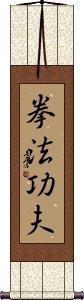
拳法功夫 is the Japanese slogan associated with Kajukenbo.
There is no way to write Kajukenbo in Japanese (as the “ka” for karate cannot be separated from the “kara” character it is supposed to represent - among a few other language issues). This slogan which reads, “fist law, kung fu” is often written on banners and patches for Kajukenbo clubs or dojos.
Body
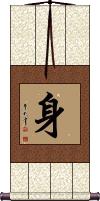
身 is how to write “body” as in your human body, in Chinese, Japanese Kanji, and Korean Hanja.
Depending on the context and certain language issues, this character can also mean: main part, hull, oneself, somebody, person, I, me, sword, lifetime, one's station in life, etc.
While this written word is universal in three languages, it still makes a rather odd selection for a wall scroll. Also, they tend to use 体 (karada) in Japanese for the body (depending on context).
See Also: Karada
Trust No One / Trust No Man
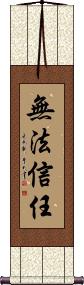
無法信任 is the kind of thing you expect to hear in a spy movie.
“Trust no one, 007!”
The first two characters express the idea of “no way” or “cannot.”
The last two characters mean “trust.”
The characters must go in this order due to Chinese grammar issues and in order to sound natural.
Note: This is not an ancient Chinese phrase by any means. It's just that we received a lot of requests for this phrase.
This is as close as you can get to the phrase “trust no man,” though technically, no gender is specified.
Learn New Ways From Old / Onkochishin
New ideas coming from past history
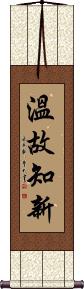
溫故知新 is a proverb from Confucius that is used in Chinese, Japanese, and Korean cultures.
It can be translated in several ways:
Coming up with new ideas based on things learned in the past.
Examine things of the past, and obtain new knowledge.
Developing new ideas based on the study of the past.
Gain new insights through restudying old issues.
Understand the present by reviewing the past.
Learning from the past.
Review the old and know the new.
Taking a lesson from the past.
Taking a lesson from the wisdom of the ancients.
Follow the old ways.
The direct translation would be, “By asking old things, know new things.”
The Character meanings breakdown this way:
溫故 = ask old
知新 = know new
Explained: To learn new things that are outside of your experience, you can learn from old things of the past. You can find wisdom in history.
 VS.
VS. 
Note: Japanese use a variant of the first Kanji in modern times.
Therefore if you order this from a Japanese calligrapher, expect the first Kanji to look like 温 instead of 溫.
In addition to 温故知新 as mentioned above, this is sometimes written as 温古知新 in Japan.
John 3:16

神愛世人甚至將他的獨生子賜給他們叫一切信他的不至滅亡反得永生 is the full translation of John 3:16 into Chinese.
This is from the Chinese Union Bible which comes from a revised version of the King James. This Chinese Bible was originally translated and printed in 1919 (several revisions since then).
Because of the origin being the KJV, I'll say that in English, this would be, “For God so loved the world, that he gave his only begotten Son, that whosoever believeth in him should not perish but have everlasting life.”
As with any translation, there are interesting cultural and linguistic issues. For instance, the word used for “world” in Chinese can also mean “common people.” So you could say that it means “For God so loved the common people...”
This does not take away from the text, as it will be understood with the same meaning and connotation.
There is no direct Greek-to-Chinese translation in print (that I know of), so this is the best available. Of course, you can ask any Greek person of faith, and they will claim that a bit is lost from the original Greek of the New Testament to any of the English versions of the Bible in print.
Guanxi
The Chinese Concept of Relationship and Exchange of Favors
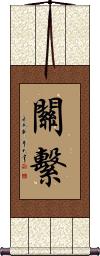
The dictionary definition is:
Relations/relationship, to concern, to affect, to have to do with, or connection.
But there's more to it...
In China, the relationship that you have with certain people can open doors for you. Having guanxi with someone also means they would never defraud you but are honor-bound to treat you fairly (of course, this goes both ways). Sometimes it is suggested that guanxi is the exchange of favors. 關繫 / 関繫 / 關係 is more about having a relationship that allows you to ask for and expect favors without shame.
There is no concept in western culture that exactly matches guanxi, but perhaps having a social or professional network is similar.
Note that there are some variations common within Chinese, Japanese Kanji, and Korean Hanja for this word... Japanese tend to use a Chinese alternate form as shown to the right for
the first character.
 There's also another alternate form of that first character (currently used as the official Simplified form in mainland China) which looks like the character shown to the right. It's basically the central radical of the alternate version shown above but without the “door radical” around it. In more free-flowing calligraphy styles, this version would be the likely choice for a calligrapher.
 In Modern Japanese, they use the character shown to the right.
They also tend to use this same form in Korean Hanja (I've only checked this word in my Korean dictionary, but it has not been confirmed by a translator's review).
 If that was not confusing enough, there is another alternate form of that second character. See right.
An Asian calligrapher of any nationality may use these forms at their discretion. However, They would tend to stick to the most common form used in their respective languages.
If you have any preference on any of these issues, please give us a special note with your order, and we'll make sure it's done the way you want.
Not the results for issues that you were looking for?
Below are some entries from our dictionary that may match your issues search...
| Characters If shown, 2nd row is Simp. Chinese |
Pronunciation Romanization |
Simple Dictionary Definition |
期 see styles |
qī qi1 ch`i chi ki き |
a period of time; phase; stage; classifier for issues of a periodical, courses of study; time; term; period; to hope; Taiwan pr. [qi2] (1) time; moment; limit; (2) time of death; last moment; (3) (archaism) midnight in red-light districts during the Edo period; (surname) Ki A set time; a limit of time; times, seasons; to expect. |
務虛 务虚 see styles |
wù xū wu4 xu1 wu hsü |
to discuss matters of principle (as opposed to concrete issues) |
増発 see styles |
zouhatsu / zohatsu ぞうはつ |
(noun, transitive verb) (1) increasing the number (of trains, planes, etc.) in operation; (noun, transitive verb) (2) increasing bond issues; increased issue |
札所 see styles |
fudasho ふだしょ |
temple which issues amulets |
病む see styles |
yamu やむ |
(v5m,vi) (1) to fall ill; (transitive verb) (2) to suffer from (e.g. a disease); to have something wrong with (e.g. an inner organ); (transitive verb) (3) (colloquialism) to be depressed; to feel down; to have mental health issues |
和稀泥 see styles |
huò xī ní huo4 xi1 ni2 huo hsi ni |
to try to smooth things over; to paper over the issues; to gloss things over |
問題群 see styles |
mondaigun もんだいぐん |
group of problems; set of issues |
普通に see styles |
futsuuni; futsuuni(sk) / futsuni; futsuni(sk) ふつうに; フツーに(sk) |
(adverb) (1) (ふつうに only) (See 普通・2) normally; ordinarily; usually; generally; commonly; (adverb) (2) (colloquialism) (used when giving a positive assessment, esp. of something that exceeds expectations) by anyone's standards; by normal standards; sufficiently; actually; genuinely; truly; (adverb) (3) (colloquialism) (describes an action) without any issues; without any difficulty; (surprisingly) well; just fine; naturally |
検討会 see styles |
kentoukai / kentokai けんとうかい |
meeting convened to discuss issues; planning conference; review meeting; feedback session; investigative commission |
無明藏 无明藏 see styles |
wú míng zàng wu2 ming2 zang4 wu ming tsang mumyō zō |
The storehouse of ignorance, from which issues all illusion and misery. |
自證身 自证身 see styles |
zì zhèng shēn zi4 zheng4 shen1 tzu cheng shen jishō shin |
A title of Vairocana, his dharmakāya of self-assurance, or realization, from which issues his retinue of proclaimers of the truth. |
訳あり see styles |
wakeari わけあり |
(exp,adj-na) (having) special circumstances (e.g. problems, issues, advantages, flaws, defects, etc.) |
訳有り see styles |
wakeari わけあり |
(exp,adj-na) (having) special circumstances (e.g. problems, issues, advantages, flaws, defects, etc.) |
任意売却 see styles |
ninibaikyaku にんいばいきゃく |
off-market real estate sale; negotiated sale due to loan repayment issues |
問題意識 see styles |
mondaiishiki / mondaishiki もんだいいしき |
awareness of the issues; (having a) critical mind; concerns |
国字問題 see styles |
kokujimondai こくじもんだい |
issues pertaining to a nation's script (e.g. standardization of kanji in Japanese) |
婦人問題 see styles |
fujinmondai ふじんもんだい |
women's issues |
時事問題 see styles |
jijimondai じじもんだい |
(noun - becomes adjective with の) current issues; current topics |
枝節橫生 枝节横生 see styles |
zhī jié héng shēng zhi1 jie2 heng2 sheng1 chih chieh heng sheng |
side issues keep arising (idiom) |
爭長論短 争长论短 see styles |
zhēng cháng lùn duǎn zheng1 chang2 lun4 duan3 cheng ch`ang lun tuan cheng chang lun tuan |
lit. to argue who is right and wrong (idiom); fig. to squabble; to argue over minor issues |
白け世代 see styles |
shirakesedai しらけせだい |
generation of young people (esp. of the 1970s) apathetic about social issues |
禍從口出 祸从口出 see styles |
huò cóng kǒu chū huo4 cong2 kou3 chu1 huo ts`ung k`ou ch`u huo tsung kou chu |
Trouble issues from the mouth (idiom). A loose tongue may cause a lot of trouble. |
節上生枝 节上生枝 see styles |
jié shàng shēng zhī jie2 shang4 sheng1 zhi1 chieh shang sheng chih |
a new branch grows out of a knot (idiom); fig. side issues keep arising |
良知良能 see styles |
liáng zhī liáng néng liang2 zhi1 liang2 neng2 liang chih liang neng ryouchiryounou / ryochiryono りょうちりょうのう |
instinctive understanding, esp. of ethical issues (idiom); untrained, but with an inborn sense of right and wrong; innate moral sense (yoji) one's innate intelligence and ability |
替古人擔憂 替古人担忧 see styles |
tì gǔ rén dān yōu ti4 gu3 ren2 dan1 you1 t`i ku jen tan yu ti ku jen tan yu |
to fret over the worries of long-departed people (idiom); to worry unnecessarily; crying over spilt milk; often used with negatives, e.g. no need to worry about past issues |
替古人耽憂 替古人耽忧 see styles |
tì gǔ rén dān yōu ti4 gu3 ren2 dan1 you1 t`i ku jen tan yu ti ku jen tan yu |
to fret over the worries of long-departed people (idiom); to worry unnecessarily; crying over spilt milk; often used with negatives, e.g. no need to worry about past issues |
王様ゲーム see styles |
ousamageemu / osamageemu おうさまゲーム |
party game in which a randomly selected "king" issues orders to other players |
マノスフィア see styles |
manosufia マノスフィア |
manosphere (online communities concerned with men's issues, masculinity and opposition to feminism) |
メンタル不調 see styles |
mentarufuchou / mentarufucho メンタルふちょう |
mental health issues; emotional distress |
信号トラブル see styles |
shingoutoraburu / shingotoraburu しんごうトラブル |
{rail} signal issues; signal problems |
Click here for more issues results from our dictionary
The following table may be helpful for those studying Chinese or Japanese...
| Title | Characters | Romaji (Romanized Japanese) | Various forms of Romanized Chinese | |
| Kajukenbo Slogan | 拳法功夫 | kenpo kunfu kenpokunfu | ||
| Body | 身 | mi | shēn / shen1 / shen | |
| Trust No One Trust No Man | 無法信任 无法信任 | wú fǎ xìn rèn wu2 fa3 xin4 ren4 wu fa xin ren wufaxinren | wu fa hsin jen wufahsinjen |
|
| Learn New Ways From Old Onkochishin | 溫故知新 温故知新 | on ko chi shin onkochishin | wēn gù zhī xīn wen1 gu4 zhi1 xin1 wen gu zhi xin wenguzhixin | wen ku chih hsin wenkuchihhsin |
| John 3:16 | 神愛世人甚至將他的獨生子賜給他們叫一切信他的不至滅亡反得永生 神爱世人甚至将他的独生子赐给他们叫一切信他的不至灭亡反得永生 | shén ài shì rén shèn zhì jiāng tā de dú shēng zǐ cì gè tā mén jiào yí qiè xìn tā de bú zhì miè wáng fǎn dé yǒng shēng shen2 ai4 shi4 ren2 shen4 zhi4 jiang1 ta1 de du2 sheng1 zi3 ci4 gei3 ta1 men2 jiao4 yi2 qie4 xin4 ta1 de bu2 zhi4 mie4 wang2 fan3 de2 yong3 sheng1 shen ai shi ren shen zhi jiang ta de du sheng zi ci gei ta men jiao yi qie xin ta de bu zhi mie wang fan de yong sheng | shen ai shih jen shen chih chiang t`a te tu sheng tzu tz`u kei t`a men chiao i ch`ieh hsin t`a te pu chih mieh wang fan te yung sheng shen ai shih jen shen chih chiang ta te tu sheng tzu tzu kei ta men chiao i chieh hsin ta te pu chih mieh wang fan te yung sheng |
|
| Guanxi | 關繫 / 関繫 / 關係 关系 / 関係 | kankei | guān xì / guan1 xi4 / guan xi / guanxi | kuan hsi / kuanhsi |
| In some entries above you will see that characters have different versions above and below a line. In these cases, the characters above the line are Traditional Chinese, while the ones below are Simplified Chinese. | ||||

Successful Chinese Character and Japanese Kanji calligraphy searches within the last few hours...



