Many custom options...


And formats...



Animal Symbol in Chinese / Japanese...
Buy an Animal Symbol calligraphy wall scroll here!
Personalize your custom “Animal Symbol” project by clicking the button next to your favorite “Animal Symbol” title below...
See also: Chinese Zodiac / Animal Years
3. Bear
4. Every Creature Has A Domain
6. Wolf
7. Beaver
8. Gazelle
9. Fox
10. Giraffe
11. Fox
12. Essence
13. Taotie
15. Human Race / Humanity / Mankind
16. Nature in Balance / Balanced Nature
17. Lioness
18. Sword of Death
19. 5. Right Living / Right Livelihood / Perfect Livelihood
Beast / Animal
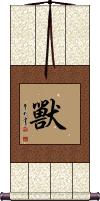
獸 means beast, animal, brute, beastly, or bestial.
Note: A strange selection for a calligraphy wall scroll.
獸 is a very generic term for a beast, so it can be one hunted for food (such as a deer or boar). It can also mean a great animal or someone who acts like a beast.
Note: In Japanese, this can be the personal name Munetada.
 In modern Japan, they use the version of this character shown to the right. If your audience in Japanese, click this special Kanji instead of the button above.
Animal Kingdom
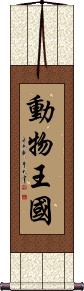
動物王國 is literally what it says.
There is even a TV show in China that is similar to Wild Kingdom or what you would currently see on the Discovery Channel that has this same title.
For your information: In the Chinese way of thinking, the Tiger is the king of the animal kingdom (lions are not native to China, so the tiger took the role that we have given to the lion in our western way of thinking).
The modern Japanese version has a slight variation on the last character (国 instead of 國). Let me know if you want the modern Japanese version (國 would be considered the old or traditional version).
Bear
Animal
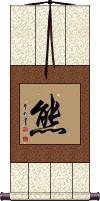
熊 is the way to write “bear” (as in the animal) in Chinese, Japanese Kanji, and old Korean Hanja.
If you are a bear fanatic, this is the wall scroll for you.
熊 is not specific to species, such as panda bears, polar bears, brown bears, etc.
If you need a more specific title, just post a contact me.
See Also: Panda
Every Creature Has A Domain
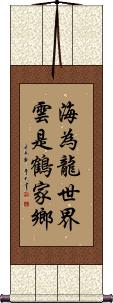
海為龍世界雲是鶴家鄉 is a somewhat poetic way to say that everyone and everything has its place in the world.
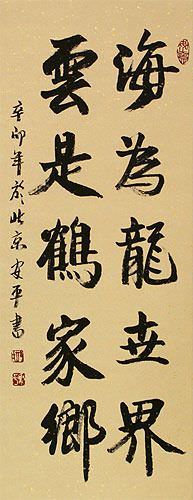 The first line (which is the column on the right) says, “The Ocean is the World of the Dragon.” The next column says, “The Clouds are the Domain of the Cranes.”
The image to the right is what this calligraphy can look like in xing-kaishu style by a Master Calligrapher.
Arata / Leather
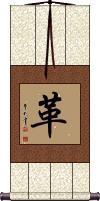
革 is the Chinese, Japanese Kanji, and old Korean Hanja for animal hide, leather, tanned animal hide, skins, hides, or pelts.
This can also mean to reform, remove, strip, expel (from an office), or to cut off.
革 is also a Japanese given name Arata and can refer to the anime character of the same name.
Wolf
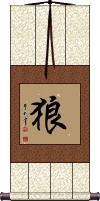
狼 is the character used to represent the elusive animal known as the wolf in both Chinese and Japanese.
If you are a fan of the wolf or the wolf means something special to you, this could make a great addition to your wall.
Do keep in mind, that much like our perception of wolves in the history of western culture, eastern cultures do not have a very positive view of wolves (save the scientific community and animal lovers). The wolf is clearly an animal that is misunderstood or feared the world over.
狼 is seldom used alone in Korean Hanja but is used in a compound word that means utter failure (as in a wolf getting into your chicken pen - or an otherwise ferocious failure). Not a good choice if your audience is Korean.
Beaver

海狸 is the animal Beaver in Chinese.
Gazelle
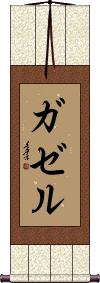
ガゼル is Gazelle (the animal or person's name) in Japanese Katakana.
Note: Because this title is entirely Japanese Katakana, it should be written by a Japanese calligrapher.
Fox
The Sly Animal
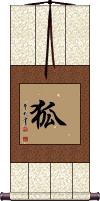
This is Chinese, Japanese Kanji, and old Korean Hanja title for the sly animal known as a fox.
Giraffe
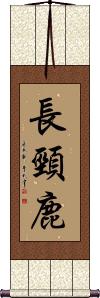
長頸鹿 is the Chinese word for Giraffe (the animal).
Not to be confused with the mythical “kirin” or “qilin” beast.
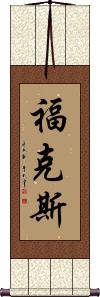
福克斯 is the transliteration to Mandarin Chinese for the name Fox.
If your name is Fox, you should probably pick our other selection for the meaning of fox (the animal).
Essence
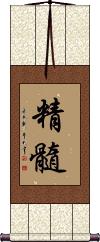
精髓 is the Chinese, Japanese Kanji, and old Korean Hanja for essence.
This can also be translated as marrow, pith, quintessence, kernel, spirit, etc.
This often refers to the nature or basis of whatever element, plant, animal, being, person, or thing you are talking about.
The original Chinese version (also Korean Hanja) and modern Japanese version of the second character differ a tiny bit:
 vs.
vs. 
Both versions are so close that both Chinese and Japanese people will recognize this word. If you want the specifically-Japanese version, click on this link instead of the button above: Order Essence in Japanese
Taotie

In ancient China, 饕餮 was a ferocious mythological animal and the fifth son of the dragon king.
饕餮 can also refer to a zoomorphic mask motif found on Shang and Zhou ritual bronzes.
As an adjective, this can mean gluttonous, sumptuous (banquet), covetousness, greed, avarice, or intense desire.
Ghost / Soul / Spirit
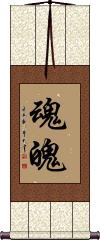
魂魄 is a Chinese, Japanese Kanji, and old Korean Hanja term for ghost, soul, or spirit.
It's used in the context of Buddhism as:
Animus and anima; the spiritual nature or mind, and the animal soul; the two are defined as mind and body or mental and physical, the invisible soul inhabiting the visible body, the former being celestial, the latter terrestrial.
Human Race / Humanity / Mankind
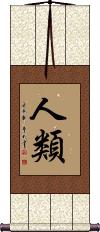
人類 is the way to say mankind or humankind in Chinese.
It's kind of the “animal title” for humans. 人類 is the word you would use if you said this phrase in Chinese, “Mammals include dolphins, monkeys, dogs, and humans among others.”
人類 is a weird selection for a calligraphy wall scroll. But a customer begged me to add this word.
Nature in Balance / Balanced Nature
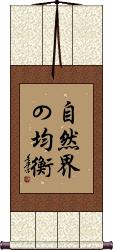
自然界の均衡 is a verbose way to say “nature in balance” in Japanese.
The first three Kanji have the meaning of “the natural world” or “the natural kingdom” (kind of like the animal kingdom but including plants and all things biological).
The third character is a Hiragana that acts to connect the two ideas here.
The last two Kanji mean equilibrium or balance.
Lioness
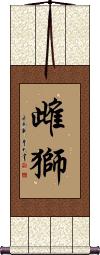
雌獅 is how to write “lioness” in Chinese.
Note: 雌獅 is not a very common title for a wall scroll in China. Perhaps because lions are not indigenous to China. Though oddly enough, the rarity of lions made them very prized - and lion dances are a popular festival attraction.
If you see the name of this animal species written on a wall scroll, it's more likely to be the masculine form of “lion.”
Sword of Death
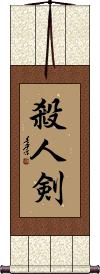
殺人剣 is a Japanese title for “Death Sword,” “Life Taking Sword,” or “satsujinken.”
This is the opposite of katsujinken or the “life-saving sword.” This title is not as commonly used in Japanese but pairs well when hung with katsujinken.
The first two Kanji are a word that translates as homicide, murder or kill (a person). 殺人剣 is specifically to kill a person (as the second character means person or human) as opposed to an animal, etc.
The last Kanji is the Japanese variant of the originally-Chinese character for a sword.
See Also: Katsujinken
5. Right Living / Right Livelihood / Perfect Livelihood
Samyag Ajiva / Samma Ajiva
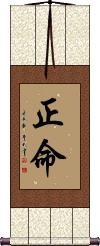
正命 (right living) is one of the Noble Eightfold Paths of Buddhism.
Right Living, along with Right Speech and Right Action, constitute the path to Virtue.
Right Living means that a Buddhist should only take a job or pursue a career in a field that does no harm. Buddhists should not work in the arms trade, as pimps or in the field of prostitution, as a butcher or in a shop that kills or sells meat, in a laboratory that does animal research, or in any other business that involves scheming or unethical behavior.
Another definition: Avoidance of professions that are harmful to sentient beings, such as slaughterer, hunter, dealer in weaponry or narcotics, etc.
This term is exclusively used by devout Buddhists. It is not a common term, and is remains an unknown concept to most Japanese and Chinese people.
See Also: Buddhism | Enlightenment | Noble Eightfold Path
Kirin / Giraffe / Mythical Creature
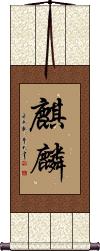
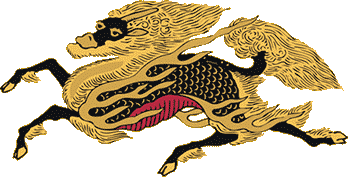
麒麟 is the title of a mythical beast of Asia.
The animal is thought to be related to the giraffe, and in some ways, it is a giraffe. However, it is often depicted with the horns of a dragon or deer and sometimes with the body like a horse, but many variations exist.
In Japanese, it is pronounced “Kirin” as in “Kirin Ichiban” beer.
Notes:
1. This is sometimes spelled as “kylin.”
2. In Japanese, this is the only Kanji word for giraffe. Therefore in Japan, this word needs context to know whether you are talking about the mythical creature or the long-necked giraffe of Africa.
3. Apparently, this was the first word used for regular giraffes in China (some were brought from Africa to China during the Ming Dynasty - probably around the year 1400). Though the mythical creature may have existed before, the name “qilin” was given to the “new giraffe.” This is because, more than 600 years ago, giraffes somewhat matched the mythical creature's description when Chinese people saw them for the first time. Later, to avoid such an ambiguous title, a three-character word was devised to mean a “giraffe of Africa.” The characters for “qilin” shown here are only for the mythological version in modern Chinese.
4. More information about the qilin / kirin from Wikipedia.
5. This creature is sometimes translated as the “Chinese Unicorn,” although it is generally portrayed with two horns. I think this is done more for the fantasy aspect of the unicorn and because most westerners don't know what a qilin or kirin is (this avoids a long explanation by the translator).
6. In Korean, this can mean kirin or simply giraffe (usually, the mythological creature is what they would think of when seeing these characters alone on a wall scroll).
Crisis equals Danger plus Opportunity?
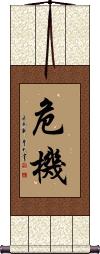
危機 means crisis in Chinese and Japanese.
Separately, the first character here does mean “danger” or “to endanger,” and the second character can mean “opportunity.”
However, I want to debunk a myth that was propagated by some westerners who did not have a clear understanding of Asian languages...
While often, Chinese/Japanese/Korean compound words (words of two or more characters) are the sum of their parts, this is not always the case. The compound is often understood with a completely different meaning than the two characters individually.
Many have said that the Chinese/Japanese/Korean word for Crisis is made up of the characters for “danger” and “opportunity.” 危機 is true when phrased this way.
However, it's not absolutely correct to say that “danger + opportunity = crisis” in Asian cultures.
English example:
If I tell you that...
Bovine creature + Guy behind the plate in baseball = Locomotive train protection

...you would think I was mad. But consider that “cow + catcher = cowcatcher,” which is the device that used to be found on steam engines to protect them if they hit an animal on the tracks. When we hear the word “cowcatcher,” we don't separate the words into their individual meanings (necessarily).
The same is true with the word for crisis in Chinese/Japanese/Korean. While you can separate the characters, few Asian people would automatically do so in their minds.
The final answer:
It is a half-truth to say, “danger plus opportunity equals crisis” in Chinese/Japanese/Korean. Use this statement and concept with caution.
Also, the second character can mean “secret” or “machine,” depending on context so I guess you have to say “a dangerous machine = crisis” or “danger + a secret = crisis.” Both of these are only slightly more ridiculous than the first premise.
PS: 危機 is probably not a great word for a scroll unless you have a special use for it.
This in-stock artwork might be what you are looking for, and ships right away...
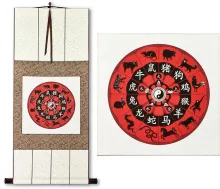
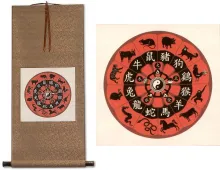
Gallery Price: $80.00
Your Price: $28.88
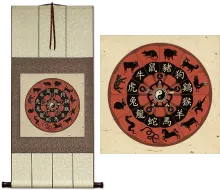
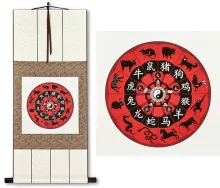
Gallery Price: $80.00
Your Price: $29.88


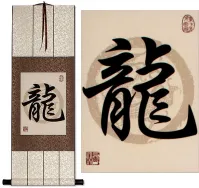



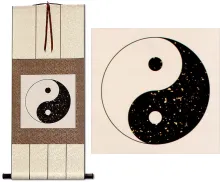

Gallery Price: $200.00
Your Price: $124.88

Gallery Price: $200.00
Your Price: $98.88
The following table may be helpful for those studying Chinese or Japanese...
| Title | Characters | Romaji (Romanized Japanese) | Various forms of Romanized Chinese | |
| Beast Animal | 獸 兽 | shishi | shòu / shou4 / shou | |
| Animal Kingdom | 動物王國 动物王国 | doubutsu oukoku doubutsuoukoku dobutsu okoku | dòng wù wáng guó dong4 wu4 wang2 guo2 dong wu wang guo dongwuwangguo | tung wu wang kuo tungwuwangkuo |
| Bear | 熊 | kuma | xióng / xiong2 / xiong | hsiung |
| Every Creature Has A Domain | 海為龍世界雲是鶴家鄉 海为龙世界云是鹤家乡 | hǎi wéi lóng shì jiè yún shì hè jiā xiāng hai3 wei2 long2 shi4 jie4 yun2 shi4 he4 jia1 xiang1 hai wei long shi jie yun shi he jia xiang | hai wei lung shih chieh yün shih ho chia hsiang | |
| Arata Leather | 革 | arata / kaku | gé / ge2 / ge | ko |
| Wolf | 狼 | okami | láng / lang2 / lang | |
| Beaver | 海狸 | hǎi lí / hai3 li2 / hai li / haili | ||
| Gazelle | ガゼル | gazeru | ||
| Fox | 狐 | kitsune | hú / hu2 / hu | |
| Giraffe | 長頸鹿 长颈鹿 | zhǎng jǐng lù zhang3 jing3 lu4 zhang jing lu zhangjinglu | chang ching lu changchinglu |
|
| Fox | 福克斯 | fú kè sī fu2 ke4 si1 fu ke si fukesi | fu k`o ssu fukossu fu ko ssu |
|
| Essence | 精髓 / 精髄 精髓 | sei zui / seizui | jīng suǐ / jing1 sui3 / jing sui / jingsui | ching sui / chingsui |
| Taotie | 饕餮 | tou tetsu / toutetsu / to tetsu | tāo tiè / tao1 tie4 / tao tie / taotie | t`ao t`ieh / taotieh / tao tieh |
| Ghost Soul Spirit | 魂魄 | kon paku / konpaku | hún pò / hun2 po4 / hun po / hunpo | hun p`o / hunpo / hun po |
| Human Race Humanity Mankind | 人類 人类 | jinrui | rén lèi / ren2 lei4 / ren lei / renlei | jen lei / jenlei |
| Nature in Balance Balanced Nature | 自然界の均衡 | shizenkai no kinkou shizenkainokinkou shizenkai no kinko | ||
| Lioness | 雌獅 雌狮 | cí shī / ci2 shi1 / ci shi / cishi | tz`u shih / tzushih / tzu shih | |
| Sword of Death | 殺人剣 杀人剣 | satsu jin ken satsujinken | ||
| 5. Right Living Right Livelihood Perfect Livelihood | 正命 | sei myou / seimyou / sei myo | zhèng mìng zheng4 ming4 zheng ming zhengming | cheng ming chengming |
| Kirin Giraffe Mythical Creature | 麒麟 | kirin | qí lǐn / qi2 lin3 / qi lin / qilin | ch`i lin / chilin / chi lin |
| Crisis equals Danger plus Opportunity? | 危機 危机 | kiki | wēi jī / wei1 ji1 / wei ji / weiji | wei chi / weichi |
| In some entries above you will see that characters have different versions above and below a line. In these cases, the characters above the line are Traditional Chinese, while the ones below are Simplified Chinese. | ||||

Successful Chinese Character and Japanese Kanji calligraphy searches within the last few hours...



